Who is an Evangelical? - A Review

The term “evangelical” has drastically different meaning to many people. In popular discourse in the United States, the talking heads have a very particular definition in mind when they speak of evangelicals. They think they are speaking of white, middle and lower class, Republican-bloc voting, misogynistic, bigots who tend to fall into the “basket of deplorables” that “cling to their guns and religion” as several politicians on the left have argued. When exit polls showed that 81% of “white evangelicals” voted for Donald Trump in the 2016 election, this merely confirmed the popular opinion (bolstered by any sniff of resistance to the Obergefell decision) that evangelicals were in the tank for any rightwing idea, were politically irredeemable, and worthy of scorn.

For several decades, there has been a strong emphasis among many people who identify as evangelical on political engagement. In 1973, when the Supreme Court of the United States wrote their Roe v. Wade decision connecting the destruction of children in the womb to the United States Constitution, this began to mobilize many of those who value human life to seek political solutions to a significant moral crisis.

Unfortunately, as the old saying goes, politics makes for strange bedfellows. Therefore, the Moral Majority, comprised largely of white evangelicals and fundamentalists, became entangled in politics on the right, finding more sympathy among Republicans than Democrats. It would take a careful discussion to determine whether the bundling together of issues into left and right became more pronounced to facilitate this shift, as a result of the increased political engagement, or for other, unrelated causes.

Whatever the cause, the result has been that many of those evangelical Christians tend to vote for Republicans. The central cause of that loyalty has been concern about abortion. This loyalty has also led to many of those evangelical-Republican voters holding unrelated, morally ambiguous positions supported by the Republican party with roughly the same vigor as their concern for the lives of innocent children.

It is this bloc of the voters who identify as “born again” and typically oppose abortion that are cited as the 81% of white evangelicals who voted for Trump in the last election. This statistic is used as a cudgel in public to argue that the vast majority of doctrinal evangelicals a) voted for Trump out of racial fear (and are thus irredeemably racist), b) have abandoned the gospel because no faithful Christian could vote for Trump, and c) should be hounded out of the public square because of their beliefs, all of which represent heresies against the political orthodoxy of this moment.

Kidd’s book, Who is an Evangelical?, helps to counter some of the careless accusations that have been recently hurled at evangelicals as a result of this sloppy thinking.

For example, the 81% number is not nearly accurate, since a large plurality of evangelicals did not vote in the 2016 election. Only about 42% of white evangelicals voted. This seems somewhat surprising for a group that is often characterized as being mainly political (and thus not primarily religious) in nature, allegedly functioning as a voting bloc for right wing causes. As political movements go, only getting 42% to get to the polls is pretty depressing.

Additionally, a number of those who did vote did not vote for either major party candidate, based on my anecdotal experience. And, the exit polls do not provide a definition for the term evangelical. This has allowed people who last entered a church when they were 8 to claim to be evangelical, with the same confidence as the weekly attender. The voting patterns of those two groups are demonstrably different.

Summary

Thomas Kidd’s book, Who is an Evangelical?, was written to provide a history of the evangelical movement in the United States and to divorce the present assumed reality of evangelicals as a racially motivated, rightwing voting bloc from the historical reality of a gospel-centric, doctrinally oriented religious movement.

Kidd is an excellent historian and has spent a great deal of time thinking about the evangelical movement in the United States. His careful analysis in this volume helps to recall the social engagement of evangelicals in history, consider the doctrinal core of evangelical identity, and attempts to reclaim space for evangelicals to speak under the flag of the gospel rather than the banner of a particular political party.

In his introduction, Kidd offers a definition of his tribe: “Evangelicals are born-again Protestants who cherish the Bible as the Word of God and who emphasize a personal relationship with Jesus Christ through the Holy Spirit.” (pg 4) This is a helpful definition, because it is a trinitarian confession that recognizes the authority of Scripture and the nature of the gospel as it is outlined in the Bible.

Kidd outlines the rise of evangelicalism in the United States, beginning with the various revivals in early American history. Kidd draws on his extensive research on George Whitefield and others of that era to write an engaging and even-handed chapter. He then moves in chapter two to discuss the nature of evangelicalism in the American Civil War. They were characterized by proselytizing, deeply interested in religious liberty, and very divided on vital political issues like slavery. Many in the South defended the practice of chattel slavery, while many in the North were deeply engaged in the abolitionist movement.

2b78933aba3c4f92b24d77ef82d017bf.jpg

Whatever degree of national cohesion there was among evangelicals before the Civil War was shattered by the division when major denominations split into regional factions over the issue of slavery. And yet, both groups retained their central theological identity. In the Jim Crow era, the term evangelical took on more racially differentiating meaning because the “fundamentalists,” who were trying to resist the doctrinal encroachments of revisionist Christianity, often shamefully neglected important social engagement. This meant that many African Americans, though doctrinally aligned with the core beliefs of evangelicals, would not accept the label because those who identified as evangelical seemed ambivalent to their valid social concerns. The Scopes Trial would shift the definition of evangelical toward opposing the public teaching of evolutionary theory in public schools, in part due to the work of the political progressive, William Jennings Bryan.

The Neo-evangelical movement began after the Scopes Trial, it was characterized by attempts to work together for evangelism and some social action, though the emphasis was strongly on the religious characteristics of the group. The contemporary popular understanding of the term evangelical as a political category was not the primary meaning of the term at any point in history. However, it was during the cultural shifts of the 60s and 70s that Republicans began to court the support of evangelicals. In part, this was accomplished because Republicans positioned themselves as being hard on communism, which was a common enemy to the gospel and to democracy. Despite the alliances that were formed, there was still a great deal of ethnic diversity among evangelicals. It was, by no means, a collection of old white men with political interests. The Moral Majority sprung out of this time, which became closely aligned with Republicanism and very vocal in the public square. Their rise helped propel the current vision of evangelicals as a certain brand of right-wing political organizers. Sometimes the line between acceptable political engagement and “excessive” political engagement was drawn along racial lines and over the types of issues being discussed. Those divisions have largely continued to this day.

Analysis

Kidd’s book, Who is an Evangelical?, is a balanced, critical look at the history of the evangelical movement from someone inside it. Unlike the caricatures that are common in popular media, Kidd provides a nuanced portrait of the gospel movement in the U.S. Notably, he does not shy away from criticizing evangelicals for their failures on issues like slavery, Civil Rights, and racial reconciliation. This is not a white wash of the record, but it does undermine the common trope that all evangelicals are racist and the entire movement was founded to preserve patriarchy, protect white power, and whatever other moral evils contemporary pundits want to heap on the group.

The portrait that emerges is that people who were engaged in the common cause of furthering the gospel united together for that purpose. Some have taken that unity as an opportunity to try to create a voting bloc on issues not directly tied (and sometimes contrary) to the gospel. Kidd’s book clarifies the history, but it also provides a nudge for contemporary gospel believers to be more careful about distinguishing justice that stems from the gospel (e.g., abolition of abortion) from prudential issues (e.g., the role of the government in establishing regulations over the economy), which are not central to evangelical belief. Evangelical has historically been a doctrinal label. We should work to make it so again.

NOTE: I received a gratis copy of this volume from the publisher with no expectation of a positive review.

Francis Schaeffer: An Authentic Life - A Review

Francis Schaeffer is one of the more significant intellectual figures for twentieth century evangelicalism and he is in danger of being forgotten. While interest in C. S. Lewis continues apace, many in rising generations of Christians do not know who Schaeffer is. Given that Schaeffer was a significant contributor to something of an evangelical awakening of the mind, forgetting Schaeffer would be a tragedy.

download (20).jpg

One of the causes of the diminution of interest in Schaeffer is that the generation that knew him best is moving out of the centers of evangelical thought into retirement. Additionally, unlike Lewis, Schaeffer did not leave by winsome fiction that captures the imagination causing younger readers to wonder what else he wrote. Schaeffer must be encountered by someone trying to make sense of Christianity and its coherence with reality.

As more of the generation that met Schaeffer and were intellectually awakened by his ministry pass away, I am thankful that Colin Duriez did the work to conduct interviews and compose a critical biography with first-person discussions of the impact Schaeffer had on many. The result, Francis Schaeffer: An Authentic Life, is an excellent and encouraging biography that captures an important moment in evangelical history.

Colin Duriez has written biographies of the Inklings, has a forthcoming biography of Dorothy L. Sayers, has written on various forms of fantasy. He seems the sort of fellow that would be interesting to engage in conversation at parties. He was also influenced by Francis Schaeffer, through the L’Abri ministries. Thus, his 2008 volume is both a continuation of the strain of his writing on Christian mind and imagination and a return to his intellectual roots.

The volume is, like most biographies, organized chronologically. It begins with Schaeffer’s family and early years, moves through his pastoral ministry, and into the various stages of his public ministry. Much of the content is derived from Edith Schaeffer’s books, L’Abri (Tyndale, 1969) and The Tapestry (Word, 1981). This biography benefits from those works, but also is enhanced because those accounts tend to cover over some of Schaeffer’s flaws.

Duriez’s account of Schaeffer’s life is realistic. It depicts a man who was exhausted by his busy schedule, had limitations due to apparent dyslexia, and was sometimes short tempered. And yet, unlike the biographical patricide committed by Franky Schaeffer, Duriez reveals a man that was hotly pursuing holiness and fell short despite his best attempts. He was, after all, simply a sinner saved by grace. The portrait Duriez paints shows Schaeffer to be a flawed hero, but still a hero.

One of the strengths of this volume is the number of personal interviews Duriez conducted. In the appendix, Duriez includes a previously published interview he conducted with Schaeffer in 1980. However, much of the biographical data in this volume is provided by discussions with his children and others that lived and worked at L’Abri for an extended period of time.

For those interested in Schaeffer, this is an essential biography. For those seeking to understand how the Christian life can be lived out in a roughly contemporary setting, Duriez’s biography is exceedingly helpful.

We Have Been Harmonised - A Review

Our capacity to forget is pretty astounding, when you think about it. A few months ago the internet was blazing over the violence against freedom protesters in Hong Kong. National attention was drawn to the issue, in part, because of backlash against the general manager of the Houston Rockets, Daryl Morely. The NBA quickly came down on Morely and dozens of significant figures within the NBA (including Lebron James) stepped forward to call Morely ignorant and essentially denounce his assertion that the Chinese government might not be entirely fair to Hong Kong.

A few things were revelatory in that event: (1) The NBA, which is focused on “social justice” when convenient, completely backed down in the face of Chines pressure and silenced their players and employees of franchises. (2) Many of the players with sponsorships in China were quick to denounce as “ignorant” the comments, despite basic facts to the contrary. (3) People upset at the NBA have already forgotten (for the most part) and are back to watching the NBA, posting about it on social media, and pretending nothing ever happened.

All of this was orchestrated through financial coercion and propaganda by the Chinese government, which is really just a puppet of the Communist Party.

A recent book by German journalist, Kai Strittmatter, We Have Been Harmonised: Life in China’s Surveillance State, pulls back the curtain on the oppressive regime in China, how it has taken hold of many Chinese hearts and minds, and how China is working to expand its power throughout the world.

Summary

Strittmatter’s volume is particularly interesting because he spent roughly three decades as a correspondent in and about China. He has, therefore, seen many of the changes occur that have turned China into a house of technological horrors. Since the advent of the internet, smartphones, and face recognition technology in China, the state has begun to develop the ability to manage every aspect of the peoples’ lives.

download (19).jpg

At one level, this is a primary source on China’s shifting controls. On another level, it is a treatise that helps explain how totalitarian regimes rise, get control, and use their people to “voluntarily” enforce the will of the rulers.

Much of what Strittmatter writes marries up with dystopian fiction. Lewis’ That Hideous Strength, Huxley’s Brave New World, and Orwell’s Animal Farm are all mashed together in the horror that is contemporary China. The frightening thing is that, because of our willingness to adopt new technologies, many aspects of it may be coming to the global West, too.

China uses a mixture of old-fashioned control techniques and modern technology to anesthetize some of their population, terrorize some of the people, and extinguish the remainder. The state invests heavily in propaganda, papering cities with pro-Party references. Even though the messages are often implausible, the message is clear that the Part controls the bandwidth.

Although there are still privately held corporations in China, despite the rise of President Xi’s new authoritarianism, but because of the power of the Communist Party, companies self-censor. Social media apps (like TikTok) have teams of censors, thousands of company employees, who read and delete posts. They also write algorithms to automatically delete phrases that might be sensitive. Even Western corporations (like the NBA) will self-censor to appease the Chinese leaders and so retain access to the lucrative markets.

The internet in China functions more like an intranet. This means that the Communist Party has installed firewalls to prevent the people from getting to Western websites. Facebook is off-limits. Even Wikipedia is forbidden. The Chinese replace these sites with their own, but always under the government’s control. For example, the Chinese equivalent of Wikipedia has removed reference to the massacre in Tiananmen Square and has even removed the historical summary of the news in 1989 to erase that event from common memory.

Much of this is boiler plate totalitarianism, which is bad enough. However, the rise of AI, prevalence of closed-circuit cameras and other technologies like smart phones turns horror into hell.

Imagine a society where cash was being slowly restricted and all purchases were now being made by credit cards or apps on the smart phone. Every purchase would then be traceable and it would be impossible to step out of the system. Imagine that the government had access to the location on your phone at all times, could turn on the microphone or camera, and could study your behaviors. Imagine that your credit history was tied into the larger pool of information about you. Imagine if crosswalks had cameras with facial recognition software, which would document if you ever crossed on the wrong light.

All of this is occurring in China. And, people are cooperating, for the most part. There are obvious benefits to this. For example, it makes it easy to screen potential suitors. No need to even date a man who will not pay his debts. No need to check the credit on a person, because you can see their behavior is consistently responsible.

But all of the convenience has a dark side, too. Those that are deemed risky citizens can be monitored even more closely. They can be prevented from travelling or making purchases. Their family can be harassed when they do something that is considered untoward. In other words, the state gains the ability to coerce any behavior it deems appropriate.

That would be wonderful if the rulers were entirely benevolent. However, as the saying goes, power tends to corrupt and absolute power corrupts absolutely. That is the growing legacy of China.

Analysis

Little of what Strittmatter reports has not been published before. Reports of the social credit system and state surveillance structures have made their way into Western media before this. However, We Have Been Harmonised puts the information together in one coherent volume.

This is not the easiest volume to read. At time the prose is a bit heavy, likely due to the fact it has been translated into English from the German. However, the work of reading the volume should not dissuade people from reading it.

We Have Been Harmonised is a critically important book. It is informative about the nature of the Communist regime in China. Many of these stories are not adequately discussed in Western culture. They should give us pause in what we purchase from China and how corporations deal with China.

More significantly, this book raises questions about the nature of community, the place of individuals within the community, the authority of the state, and the dangers of technology. Anyone thinking seriously about politics and technology in the contemporary age should read this volume. What China is doing by fiat, many of us are enabling voluntarily in the United States. This is a cautionary tale.

Note: I received a gratis copy of this volume from the publisher with no expectation of a positive review.

Shantung Compound - A Review

One of the biggest problems with political thought is that everyone is trying to argue for a solution to a given problem, but few of those speaking have truly taken time to understand the nature and complexity of the problem. They may have compiled statistics, done interviews, or taken pictures to represent the symptoms of the problem, but rarely have they taken the time to look beyond the symptoms to the source.

In general, those who have the most confidence in their solutions being the panacea for whatever ails society, whether in politics or in economics, have done the least consideration of what it is to be human. Drugs, violent crime, sexual perversions, racial hatred, and systemic inequity are all symptoms. The heart of the problem is humanity and the sin nature we all were born with.

Langdon Gilkey’s book, Shantung Compound: The Story of Men and Women Under Pressure, is both a memoir and a well-considered assessment of humanity. Though Gilkey was a theologian, this book is much more interesting for its discussions of human nature regarding political and economic order.

download (18).jpg

The book contains fourteen chapters. There is a rough chronology to it, but its core is presented thematically. Gilkey covers adaptation to deprivation in an internment camp, establishment of political order, the rise and fall of the black market, the significance of the human desire for space, and the search for meaning in the narrowed confines of a prison camp.

Shantung Compound is, in part, an explanation of why Gilkey came to reject the anthropology of his liberal Protestant upbringing and take a much less idealistic view of what is politically possible. Gilkey is neither socialist nor capitalist. In fact, he offers significant questions for rigid adherents to both poles of economic order.

Throughout the book, Gilkey is exceedingly critical (and likely somewhat dishonest toward) religious adherents, particularly the Protestant missionaries that were incarcerated alongside him. However, he also raises significant questions about the way so many of the Protestant missionaries failed to live out their ideals of selflessness and sacrifice when their basic needs were encroached upon. Gilkey is adamantly non-exclusive in his understanding of salvation and morality, but at the same time he affirms the necessity of the existence of a god as the best explanation for the order that exists.

Those interested in accounts of World War II will find this another interesting perspective. It shares with Victor Frankl’s Man’s Search for Meaning multiple significant traits: it deals with prisoners in an enemy camp, faced with physically trying conditions, and, more significantly, the strong potential for despair. Both the agnostic Frankl and Gilkey arrive at similar conclusions that humans must find meaning outside of themselves if they are to keep from despair and social anarchy when everything is stripped away. Intriguingly, both men argue there must be meaning behind work besides mere survival and economic reward.

Frankl’s classic book provides a deeper look at the individual human condition, because it was written based on his time in a Nazi concentration camp. Gilkey’s experience, though harsh, was much less horrid because he spent the war in a civilian run prison camp. Neither experience was pleasant, but Gilkey’s allowed him to observe the construction of a new, basically independent society within the prison camp.

The international collection of prisoners in the Shantung Compound had autonomy to set up their own councils, manage their own cooking, and distribute those resources provided according to whatever rules they could establish. This self-contained society, who resources were limited and provided by their captors (with the exception of limited black-market goods), had to establish order without recourse to force, encourage each other through entertainments, and maintain satisfaction with relatively equitable distribution of very limited goods. The accounts of how that was accomplished reveal a great deal about political theory.

At the same time, the artificial circumstances limit the applicability of some of its lessons. At the end, Gilkey attempts to argue for greater international aid as a way to establish lasting peace. Setting aside the rafts of evidence that have been published since 1966 by people from both sides of the political spectrum, which shows the dangers of long-term aid, his case is not proved by this account because of the involuntary isolation of this community. In other words, some of the lessons are very helpful, but it is dangerous to draw too many firm conclusions because the same fences and guards that created the experiment also create the artificiality that keeps the lessons of Shantung Compound from being universally applicable. We cannot check our reason on the basic even of a well-considered anecdote.

Gilkey’s Shantung Compound is an important book, I think, for those considering the nature of humanity. It is the record of an experiment that ran for quite long enough to draw some conclusions. There is some helpful reasoning in the volume about ethics, politics, and human nature. It is the sort of book that those thinking about political theory and economics would do well to consider, especially as Western societies wrestle with the excesses of affluence and the cultural rot that has resulted.

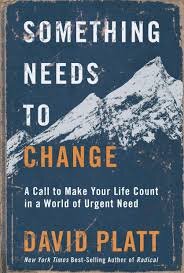
Something Needs to Change - A Review

David Platt wrote Radical in 2010. The subtitle of that book was Taking Back Your Faith from the American Dream. That compelling book was a call to resist the materialism and superfluous comforts of the idealized American existence and pursue a missional alternative that included frugal living, generous giving, and the willingness to go to all the nations with the gospel.

download (17).jpg

In the years since I’ve met many people who have read the book, who studied it in a small group or as a church, or who have heard its core message summarized. Most of them continue to live a typical American middle-class lifestyle, with a comfy house, fun vacations, and a great hope in retirement. Many of the accounts of studying the book include Christians meeting in the expansive homes of the American suburbs enjoying rich desserts. The irony is often lost on those who recount it.

For Platt, who spent four years at the helm of the Southern Baptist Convention’s International Mission Board, the irony still seems to be too much. He has recently published a volume, Something Needs to Change: A Call to Make Your Life Count in a World of Urgent Need, that reissues the call of Radical and seeks to make it more personal.

Something Needs to Change is a memoir or sorts that recounts a seven-day trip Platt took through the Himalayas just before he accepted the call to the International Mission Board. He outlines the devastating poverty he encountered, the horrific lostness, and the depths of human depravity that were evidenced in the communities Platt encountered.

This book is nuanced. It is not merely a 200-page guilt trip. It is an extended meditation about real needs by someone who does not have all of the answers. Platt seeks to uncover the desperate needs of the world, while still wrestling with our call to live in the place God has given us. By the end of the book, it should be clear to the reader that Platt is not proposing a one-size-fits-all solution, but rather calling for an unfettered reconsideration of our priorities and actions.

Platt is likely to face criticism from both political poles about this volume. He recognizes the deep humanitarian needs of those living in abject poverty and sees that as humans we cannot ignore them. At the same time, he cannot fail to note the even deeper need to meet to alleviate the spiritual poverty of those living apart from Christ. His proposal is to develop a both-and solution, but by all means to do something.

To often good theory dies on the pages of the book and never makes it to the hands of the reader. In Western culture we talk about the needs of the poor, but try to pay off the government to deal with their problems while hoping to keep their hands (and lives) free of the concerns of the dirty poor. In the same way, some groups claim earnest concern for the environment, but continue to drive excessively large vehicles excessively long distances while consuming excessively large quantities of beverages shipped and excessively long distance and presented in excessively wasteful packaging.

As Platt notes, something has to change. His book is a call for people to consider what that change will look like in their lives. For the business person, it may be to expand their company into a lesser served area of the world to provide jobs and resources to those who need it. For some, it may be to take marketable skills they have acquired and apply them to humanitarian solutions for areas reached neither by the gospel nor the material abundance of Western culture. There are no firm prescriptions because for each of us the task is different and our ability to contribute is uniquely shaped by God’s gifts to us.

Above all, however, we need to stop doing nothing and do something.

Platt’s book in another reminder that many of us live lives of self-satisfaction, oblivious to the great needs of the world. We will be accountable for how we have used our time and resources one day when we stand before a holy God. On that day some of our accounts of purchased comforts and wasted days will be a source of sorrow. Something Needs to Change is a reminder that day is coming. We should live like we expect it.

Note: I received a gratis copy of this volume from the publisher with no expectation of a positive review.

The Pleasures of Reading in an Age of Distraction - A Review

Why do you read?

I am something of an addict myself, so sometimes I’m not sure whether I am reading because it is an activity that I love, a duty that I own, or a habit that I need to break.

In particular, as someone who reviews books (I typically write 50-75 book reviews a year now), I find myself always with a book in my hand. This is, of course, something of a security blanket when people become too intrusive. For an introvert, a book can become an impermeable fortress that miraculously blocks out all noise and unwanted social interactions. (Except for that really annoying, fearful woman on a flight a few years ago who insisted on peppering me with questions as we crossed the country.)

And yet, despite my relative enjoyment of reading as an exercise, I find myself plodding through books that I do not really enjoy. Part of this is that I have committed to always read the entire volume (at least once) before I write a review. Amazingly, this is not something that all reviewers do, and it often is apparent from their reviews. However, there are other times that I end up holding a volume in my hands that has been deemed a classic (or at least notable in its field) pushing through even though I am gaining little pleasure and often even less value from it.

Books that I have acquired out of a sense of duty are intermingled on my shelves with the books I have read and enjoyed or at least profited from (I did not enjoyed Cormac McCarthy’s book, The Road, but I did profit from reading it.). Despite having been assigned The Brothers Karamazov as a sophomore in college (and doing well in that class), I still have not read it. Two copies of that auspicious volume sit on my shelves, staring at me like the roving eyes in the portrait of long deceased ancestor, but each time I pick up the book I find myself soon drifting to other interests. I have often been left disappointed in myself as a failure for not latching on to one of the great works of human culture.

Alan Jacobs provides an alibi for many of us in his book, The Pleasures of Reading in an Age of Distraction. This volume, written to bibliophiles who read voraciously, is a stark reminder that there is much more to reading than checking off a big to-do list, the completion of which authorized one to be deemed culturally astute, wise, or whatever.

As a professor of English and one deeply engaged in discussions of thinking and culture, Jacobs does not swear off reading from the canons of volumes curated by previous generations. He does, however, recognize that in our present age of constant distractions and competing demands for our attention we are likely to lose a great deal more by attempting to force our way through the works presently uninteresting than by reading according to our whim.

Instead, Jacobs pleads: “For heaven’s sake, don’t turn reading into the intellectual equivalent of eating organic greens, or (shifting the metaphor slightly) some fearfully disciplined appointment with an elliptical trainer of the mind in which your count words or pages the way some people fix their attention on the ‘calories burned’ readout. . . . This kind of thing is not reading at all, but what C. S. Lewis once called ‘social and ethical hygiene.’”

Whim, is, therefore the pursuit of one’s current intellectual interests. The pursuit of a sort of pleasure that may be more like the “runner’s high” that comes after breaking through “the wall” during a long run than the sugar-induced coma after consuming half of a cheesecake. That is, whim and pleasure ought not to be taken as a license to avoid hard works in favor of breezy novels, but rather to allow a mixture that fuels rather than smothers the engagement of the mind.

I think of my own habit or re-reading The Lord of the Rings approximately annually. (A habit I share with Peter Kreeft, so I have never felt too badly about it.) On one hand I do this because, although it is the forebear of a genre of fantasy for which I have little taste, each time I encounter the book I am deepened in my understanding of the true, good, and beautiful. Having read the story more than forty times has increased rather than diminished my pleasure in reading it. According to the reading list measure of intellectual greatness, which is often supported through works like Mortimer Adler’s How to Read a Book, I am losing time and missing opportunities to progress intellectually. However, my repeated re-reading of Tolkien’s masterpiece is an attempt to let the book master me rather than me mastering a canon of literature.

By re-reading works that I delight in and which ground me in humanity (I think of much of C. S. Lewis’s corpus), I am pointed toward and encouraged to delve more deeply into other books. I have yet to conquer Dostoevsky’s Brothers (though in my defense, I have read Demons), but someday I might. Alan Jacob’s book, The Pleasures of Reading in an Age of Distraction offers a comforting salve to my aching conscience reminding me that the purpose of my reading is to enjoy it, to be shaped by it, and not merely to eat my veggies.

Those who delight in reading will also take pleasure in Jacobs’ book on the subject. It is a sort of Inception for the bookish crowd, since it is a book about reading books. Above all, The Pleasures of Reading in an Age of Distraction, is a well-considered, well-written treatise on a subject that many of us hold very dear.

Adorning the Dark - A Review

download (15).jpg

The world can be a very dark place. It’s easy to get overwhelmed by the evil that surrounds us. It invades every corner of our existence. Sin is ever with us and peace can be elusive. The news, our social media, the way people treat each other in our presence are a constant reminder that on this side of Genesis 3, things are not the way they are supposed to be.

And yet, there is beauty. Common grace exists. We see wonder that remains in the created order around us. There is order to be observed and delight to be found in God’s goodness, resounding like echoes in a quiet canyon.

Amid the darkness of this world, we have the responsibility to adorn the dark with grace-filled art. We have a duty to bear the flame and adorn the dark.

Andrew Peterson’s recent book from B&H is, as the title implies, about Adorning the Dark.

Summary

This is much less a how-to book and much more a memoir of how the Rabbit Room, Hutchmoot, Behold the Lamb of God, and the multiple other projects that Andrew Peterson has played a part in have come to pass. For those who enjoy Peterson’s music and the network of musicians and artists that he celebrates, this is an engaging account of how one man and his friends are working to make the world a more beautiful place.

For those who are seeking a collection of thoughts on how to replicate Andrew Peterson’s vision or reproduce exactly what he has done in his several decade career, this book will not meet that desire. However, those who have been blessed by what Peterson has done will find this an engaging and encouraging read.

There is some theory in this volume, but there is much more story. Readers will get a sense of the importance of place, the need for story, the vital need that we have for friendship and cooperation. All of this is carried along in Adorning the Dark. There is a real sense of love for God and his creation that is apparent on every page.

Critique

This is a thoroughly enjoyable book, but it is not a highly theoretical book. That is likely to make some people very happy while frustrating others. Peterson is a gifted artist and storyteller. He is not a scholar or theoretician. This is a book that digests and recasts the intellectual work of others, but it does not till new ground. At the same time, Peterson shows how the theories of others can be worked out in our time and culture.

The degree to which one appreciates Adorning the Dark will depend significantly on what the reader is looking for. Fans of Andrew Peterson will find this encouraging and enlightening. There will be a significant number of creative people who will find this inspiring and instructional. The practical and appreciative will gain the most pleasure and benefit from this short volume. Those seeking an advancement of the philosophy of art or beauty will do better to look to the sources Peterson lists in the back of the book.

The most important thing this book teaches readers is that our pathway to adorning the dark will be different than the authors. Our goal may be the same, but we are not all called or gifted to be independent musicians who write children’s fantasy novels. The Rabbit Room is a ministry specific to Peterson’s time, place, and community. Our task is not to reproduce what Andrew Peterson has done, but to make the world beautiful in our own way.

NOTE: I received a gratis copy of this volume from the publisher with no expectation of a positive review.

The Benedict Option - A Review

download (14).jpg

Rod Dreher’s 2017 book, The Benedict Option: A Strategy of Christians in a Post-Christian Nation, caused quite a stir when it was published. It was reviewed both favorably and unfavorably. Dreher defended his position at The American Conservative, the magazine website he is the editor of, vocally and often. There were points in the public discussion that it wasn’t clear that everyone who was criticizing the book had read the same thing.

The Benedict Option is an idea borrowed from the monastic order that descended from St. Benedict. Dreher drew the idea that a resurgence of a Benedictine ethos would be beneficial from Alistair McIntyre’s seminal work, After Virtue.

Dreher, formerly a Roman Catholic, who has migrated to the Eastern Orthodox faith, sees a separatist community as the path forward in resisting the corrosive effects of our post-Christian culture.

Strengths

It is clear that Dreher has a good understanding of the problems with Western culture. It isn’t that one thing or another is the big problem. For example, sexual immorality in its various forms as celebrated by our culture, is not the main problem with our world. Or, perhaps more clearly, it is not unique to our culture.

The unique aspect of our culture is how relentlessly intrusive the anti-Christian influences are. Before the digital age keeping your kids from pornography was largely a function of not buying dirty magazines and reasonably screening their time at a friend’s house away from the family. Now pornography is streaming down the same digital pipeline as the cute, if inane, videos about making pretty bracelets or surviving in the wilderness.

Dreher recognizes that even if parents put a filter on their home internet and monitor usage carefully, the vast majority of the parents in the community have given their child their own digital device with unfettered access to whatever the internet might offer. The only way to keep you kids safe (that is, to preserve them in some condition of relative innocence) is to form a contrast community that has agreed upon norms to help protect the group.

Another strength of Dreher’s vision is that, if implemented, it would give Christians the opportunity to practice authentic community in ways that are exceedingly difficult in our dis-integrated modern world. The Benedict Option would require intentional re-integration of life, neighborliness, and humanity. There is something strongly attractive about the move toward a more conscientious observation of the creational order.

Weaknesses

Although the vision Dreher presents are attractive and do seem to answer many of the contemporary, the Benedict Option is not without its difficulties. Many of these were made apparent during the period after the release of the book, when the roiling rage of reviews threatened to swamp the Christian blogosphere. Many of Dreher’s critics seemed to misread his book, exaggerating his claims. However, there are some legitimate points of criticism.

Most significantly, this book makes much less sense read independently than it does when read as a sequel to Dreher’s 2006 book, The Crunchy Con Manifesto. That book gives a better sense of what Dreher’s desired cloister might look like. In fact, looking back at many of the reviews of The Benedict Option, much of the criticism of the book seems to be based on assumptions about the nature of Dreher’s vision for community, which is spelled out much more clearly in his earlier book. Putting the two books together also makes it clearer that Dreher’s book is not merely a reaction to the infamous Obergefell decision, but a rejection of the broader tendencies of modernity.

As a second significant weakness, Dreher’s Benedict Option seems to give little place for evangelistic missions. It seems to point toward bolstering the bastions rather than sending out emissaries for Christ. Dreher clearly does not deny the importance of evangelism, but the theme is largely absent from his work. Taken in combination with his Roman Catholicism and Eastern Orthodoxy, the failure to discuss this important duty of Christians warrants concern by missions-oriented Protestants.

Conclusion

If you’ve not read The Benedict Option and have formed your opinions about the book from the internet chatter about it, then you’ve likely drawn the wrong conclusions. Dreher posits an idea, which I think deserves a hearing, even if it needs significant modification to be applied. The best thing about Dreher’s Benedict Option is that it offers a positive conception of life as it should be to discuss and strive for. In a world where Christian culture tends to mimic and act as slow-moving revolutionaries, Dreher offers something different.

It may be work quoting a couple of paragraphs of The Benedict Option to give a sense of the work in Dreher’s own words:

The Benedict Option is not a technique for reversing the losses, political and otherwise, that Christians have suffered. It is not a strategy for turning back the clock to an imagined golden age. Still less is it a plan for constructing communities of the pure, cut off from the real world.

To the contrary, the Benedict Option is a call to undertaking the long and patient work of reclaiming the real world from the artifice, alienation, and atomization of modern life. It is a way of seeing the world and of living in the world that undermines modernity’s big lie: that humans are nothing more than ghosts in a machine, and we are free to adjust its settings in any way we like.

There is some wisdom in what Dreher outlines. It is worth considering his plan of action to determine if we can formulate a better one.

God and Galileo - A Review

The legend of Galileo’s scientific rebellion against the faith has grown to enormous levels. It is a mainstay myth in the legendarium of modern culture: The Church rejected science, so Galileo chose science over the church.

It’s a common story that I heard growing up, but it is wrong.

David Block and Kenneth Freeman have written a thoroughly engaging book that works through the faith/science question in light of a letter that Galileo wrote a Letter to the Grand Duchess Christian of Tuscany.

Like most of the time when you actually read the primary sources, it quickly becomes apparent that the grade school history book account of Galileo and the Church, faith and science is dramatically different than what was portrayed.

God and Galileo: What a 400-Year-Old Letter Teaches Us About Faith and Science is an accessible, informative read on the faith/science dialogue, especially the particular history surrounding Galileo’s heliocentric model of the cosmos. As someone who has done a fair bit of reading on the topic before, I was thoroughly engrossed and thoroughly entertained by the account Block and Freeman give.

The book is divided into three parts. Part One has eight chapters. Part Two contains three. Part Three consists of two chapters. Helpfully, the book also includes an appendix, which contains the entire Letter to the Grand Duchess reprinted.

A detailed summary of each chapter would be wearisome, but the authors discuss important topics in the faith/science debate like the relationship between special and general revelation, the tenacity with which we hold our interpretations of Scripture about natural phenomena, and the errors of scientism. There are also several historical vignettes that enrich the discussion and help provide the backdrop to Galileo’s particular situation. These vignettes also reveal that although Galileo did not fair well, the reality is that Christendom adopted his position not long after his death and has even built some significant observatories for continuing astronomy in his legacy. The final two chapters of the book offer the testimonies of Blaise Pascal and David Block.

It’s hard to characterize this book simply, to put it into a clear category. Usually that is a criticism, but in the case of God and Galileo it is because the book does a great deal well. Are you seeking a resource to disrupt a materialist’s view that faith and science are mutually exclusive? This book can help do that. Are you interested in the contours of the faith and science debate as a Christian? This book will inform you. Are you looking for an enjoyable read for a quiet evening? This book offers it. Are you longing for a volume that encourages you to enjoy God through both his special and general revelation? This book calls you into a sense of wonder at both.

Block and Freeman have done excellently with this book. This is a volume that should get a wide audience and that bears re-reading. Two significant astronomers reflecting on the integration of faith and science would draw a huge crowd on the seminary campus or university. This book is like getting a series of those talks in a digestible written form.

NOTE: I was provided a gratis copy of this volume by the publisher with no expectation of a positive review.

Pursuing an Earthy Spirituality - A Review

When someone refers to something as “spiritual” it often conjures the image of something ascetic, disembodied, or concerned with something other than the physical world. That impulse is a result of gnostic impulses that are foreign to biblical Christianity. In truth, while there is certainly division between body and soul in the human, our earthly life is a significant part of our spirituality.

C. S. Lewis’s writing is powerful on many levels, which is part of the reason he remains popular today. One of the themes that makes Lewis so helpful is idea that joy is attainable on this earth as embodied beings. That is, Lewis teaches his readers that our bodily lives have value, can bring glory to God, and can be a source of delightful worship as we live, eat, and love.

download (12).jpg

Gary Selby traces the theme of embodied worship in his book, Pursuing an Earthy Spirituality: C. S. Lewis and Incarnational Faith. Selby contrasts an earthy spirituality to a “negative spirituality,” which emphasizes solely spiritual goods.

After a brief introduction, the book is divided into eight chapters with a short conclusion. Chapter One begins, not surprisingly, by analyzing what Lewis meant when he wrote of Joy. The second chapter considers the nature of God as a good creator who wants his creatures to delight in him through creation. Chapter Three explores the negative spirituality Lewis grew up with, which still plagues so many Christians. In the fourth chapter Selby considers a Lewisian spirituality, which calls believers to be both conscious of good things and to choose the good over the lesser. Chapter Five delves into the formation of character through a Lewisian spirituality. The sixth chapter applies the positive spirituality found in Lewis to the physical life, especially to eating, which is a significant topic in Lewis’s fiction. Chapter Seven deals with seeking out community with those whom we might otherwise avoid. In the eighth chapter, Selby explains an earthy spirituality can positively impact our hope of heaven. The conclusion ties the book together by revisiting the topic of joy.

More than five decades after Lewis’s untimely death, many of the possible topics about Lewis’s life and work have been written. There have been favorable biographies, critical ones. Dissertations of varying content and quality have been composed. For the most part, books about what Lewis said about particular topics have been written. There is, within the field of Lewisiana, a growing danger of repetitiveness or digression into meditations about “what Lewis means to me.”

Pursuing an Earthy Spirituality manages to avoid the status of retread. There is a great deal in this volume that overlaps other treatments of Lewis, but Selby writes well, thinks clearly, and presents Lewis in a way that is both helpful and interesting.

This is a book that does well by pointing the reader back to Lewis. It should be read after one has already read a great deal of C. S. Lewis, since Selby is integrating themes from across Lewis’s canon. Readers who have read The Chronicles of Narnia and a few of Lewis’s shorter non-fiction works will probably feel a little lost in this book. Those who have feasted on the Space Trilogy and many more of Lewis’s essays and non-fiction books will find Pursuing an Earthy Spirituality very engaging and delightful.

As such, this is a volume that belongs on the shelves of those who enjoy and have deeply read the work of C. S. Lewis. I expect to find myself referencing this volume in years to come as I continue to think and write about Lewis’s work.

NOTE: I received a gratis copy of this volume from the publisher with no expectation of a positive review.