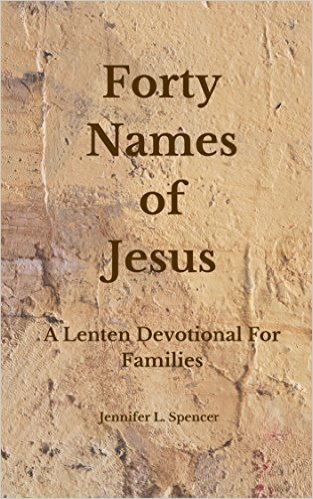
Forty Names of Jesus - Day 5 - Light of the World

This is the fifth (and final) preview day of the series of Lenten Devotionals that my wife, Jennifer wrote. If you have found these beneficial, you may consider purchasing the e-book here. We both hope you've enjoyed them and have deepened in your love of Christ through them. There is another free day scheduled for Feb 16, 2016, but we were limited to 5 days free.


5. Light of the World

 John 8:12

 Again Jesus spoke to them, saying, “I am the light of the world. Whoever follows me will not walk in darkness, but will have the light of life.”

 Optional – John 1:1-9, Matthew 5:14-16

When God created the world, the first thing he made (and the only thing on the first day) was light. Without light, you can’t see anything else! It makes sense that God made light first. Before that, there was no way to see. Do you think that would make you afraid? Being in total darkness without even light from stars in the sky or a neighbor’s house is very scary. Our eyes play tricks on us in the dark, and we think we see sparkles or colors. We lose our sense of direction and fall on something or run into something. So light is one of God’s wonderful creations and a gift to us.

Light is so important and good that it is also a way for Jesus to describe himself. Jesus says he is the “light of life.” He’s not just talking about daylight, or an electric light, to help us see with our eyes. He’s talking about light to guide us in how to live – how NOT to be lost and away from God forever.

When we don’t know what to believe or who to trust, that’s like walking in darkness. Things may seem fine for a while. But there are many dangers we can’t see, and it’s just a matter of time until there’s a big problem. Following Jesus in his light means we will never be totally lost. He will guide us to God in the end, through himself, and we will be saved. No darkness can ever be too much for him.

Jesus also told his disciples that they are lights in the world, and they should let their light shine by doing good deeds. But just like Jesus – the true Light – the disciples are to point people to God and bring glory to him. As Jesus’s followers, we don’t do good works to get other people to praise us. We do them so that others will see Jesus, the light for the nations, offering salvation to the ends of the earth (Isa. 49:6). Let’s praise him that he has made us walk in light!

 Key idea: Helps us to see

Forty Names of Jesus - Day 4 -


4. Immanuel

 Matthew 1:22-23

 All this took place to fulfill what the Lord had spoken by the prophet: “Behold, the virgin shall conceive and bear a son, and they shall call his name Immanuel” (which means, God with us).

 Optional – Isaiah 7:14, Psalm 139:7-12

 Where does God live? God is everywhere – there is nowhere you can go to escape from God. Anywhere you can go, God is already there. But at times throughout history God has especially revealed himself in certain places. In the Garden of Eden, God used to walk with Adam. God had created a perfect home for the first people, Adam and Eve, and God himself would be there in that place with them. That is amazing, and something none of us have ever experienced.

But you know what happened. Adam and Eve sinned, and they had to leave God’s presence. They had to leave the beautiful, flawless garden, and nothing has ever been completely, totally right since then. Because of Adam’s sin, God said that everything would be cursed. That means things are broken and messed up. Nothing is the way God designed it, with no death or problems. God put this curse on the whole universe and everything in it, including nature, animals, and people. The brokenness reminds us that we need God to send a rescuer. So ever since that time, people have not been able to be with God in the way Adam and Eve could be with him before their sin.

Because people aren’t perfect and sinless anymore, it would kill them to be in God’s perfect and holy presence. It would be dangerous – and deadly! Moses had to be protected from seeing God’s face when God spoke the ten commandments and the rest of the law to him. When God’s glory was with the Israelites, the tabernacle and the temple had to be surrounded by courtyards and walls and curtains. God’s glory was in the center room, called the Holy of Holies, and his holiness would destroy any sinful people who came near unprotected.

Think about how sad it would be, to know there is a wonderful, powerful, awesome God that we have no chance of ever meeting. But we can be with God, because Jesus came to be Immanuel – the name that means “God with us.” He came as God in a human body, to live just like humans, with other people, living the same kind of life. And he promised to someday take all who believe in him to be with God, forever, with no more sin or brokenness or sadness. Immanuel is the name that reminds us God has been with us and will be with us again! Let’s thank him and tell him how we look forward to that.

 Key idea: God with us


To read day five, click here. 


Forty Names of Jesus - Day 3 - Redeemer

Today is the third day of the forty leading up to Resurrection Sunday. Here is another preview of Jennifer's devotional guide on some of the names of Jesus.


3. Redeemer

 Galatians 3:13

 Christ redeemed us from the curse of the law by becoming a curse for us—for it is written, “Cursed is everyone who is hanged on a tree.”

 Optional – Isaiah 43:14-15, Titus 2:11-14, Leviticus 25:47-49

 Did you know that God’s people were slaves at one time? You probably do, if you know about Moses and how God sent him to lead the people out of Egypt. The Israelites were slaves in Egypt. That means they could not choose how to live their own lives, and they were treated cruelly by the Egyptian masters. The Israelites felt hopeless, because they could not defeat the Egyptians themselves. In Exodus 6:6, God tells Moses, “I am the Lord, and I will bring you out from under the burdens of the Egyptians, and I will deliver you from slavery to them, and I will redeem you with an outstretched arm and with great acts of judgment.” Redeem means to buy someone out of slavery. The Israelites needed this, and God rescued his people using the plagues he sent on Egypt. Throughout the Bible, God is called Israel’s redeemer.

Another example of someone who was redeemed is Ruth. She wasn’t a slave, but she was poor. People who were poor were in danger of losing their family’s land and inheritance, and so very poor people could be redeemed as well. That is what Boaz did for Ruth – he redeemed the land of her husband who had died, and married Ruth, rescuing her from poverty. Ruth could not have done this for herself, and until Boaz redeemed her she was not free to live how she wanted because of her need.

Do you see what was similar in the stories? People who couldn’t help themselves and were not free to do what they wanted: these are the ones who need a redeemer. We are people who need a redeemer too. We aren’t slaves to another person, but we are slaves to sin and we can’t help ourselves. Our hearts are not free to do what we please but are full of sinful desires that we act on. This sin has us captive to it, and we keep on doing it even if we know it’s wrong and wish we could stop. Because we are sin’s captives, we are also facing the penalty of our sin – God’s judgment. A price had to be paid, to redeem us – to get us out from under the power of sin, and get us out from under the punishment for sin. Jesus died for us, in our place, to redeem us from sin and sin’s curse! The Bible tells us that he was rich, but for our sakes he became poor (2 Cor. 8:9). We can never thank him enough for this. We should worship him every day for giving up his riches and paying our price! Let’s do that now.

 Key idea: Pays the price to get us out of slavery


To read day four, click here. 

Forty Names of Jesus - Day 2 - Christ

This is the second of five preview days of Jennifer's e-book, Forty Names of Jesus. You can read Day 1 here. The idea is to allow folks to read it and use if with their families before they purchase it. 

The bigger idea is to get families into the Bible in this time leading up to Easter considering the person and the work of Jesus Christ as he is represented throughout Scripture.

This is a Lenten devotional in the sense that it can be particularly useful in building up excitement for Resurrection Sunday, not in the sense that it is a special means of grace or part of a religious duty driven by adherence to tradition. Use this anytime with your family. But when better than in the days before Easter?

------------------------

2. Christ

 Matthew 16:15-17

 He said to them, “But who do you say that I am?” Simon Peter replied, “You are the Christ, the Son of the living God.” And Jesus answered him, “Blessed are you, Simon Bar-Jonah! For flesh and blood has not revealed this to you, but my Father who is in heaven.”

 Optional – Luke 2:11, John 1:41, Luke 24:44-49

 When people teach, or preach, or pray, have you ever noticed how many ways they can use Jesus’s name? “Our Lord Jesus Christ”, “Christ Jesus the Lord”, “Christ Jesus”, “Jesus Christ” or simply “Christ” are some of the ways people say his name. The reason that the word “Christ” can move around before or after Jesus is that “Christ” is a title. It’s not his last name, or his first name, but a title like King or Commander. That’s why people called him “the Christ” – Christ is the Greek word with the same meaning as Messiah. It means Anointed One, and to anoint someone meant to choose him for a special purpose, a special role.

God had promised through his prophets, like Isaiah, David, and Micah, that he was going to send his Chosen Messenger to rescue his people. By using the name “Christ” or “the Christ”, the disciples, angels, and Jesus himself were saying they believed God had kept his word – Jesus was the Promised One whom God sent. And we can worship him now and praise him for that – we recognize he is the fulfillment of God’s promises. He came once, to live among us, die, and rise again. He will come again to rule forever. We love and adore and serve him because he is God’s chosen one – He is Christ! Let’s worship him in prayer now.

 Key idea: Anointed one, chosen one (Greek)


To read day three, click here. 

George Liele - The First Baptist International Missionary

William Cary often gets credit for being the first Baptist sent as missionary to the nations. He certainly deserves credit, along with pastor Andrew Fuller, for kicking off the modern missionary movement.

Adoniram Judson frequently is identified as the first American missionary for leaving the shores of the U.S. in 1812. However, he isn't the first missionary to leave this land to go overseas, nor the first Baptist. Judson is important, but there was a Baptist missionary that preceded him.

The title of the first Baptist missionary actually belongs to a black man from colonial America named George Liele.

Biography

Liele was born a slave in the colony of Virginia in 1750. He converted to Christianity in 1773 in the church of his master, Henry Sharp. He gained his freedom in 1778 from Sharp so that he could preach the gospel. In 1783, since he had sided with the British in the revolution, in order to be evacuated from America with British troops, Liele became an indentured servant in exchange for his family's passage to Jamaica. After a short time he repaid his debt and was freed again. He then turned his attention to preaching the gospel to the slave population of Jamaica.

Liele was persecuted by the plantation owners of Jamaica for preaching the gospel. But he continued to preach the gospel.

Although he pastored many years, he did not rely on his pastorate for his income but worked as a teamster/hauler and farmer to support his livelihood.

Liele is an impressive example of a faithful Christian and an important figure in black history. Below you can watch Danny Akin's tribute to Liele in the form of a sermon on the text of Galatians 6:11-18.

Preaching from Galatians 6, Dr. Akin speaks about the marks of a cross-centered ministry and how these marks are seen in the life and ministry of the first Baptist missionary to the nations, George Leile, a former African slave who planted the Gospel in Jamaica.

Forty Names of Jesus - Day 1

As some of you may know, my wife Jennifer has put together an e-book of forty devotionals for families with children. I posted about it earlier on the blog to announce the book launch.

A sample of five days will be posted to give everyone a chance to try before they buy. Additionally, there will be some free and discounted days in the mix.  

You'll find the first entry below, and a link to the second day at the end. 


1. Jesus

 Matthew 1:21

 She will bear a son, and you shall call his name Jesus, for he will save his people from their sins.

 Optional – Luke 2:21, Matthew 1:18-25.

 Soon it will be springtime, and we will celebrate Easter. As we get close to Easter, each day we are going to spend some time thinking about who the Bible says Jesus is, and what we should know about him, and why we should worship and love him.

Easter, or Resurrection Day, is a very important day because we celebrate how Jesus died and rose again! That’s the best news ever, in all of history, and the best news we can ever share with other people. But something else happened first – something called the Incarnation. That word means Jesus was born as a baby, and lived as a man, for about 33 years before he died. We hear about this most often at Christmas. But before we get into all the names of Jesus – names the Bible uses in the Old Testament and in the New Testament, and what those names teach us about him – we’re going to find out how he got the name everybody called him, every day. His whole life, from the time he was a baby, and a child like you, to a grown-up adult like me, his family and friends and anybody talking to him called him “Jesus.”

Now, you know Jesus was special from the time he was born – you know how it happened with angels in the sky, and shepherds, and wise men. But actually it begins before then. He was given a special name before he was even born! It was unusual because an angel told Joseph in a dream that Mary, his promised wife, was going to have a baby, and the baby’s name was to be JESUS. The angel gave Joseph God’s message to call the baby Jesus because the name meant something. The words and sounds that the name Jesus comes from mean “God saves.” The angel told Joseph that that was Jesus’s name, because for him, it meant, “He will save his people from their sins.” So while Jesus’s resurrection is the biggest news, and the most important thing to remember, the importance started a long time before that. Even before he was born, Jesus had a name that told what he would do when he grew up. He would save his people from their sin. And he does! Let’s pray.

 Key idea: Saves his people from their sins


To read day two, click here.

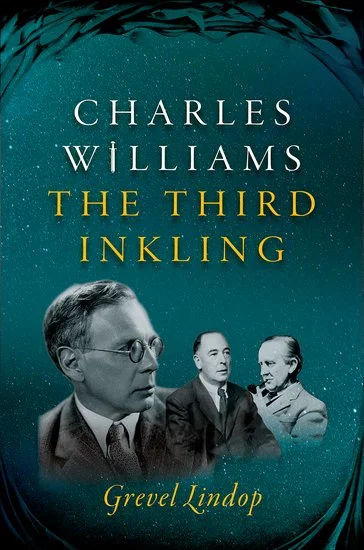
Charles Williams: The Third Inkling - A Review

Charles Williams stands in literary history among the group of men called the Inklings.  Most famously, that group includes J.R.R. Tolkien and C.S. Lewis. Often Owen Barfield is mentioned along with them, too.  Williams gets discussed but often on the fringes—a much less known person than Lewis or Tolkien. He remains known, in part, because of his association with the other two.

Whereas there are many biographies (authorized and otherwise) on Lewis and Tolkien, there have been few on Williams. Recently Oxford University Press has published a lengthy biography on Williams by poet and literary critic, Grevel Lindop.

Who is Williams?

It is appropriate that OUP publish this biography of the third Inkling because Williams’ biography is as much the history of OUP as it is the story of his own life. He worked for many years as an editor at Amen House, the London office of the Oxford University Press. During World War II, he worked for OUP in Oxford proper.

For the student of English literature, particularly of modern British literature, Williams’ life and work is interesting because of his interactions with the intelligentsia of that era. He corresponded in detail with Dorothy L. Sayers. He was friends with T.S. Eliot. He interacted with Dylan Thomas and Gerard Manly Hopkins and others. Some of these, even more than Tolkien and Lewis, are names that haunt the syllabi in colleges to this day. Williams helped shape the literary history of the English language due to his significant position as an editor of volumes, curator of anthologies, and author of prefaces and introductions. Lindop chronicles the work of Williams quite adeptly along those lines.

Williams was also a creator of literature. He wrote poetry, plays, and novels. Some of them are still in print today. In this endeavor Williams was, perhaps, no less avid than some of his more popular friends. However, he was much less successful.

Although he wrote numerous novels, plays, and poems, he was regularly in financial difficulty. (This stemmed in part due to the low wages paid by OUP.) Yet he, like many other creative people, was frantic to put his vibrant imaginations onto paper and thus bring others into the worlds he was creating. He often published without pay and when he was paid, it was often very little. In that regard little has changed in the literary world.

He was enthralled with the Arthurian legends as well as with mystic and sometimes occult practices. Williams was involved in several secret organizations that incorporated various magical rituals, mystical concepts such as sharing the pain of others, and syncretistic practices that melded Christianity with pagan rites. Most of what Lindop describes is rather benign and not dark magic, as it were, but Williams had shaky theology to say the least.

His Theology and Praxis

Williams was obsessed with his notion of Romantic Theology and wrote a book by that title. The concept is that through romantic love one could have a spiritual experience. Lindop deals with this in some detail, but it is not a fully orthodox conception of worship. However, it points toward some of the disturbing aspects of Williams’ amorous life.

He married a woman for whom he experienced something akin to love at first sight. He and his wife, whom he nicknamed Michal after David’s wife, remained married until his death just before the end of World War II. However, Williams was not faithful to her in any true sense of the word.

According to Lindop, it does not appear that Williams committed physical adultery with any woman. However, he committed many emotional affairs with young women around the office of Oxford University Press. In these relationships Williams often released sexual energy through mildly sadomasochistic practices like light spanking, striking palms with rulers, and other minor forms of “discipline.” Often these encounters occurred in broad daylight in the offices of OUP. In many of these interactions, Williams acted as a spiritual mentor to the young ladies, thus inculcating their devotion and submission to his odd practices.

Williams also developed the idea that the biblical mandate to “bear one another’s burdens” included the ability to suffer by proxy for an individual—to take on the physical and emotional pain of someone, whether known or not, and thus reduce it. He was quite active in organizing these activities among what seems to be a fairly broad group of spiritual followers. 

Relative Obscurity

The unwholesome affections and spiritualism help explain why Williams, even when he is read, does not resonate with as wide an audience as Lewis and Tolkien. Certainly, as Lindop documents, Williams was as innovative as the two more famous Inklings, perhaps even more innovative. But his gospel was tainted by spiritualism and distorted understanding of love. This cannot help but come through in his writing. While Lewis and Tolkien are telling the greatest story ever through their myths, Williams was caught up in spiritualism that effectively drew his mind from the truth.

Also, where Lewis and Tolkien understand joy and hope, Williams led an unhappy and unfulfilled life. He was constantly nervous. He was always something of a social oddity. He withdrew from his family often to be creative and productive. Lindop paints the portrait of one who well knew suffering, but little knew joy. This, too, seasons his writing and helps explain why he continues to be read but rarely devoured by generations of devotees, like those that follow Lewis and Tolkien.

Lindop’s biography of Charles Williams is good. The research is well done, with many footnotes and ample evidence of thorough research into Williams’ extensive correspondence and his voluminous literary estate.  This is a book that needed to be written and has been written well. If it fails to inspire as much as a biography of another Inkling, that is likely because a fair telling of the life of Charles Williams cannot be a happy story if it is to be an honest one.

Note: I received a gratis copy of this volume from the publisher with no expectation of a positive review.

Are You Ready for Lent?

It’s nearly the start of Lent. For many Protestants, that doesn’t traditionally mean much. However, similar to Advent, Lent was established as a way to intentionally build up anticipation for Resurrection Sunday.

If you are looking for family activities to help celebrate the coming of Christmas, Advent has dozens of products from a Protestant perspective, but there aren't as many options for Lent.

I’ve always thought that Easter is just as significant as Christmas. However, in the low church tradition and in culture in general, Christmas gets a lot more attention. A lot of this has to do with the commercialization of Christmas.

We’ve picked up the Jesse Tree tradition and other intentional lead-ups to Christmas in order to focus the kids’ minds on Christ. Everyone is talking about it, so simple traditions that build on Scripture and focus on the nature and purpose of the incarnation and show how the whole biblical narrative points toward the coming of Christ are invaluable. They take the anticipation of the countdown and emphasize the hope that is the foundation of the holiday.

There are fewer options for Lent from a Protestant perspective to raise the anticipation of that important holiday.

That is why my lovely wife, Jennifer, wrote a series of Lenten devotionals for children. Each one highlights a name of Christ in Scripture. Each one takes about 5 minutes to read. They are focused at children ages 5-10. Additionally, Jennifer has recommended some basic activities (like building a chain), that can be fun for the family and lead to a visible reminder of the approach of Easter.

It’s not just for the kids, though. Parents, too, benefit from going through thoughtful preparation for Resurrection Sunday. After all, which one of us couldn’t do with a little more time seeking to understand and honor Christ?

As Jennifer writes in her introduction:

One of the books that greatly influenced me as a student was Knowing God, by J. I. Packer. In Chapter 1, he says, “Our concern must be to enlarge our acquaintance, not simply with the doctrine of God’s attributes, but with the living God whose attributes they are. As he is the subject of our study, and our helper in it, so he must himself be the end of it. We must seek, in studying God, to be led to God. It was for this purpose that revelation was given, and it is to this use that we must put it.” In writing this book, my hope was that I would use these discussions not only to inform my children about Jesus, but to lead them to him. Packer goes on to say that “…we turn each truth that we learn about God into matter for meditation before God, leading to prayer and praise to God.” Reviewing these names and preparing to explain them to others is meditation, but I encourage you not to stop there. Take what you are thinking about and turn it towards Christ himself. Praise him along with your children as you allow these names and discussions to be a part of your life for 40 days.

Obviously, I’m a big fan of the project. So this isn’t a review, but a post to let you know that the devotional is out there on the market and available for purchase. It’s not about the money, but Amazon is a fairly universal platform and they make you charge.

In case you want to try it out, five days’ worth of posts will be made available online here at Ethics & Culture. There will be some free days coordinated in there.

Immigration and Unbiblical Reasoning

Politics brings out the worst in people. It really does.

A picture of the Alabama Baptist newspaper taken from Twitter. The author's name was smudged intentionally.

Sometimes it also brings out the worst people, but that is another topic for another day.

At times, politics can cause people to speak up who shouldn’t because they haven’t given time to fully vet their ideas or allow someone else to help them think through the implications of their reasoning. This if forgivable when someone is at the open mic at a townhall meeting—we’ve all said things poorly when we were on the spot. However, when you write something for publication—perhaps in the state Baptist newspaper—it should really be carefully considered by some friends so you don’t say anything foolish.

Recently a pastor in Alabama wrote an ill-conceived letter to the editor of the Alabama Baptist newspaper where he demonstrated a ridiculous level of biblical ignorance.

The letter is a call to block Syrian refugees from entering the U.S. I happen to disagree with a wholesale restriction of immigration based on religious grounds. However, I accept that other people can get to a different answer than I do within the bounds of orthodox Christianity. That question is not the point of this post.

It is the letter writer's reasoning that is both dangerous and questionable. It displays a blatant ignorance of clear Scriptural teaching.

The Position and Argument

The basic position: “I am against allowing the refugees the rights to America’s soil and my neighborhood.”

He uses several points to support his argument:

1.           The Old Testament called for putting the Canaanites under the ban because of the impact of intermingling with idol worshipers on the people of Israel.

2.           The Syrians are not the author's neighbors because they don’t “value the same standards of life and way of life that I value.”

3.           Allowing Syrians into the country will destroy our children’s future because (at least these) Muslims hate Christianity and America.

4.           The increase of an American Muslim population will not lead to a growth in or of Southern Baptist Churches.

I don’t think I am misrepresenting his arguments as they are written. See the article in the picture in this post.

America and Israel

Let’s assume for the sake of discussion that the position to exclude all Syrian refugees is acceptable. Even so, his basis for the argumentation is unbiblical and in danger of subtly conflating America with Israel, if it doesn’t do that overtly. This is bad hermeneutics.

With regard to God’s call for the Israelites to be the instrument of divine judgment on the Canaanites, and not to intermingle or intermarry with them, the letter writer gets the biblical facts right but the application wrong.

America is not Israel. Post-1948 Israel is not identical to the Israel of Scripture. The idea that God’s command to destroy the Canaanites or not to settle near them or make alliances with them applies to contemporary Christians in a religiously plural nation-state is unquestionably false.

I don’t think the author is calling for the extermination of non-Christians living nearby, but even seeking an underlying principle in the passage that there is a Christian mandate to pursue religious homogeneity through political means is unsupportable.

Christians should participate in the political system, but Christianity is not a political entity. Nowhere did Paul (for example) call for such an application of the OT law for contemporary believers because many of those commands were part of the civil law, which was given to the nation-state of Israel for a specific purpose at a specific time.

By introducing this as support for a ban on immigration of individuals from a particular religious tradition, the writer is introducing a strange hermeneutic that would be very difficult to apply consistently.

Are You My Neighbor?

The author didn’t have to make it all the way to the Bible to eradicate the error in his letter regarding who is his neighbor. VeggieTales would have sufficed. However, had Pastor the man chosen to consult his Bible before making a statement on politics in public, he would have discovered that Jesus already gave a pretty clear indication of what constitutes a neighbor.

Luke 10:25-37 is Jesus’ explanation, by way of a parable, of who someone’s neighbor is. Without going into full-blown exegesis, I can say with confidence that Jesus utterly rebuts the notion that, to use the words from the Baptist newspaper, “My neighbors are the people that value the same standards of life and way of life that I value.”

Now, it may be that the people who live in the geographical region surrounding the letter writer indeed fit his description. However, the ethical mandate to care for the neighbor applies to people that don’t look like us. Therefore, the author is dead wrong when when he says that helping refugees “is not a matter of loving your neighbor.”

Again, there are different ways of doing this that don’t involve allowing immigration to the U.S. But at no point can a Christian affirm the truthfulness of the Bible and and properly affirm such a statement as it stands.

The Hatred of Muslims

The third argument is that we shouldn’t let Syrians in because of their “unknown background but known hatred for Christianity and America.” Letting them in will be bad for future generation because they “will destroy any future our children may have.”

First, not all Syrians are Muslims. That may not be true in the long term, based on the reports of slaughter and persecution of Christians by ISIS. However, this assumption is just factually wrong.

Second, all Muslims do not hate Christianity and America. This is like saying that every Christian acts like a member of Westboro Baptist Church. Or like saying that every Christian (or any Christian) thinks that people should be stoned for adultery.

It is aggravating when atheists and others make stupid accusations about Christianity based on the actions of sub-Christian groups like Westboro Baptist Church. I argue that WBC’s actions are not representative of what the Bible teaches. And yet, the people at WBC believe they are doing what God wants them to do because they misread the Bible. Still, I deserve not to be judged for WBC's bad theology.

Similarly, when atheists ignore hermeneutics and argue that contemporary Christianity is bound to the OT civil law, it is frustrating. They often lack the nuance (or concern) to read Scripture through the lens of the Christian tradition. Their argument is annoying because it misrepresents my position due to their ignorance.

If this misrepresentation is unacceptable to us as Christians, we should be careful about similarly misrepresenting others, including Muslims.

I do not deny that acts of terrorism have been perpetrated by Muslims. I do not deny that those violent Muslims believe they are interpreting their holy writ properly. I do not deny that I can read pieces of their scriptures and come to the conclusion that Islam is an inherently violent religion. However, I am also not steeped in their tradition and hermeneutics, so I’m not qualified to adjudicate who are the normal Muslims and who are the crazy fringe. I am capable of discerning by comparing it with the Bible that it is a false religion that does not save, but for me to make absolute statements about the political nature of Islam in its present expressions is inappropriate.

In fact, many Muslims vocally decry the violence of the Muslim extremists.  To be fair to them (just as I’d like the atheist to be fair to me as a Christian) I should accept the fact that Islam has diverse manifestations and I should not, based on my inexpert Koranic hermeneutics, reject all Muslims from entering into the U.S. due to their religion.

A third rebuttal of this point is a simple call to common sense and a hope for religious liberty. We cannot have religious liberty for some and not for all. By arguing for excluding Muslims from American based on their religion, this pastor is feeding the anti-religious bias that is growing in the U.S.

All religions are not equally true, but if religion is to have a place in our society we cannot pick and choose who gets favors and who doesn’t. That is exactly what the non-establishment clause of the Constitution was designed to protect against.

Exclusion for Church Growth

The last argument in the letter is that allowing Syrian refugees to enter the U.S. will increase the number of mosques and not SBC churches.

He is likely correct here. If there are more Muslims in the U.S. (recognizing that many of the Syrian refugees are, in fact, likely to be Muslim) there will be more mosques. And, they are unlikely to build or plant new SBC churches.

So what?

The argument that we should expand immigration because it will bring the nations to hear the gospel in the U.S. is weak. It is likely true if Christians are living faithfully, but it is a shaky foundation for a political decision.

The refugees are likely to bring their religion with them to a new country. But that in and of itself is not a reason to ban them from entering.

This goes back to a fear of legitimate religious freedom, which necessarily results in plurality of (but not necessarily within) religions. It also points toward the misconception of America and a Christian nation analogous to Israel.

America is not a new covenant incarnation of old covenant Israel. Certainly there is a strong heritage of Judeo-Christian thought in the U.S. that we all benefit from. I do not deny that many of the Puritans intended to build a theocratic society and likened their settlement to Israel.

However, the founding documents of the United States were not inspired by God. We do not have a charter to bring Christianity to the world through political means. In fact, to do so is to abuse our government and to seek the sort of Messianic kingdom that Christ expressly refused to establish during his sojourn on earth.

In short, the final argument is his weakest, but the most revealing. He displays a sub-Christian nationalism that conflates Christianity with America and misapplies the gospel to political rather than spiritual redemption.

Conclusion

As I have said, I think there are legitimate ways to arrive at an immigration policy that excludes victims of the ongoing violence in Syria. I recognize there are legitimate concerns for mass immigration based on recent events in Europe. (On the other hand, I think that Alan Noble’s recent article in Christianity Today helps to explain a way forward that accounts for those concerns.)

Arguing for restrictive immigration policies is one thing, but the writer shreds his Bible and puts himself in an untenable position with his reasoning. His conflation of American nationalism and Christianity is a more dangerous concern than potential religious influence of Syrian refugees.

Statistics that Broaden Our Perspective

Figures often beguile me, particularly when I have the arranging of them myself; in which case the remark attributed to Disraeli would often apply with justice and force: "There are three kinds of lies: lies, damned lies and statistics."
Mark Twain's Own Autobiography: The Chapters from the North American Review

The use of statistics in argumentation is often maligned. Often this is for good reason, since some very subtle sleights of hand can cause factually correct statistics to significantly misrepresent reality.

For example, there is the joke about the PR department’s reporting of the results of the annual softball game against the R&D department. After losing by a dozen runs, the company newsletter reported that the PR department had suffered a single loss that season while the R&D department had finally managed to achieve their first win of the year.

Despite the very plain dangers of the use of numbers, they are often a good way to illustrate things. Sometimes numbers, when properly used, can help put things into a whole new perspective.

Human Deaths due to War

This video about the numbers of deaths during various wars in history shows how statistics can help us understand our world a little better. Particularly with the rise of the modern media, with social media increasing the number of citizen reporters, we get a steady stream of information about who is killing who and how awful it is. This video helps to put things into perspective

Without diminishing the reality of human suffering, this video shows that things may not be as bad as we believe based on our Facebook feeds. It would be good to live in a world where no one is killing anyone. In fact, I long for that day, though I anticipate it won’t come until Christ returns.

Life is hard and injustice is real, but this visual representation of statistics helps put things into perspective. And perspective is helpful in keeping us from being overwhelmed by the horrors of the world. There are many horrors and will continue to be more, but it may be they are not nearly as pervasive as we might think.

Outrage Porn

Social media enables what has come to be known as "outrage porn." If a definition is required, outrage porn is the phenomenon where people are addicted to being upset about what someone (usually distant from them) is doing and how wrong it is.

This is what leads to people actually getting upset over the colors of a dress in a picture on the internet. It is what leads to a constant stream of angry bloggers (from the right and the left) taking the words of actors, politicians, and regular people out of context, writing about them, and starting a movement to call for the people’s demise. (Or worse yet, actually caring what some of these celebrities say and thinking it is important simply because they say it.)

Outrage porn is how we get a national debate over a boy with a science experiment clock or intentional faux bomb thingy. It doesn’t matter that none of us are in a position to know enough about the topic, we are justified in lauding the victim and crucifying the authorities or mocking the supports and justifying suspicion based on religious grounds. (This is a false dichotomy, of course, but it makes the point.)

We’ve lost perspective because of the broadening of our field of view with the narrowing of our focus. We can see the whole world through the internet, but the lens tends to be more and more biased. Often the bias is myopically focused on the present to the exclusion of the past. (After all, we can’t really trust history because it was written by the dominant culture.)

Taking a Step Back

The video and its visual representation of history (inasmuch as the statistics are reliable) help to put things into perspective by breaking through the “newness” of the newsfeed and seeing history synchronically; it sets different eras beside each other.

In this case, it reinforces the horrors of World War II. It helps me to understand the generation that lived through it a little better. It also shows me that today might not be quite as bad as I thought.

There is room for concern, but no need for despair. In that, this is a helpful video, really.