A Look at One Case for Population Control
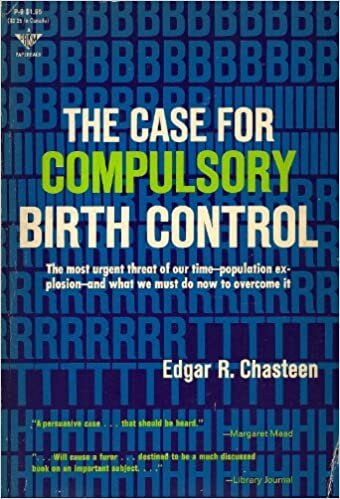
In the deep, dark corners of the Southern Baptist Convention’s theological past is a sociologist who taught at a Missouri State Convention affiliated college, wrote for the Christian Life Commission (the precursor to the ERLC), and advocated for abortion, forced sterilization, and legal penalties for exceeding an approved number of children. Since that point, his college disassociated from their denomination and Chasteen went on to form a non-profit organization dedicated to affirming the equal validity of all religions. Just how Baptist or even Christian Chasteen is or ever was is up for debate. There is little in his 1971 book or his various websites that can connects him to anything like Christian orthodoxy.

The thesis of Chasteen’s book is “that unless we act now to legislate a limit of two children per family, we have little hope of solving the other problems that beset us.” (vii) That problem Chasteen describe as an insidious disease: “The cancer of runaway population growth has eaten away both heart and soul of the body politic. We are on the verge of anarchy with only our will to survive and our determination to act staying our fall.” (33)

For Chasteen, every problem was driven by overpopulation. He writes, “If, as a nation and as individuals, we can summon the intelligence and the courage to bring population growth under control, we will find ourselves still faced with problems of race relations, crime, alienation, apathy, environmental degradation, and so forth, but with one big difference. The problems will then be capable of solution, whereas now they are not.” (33)

Chasteen echoes Paul Ehrlich’s popular book, The Population Bomb, in his concern for the growing number of individuals on the planet. His book, The Case for Compulsory Birth Control, was written while the Rockefeller commission was composing their report, which was commission and subsequently rejected by Nixon. Like Chasteen, the Rockefeller commission affirmed eugenic policies, widespread birth control funded by the government, and the expansion of access to abortion. Unlike Chasteen, the Rockefeller Commission only advocated for voluntary sterilization.

The entire tenor of Chasteen’s book is anti-human. He expresses concerns that “Death rates in the industrializing nations began to drop while birth rates remained at their previously high levels.” (25) Which leads to complaints that Americans shared medical technology with developing nations with a false sense of compassion and without permission.

Argues Chasteen:

“America has shared its medicines with the world, thinking that by doing so it was saving millions of people from early death, and so it was. . . . [However,] we were operating on a foundation of mistaken morality which made keeping people alive and end in itself. We inoculated, immunized and sprayed, and we felt good about our actions. . . . Motivated by benevolent ignorance of social forces and human desires, America played unintentional havoc with the destinies of nations and peoples. . . . In some parts of the world death rates were cut in half in only a decade, and sometimes without the consent or knowledge of the governments affected.” (26–27)

There is more, but it does not get much better.

At the root of Chasteen’s ethics is an individualistic, subjectivistic presumption: “An action is moral only when prompted or hindered by what is right as defined by the individual conscience.” (187)

In light of that naked assertion, Chasteen argues, “What this means is that a new rationale for sexual responsibility and exclusiveness is needed.” (187)

Chasteen demonstrates a full-throated adoption of the sexual revolution:

“Contraceptive technology has made it possible to separate sexual intercourse from conception, making it possible (and necessary) for us to rethink the philosophy of sex worked out before contraception. A very simple formula can be stated:

coitus – contraception = procreation

coitus + contraception = expression” (184)

He celebrates the individualism and autonomy of human sexuality because sex became disassociated from procreation, so that a woman on chemical birth control “can express her sexuality as she expresses her opinion––because of the meaning it has for her as an individual.” (184) He makes a similar argument for males who have had vasectomies.

Chasteen makes clear what contraception has done for sexual ethics in contemporary society:

“Contraception makes it possible to view sex as voluntary, interpersonal behavior rather than a necessary act of survival. Sex becomes a special method of communication between male and female. Sex thus loses its exclusively biological meaning and becomes more social. Like all social relationships, sex can be made constructive or destructive, depending upon the attitude and behavior of those involved. Sex can become a dialogue between two people in which comes to understand and appreciate the other. It can be an expression of the mutual dependence to human existence. Sex can be an enriching and compassionate human encounter or simply another opportunity for exploitation, satisfying a biological urge but destroying humanity socially and spiritually. It’s up to us.” (189)

There are a lot of strands to unwind in Chasteen’s writing on the subject, but he makes explicit the arguments that are assumed in our culture regarding the purpose of sex. The autonomous self is the champion of Chasteen’s moral vision, with no reference to the Christian faith, historical or otherwise. It is the individual alone who determines what is right. (A belief that undermines Chasteen’s plea that his perspective is the correct one, but whatever.)

Several lessons can be gleaned from reading books like Chasteen’s, The Case for Compulsory Birth Control.

1.       There were good reasons for the Conservative Resurgence in the Southern Baptist Convention. Chasteen advocates for multiple anti-Christian positions that are untenable with anyone remotely committed with the content of Scripture. The convention had to rid itself of the cancer of those like Chasteen to survive as a gospel-focused entity.

2.       The population control movement, which is now growing because of concerns over climate change, has its roots in a dark movement that has to find a way to mourn the decrease in suffering due to premature death. It has not, as far as I can tell, found a way to do so, it has simply tended to skip over the assumption that it would be better if the superfluous people didn’t survive past their age of usefulness.

3.       Beware people who see one big social problem as the key to all other problems. A big idea like overpopulation, systemic racism, or climate change can be used as a way to blind listeners to the moral evil being proposed on one front for the perceived good result on another. Society is complicated. Solving climate change won’t fix poverty. Eliminating systemic racism won’t reduce our carbon footprint. Limiting population growth will not eliminate crime. It is impossible to attain a good society through persistent evil.

Dignity for Back Row America

God created humans in his own image. (Gen 1:26–27) There is a great deal of honor and dignity that comes with that blessing. We all subconsciously recognize our status as made in the image of God, which gives everyone an innate desire for dignity.

In 2019, former Wall Street trader, Chris Arnade, left his day job to photograph and interview people from what he calls “Back Row America.” This group includes individuals on the political left and right, but who have all been effectively left behind by polite society and the economy.

Arnade’s journeys took him across the United States to areas with mixed histories, ethnicities, and economic struggles. As he notes in his introduction:

“What they had in common was that all were poor and rarely considered or talked about beyond being a place of problems. All had been described as left behind, despite some, like Hunts point, being adjacent to rich and successful neighborhoods. Residents growing up in these communities faces immense structural obstacles, and some, like minority neighborhoods, had for a very long time.

Despite their differences––black, white, Hispanic, rural, urban–they were all similar to Hunts Point in one important way: despite being stigmatized, ignored, and made fun of, most of the people I met were fighting to maintain dignity.

They feel disrespected––and with good reason. My circles, the bankers, business people, and the politicians they supported had created a world where McDonald’s was often one of the only restaurant options––and we make fun of them for going there.”

And if you’re reading this, you (like me) probably fall into the category who have fallen into unfounded assumptions about people and ignorant attitudes toward them because they looked down and out, were at a McDonalds, especially if they were a bit loud or out of place in public. Very few middle class and up individuals are exempt from having experienced this in themselves.

Dignity is a raw look at the desire for respect. It’s a reminder that everyone has a story. There was a commercial that ran when I was a kid during the height of the drug wars. It reminded the audience that “no one wants to be a junkie when they grow up.” The message was clear: if you use drugs, you are a loser and the way you get there is by making bad choices.

There is some validity in that argument, but it fails to take into account social and cultural pressures. It neglects the influence that the frustrations about systems that are designed for people with resources.

Think about how it is nearly impossible to apply for a job without a home address. Or consider what it is like to fill out a background check application when you’ve bounced from apartment to shelter to relatives’ homes for the past three years. Furthermore, ponder what it must be like not to have a working smart phone, tablet, or computing device in a timeframe when apps, websites, and email are primary means of communication. There are many people who live close to the line of success and failure, where a blown-out tire, a medical problem, or a couple of mistakes between paydays can start ripples that spread into disfunction. Eventually, the comfort of a drug-induced high can seem like a blessing that takes away the pain and stress for a little while. It doesn’t make anything better, but it can make someone feel better for a little while.

dignity.jpg

Arnade reminds us that the person who has fallen into the hole of addiction may not have known anything different or may have been set on the path by a personal disaster. They are worth respect. They deserve dignity. They are made in the image of God.

There are unhealthy aspects of this book. Arnade admits that his involvement in the night life of the streets contributed to his own drug issues and problems within his family. There is also a level of voyeurism in reading the accounts of prostitutes, drag queens, dealers, unemployed, and underemployed. If voyeurism can be justified, at least Arnade’s Dignity carries out the purpose of reminding readers that the weathered, bedraggled, odd-behaving individuals we often avoid in public are people, made in the image of God who have stories, hopes, dreams, and a desire to be recognized for the goodness of being human.

Dignity should help remind readers that the unwashed “other” are not a problem to be dealt with, but people to be engaged with as worthy of respect and honor. As well, Arnade issues a warning that the same group is not a social project that exists to make the middle class feel good about their beneficence. There aren’t a lot of particular solutions in Dignity, but recognizing the inherent value of those on the edge of society is a big step toward spanning some of the fissures in our divided country.

The End of Our Exploring - A Review

If what I see on social media is to be believed, all the cool kids are deconstructing the faith of their childhood. It’s all the rage, but it’s not really a new thing.

For some, kissing dating goodbye was a traumatic experience, though for many of the most vocal critics, I suspect Josh Harris’s book provided a solution to a problem they only wish they had. Nevertheless, the experience turned too much for Harris’s faith, as he has recently abandoned Christianity and begun selling “deconstruction kits” along with a series of webinars for $275.

Other deconstruction workers are less entrepreneurial, but there is a steady stream of people who were once overt, professional Christians who have transitioned to making money off of deconverting and encouraging other people to do the same.

One response to the deconstruction/deconversion movement is to provide answers to the cultural defeaters of the day. Standard apologetics books like Lee Strobel’s Case for Christ or Josh McDowell’s More than a Carpenter provide helpful aids to those with general struggles regarding particular questions about Christianity. Other books like Tim Keller’s The Reason for God and Making Sense of God tend to focus on bigger picture problems and defeaters. Recently books like Alisa Childers’s Another Gospel? tell the story of starting down the path of deconstruction and ending back a Jesus. These assume that someone is either outside of Christianity looking in or already down the road of deconversion and need pulling back. It is a helpful approach for many.

But what about those that stand on the fuzzy border between faith and doubt and wonder which way to turn?

end of.jpg

Matthew Lee Anderson’s 2013 book, The End of Our Exploring: A Book About Questioning and the Confidence of Faith, provides a helpful resource for those with questions or who want to create a space for legitimate questions within the faith community.

Anderson is a pastor’s kid who was (by his own confession) the insufferable know-it-all who was too cocksure to ask good questions or hear good answers. He has come a long way, and this book can help readers make significant progress without some of the awkward relationships.

The book begins by exploring the nature of questioning, identifying that many questions are not good questions because they presuppose an answer. They key message is that good questions can be helpful as we seek to recalibrate our faith—knocking off the pieces inconsistent with Scripture and keeping the parts that fit with an integrated biblical understanding––but most people are not well-equipped to ask good questions.

Anderson goes on to note that our information economy that values data rather than wisdom contributes to shallowness of discourse. So does the shallowness with which much of the Christian community in the West actually holds their Christian convictions. The result is that young people often either fail to ask good questions or encounter hostility when questions are asked.

Questioning is viewed as dangerous in some churches because too few people know the answers. In some churches, questioning is taboo because it leads to the uncovering of inconsistencies between faith and practice. Sometimes questioning is unwelcome because the people being questioned have the same questions, fear they are wrong, but are clinging to faith in the face of that prospect.

Some see questioning as an act of faithlessness, but Anderson shows how good questioning can be a catalyst for a deeper faith, because there are valid answers to the hardest questions that can be tossed at Christianity. The End of Our Exploring explains why that is so and also helps the reader begin to formulate better questions.

As a parent of children who “know all the answers” because we have spent a lot of time on discipleship, I find Anderson’s faithful but open approach to questioning helpful. This is a book that I will have my children read toward the end of high school. Sometimes it is frightening that my kids have the ready answers to theological questions. I worry that they have borrowed my authority, as it were, because they have seen me teach through an abbreviated systematic theology, several books of the Bible, and other topical lessons. They know that I have read the books and explored the questions, but it is important that they do some of their own exploring, too.

The way that Anderson encourages exploring is critical to the outcome achieved. The nature of this exploring is clear from the title of the book, which comes from a T. S. Eliot poem:

And the end of all our exploring
Will be to arrive where we started
And know the place for the first time.

That perspective marks the fundamental difference between faithful questioning and deconstructing. When people deconstruct they are seeking to tear down because they’ve already decided the thing is wrong. Anderson’s questioning and exploring is an attempt to know the truth better. It does not presuppose the truth, as if the conclusion is foregone and the exploration is simply a sowing of wild oats, but it does not begin from a posture of skepticism and caustic disbelief.

 The End of Our Exploring is a warm, personal book. It is thoughtful, rigorous, and challenging. Above all, it is helpful as I continue my exploring and seek to point other explorers toward a deeper understanding of truth.

Why Doesn't Everyone in the SBC Simply Reject CRT Openly?

In the tribal warfare of the internet age one of the hot disputes is over Critical Race Theory (CRT). In my own circle—evangelical Christians in general and Southern Baptists in particular—the fire of war over CRT is hot, though little light has been produced.

In this brief post I will tackle the simple, but repeated question, “Why doesn’t everyone within the SBC simply reject CRT openly?”

The answer to that question seems relatively simple and obvious to me. However, since people don’t seem to see it, I am going to try to explain it without getting myself caught in the blaze of controversy.

What is CRT?

The heart of the debate over CRT should be the definition of CRT. The problem with the debate is there are many definitions of CRT. I will list two of the edge definitions, but there are a million shades between.

Some proponents define CRT as method of studying the outcome of racially biased laws and cultural trends that have had and continue to have a disparate impact on ethnic groups. That is what proponents like Delgado set out to expose. It’s simply the attempt to ask the question, “How have laws intentionally or unintentionally led to poorer outcomes for ethnic minorities?” or “How has race (or ethnicity) impacted social outcomes and why?” Let’s call this “CRT A”.

To others, CRT is the process of explaining why contemporary American Whites are uniquely responsible for current ethnic disparities and ought to continually repent of their privilege that explains the majority of their positive outcomes. To be White is to be tainted. One must repent of being White. Capitalism is White. Western Culture is White. Being White is bad, therefore we must adopt Socialism, reject classical literature, and continually repent of being born White or supporting Whiteness (even if we aren’t actually ethnically Caucasian). This is a caricature of many versions of CRT, but the internet will reveal enough cases of people who say they are advocating CRT proclaiming these things that we need not exclude them from the discussion. Let’s call this “CRT Z”.

One need not agree with either of these definitions to accept that there are people who describe their position as CRT that hold to them. In other words, neither of these may be “true CRT,” but there are proponents of “CRT” that argue these positions.

Recognizing the Difference

It doesn’t take a genius to see that there is a world of different between the first definition and the second. It also does not take much discernment to accept that the first approach may frame a legitimate (even if not correct) mode of inquiry, while the second is another form of racism.

There is, in short, terminological confusion.

Sometimes this confusion is used by the intelligentsia in a Motte and Bailey approach, where they throw out some controversial racial analysis or critique of that analysis and retreat to the safer ground of their polar definition when challenged. Sometimes, I think, people discussing CRT have read so narrowly (not to say they haven’t read extensively) that they legitimately haven’t encountered another perspective or one that represents the harmful extremes. Or, in other cases, they have granted too much grace to “their side” of the debate that they don’t see the encroachment into the unreasonable.

At the very least, as we think about the issue, we should recognize that definitions are the key. CRT is not monolithic, so we should seek to understand before we argue.

Why Not Just Reject the Term?

After the messengers of the Southern Baptist Convention affirmed Resolution 2, On the Sufficiency of Scripture for Race and Racial Reconciliation, there has been an outcry in some subsections of the SBC that the statement does not include a clear rejection of “CRT.”

The statement itself is sound, biblical, and resonates with the various statements on race and racial reconciliation that the SBC has adopted in the past. For those that care to read it, it quickly becomes clear that “CRT Z” and many variants on that side of the spectrum are out of bounds based on that description.

The complaint among some is that “CRT A” is not as clearly anathematized by the statement. Therefore, when individuals ask questions like, “How has race (or ethnicity) been used unjustly in society or resulted in unjust outcomes?”, it is not clearly out of bounds. Of course, it is also not clear that someone asking such a basic question about race (or ethnicity) is necessarily reliant upon the tenets of CRT.

“That Sounds Like CRT”

And that is exactly the reason why it was good to issue Resolution 2 without an explicit rejection of CRT.

In some corners of the internet, it has become increasingly common to argue that any analysis of society, data, or theology that includes a consideration of race or ethnicity is a form of CRT. This is, whether intentional or not, an error that conflates the problems of “CRT Z” with any discussion of race or ethnicity, or its lingering effects.

In opposition to these discussions, some have absolutized statements like Paul’s Galatians 3:28 (There is neither Jew nor Greek, there is neither slave nor free, there is no male and female, for you are all one in Christ Jesus), arguing that it means that there should be absolutely no consideration of differences created by or resulting from race or ethnicity. However, Paul wasn’t arguing that those categories did not exist (otherwise why did he differentiate the circumcised from the uncircumcised in Col 4), but that they should not impact unity in the body of Christ.

It would be funny if it were not so painful, but some of those most vocal about using Gal 3:28 to outlaw any discussion of racial (or ethnic) differences are also the most careful to differentiate the roles of men and women in the church. To be logically consistent, if Galatians 3:28 means that we can never talk about racial disparities in the church, then those that hold that position should not recognize a different function in the church between men and women. In other words, they should be willing to accept female pastors. Most often they do not. That would reflect a consistent, though incorrect, application of Gal 3:28.

Because there are longstanding social impacts due to race—one need only look at the existence of distinct African-American denominations (which were largely formed in response to overt racism in predominately white denominations)––some critics paint any theological or social analysis that recognizes the actual differences related to race (or ethnicity) as a form of CRT, whether or not the accused has any knowledge of or intent to use CRT.

The existence of real and obvious racial (or ethnic) differences means that there are times that examining those differences is necessary and warranted.

The Bigger Problem

The bigger problem with the CRT debate, and a reason why we should not try to anathemize “CRT” wholesale, is that the some of the loudest voices against “CRT” are also the ones who argue that any analysis that includes racial (or ethnic) differences are using “CRT,” whether any form of actual CRT is actually in play. Often, it seems that these accusations are made more on political grounds (i.e., someone supports a different economic or social policy) than on the basis of careful understanding of the ideas under discussion.

Let me simplify: The logic of some of the loudest anti-“CRT” argumentation goes like this:

1.       CRT is a form of analysis that considers racial (or ethnic) disparities.

2.       Scholar or pastor X has cited analysis or made a declaration that takes into account racial (or ethnic) disparities.

3.       Therefore, scholar or pastor X advocates for CRT.

Anyone who has taken basic logic will recognize the problems with this line of reasoning.

Unless ALL discussions that take into account racial (or ethnic) disparities are CRT, then the logic doesn’t follow. And even that logic is based on the assumption that all versions of CRT are irredeemably bad (or at best unhelpful) and inconsistent with the gospel. Some argue that “CRT A” and some similar versions are relatively benign and may actually help illuminate the current situation, but that is a different discussion for a different day. However, it shouldn’t be impossible for us to imagine that an individual may recognize that “CRT Z” is bad, while still being able to glean something of value from “CRT A” even if, in the end, the individual rejects the policy proposals of those who use “CRT A.”

It’s also possible to ask questions similar to those who use and advocate for “CRT A” and yet not be dependent upon their ideas. Simply because one things sounds similar to another does not mean those things are the same.

Sometimes arguments about who is “using CRT” play out in these obvious terms, but often it is more subtle. And yet, many of the attempts to combat “CRT” among inerrantist evangelicals amounts to:

a.       That individual used language or addressed a concept that could be associated with CRT.

b.       Therefore, that individual advocates for CRT.

c.       CRT is bad.

d.       Therefore, that individual must be ridiculed and abused publicly and, if possible, fired.

If we’re being honest, we’ll recognize this pattern. It isn’t universal, but it is fairly common. And, if we’re being serious about being thoughtful, we’ll recognize why it isn’t helpful.

We should also recognize statements that absolutize rejections of “CRT” are a tool for vocal groups within our communities to prevent discussion about important issues, because once the accusation is made that someone is advocating “CRT,” whether true or not, then the person will be forced to defend themselves or risk losing their job. There is an element of McCarthyism to the whole situation.

Conclusion

I set out to answer the question, “Why doesn’t everyone within the SBC simply reject CRT openly?”

There is no question that more discussion is needed, but I think I’ve begun to explain why absolute statements on CRT are unhelpful, especially when “CRT” means radically different things to different people and that, for some people, simply raising questions about race lead to accusations of “CRT.” The kind of pseudo-thoughtful analysis that has replaced honest engagement with ideas, especially around concepts like “social justice” and “CRT,” is not helpful.

Significantly when some voices assume CRT is at the root of any discussion of race (or ethnicity) that arrives at different conclusions than those of another group, we have a problem. Additionally, if the simple recognition that one’s cultural background shapes one’s understanding of a context is a version of CRT, then it is an unhelpful label.

Since the label “CRT” is so ambiguous, it is better to identify the aspects of “CRT” that are objectionable and explain why they are inconsistent with Scripture. Then we can all examine the statements of scholars and pastors in comparison to those tenets and argue against objectionable content rather than making accusations of things that “sound like” or “are not sufficiently opposed to” whatever “CRT” is in the mind of this or that cultural commentator. Based on the statement of those on the SBC resolution committee, this sort of action—to make clear what is inconsistent with biblical orthodoxy—is exactly what was being attempted with Resolution 2.

Will this scratch the itch of the culture warrior? No, but usually they live for the denunciation and the battle rather than the truth. But for those that are being honest and careful in their pursuit of truth, statements like Resolution 2 are a step forward in identifying the guardrails for civil discussion.

Why We Can Trust the New Testament

1788551199_34f2dc9d45_z.jpg

Without a doubt, there have been times within human history when it has been difficult to get access to high quality resources about important topics created by experts. People used to have to go to universities or ticketed events to get access to the experts.

The internet has, of course, changed that. Not only has it provided us easy access to an endless supply of cat videos, but it has also provided opportunities to get easy access to legitimate experts with a few clicks and the right key words.

The problem with this free and open information society is that it can be hard to differentiate the hacks from the heroes. In some cases, the hacks make videos with better production value, which makes them seem more authoritative, even as they are really ignorant.

The Trustworthiness of the New Testament Text

The actual point of this post is not to discuss the media ecology of the internet, however, but to provide some resources on the text of the New Testament and its trustworthiness.

One of the main challenges raised to belief in Christianity is the trustworthiness of manuscripts of the New Testament. The accusation leveled against the Bible is that we cannot really know what the New Testament teaches because of variations in the available manuscripts. Daniel Wallace has dealt with that very effectively.

The Reliability of the Gospels

Another significant question is why there are differences between the various Gospels. In a lecture, Mike Licona helps explain the genre of the Gospels, the literary conventions of the day, and why we can trust the Gospels as authentic and faithful, even when they don’t match modern standards of documentation.

Peter Williams presents another approach to the reliability of the Gospels that deals less with the literary attributes and focuses on the content of the Gospels. This is a complementary perspective to the one that Licona presents.

The Formation of the Canon

Also significant is how the canon of the New Testament was formed. Some critics like to claim that a power struggle between church leaders led to certain books of equal value and authority being excluded from the canon, so that we should be just as open to the truthfulness of the Gospel of Thomas as we are to the canonical gospels. Michael Kruger helps dispel that notion.

Conclusion

These men are each expert in their field and respected in their academic disciplines, even among those who do not agree with their theological conclusions, because they have demonstrated proficiency in their discipline. That we live in an age where such resources are readily available is amazing. That we often fail to take advantage of this level of expertise is a shame. Taking a few hours to watch these videos (even with your family) would be an excellent means of discipleship for yourself and your family.

Eschatological Discipleship - A Review

Trevin Wax is one of the most incisive cultural commentators in the evangelical community. He has a talent for moving past pearl clutching about trends in pop culture by asking foundational questions about the ideas that animate to moral activity in entertainment and society. His 2018 book, Eschatological Discipleship is an overt presentation of the theological analysis that is evident in the background of Wax’s popular books and blogs.

81PIcNrSKoL-200x300.jpg

Eschatology is the oft neglected and frequently abused topic in Christian systematic theologies. As Wax notes, discussions of the end times in seminary courses tend to be stuck on the end of the course syllabus and often are the first to get axed when discussions of soteriology and ecclesiology run long at the beginning of the semester. More often, the term eschatology is understood to mean endless debate about the nature and timing of the rapture, the intrigue of the mark of the beast, and various theories on the millennium.

This book gets beyond the most common pitfalls of eschatological debate to focus on the core issue of eschatology as it is woven throughout Scripture. In particular, Wax emphasizes the idea of eschatology as a source for telos; it is the theological topic that provides the best evidence for the meaning of life. In other words, eschatology is not primarily about charts and timing, but about providing a lodestar of eternal purpose to navigate life in ever-changing times.

In Eschatological Discipleship: Leading Christians to Understand their Historical and Cultural Context, Wax does something few treatments of the topic do: he offers an analysis of the eschatologies of worldviews that compete with Christianity. His analysis of the eschatology of the Enlightenment, the Sexual Revolution, and Consumerism are unique in their revelation of the unspoken, but evident meaning encoded in those rival systems of meaning. This book provides a framework for discussing the often-obscured theologies of those movements.

Wax begins the book with a chapter defining the term eschatological discipleship. He argues, “eschatological discipleship is spiritual formation that seeks to instill wisdom regarding the contemporary setting in which Christians find themselves (in contrast to rival conceptions of time and progress) and that calls for contextualized obedience as a demonstration of the Christian belief that the biblical account of the world’s past, present, and future is true.” (p. 41) This definition makes clear Wax’s aim, which is to present a theological argument that unquestionably leads to obedience.

In three chapters, Wax presents a biblical theology of eschatological discipleship, beginning with the Old Testament, then focusing on the Gospels and Acts, and concluding with a survey of the topic in Paul’s letters. It becomes evident through this survey that all of Scripture encourages Christians to ask, “What time is it?”, so they can understand their culture and how they should live in their particular context to the glory of God.

Chapter Five presents the idea of eschatology within non-Christian thought, which leads the way into the helpful analysis of the next three chapters. In the sixth through eighth chapters of the book, Wax performs a critical analysis of the eschatology of the Enlightenment, the Sexual Revolution, and Consumerism, which all compete with Scripture to dominate the worldviews of Christians in our age. In the final chapter, Wax shows how his presentation of eschatological discipleship can enhance the practice of evangelical theology and equip every church member to better respond to the confused theologies around them.

Trevin Wax is one of the most gifted writers among evangelicals. This academic book is no exception. The prose is clear and the arguments careful. He manages to raise concern about the real problems within the dominant culture of the West without calling for withdrawal or reflexive combativeness. Eschatological Discipleship is a specimen of Christian scholarship in its most helpful form: theologically precise and readable.

Those who have read other books by Wax will likely see the connection between another of his recent books, This is Our TimeEveryday Myths in Light of the Gospel, and this volume. Eschatological Discipleship makes clear the theological framework that This is Our Time presents in a practical, popular format. The close connection between the two books offer an example for Christian scholars for how to translate scholarship for broad consumption and how to most efficiently steward their research by pitching their arguments to multiple audiences.

Eschatological Discipleship is a useful resource for pastors and scholars seeking to understand the contours of contemporary culture better. Theologically informed laity will likely find this book an accessible and informative volume, too. This is a book that will have enduring value for its analytical content and exemplary argumentation.

NOTE: This article was originally posted at the B&H Academic Blog, which has since been archived due to a change in strategy.

One Child - A Review

China’s one child policy offered promise of economic blessing, but has resulted in sociological disruption leading to economic problems, leaving trauma and tragedy in its wake. This is an example of a government trying to plan its way to prosperity.

In a 2012 book, One Child: The Story of China’s Most Radical Experiment, journalist Mei Fong explores the impacts of the technocratically-driven population policy instituted by China several decades ago.

One Child is an engaging book. Fong writes clearly, tells captivating stories, and systematically arranges the book in a way that makes it an enjoyable and informative read.

One of Fong’s main goals in writing One Child is to demonstrate that the infamous policy of Communist China is not the blessing that some have argued it to be. She writes,

“It took me a while to realize that, contrary to popular thinking, the one-child policy had very little to do with China’s double-digit economic growth of the past thirty years, and will actually be a drag for the next thirty.” (9)

Fong came to realize that people are both consumers and producers. Although she does not articulate the idea clearly in her book, it seems that she also recognizes that the economy is not a pie of a fixed size. That is, having more productive citizens does not mean that the same wealth must be distributed to more people more thinly. It means that more people will produce more wealth, which can be available to many people. The economy is not a zero-sum game.

download (1).jfif

The tragedy of the one-child policy is manifold. Fong notes that the policy has created a class of non-citizens in China who, because they were the extra child born over the limit, cannot be registered and cannot get health care, an education, or jobs. They are the hei haizi, “black children,” undocumented and ignored.

One of the more frightening aspects of the one-child policy has been the eugenic emphasis. Fong argues, “Chinese authorities were never shy about stating this aim of the one-child policy: fewer births, higher-quality births.” (28) The right people should be able to procreate to create the right sort of citizen. The result of such policies is always horrific abuse of human rights.

Fong tells the story of one factory worker pregnant with her second child. She believed she was qualified for an exemption, but the local officials disagreed. They demanded an exorbitant fine, which her family could not pay, and was subsequently forced to have an abortion. Fong writes,

“Feng, meanwhile, was made to sign an agreement she voluntarily consented to the abortion. On June 2, she was injected with a substance to kill the fetus. She later said, ‘I could feel the baby jumping around inside me all the time, but then she went still.’” (61)

Furthermore, “In some parts of the country, pregnant women without birth permits were marched off in handcuffs to undergo forced abortions.” (70) In the 1990’s, the policy expanded to punish behaviors that could be more or less linked to unsanctioned births, “Women were fined for living with a man out of wedlock; for not using contraception, even if it didn’t lead to pregnancy; or simply for not attending regular pregnancy checkups. In Jiangsu, women had to line up twice monthly for pregnancy tests and publicly pee in cups.” (73)

Contributing to this, there was “a wage incentive for birth-planning officials, which was tied to how many sterilizations and abortions they were able to achieve. . . . [According to one former official,] ‘Some girls were forced to get surgeries even though they weren’t pregnant at all.’” (75]

The enforced abortion regime is one of the most horrific aspects of the policy that Fong records. Interestingly, she herself is a proponent of abortion and considered terminating her first pregnancy, which later ended in miscarriage, which only makes the horror of her stories more apparent.

The sociological impacts of the one-child are also striking. Fong details how combining one-child policies with a culture that expects children to take care of their parents puts extreme pressure on children to get into lucrative careers so they and their spouse can support their own child plus up to four parents and, potentially, grandparents as well. The emotional burden on the child who fears failing a test and being forced into factory work is obvious.

China has also instituted minimum ages for marriage. A man cannot get married before he is 22 and a woman before 20. But if school is not complete and a career not established, then marriage will logically be delayed. Subsequently, the age of marriage goes up and the window of fertility shrinks. The result is increasing infertility, which is making it more difficult for some workers to conceive and bear even the quota of children they are allowed.

Fong’s book is a helpful exposé of the regime in China. It is a reminder that government tinkering in families and biology are often ill-fated, even when they have positive motives. It is also a reminder of the horror of abortion that underlies many zero population growth or other population control movements. These are consistently pitched as “voluntary,” but once the government steps in “volunteerism” often shifts to coercion. People should be careful what they wish for.

Are Ethics More Important than Theology?

Why do some Christians love theology more than people? After all, from an eternal perspective, people matter more than ideas. It does not matter what you believe as long as you are doing good things in the world. Some people who do not even believe in Jesus are better Jesus-followers than Christians—these people are the real Kingdom of God.

12347402345_6dd2abfc2f_z.jpg

If you read progressive Christian blogs or follow left-leaning Christian pundits on social media, you will have likely heard some of the assertions in the previous paragraph. Some form of them is repeated often enough to be recognizable at a glance.

The basic claim of those who make these claims is that practical Christian ethics is the heart of Christianity, while Christian theology is mere speculation about things that are largely unknown and mostly unknowable. Ethics is reality; theology is speculation. Therefore, ethics is more important than theology.

As a Christian ethicist, I heartily affirm the importance of Christian ethics. However, faithful Christian ethics presupposes a foundation of orthodox Christian doctrine. An authentically Christian ethics is the superstructure on a foundation of an orthodox, biblical theology. We cannot do ethics apart from theology.

In her excellent essay “Creed or Chaos?” Dorothy L. Sayers argues,

It is worse than useless for Christians to talk about the importance of Christian morality unless they are prepared to take their stand upon the fundamentals of Christian theology.

She goes on to explain that Christian morality without a doctrinal foundation quickly becomes humanism, which eventually fails to motivate right action.

Doctrine is the very heart of ethics. Unless you believe the right things, there is little hope that you will do the right things. If someone does not believe that humans have inherent value, they are unlikely seek to relieve their suffering or may justify doing harm while calling it good. Proper concern for the wellbeing of other humans is not self-generated; it arises from an anthropology that values people as made in the image of God. When anthropology fails, so does true compassion for other humans.

For example, movements that advocate for voluntary euthanasia are often couched in terms of individual autonomy and alleviation of suffering. Assisting in the suicide deaths of the old and the infirm is ethical if your anthropology presumes that humans have a right to self-determination and that human suffering is purposeless. A deep theological sentiment lies behind a pro-euthanasia ethic. Ethics springs from a foundation of those doctrines that are believed.

Jesus is clear about belief being the basis for human action. Luke records him explaining the relationship between the act of speech and the beliefs of the heart: “A good man produces good out of the good storeroom of his heart. An evil man produces evil out of the evil storeroom, for his mouth speaks from the overflow of the heart” (Luke 6:45, HCSB). Bad beliefs will lead to bad character, which will lead to bad actions.

Those who seek to affirm ethics over theology are wrong to diminish the importance of doctrine. However, a fairer critique could, at times, be that theologically sound Christians sometimes fail to live out the ethics that are demanded by their theology. Such was Carl F. H. Henry’s criticism of early evangelicalism.

The core theme of Henry’s brief volume The Uneasy Conscience of Modern Fundamentalism is that doctrinally orthodox evangelicals (i.e., those who held to the fundamentals of the faith) often fell into the trap of repudiating social ethics simply because social activism was associated with modernist, theologically liberal Christians. This led faithful and theologically sound Christians to reject just action to mitigate harms, though those actions would have occurred in ways that were consistent with and even demanded by a doctrine faithful to Scripture. Such failures, Henry argued, caused early evangelicals to have an uneasy conscience.

Henry’s indictment of his own theological tribe should come as no surprise, since Jesus’ words about the overflow of the heart are followed immediately by a sharp rebuke of those who have a proper faith, but fail to act on it (Luke 6:46-49). Or, in perhaps the most misunderstood verse in Scripture, James 2:14-17 reminds Christians that faith that does not lead to ethical application is dead.

The problem in these situations is not that people were concerned about right doctrine, but that they failed to act upon it. Perhaps they understood the theological propositions, but did not have a living faith to drive them to live the ethical implications of those doctrines. These critiques are reasonable. However, the assertion that doctrine is unimportant is untenable.

The assertion “ethics matters but doctrine does not” requires a presumption that theology is abstract while action is concrete. Nothing could be further from the truth. Ethics is abstract to the extent that even our good actions are tainted by sinful motivations and have unknown consequences. Theology—the study of God and his works—is concrete inasmuch as its object is known and knowable. Orthodox doctrines are not arbitrary constructions that satisfy the desire for completeness and intellectual attainment of theologians and exegetes. Most theology is done in the crucible of real-life concerns in an attempt to discern what is right and godly, which is the only possible foundation for a Christian ethics. Again, Sayers is helpful as she describes the formulation of doctrine:

Dogmas are not a set of arbitrary regulations invented a priori by a committee of theologians enjoying a bout of all-in dialectical wrestling. Most of them were hammered out under pressure of urgent practical necessity to provide an answer to heresy.

This is no less true about the doctrines that undergird human sexual ethics than it is about teachings that deal with Christology. The church has often had to specifically codify previously assumed or unconsidered doctrines in the face of innovative challenges that threaten to undermine the doctrinal core of Christianity. This does not represent a failure to love the people who hold faulty doctrine: it is a sign of faithfulness to the one who calls Christians to love people. Paul’s admonishment is to speak truth in love, not to reject truth in the name of love (cf. Eph. 4:15).

Christians would do well to live out their faith. They would also do well to ponder Jude’s words to the church, which include a call to contend for the faith—the sound doctrine—that was given to the saints because those who rejected those teachings led others to practice bad ethics (Jude 3-4). Christianity is not merely about right doctrine, but orthodoxy cannot be rejected without a grave cost to ethics.

NOTE: This article was previously posted at the B&H Academic Blog, which has since been archived due to a change in media strategy.

My Tech-Wise Life - A Review

It’s one thing to argue that a plan like the one Andy Crouch outlines in Tech-Wise Family would work. It’s another thing entirely to find out how the people who participated in the plan felt about it. The 2020 book, My Tech-Wise Life, which was co-authored by Amy Crouch (Andy’s daughter) and Andy Crouch provides a portal into one teenager’s thoughts on her family’s approach to technology.

download (46).jpg

Amy Crouch is a student at Cornell University. As she describes herself in this book, she is not an exceptional being in the ways that our world often describes it. She is not a social media influencer with her own cable TV show, she has not won Olympic Gold, she has not developed a new technology that will end malaria in the world. However, at the age of 19, she did complete a manuscript for this volume. This is someone who may not be extraordinary in the conventional sense, but is the sort of person that I’d like to hear from about how a method of navigating the distractions of our tech-saturated world can come through and be the sort of college freshman that can write a good book.

This is a short book, but a helpful one for this particular moment. In eight chapters, Amy explains why her family’s conscious, tech-minimal lifestyle was a good thing. Each chapter is accompanied by a letter of response from Andy Crouch, Amy’s father. In Chapter One, Amy begins by demonstrating how social media can make us feel inadequate through comparison. A casual photo highlights our imperfections, which can make our image-infatuated minds dwell on negative self-perceptions. The answer that Amy provides is not to revel in self-love and post more ugly pictures on purpose, but to recognize the limitations of technology, keep tech in check, and focus on real life relationships. In the second chapter the topic is distraction. Anyone who writes knows how easy it is to get sucked into the cycle of clicking through social media platforms, email, and anything but the task at hand. Those who get notifications will find their phones constantly buzzing, drawing them away from essential tasks. The result is a harried life of distraction and unproductivity, which if started at a young age can set up patterns that undermine a teen’s future. Amy’s answer is to take control, limit apps, take media fasts, and keep the main things the main thing. This is enabled by a family structure than supports, encourages, and, when necessary, enforces such discipline.

Chapter Three wrestles with the question of connection and isolation. She discusses strategies to use technologies to connect rather than isolate. This begins by recognizing how easy it is for our portable entertainment devices to keep us isolated and treasure the connection. Social media is a fine garnish, but our goal should be a life off-grid. The secret to getting there is recognition of which has the greater value. In the fourth chapter, the topic shifts to the problem of secrets, privacy, and the digital age. Amy’s emphasis in this chapter is the problem of porn, which is distorting self-perceptions, expectations about sex, and relationships. Additionally, she talks about how the prospect of secrecy or anonymity can enable negative behaviors. Amy recognizes the good of privacy, but also that it is a limited good, so that having parents who can help when you’ve been sucked into binge watching a fairly harmless, but not-particularly-valuable show can provide some direct feedback.

Chapter Five deals with the issue of lying online. This has been encouraged, in some cases, because of the age limits of apps like Facebook, so that 11-year-olds would claim to be 13 in order to get access. Now the realization that a million identities and faux accomplishments are only a few clicks away. The message here is that it isn’t worth it, your real friends will know the truth, so you are burning bridges by presenting a false front online. The sixth chapter tackles the topic of using technology to avoid boredom. Here Amy channels some of the wisdom of her father (the culture maker) to argue that boredom is a good thing and the source of creativity and greater community.

The topic opens in several earlier chapters, but Chapter Seven explores the issue of technologies replacing sleep time, especially among teens (who need more than most adults). The stats are inarguable. 24/7 access to phones and computers is taking away from the rest that kids (and adults) need to live healthy, cognitively balanced lives. Amy’s solution is to put boundaries on phones, keep them out of the bedroom, and practice Sabbath where minimal technology is available to distract from other activities. The final chapter is an exhortation to live in hope. Basically, we need not acquiesce to the negative influences of technology. We can, in fact, take control and have a more positive experience if we take control, set limits, and live in communities that encourage healthy limits to technology.

I commend both Andy Crouch’s book, The Tech-Wise Family, and the combined effort with his daughter, Amy, My Tech-Wise Life, to both individuals and families. My Tech-Wise Life is obviously marketed toward teens, but I found it to be refreshing and helpful in many ways. It serves to undermine the argument, which I have heard some parents make, that limiting access to technology is going to “make my kid angry for living like we’re Amish.” Amy shows that when the whole family tries to live a tech-wise life it can make for a much better experience.

This book is very important in the attention economy because it shows (rather than states) the possibility and promise of limitations to technology. Amy encourages asking why one should use a particular technology or platform, not merely how to get access to it. Though the applications will change faster and faster, the principals are the same.

If you are a parent, read The Tech-Wise Family and this book, too. If you are a youth pastor, buy copies to distribute to your students. If you are a pastor, read this book, buy copies to have on hand when you have families come in for counseling due to results of stress that a tech-harried life will cause. This book does not answer all questions or make detailed theological arguments, but it provides a way forward for one of the most pressing questions of our day.

NOTE: I made the decision to refer to Amy by her first name due to the fact that this was co-authored by her father, to simplify the language. Since there are distinct divisions between her work and her father’s the first name seemed the simplest way to make the differentiation.

The Story Retold - A Review

As Qoheleth warned his son, “There is no end to the making of many books, and much study wearies the body.” (Ecc 12:12b, CSB)

This may be said of publishing in our day and age, even of evangelical publishing, with more new books being pumped out than any person can possibly read. And yet, there are so many good books being published that it is difficult to let them pass by. Sadly, there are many engaging books that I never open the covers of. But the ones that I do find are often worth writing about.

One recent, good book that I’ve had opportunity to peruse is G. K. Beale’s and Benjamin Gladd’s volume, The Story Retold: A Biblical-Theological Introduction to the New Testament. The occasion of my reading this book is preparation of a New Testament survey for my daughter’s homeschool curriculum, but the benefit has extended well beyond that preparation.

download (45).jpg

In my library I have multiple whole-Bible and New Testament biblical theologies. I also have a handful of intro or survey texts for the New Testament. What need is there for yet another item in my home library on the same topic?

Need may be too strong a word here, but there is certainly benefit in owning this beautiful and rich book.

I was expecting another survey text with a little more theological thrust, but Beale and Gladd have gone well beyond that. This is a book that should be paired with a standard survey (they recommend Carson and Moo), because The Story Retold skips much of the standard authorship, dating, textual criticism information and jumps into what the text says, what it means, and how that relates to the rest of the canon of Scripture.

This book is deeper than a basic introduction, exploring the corners of significance and sometimes seeming more like a commentary than a survey text. In many cases, Gladd and Beale do a lot of work to show how a given book of the New Testament fits in with other New Testament books and especially Old Testament books. One of Beale’s major interests is temple imagery throughout the canon, so it is little surprise that shows up on a regular basis in this volume.

The Story Retold is a valuable resource in a Christian’s home library because it pushes the reader toward a deeper understanding of the whole message of Scripture. The “verse a day” mentality is demolished as the pieces are put together into a beautiful mosaic that reveals Christ as the central character of all of Scripture.

In addition to its helpful content, this volume is simply beautiful. It is printed on heavy, glossy paper with full color illustrations. The publishing team included artwork and illustrative photographs that enrich the text, not merely adorn it. The book is, itself, simply a pleasure to read and peruse.

The challenge of this volume is that it may be a hard place for beginners to start. The subtitle indicates that it is an introduction, but in some ways this is an introduction to the particular method of reading Scripture—Biblical theology—rather than to the text itself. If a new believer is looking for a place to begin to try to put the pieces of Scripture together, The Story Retold may prove heavy going without an experienced guide. However, for the saint who has some of the basics down, this is a book that will accelerate growth in biblical understanding and depth of knowledge of the whole message of the Bible.

This book has gone from a supplemental text that I was using to prepare some lectures for my daughter’s homeschool curriculum to a book that is going to be a core textbook for the course. Moreover, I would encourage Christians building their libraries to add this book. Pastors should own a copy, because I’ve referenced it in preparation for Sunday School lessons and can see its helpfulness for sermon prep. Professors teaching a NT Intro or Survey should consider this as a secondary text that will significantly enhance the students’ understanding of the Bible. Families should consider having this accessible because children may find themselves thumbing through the pictures and straying to examine the valuable content.

In short, The Story Retold is a useful book. It is a good book. It is a beautiful book. And it is a book that deserves a wide and long-term audience.

NOTE: I received a gratis copy of this volume from the publisher with no expectation of a positive review.