Weekend Reading

Language-learners like to swap war-stories about their struggles, whether with Chinese tones, Japanese honorifics, German articles, Russian cases or Danish pronunciation. Each language challenges the learner with something unique. After twenty years of knowing passable French, Johnson learned today that two French words are masculine in the singular and feminine in the plural: amour (love) and orgue (organ, the musical kind). It is un amour fou, but des amours folles. This kind of thing can only make the learner shake his head: isn’t French grammar complicated enough already, to say nothing of French amours? It is easy to spend an entire lifetime learning the quirks of one’s native language, without having to boggle the mind with a foreign one.

All this diversity, when not a headache, is something to admire. But one quirk unites the world’s languages rather than dividing them: the weirdness of prepositions. Not all languages have prepositions as such: some languages use word endings instead of prepositions. But whether standalone or as endings, they are odd all around.

Prepositions seem simple enough. A child learns them as spatial relations, perhaps in a book with deceptively simple pictures. The box is on the table. Now it is under the table. The ball is in the box. Now it is next to the box.
I want to suggest that it is the theology of man made in the image of God that not only grounds morality, but also underpins our response to the Euthyphro dilemma. Because we are made in the image of God not only do we have reason to be moral, but what is moral is also that which is like God. But what does it mean to be made in the image of God?

In Genesis God decides “let us make mankind in our image, in our likeness”[1]. The traditional understanding of the image of God has been the one filtered through a Greek mindset. A concept which focuses on the abstract and tries to locate what it means to be made in God’s image in terms of some property of existence. However, in the last century there has been much study into the concept of the image of God in its original Hebraic context. The Hebraic understanding of man made in the image of God gives a much more functional, and in many ways fuller, understanding of what it means to be human.
In general, some evangelicals who are keen on the race issue propose that the gospel and responsible gospel action are the solutions to the current racial divide in this country and beyond. I am an African-American Southern Baptist scholar with a multi-racial heritage. I published a book called One New Man (B&H Academic, 2010) where I made this very point. Another set of evangelical biblical scholars, Kenneth Mathews (white) and Sydney Park (Asian) published The Post Racial Church (Kregel, 2011) and made a similar point. However, when one listens to the different perspectives on race, gospel, and racial reconciliation that come from the pulpits of the evangelical movement in general, and from Southern Baptists in particular, one might wonder whether they really know what they are talking about.

Certain Southern Baptists view racial reconciliation as a social issue instead of a gospel issue because of an incomplete understanding of the gospel and race. For example, Randy White, a white Southern Baptist pastor in Texas, wrote a piece in 2014 titled “I Don’t Understand the Evangelical Response to Ferguson.” He argued that racial reconciliation is not a gospel issue but rather a social issue. He limited his definition of race to skin color. He strongly criticized fellow Southern Baptists Matt Hall (Southern Seminary), Russell Moore (ERLC), Eric Mason (Epiphany Fellowship Church), and Ed Stetzer (Lifeway) for suggesting, in light of the sad events in Ferguson, that the Christian gospel speaks to issues of race and racial reconciliation.
More than 700 people are known to have died in a powerful earthquake that struck Nepal, with many more feared trapped under rubble, officials say.

The 7.8 magnitude quake struck an area between the capital, Kathmandu, and the city of Pokhara, the US Geological Survey said.

Tremors were felt across the region, with further loss of life in India and on Mount Everest.

A Nepali minister said there had been “massive damage” at the epicentre.

5. David Platt started doing "Secret Church" meetings as times of intense discipleship for his local congregation, which were designed to simulate the covert, hours-long meetings of Christians in countries where Christianity is de facto or de jure forbidden. In an ironic, but saddening turn of events, the Church at Brook Hills, at which Platt was lead pastor until he was called to the SBC's IMB presidency, was threatened on the night of their coming Secret Church meeting in an apparent attempt to disrupt the meeting. The venue was moved:

The Church at Brook Hills in north Shelby County is no longer hosting an expected 2,000 people tonight for a religious gathering called Secret Church featuring well-known Pastor David Platt after receiving a threat against the event this morning.

Church at Brook Hills communications director Chris Kinsley said a threat received by the church this morning resulted in evacuation of the building due to safety concerns as members of Birmingham-area law enforcement searched the grounds.

Nothing suspicious or threatening was found at the church, but Kinsley said tonight’s Secret Church event will not be held at the Brook Hills location. “We’re going ahead with the simulcast but this particular location of the event will be changed,” he said.

Worth Reading - 4/24

For centuries, the Armenians lived in relative peace in the Ottoman Empire. The Koran’s stance towards non-Christians is inconsistent. At some points, it advocates the persecution of all non-Muslims (kaffirs), but in others it advocates tolerance for Christians and Jews, as they are “peoples of the Book.” The Ottomans applied the latter passages with regards to the followers of Abrahamic religions in its millet system, which gave religious minorities self-rule.

This ended abruptly in 1894-6, when Sultan Abdul Hamid II massacred at least 200,000 Armenians and occasionally Greeks and Arab Christians in his attempt at Islamizing the Ottoman Empire. By 1908, the Young Turks overthrew Hamid’s autocratic rule and introduced constitutional democracy. The Young Turks were nationalists and religious chauvinists. Although they detested religion and wanted French-style laïcité for Turkey, they turned Islam into a marker of national identity. On April 24th, 1915, the Young Turks began the mass murder of up to 1.5 million Armenians, whom they saw as an obstacle to the creation of an ethnically and religiously homogenous state and whose pro-Russian sympathies they distrusted. This was the twentieth century’s first genocide.

In his Burning Tigris: The Armenian Genocide and America’s Response, Peter Balakian argues that Abdul Hamid’s massacres sparked the “first international human rights movement in American history.” Throughout the nineteenth century, American Protestants sent missionaries to Armenia, finding the already-Christian Armenians more willing converts than the Muslim Turks. The missionaries set up a college as well as many schools and a hospital. Thanks to these missionaries, Armenia was a familiar name to many Americans by 1894.
We all know busyness. Everyone is busy. And everyone complains about being busy. Busy, busy, busy. Busy is a buzzword (even phonetically). Most of us have grown fairly comfortable with busyness.

But to call busyness (meaning a frenetic, distracted lifestyle) “moral laziness” suddenly makes us uncomfortable. It means that busyness is not something that merely happens to us. It is something we choose. As objections begin to rise in our minds, it is helpful to remember what Jesus said to busy Martha: “Mary has chosen the good portion” (Luke 10:42). Martha, you have chosen something else.

So why do we choose busyness? Prof. Hindmarsh says that too often we make it a “statement of self-importance.” We use busyness as way of telling ourselves and, maybe more importantly, others how essential we are. Busyness is a way of posturing our significance. Ouch. I’ve done this.
Baptism is how you publicly identify yourself with Jesus and with his people (Acts 2:38–41). It is how you visibly signify that you are united to Christ in his death, burial, and resurrection (Rom. 6:1–4). It is how you become identified before the church and the world as one who belongs to the Triune God (Matt. 28:19). It is how you publicly embrace Jesus as your Savior and submit to him as Lord (1 Pet. 3:21).

Baptism is where faith goes public. It is how you nail your colors to the mast as Jesus’ disciple. Therefore baptism is how a new Christian shows up on the whole church’s radar as a Christian. Baptism is like a jersey that shows you’re now playing for Jesus’ team. Because of this purpose Jesus has assigned to baptism, a church may publicly identify itself only with those who have publicly identified with Jesus in baptism.
The cross of Jesus satisfied the condemning wrath of God against us (Romans 3:21-26). Now, through faith alone, we step into the circle of divine acceptance forever. But Hebrews 12 also reminds us that, precisely because we are now God’s beloved children, he will discipline us along the way. Our justification and adoption are not at stake. That was settled at the cross, and we received our full reinstatement with the empty hands of faith. Now God is deepening us in our sanctification, which includes painful disciplines. That is the “wrath” the prophet spoke of in 2 Chronicles 19:2. It means that our Father is not emotionally detached as he grows us up. It means he is emotionally engaged. When he disciplines us, his heart graciously feels fatherly indignation, grief and anger as part of his love. If, when we offend him and harm others, God felt nothing but a placid equanimity, could we even trust his heart? He is really connecting with us.

The cross removes God’s condemning wrath. It does not remove God’s disciplining wrath. Condemning wrath sends a sinner to hell. Disciplining wrath prepares a sinner for heaven. God is psychologically complex enough — even human fathers are complex enough — to cherish his erring child and to chastise his erring child, both at the same time, plus more, with the various emotions appropriate to every aspect of the relationship.

Worth Reading - 4/23

1. Kevin DeYoung writes about the importance of honesty in communication. The God of justice hates false reports:

This post is not about any one thing in particular. And at the same time, it is about a great many things that take place on the internet. Here’s the Bible passage I want us to reflect on for a few minutes:

“You shall not spread a false report. You shall not join hands with a wicked man to be a malicious witness. You shall not fall in with the many to do evil, nor shall you bear witness in a lawsuit, siding with the many, so as to pervert justice, nor shall you be partial to a poor man in his lawsuit” (Exodus 23:1-3).

I see at least four prohibitions in these verses.
How should evangelicals wishing to restore the moral foundations of public life respond to fellow citizens and self-proclaimed atheists like James Sansom, who believe that natural law supports an ethic of self-indulgence against the sort of morality we mean to restore? Should we appeal to the same philosophical system on which atheists rely, or is there a better strategy? Should the success of evangelicals engaging the public square depend on hoping supernaturally grounded moral standards can be restored by alleging no need to rely on God or supernaturalism of any kind? Or is there some more effective strategy?

I will argue that once secular society generally denies the reflected presence of divinely imposed moral standards in nature, appealing to nothing other than nature as it is can no longer be a viable strategy for reviving confidence in the possibility of discovering such standards; and that under such conditions restoring the possibility of discovering such standards depends not on alleging to agree with the irrelevance of supernaturalism, but rather on appealing directly to the reality and relevance of supernaturalism for discerning the reflection of moral order in nature.

3. Karen Swallow Prior came to visit us at Southeastern a few weeks ago. She was talking about her most recent book, Fierce Convictions, and the importance of intellectual rigor and social engagement:

In order to change the mind of Parliament about the slave trade, More realized she would first have to change the people’s perspective. Her abolitionist efforts were some of the first propaganda campaigns seeking to influence public opinion.

”The tracts were politically and religiously conservative but socially liberal,” Prior said. “They supported traditional hierarchies and work ethics, yet empowered the poor in arguably radical ways by providing reading material that improved literacy with the use of elevated language accessible to readers.”

The tracts became very popular in London since they combined entertainment and instruction, she said. The tracts’ timing made them applicable to poor classes who were becoming literate.

”The tracts included not only lessons in morality and religion but also recipes, thrifty hints, and tips for self-improvement,” she said.
Humility means we don’t just affirm in the abstract that we “we see in a mirror dimly” (I Cor. 13:12), but we genuinely receive this truth with our hearts, and put it into practice in our day-to-day interactions. Other people can see things we cannot see, and editors in particular are sensitive to things that writers cannot see—especially issues of formatting, publicity, and style. In dealing with an editor, as in all of life, we must heed James 1:19: “let every person be quick to hear, slow to speak, slow to anger.”

It can be really hard, especially when you are painstaking about the details of your writing, to receive editorial changes and comments that feel slipshod or insensitive to your voice or meaning. The temptation is to get annoyed and reject the whole thing. But “a wise man listens to advice” (Prov. 12:15), and “he who listens to reproof gains intelligence” (Prov. 15:32). Even in relatively poor editing there are usually things we can learn.

My experience is that writers tend to either not care at all about edits (especially if it’s an interview or they don’t write regularly), or they get bent out of shape at any changes. The goal is to strike a balance between the two, and so we need to know our temptation. In so many areas of life it is important to “submit to the process.” If we submit to the editorial process, though it can be uncomfortable at points, it will strength and broaden our writing over the long-term.

Earth Day Reading - 4/22

1. The Gospel Coalition ran a post I wrote about engaging culture through Earth Day as Christians:

Our churches spend vast amounts of time and money on outreach programs to engage our communities outside the church. We have a strong interest in engaging our neighbors with the gospel. Participating in Earth Day activities is one way we can meet with fellow citizens—many of whom need to hear the gospel—by engaging in activities for the common good and building meaningful relationships.

As people of the cross living in a world that needs to hear and see the message of the gospel, becoming cobelligerents for the common good through certain forms of environmentalism may provide opportunity to connect to our communities by being good neighbors.

When we use resources wisely, pick up trash, and maintain the landscaping in our parks, we demonstrate thankfulness for God’s work in creating the world around us. We also point forward to a future state of flourishing when a frustrated creation will be set free from “its bondage to corruption and obtain the freedom of the glory of the children of God” (Rom 8:21). Caring for creation can powerfully demonstrate God’s love.

2. On the same topic, here is the interview I did with Steve Noble a couple of weeks ago on his radio show, Called2Action:

3. My posts on environmental ethics here at Ethics and Culture:

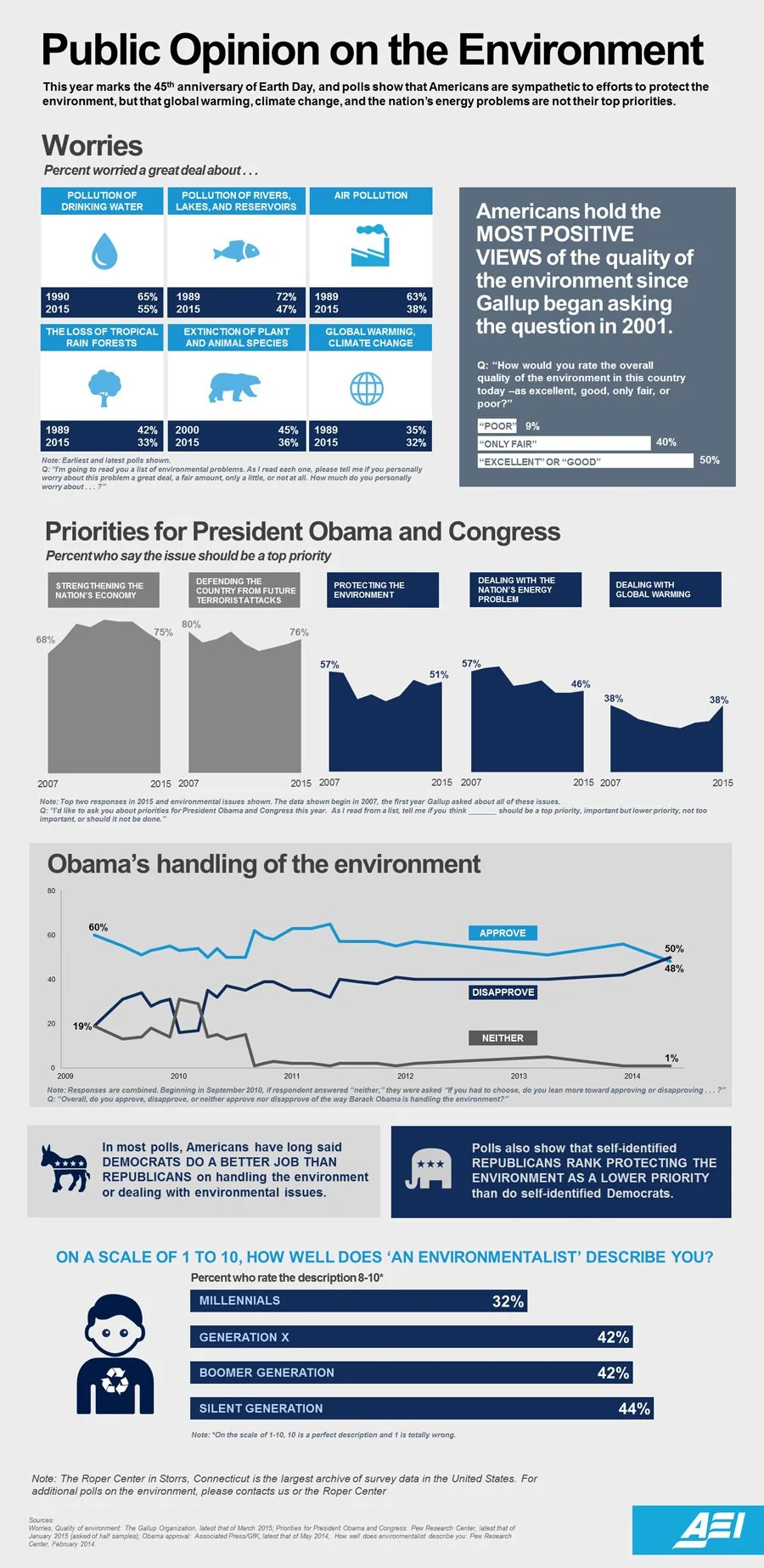
4. The American Enterprise Institute shared an infographic representing public opinions on the environment.

Worth Reading - 4/21

One rarely finds oneself trampled by herds of evangelicals making their way to the Augustine section of the local bookstore. One reason for this, of course, is that evangelical bookstores don’t even have such a thing as an “Augustine section.” Where would they find the room amidst all the Precious Moments figurines, test tubes of anointing oil, and tins of Test-a-Mints? The mighty Augustine can’t compete.

A more significant reason for Augustine neglect is the mere fact that he lived a very long time ago. We Americans rarely read old books, and Augustine’s are old books. We tend to limit ourselves by era, tribe, and category—we read books written in our day, by people just like us, and that can be placed in one or two limited genres. We find it hard to imagine that a bishop living 1,600 years ago might have something to teach us. But this sort of epistolary reductionism is to our detriment: older books are precisely the ones that can help us to escape the limitations of our current era, learn from those who are not a part of our local tribe, and transcend the categories to which we have become accustomed. Plus, we get the added benefit of having time itself weed out the bad works, leaving us with the gems.

2. Hugh Welchel from the Institute for Faith, Work and Economics explaining how a limited worldview has truncated a sense of responsibility for faithful living in this world:

Scripture begins with the creation of all things and ends with the renewal of all things. In between it offers an interpretation of the meaning of all history. In his book The New Testament and the People of God, N.T. Wright says that the divine drama told in Scripture “offers a story which is the story of the whole world. It is public truth.”

The biblical story makes a comprehensive claim on all humanity, calling each one of us to find our place in God’s story.

3. Karen Swallow Prior explain why the argument that Jesus never explicitly said something is an example of bad hermeneutics:

Red Letter Christians emphasize the words of Jesus printed in red in some modern versions of the Bible. The movement made its official entrance onto the evangelical platform nearly ten years ago, setting out “to take Jesus seriously by endeavoring to live out his radical, counter-cultural teachings as set forth in Scripture, and embracing the lifestyle prescribed in the Sermon on the Mount.”

Red Letter Christians claim, “You can only understand the rest of the Bible when you read it from the perspective provided by Christ.”

But practice can’t be separated from interpretation.

While the highest levels of biblical and literary hermeneutics seem to confound us, a basic and valid interpretive lens for reading the Bible can be as straightforward as approaching a great literary work. (Of course, as most college freshmen will tell you—and this English professor will confirm—skillful reading of literature doesn’t come naturally. It must be learned.)

The inspired Word of God, the Bible is also a literary work written with artistry, a narrative arc, and themes both major and minor. Just as there are valid and invalid approaches to reading Huckleberry Finn, there are right and wrong ways to read the Bible. As readers, whether our text is God-breathed or merely mortal, we must take into account genre, purpose, audience, structure, and point of view. We find meaning by understanding each passage within context of the whole.

4. The latest edition of Themelios, the journal of The Gospel Coalition, is out and available free online. I've got a book review in this issue in the Systematic Theology section.

Worth Reading - 4/20

The evening of October 19, 1856 commenced a season of unusual suffering for Spurgeon. His popularity had forced the rental of the Surrey Garden Music Hall to hold the 12,000 people congregated inside. Ten thousand eager listeners stood outside the building, scrambling to hear his sermon. The event constituted one of the largest crowds gathered to hear a nonconformist preacher — a throwback to the days of George Whitefield.

A few minutes after 6 o’clock, someone in the audience shouted, “Fire! The galleries are giving way! The place is falling!” Pandemonium ensued as a balcony collapsed. Those trying to get into the building blocked the exit of those fighting to escape. Spurgeon attempted to quell the commotion, but to no avail. His text for the day was Proverbs 3:33, “The curse of the Lord is in the house of the wicked” — a verse he would never preach again.

An eyewitness recorded, “The cries and shrieks at this period were truly terrific. . . . They pressed on, treading furiously over the dead and dying, tearing frantically at each other.” Spurgeon nearly lost consciousness. He was rushed from the platform and “taken home more dead than alive.” After the crowds dissipated, seven corpses were lying in the grass. Twenty-eight people were seriously injured.

The depression that resulted from this disaster left Spurgeon prostrate for days. “Even the sight of the Bible brought from me a flood of tears and utter distraction of mind.” The newspapers added to his emotional deterioration. “Mr. Spurgeon is a preacher who hurls damnation at the heads of his sinful hearers . . . a ranting charlatan.” By all accounts, it looked as if his ministry was over. “It might well seem that the ministry which promised to be so largely influential,” Spurgeon said, “was silenced for ever.”
Many readers will know historian David Bebbington’s standard definition of evangelicals as Protestant Christians marked by biblicism, crucicentrism (the centrality of Christ’s work on the cross), activism, and conversionism. I have argued – and continue to argue in my forthcoming biography of George Whitefield – that for eighteenth-century evangelicals, an emphasis on the ministry of the Holy Spirit was also a defining mark, one that set them apart from their forebears more than biblicism, crucicentrism, and activism.

I agree with Swaim that the term evangelical, as used in the media, obscures fundamental differences between those lumped together as people who “feel strongly about their faith.” There are at least four types of Christians who often get cast as evangelicals who really are not evangelicals, if that term has any meaning.

3. An essay on the importance of reading as a discipline of the Christian life:

Lots of people ask me on a regular basis how I read so much. My answer is that the only way I can keep up with my reading habits is to discipline myself to read. I typically read two books or more a week. Lately, that number has been significantly down as I’ve been busy with the many ministry activities. I notice the less time I have to read that the more I feel overwhelmed. Self-feeding is a very important aspect of ministry. It’s one of the reasons Paul says in 2 Timothy 4:13, “When you come, bring the cloak that I left with Carpus at Troas, also the books, and above all the parchments.” Notice what Paul says here. He says bring me my “cloak” and his “books, and the parchments”. We don’t know what books the Apostle Paul was talking about here, but the parchments were the Scriptures. Paul wanted godly books to read and his Bible. This shows that the Apostle Paul, a man who wrote thirteen books in the New Testament, who likely had what we would consider today multiple Master’s Degrees and likely two Ph.D.’s still saw his need to read godly material and to read and study the Scriptures.

4. My mentor, Dr. Daniel Heimbach, did an interview for the school. Here's what he said about his life as a professor and a moral witness for Christ in culture:

Q: When a student completes your class, what do you want him or her to walk away with at the end of the semester?

A: I want every student to leave my class loving Jesus, the Word of God, God’s holiness, love and glory more than ever before. Also, to be filled with a well-informed passion to engage the world in moral witness more faithfully, fruitfully and relevantly than ever before.

Q: We always say that every classroom at SEBTS is a Great Commission classroom. What does that look like for your class?

A: I teach Christian ethics, which is essential to the Great Commission. I see Christian ethics as being, not just part of the Great Commission, but as understanding the whole thing the right way.

True ethics—God’s one and only true and real way of ordering good and bad, right and wrong, righteousness and wickedness, blessing and cursing, justice, punishment, and accountability, wisdom and foolishness, including God’s purposes, direction, and goals, and what the Bible refers to as “the ways” of God—is the ocean of rightly ordered reality in which we swim as Christians. Understood this way, Christian ethics is what the Great Commission is all about.

Worth Reading - 4/17

Millennials are obsessed with entrepreneurship. A study by Young Invincibles, a national organization working to engage young adults in public policy, found that 54 percent of U.S. millennials either want to start a business or have already started one. Entrepreneurship promises autonomy, creativity, innovation, and artistic expression. These are the things that make millennials tick.

Millennial fixation with entrepreneurship may have risen out of necessity; today’s job market isn’t as strong as it was a decade ago. Economic prospects are particularly daunting for recent college graduates.

In an era of #selfies, ego matters, too. But whatever their motivations, millennials are creating charitable giving apps, extracting honey from rooftop beehives, and pickling vegetables. Millennials are no longer fighting capitalism, but transforming it. Capitalism, it seems, is redeemable.

2. The average readership for an academic paper is tiny, which means that many intelligent people in higher education are failing to influence public discussions because no one is reading what they write:

MANY of the world’s most talented thinkers may be university professors, but sadly most of them are not shaping today’s public debates or influencing policies.

Indeed, scholars often frown upon publishing in the popular media. “Running an opinion editorial to share my views with the public? Sounds like activism to me,” a professor recently noted at a conference, hosted by the University of Oxford.

The absence of professors from shaping public debates and policies seems to have exacerbated in recent years, particularly in social sciences.

In the 1930s and 1940s, 20 per cent of articles in the prestigious The American Political Science Review focused on policy recommendations. At the last count, the share was down to a meagre 0.3 per cent.

Even debates among scholars do not seem to function properly. Up to 1.5 million peer-reviewed articles are published annually. However, many are ignored even within scientific communities - 82 per cent of articles published in humanities are not even cited once. No one ever refers to 32 per cent of the peer-reviewed articles in the social and 27 per cent in the natural sciences.

3. A conversation about faith, work, and the Christian life between a Seminary President and a Facilities Worker:

There are only two people with permanent, personally designated parking spots on the campus of Southeastern Baptist Theological Seminary. As you would expect, one is for the president, Dr. Danny Akin.

The other spot is for Mr. Eugene Smith, the 88 year-old man who works for facilities.

Mr. Eugene, as he is affectionately known, has been working at Southeastern for more than thirty-five years. He started working for the school about the age many people are thinking of early retirement, but he doesn’t really know what retirement is.

4. Be nerdy and watch this video on how aluminum cans are made:

Worth Reading - 4/15

The body of the tiny 78-year-old woman, gray hair falling over stiffened shoulders, was brought to a hillside at Western Carolina University still clad in a blue hospital gown and chartreuse socks.

She was laid on a bed of wood chips, and then more were heaped atop her. If all goes as hoped, the body will turn into compost.

It is a startling next step in the natural burial movement. Even as more people opt for interment in simple shrouds or biodegradable caskets, urban cemeteries continue to fill up. For the environmentally conscious, cremation is a problematic option, as the process releases greenhouse gases.

Armed with a prestigious environmental fellowship, Katrina Spade, a 37-year-old Seattle resident with a degree in architecture, has proposed an alternative: a facility for human composting.

2. The Moral Bucket List from David Brooks. This is a thought provoking read:

ABOUT once a month I run across a person who radiates an inner light. These people can be in any walk of life. They seem deeply good. They listen well. They make you feel funny and valued. You often catch them looking after other people and as they do so their laugh is musical and their manner is infused with gratitude. They are not thinking about what wonderful work they are doing. They are not thinking about themselves at all.

When I meet such a person it brightens my whole day. But I confess I often have a sadder thought: It occurs to me that I’ve achieved a decent level of career success, but I have not achieved that. I have not achieved that generosity of spirit, or that depth of character.

A few years ago I realized that I wanted to be a bit more like those people. I realized that if I wanted to do that I was going to have to work harder to save my own soul. I was going to have to have the sort of moral adventures that produce that kind of goodness. I was going to have to be better at balancing my life.

3. Don Carson discusses the doctrine of inerrancy with Keith Whitfield: 

Systematic Theology is math, a skeleton. It is a system of organizing thoughts so that finite minds can begin to understand an infinite God (in a distinctly western way, mind you). Systematic theology is a support system for the reality of relationship with God. Too often, though, it is put forth as the face of faith instead of being the framework of it. All the “ologies” (soteriology, eschatology, pneumatology, Christology, etc.) you know are not your relationship with God. They are not the true story of God. They support those things for you. They need muscles and veins and organs and skin to make them alive, to adorn them in beauty.

For many people, yea most people, systematic theology is not any more beautiful than algebra. It is intimidating or cumbersome or boring or argumentative. It can even be a deterrent from connecting with God when misused. “Misused” in this instance means thrust in people’s faces, worn as a badge of honor, broadcast as the defining characteristic of faith. People don’t need a systematic, organized understanding of God to be saved. They don’t need to have their beliefs divided and subdivided. They need a relationship, a deep, personal, intimate relationship.

Worth Reading - 4/14

1. Should you pursue a Ph.D.? Thomas Kidd offers some thoughts on the subject:

If you are a Christian thinking about graduate school, let me say this: we desperately need serious, thoughtful Christians to be active in academia and publishing, as a matter of Christian witness to both students and other professors. Being a professor is a great life, assuming you can get a job. But graduate work is not for everybody.

2. A harmless, obviously inoffensive Tweet draws a backlash on Twitter. The "offending" company apologizes. An example of the power of ridiculous outrage:

pple’s new iOS 8.3 release consists of 300 new emojis, including kissing lips, googly eyes and a smiling poop (we wish we were making that up). But they also include racially diverse emojis, including cartoon faces with brown and black skin.

In its tweet, Clorox seemed to be commenting on why bleach wasn’t included among the hundreds of other household items that Apple had added to its list of emojis. But on social media, offense was taken.
In our hectic world of go, Go, GO! it seems difficult to simply find time to sit down and think. In my own life, I have felt the pressure of three different jobs, being overrun with the need to produce content (which I have not), while not abandoning my family in the process.

Oftentimes, I do not have time to sit and think simply because I over-commit. Being a publishing director for LifeWay is my full-time job. Being a teaching pastor and elder of The Fellowship is my bi-vocational ministry. Teaching classes like Christian Leadership for Union University has been an addition to it all. So, when you are busy–and we’re all busy–we need principles we hold to in order to simply think, dream, and strategize.
Good Friday, April 14, 1865, was surely one of Abraham Lincoln’s happiest days. The morning began with a leisurely breakfast in the company of his son Robert, just arrived in Washington after serving on General Grant’s staff. “Well, my son, you have returned safely from the front,” Lincoln said. “The war is now closed, and we soon will live in peace with the brave men that have been fighting against us.” He urged Robert to “lay aside” his Army uniform and finish his education, perhaps in preparation for a law career. As the father imparted his advice, Mary Lincoln’s seamstress, Elizabeth Keckley, observed, “His face was more cheerful than [she] had seen it for a long while.”

At 11 a.m., Grant arrived at the White House to attend the regularly scheduled Friday cabinet meeting. He had hoped for word that Gen. Joseph E. Johnston’s army, the last substantial Rebel force remaining, had surrendered in North Carolina, but no news had yet arrived. Lincoln told Grant not to worry. He predicted that the tidings would come soon, “for he had last night the usual dream which he had preceding nearly every great and important event of the War.” Gideon Welles asked him to describe the dream. Turning toward him, Lincoln said it involved the Navy secretary’s “element, the water—that he seemed to be in some singular, indescribable vessel, and that he was moving with great rapidity towards an indefinite shore; that he had this dream preceding Sumter, Bull Run, Antietam, Gettysburg, Stone River, Vicksburg, Wilmington, etc.” Grant remarked that not all those great events had been victories, but Lincoln remained hopeful that this time this event would be favorable.

Worth Reading - 4/13

1. Conference attendance and porn usage: a tragic and shameful connection:

I interviewed hotel managers about this when I was teaching in the sociology department at Univ of Virginia. All managers said that porn rates increase during conferences in general. That’s normal because they have more guests. A few admitted that it seems to be the same or a bit more when Christian conferences come to town. One manager was a Christian and he said a line I’ll never forget: “Unfortunately, ‘they know you are Christians by your…porn consumption’ is more truthful than ‘love’ when it comes to this.”

2. The ERLC treats the problem of porn, because it is a real issue in the world:

God didn’t leave us to fight this battle on our own. He sent His Son for our sake. Think about this — the Creator of the Universe cares about the problem of porn. What a tiny, finite problem for the One who chooses to sustain the burning of gaseous beings in space and gravity’s effect on the tides! This is not to say that sin is some small, overlook-able act. Sinning against God — whether contemplating murder or lustfully clicking your way out of a porn site — is an act of what R.C. Sproul calls “cosmic treason”. We act against the will of the only One who deserves to exist. And still, He gives us grace for even the most shameful, despicable worries.

America’s addiction will never be satisfied. The problem of porn will not go away on its own. We have to fight it. We have to put on the whole armor of God. We have to mortify our sin. John Owen wrote, “Be killing sin or it will be killing you,” and he couldn’t be more right. If we aren’t killing the problem of porn, we will ruin our future hope of human flourishing and pillage the wondrous riches of God’s great grace, launching assault on the Lord’s precious gift to sinners.

3. Why does college tuition cost so much? The answer may not be what some people claim it is:

The conventional wisdom was reflected in a recent National Public Radio series on the cost of college. “So it’s not that colleges are spending more money to educate students,” Sandy Baum of the Urban Institute told NPR. “It’s that they have to get that money from someplace to replace their lost state funding — and that’s from tuition and fees from students and families.”

In fact, public investment in higher education in America is vastly larger today, in inflation-adjusted dollars, than it was during the supposed golden age of public funding in the 1960s. Such spending has increased at a much faster rate than government spending in general. For example, the military’s budget is about 1.8 times higher today than it was in 1960, while legislative appropriations to higher education are more than 10 times higher.

In other words, far from being caused by funding cuts, the astonishing rise in college tuition correlates closely with a huge increase in public subsidies for higher education. If over the past three decades car prices had gone up as fast as tuition, the average new car would cost more than $80,000.

4. Our irrational fear of flying. A discussion of why it really still is safe to fly:

It’s still easily one of the safest ways to travel. Public perception has been skewed by recent disasters, such as the Germanwings crash and last year’s two Malaysia Airlines tragedies. Intense media coverage and horrifying disaster photos can make people fear extremely rare events while blithely ignoring more commonplace risks. Statistics show, however, that the chance of a passenger dying on any given flight with one of the world’s major airlines is just 1 in 4.7 million. In any given year, your chance of dying in a traffic accident is 1 in 14,000. You even have a higher chance of dying in a lightning strike (in any given year, 1 in 1.9 million). In the 1970s, an average of 68 commercial planes crashed each year, with 1,676 fatalities. But thanks to vast improvements in cockpit protocols, computerized navigation equipment, and the aircraft themselves, those figures have been almost halved, to 40 crashes and 832 deaths. Last year, about 100,000 flights took off around the world every single day. Of the 33.4 million annual flights, only 21 crashed — an almost miraculous safety record. As aviation safety expert Carl Rochelle puts it, “the most dangerous part of your airline flight is the trip to the airport.”

Weekend Reading

“We will beat them, and all the things they have will be taken.”

This ultimatum from a Hindu extremist group threatened any Christians who would gather to worship in their village. Some members fled to the nearby city of Ranchi, where they found refuge through a local pastor. Those who remained discovered the threats were not empty.

Militants recruited a mob from 21 surrounding villages in northern India. The group descended on the congregants on Sunday morning, yelling insults, tearing up Bibles, and using large bamboo sticks to strike men and women alike.

One woman recounted the September 2014 attack to pastor Mohan,* whose congregation in Ranchi planted her village church. The mob had chased her, yelling, “Let’s kill her! Finish her off!” When she sought refuge inside her home, they threw large stones on the corrugated roof until it collapsed. Gaining entrance, they beat her with the sticks, smashed every possession, great and small, and stole her legal documents and life’s savings.

2. The number of women engaged in apologetics is growing, and that's a very good thing:

At the time, Ordway was in her early 30s and teaching literature and composition at a public college in Southern California. Since graduate school, she had thought of Christians as superstitious, Christianity as a “blemish on modern civilization,” and the Bible as a collection of fairy tales. “I was radicalized as an atheist and hostile toward Christians in general,” says Ordway.

But as she continued talking to her coach and reading works of apologetics—including N. T. Wright’s defense of the Resurrection—Ordway confessed faith in Christ. Now she finds herself in another new country, directing the master in apologetics (MAA) program at Houston Baptist University (HBU), a small liberal arts college in the heart of the nation’s energy capital. There, she is among a burgeoning group of women who are reshaping apologetics in the West.

“These women are expanding the scope of apologetics beyond the traditional male bastion,” says Lee Strobel, author of The Case for Christ and now on faculty in the MAA program. He sees his colleagues as building a movement that’s “cutting across gender and racial barriers” to draw more people to faith.

“Women bring a deep relational intelligence to apologetics,” says Kelly Monroe Kullberg, founder of the Veritas Forum, a university-based organization that hosts apologetics events across North America and Europe. “They bring a sense that biblical truth is the highest love for human beings.”
A couple of weeks ago, Cathy Lynn Grossman of the Religion News Service wrote a post providing analysis of this data that was titled, “Millennials are the ‘don’t judge generation’ on sexual morality: Survey.” Unfortunately, that’s not true. Regarding sexual morality, Millennials are judgmental, just in different ways than their parents or grandparents were.

Grossman quotes Robert Jones, the CEO of PRRI as saying, “Millennials seem reluctant to make blanket black-and-white moral pronouncements about issues they see as complex.” That’s where this idea of the “don’t judge generation” comes from. It’s true, Millennials seem reluctant to make blanket black-and-white moral pronouncements about complex issues, and that’s exactly how they are judgmental. Millennials don’t just keep from making black-and-white statement themselves, they think that it is morally reprehensible and “discriminatory” for anyone to make black-and-white moral pronouncements about these issues.

The only thing Millennials are black-and-white on when it comes to matters of sexual morality is that you aren’t allowed to be black-and-white on sexual morality.

4. Husbands, you can't afford to have your wife stay at home! A tribute to the stay at home mom:

My wife stays home and takes care of our son every single day. She changes his diapers, feeds him, plays with him, puts him down for his nap, and comforts him when he’s upset. And that’s just the bare minimum. A child can typically get that attention at a day-care. But on top of that, he is her only focus. There’s no other children to tend to. He gets all of her. All of her love, all of her time, all of her energy. She is always there, always near, and always listening. Obviously, this is part of being a parent. You take care of your child and you raise your child. But let’s face it. In our day and age, every service (and I mean EVERY service) is hirable. There is a company ready and willing to do just about anything. So while, yes, my wife is my son’s mother and it is a natural result of being a parent to love and care for your own child, there is also a very quantifiable dollar amount that can be attributed to the services rendered. I am in no way trying to simplify, objectify, or devalue the priceless love of a mother for her child. But let’s be real. Pay day feels good for a reason. Because you’re seeing your hard work appreciated in a tangible way that lets you “treat yo self”. And this is exactly why I can’t afford my wife being a Stay-At-Home Mom. The national average weekly salary for a full-time nanny is $705. That’s $36,660 a year.[1]

We make ends meet comfortably and are by no means scraping the bottom of the barrel. But according to the 2014 tax brackets, we fall nicely in the second tier, right in the $12,951-$49,400 tax range. Even if we were making the maximum amount allowed for our tax bracket, the services rendered of caring for our child every single day of the year would absorb the majority of our income. Flat out, no question, game over, I cannot afford my wife to be a Stay-At-Home Mom. And that’s just the beginning of it.

Worth Reading - 4/10

1. In the mind of some, all that is lacking from people is opportunity, thus if resources were provided, everyone would be successful. Here is a story that seems to provide evidence against that assumption:

The fact that Grand already possessed a valuable skill should have been a hint that his homelessness was not going to be “cured” by learning to code. As McConlogue later acknowledges, “Homelessness is not a feature of someone, or a condition.” If homelessness was a “feature or condition” it’d likely make the problem easier to solve. Unfortunately, though, the reasons people are homeless are complex and often rooted in the specific context of the individual.

What then should we take away from this failed experiment? I think there are two things we can learn.

First, this example should make us more humble about thinking that we can solve the problem, even the problem of a single individual’s homelessness, by our own efforts. Sometimes we can, and when we can, we should do what is possible to help the homeless find safety and shelter. But we shouldn’t think that we are going to make much of a difference unless we are able to address the real problems (like mental illness) that often lead to homelessness.

Second, as Christians there is something we can do to help people in this condition: share the gospel with them. While this may seem obvious, it seems we too often think that sharing the good news about Jesus is something that should be done only after we solve their “temporary” problem of chronic homelessness. But as in the case of Leo Grand, we see that the problem isn’t something we can fix and isn’t likely to end anytime soon. If we tarry in proclaiming to them the good news until they have an earthly shelter, they may miss out on finding an eternal home in God’s Kingdom.

2. What is deism? Thomas Kidd gives some background:

The fact that Grand already possessed a valuable skill should have been a hint that his homelessness was not going to be “cured” by learning to code. As McConlogue later acknowledges, “Homelessness is not a feature of someone, or a condition.” If homelessness was a “feature or condition” it’d likely make the problem easier to solve. Unfortunately, though, the reasons people are homeless are complex and often rooted in the specific context of the individual.

What then should we take away from this failed experiment? I think there are two things we can learn.

First, this example should make us more humble about thinking that we can solve the problem, even the problem of a single individual’s homelessness, by our own efforts. Sometimes we can, and when we can, we should do what is possible to help the homeless find safety and shelter. But we shouldn’t think that we are going to make much of a difference unless we are able to address the real problems (like mental illness) that often lead to homelessness.

Second, as Christians there is something we can do to help people in this condition: share the gospel with them. While this may seem obvious, it seems we too often think that sharing the good news about Jesus is something that should be done only after we solve their “temporary” problem of chronic homelessness. But as in the case of Leo Grand, we see that the problem isn’t something we can fix and isn’t likely to end anytime soon. If we tarry in proclaiming to them the good news until they have an earthly shelter, they may miss out on finding an eternal home in God’s Kingdom.
Perhaps one of the most iconic plantation homes of the South, Boone Hall is not famous for its stately brick home or elegant column-lined porch.

What makes the home a landmark is the iconic driveway lined with live oak trees.

The branches of the grand trees, originally planted in 1743, meet over the drive to form a magnificent leafy canopy dripping with Spanish moss. Soft sunlight streaming through leaves at the end of the day makes the scene especially magical.

Of course what visitors do not see is the massive system of roots tangled beneath the ground. These roots have nourished and supported the trees above ground for over 200 years and yet are hidden from sight.

I think there is an important parallel to be drawn here between the roots and trees of Boone Hall Plantation and the way the human heart operates.

4. The Irish Twins from Lutheran Satire are at it again. This time, instead of arguing about the Trinity with St. Patrick, they are undermining Richard Dawkins' critique of Christianity. 

Worth Reading - 4/9

“Racial reconciliation is not something that white people do for other people,” proclaimed Russell Moore in March. Moore, a white man from Mississippi, was opening a meeting of the Southern Baptist Convention in Nashville, Tennessee, with an eminently tweetable, infinitely complicated call to end racial division within the church.

As membership in the Southern Baptist church stagnates and baptisms decline, and as America’s younger generations are becoming more diverse and less religious, this kind of rhetoric could seem like a straightforward bid for survival. Millennials care deeply about race and racial justice, so the church has to care, too. Moore’s calls for reconciliation seemed heartfelt, though, as did those of many of the pastors and leaders who met at the Southern Baptists’ conference on race. And they are part of a consistent, longstanding effort. Since at least 1995, the church has been publicly repenting for its history of racial discrimination. Arguably, it has made progress; minority participation in Southern Baptist congregations has blossomed. Yet after two decades, the public-policy arm of the church is still focused almost exclusively on conservative social issues, rather than topics like poverty and mass incarceration, which have a significant impact on racial disparities in America. As the demographics of the church change, the Southern Baptists will have to reckon with these issues—or, perhaps, face future decades of division within their churches.

2. In praise of irrelevant reading. A fun essay by Wesley Hill over at First Things:

When I moved to England to start a Masters degree in theology, I knew I wanted to study St. Paul’s letter to the Romans. Like many of my counterparts in the Reformed theological orbit, I was enthralled with questions of law and grace, election and final judgment. During my first year of undergraduate study, I’d sat out on the front lawn of the college green, sweating in the spring sunshine, reading N. T. Wright’s What Saint Paul Really Said. I was certain that the most important questions I could write about in my postgraduate study would have something to do with Jews and Gentiles in Christ in those dense later chapters of Paul’s Romans.

I remember stepping into my advisor’s office with confidence, brandishing a sheet of paper with my notes and proposed outline, like a beaming kid shoving his latest Play-Doh creation into Dad’s line of sight for approval. And my outline was met with approval, at least in part. But what I didn’t yet realize about theological research is that it can almost always benefit from paying attention to the irrelevant. Which is what my advisor wanted to show me.

“Why don’t you go have a look at Karl Barth’s Epistle to the Romans,” he said, sliding my notes back to me across his desk. I blinked. Having been steeped for the past few years in Greek and Hebrew exegesis and historical study of the first century, I didn’t see much point in reading Barth. Hadn’t the great biblical scholar Brevard Childs paid Barth the backhanded compliment of calling his exegesis a “virtuoso performance,” effectively condemning it as too creative for its own good? Hadn’t James Barr, another accomplished biblical historian, dubbed Barth’s exegesis—you can hear him sighing as he wrote these words—“wearisome, inept, and futile”? I couldn’t see what benefit I would gain from reading Barth, mired as his commentary was in early twentieth-century debates about Protestant liberalism and existentialism. What I wanted was to understand Paul, not wriggle down some rabbit trail of philosophically inflected theology.

3. Stop pretending to be offended by everything! Here is a helpful post from the National Review that is arguing we should quit our addiction to outrage porn:

If I treated The Daily Show as a serious news program, I’d probably note the irony of Noah’s replacing a didactic scold whose entire shtick is predicated on making fun of people whose statements he has taken out of context. And though Noah asks for understanding, it’s unlikely he will be extending the same to conservatives. But just as no one is coercing liberals to listen to Rush Limbaugh or Glenn Beck (although the Left has campaigned to banish both from the airwaves), it’s easy to ignore The Daily Show. I do it almost every day.

The problem with this kind of prefabricated reaction is not that it emboldens haters but that it crowds out legitimate grievances. Everything begins to stink of politics, and we start sounding like a bunch of humorless protesters. There is nothing wrong with calling out people for the things they say, but there is something fundamentally illiberal about a mob’s hounding people for every stupid tweet or making snap judgments about entire careers based on a few comments. Most often, the purpose is to chill speech. At some point, Americans decided they were going to be offended by everything. And, I guess, that’s what really offends me most.

4. Often our first response is the wrong one. Aaron Earls argues our first thought should be to pray, not to speak:

When I saw Walter Scott, an unarmed black man, had been shot and killed by a white police officer in Charleston, my first response was wrong.

When I heard about the mess surrounding Indiana’s Religious Freedom Restoration Act, I didn’t have the right initial response then either.

If I’m honest, the first action I usually take after every significant global, national, local or personal event is mistaken.

It’s not that I lash out in misdirected anger or refuse to follow the facts of the case. Instead, my first response is always to say something to anyone except the One who can actually do something about it.

I want to tweet something or post on Facebook or write a blog post or do anything—and everything—except pray.

Praying seems so passive, so weak, so much of a responsibility shift. But that’s kinda the point.

Worth Reading - 4/8

1. How did the Nazi concentration camps work? A somber topic, but an informative read from the New Yorker:

One night in the autumn of 1944, two Frenchwomen—Loulou Le Porz, a doctor, and Violette Lecoq, a nurse—watched as a truck drove in through the main gates of Ravensbrück, the Nazi concentration camp for women. “There was a lorry,” Le Porz recalled, “that suddenly arrives and it turns around and reverses towards us. And it lifts up and it tips out a whole pile of corpses.” These were the bodies of Ravensbrück inmates who had died doing slave labor in the many satellite camps, and they were now being returned for cremation. Talking, decades later, to the historian and journalist Sarah Helm, whose new book, “Ravensbrück: Life and Death in Hitler’s Concentration Camp for Women” (Doubleday), recounts the stories of dozens of the camp’s inmates, Le Porz says that her reaction was simple disbelief. The sight of a truck full of dead bodies was so outrageous, so out of scale with ordinary experience, that “if we recount that one day, we said to each other, nobody would believe us.” The only way to make the scene credible would be to record it: “If one day someone makes a film they must film this scene. This night. This moment.”

Le Porz’s remark was prophetic. The true extent of Nazi barbarity became known to the world in part through the documentary films made by Allied forces after the liberation of other German camps. There have been many atrocities committed before and since, yet to this day, thanks to those images, the Nazi concentration camp stands as the ultimate symbol of evil. The very names of the camps—Dachau, Bergen-Belsen, Buchenwald, Auschwitz—have the sound of a malevolent incantation. They have ceased to be ordinary place names—Buchenwald, after all, means simply “beech wood”—and become portals to a terrible other dimension.
We in the English-speaking world have survived thirty-seven years without “How to Write a Thesis.” Why bother with it now? After all, Eco wrote his thesis-writing manual before the advent of widespread word processing and the Internet. There are long passages devoted to quaint technologies such as note cards and address books, careful strategies for how to overcome the limitations of your local library. But the book’s enduring appeal—the reason it might interest someone whose life no longer demands the writing of anything longer than an e-mail—has little to do with the rigors of undergraduate honors requirements. Instead, it’s about what, in Eco’s rhapsodic and often funny book, the thesis represents: a magical process of self-realization, a kind of careful, curious engagement with the world that need not end in one’s early twenties. “Your thesis,” Eco foretells, “is like your first love: it will be difficult to forget.” By mastering the demands and protocols of the fusty old thesis, Eco passionately demonstrates, we become equipped for a world outside ourselves—a world of ideas, philosophies, and debates.

Eco’s career has been defined by a desire to share the rarefied concerns of academia with a broader reading public. He wrote a novel that enacted literary theory (“The Name of the Rose”) and a children’s book about atoms conscientiously objecting to their fate as war machines (“The Bomb and the General”). “How to Write a Thesis” is sparked by the wish to give any student with the desire and a respect for the process the tools for producing a rigorous and meaningful piece of writing. “A more just society,” Eco writes at the book’s outset, would be one where anyone with “true aspirations” would be supported by the state, regardless of their background or resources. Our society does not quite work that way. It is the students of privilege, the beneficiaries of the best training available, who tend to initiate and then breeze through the thesis process.

3. What's it like to become a joke on the internet? This is one woman's story of how her slightly odd behavior became the subject of derision and how it made her feel. (Note there is some language in this, but it is well worth reading despite that.)

One night, about 10 months ago, I got an email from a friend in Vermont, with the subject line “Is this you!?”

I clicked it open, and the friend had sent me a link to a website called “Youredoingitwrong.com,” which is a site of all viewer-submitted photos of people doing things hilariously, ignorantly wrong in public. The exact page, or image, that this friend had sent was the inside of a Snap Fitness workout center, and the camera point-of-view was looking at the back of a person on a treadmill—looking through and past some pieces of exercise equipment in the foreground, as if, you know, spying.

The person we see on the treadmill is quite large, and though we can’t see her face, she seems to be female because she has long hair in pigtails. She’s wearing denim overalls, big denim overalls, like a farmer, and—this is the important part—she’s not walking on the treadmill. Her big body in her big overalls is sitting in one of Snap’s spindly little red folding chairs, on the treadmill—which is not moving—and she’s looking up above the treadmill display, watching the flat-screen TV that’s mounted on the wall. She is definitely “doing it wrong.”

4. How much profit do corporations really make? It's probably less than you think:

“Someday this will all be yours,” I said, waving my hand across the aisles of the Piggly Wiggly. I was trying to ingratiate myself with my boss, the general manager for the biggest grocery store in Clarksville, Texas. He just smirked and shook his head. “For every dollar in sales, how much do you think this stores earns in profit?”

At the time I was taking high school economics and considered myself something of a financial savant because I knew the difference between stocks and bonds. Still, I was in full-on toady mode and thought it best to undershoot what I believed the true profit margin to be. I went with a safe number that I knew must be far too low. “About forty cents?” I asked.

“One cent,” he said. “For every dollar we put in the cash register we keep about one penny in profit.”

Worth Reading - 4/7

1. How did coffee become an acceptable vice for Christians? A thoughtful commentary on coffee culture:

Christians and coffee have a long and storied history, from the Reformation to the church basement coffee hour. Wherever two or more are gathered in the name of God, you can usually also find an urn of mediocre brew and a stack of Styrofoam cups.

The trajectory of coffee drinking in America, from a shared and slow activity to a personal and quick transaction, mirrors the trajectory of evangelical Christianity. Lent is almost over, and many Christians will rejoice that they can once again get their regular coffee fix. But most of us would never give it up in the first place.

Coffee fuels many of us—54 percent of American adults drink it on a daily basis. It gets us through the worst days, gives us a reason to get out of bed and restores us to the angels of our better nature. If that sounds a little religious, it’s no coincidence.

Coffee is an acceptable vice. Unlike alcohol, which many evangelicals either abstain from or approach warily, coffee has been enthusiastically embraced.

2. On the cultural bias against Christians in the U.K. Is it fundamentally backward to be faithful?

The question was asked in a tone of Old Malvernian hauteur which implied that spending time in religious contemplation was clearly deviant behaviour of the most disgusting kind. Jeremy seemed to be suggesting that it would probably be less scandalous if we discovered the two men had sought relief from the pressures of high office by smoking crack together.

Praying? What kind of people are you?

Well, the kind of people who built our civilisation, founded our democracies, developed our modern ideas of rights and justice, ended slavery, established universal education and who are, even as I write, in the forefront of the fight against poverty, prejudice and ignorance. In a word, Christians.

But to call yourself a Christian in contemporary Britain is to invite pity, condescension or cool dismissal. In a culture that prizes sophistication, non-judgmentalism, irony and detachment, it is to declare yourself intolerant, naive, superstitious and backward.

3. "Joy to the World" is really an Easter hymn. This is my latest contribution at The Institute for Faith, Work and Economics:

One of my favorite hymns is “Joy to the World.” We usually sing it around Christmas, but for years I have thought of it as an Easter hymn.

The first verse calls for us to have joy because the Lord has come, and calls for heaven and nature to sing. Nature is singing in anticipation of the redemption spoken of in Romans 8:19–21, when the effects of the Fall are removed.

4. A thoughtful post by Tim Challies that helps explain why so much ethical discourse seems impossible in our contemporary milieu:

We are at an interesting point in history. I guess there’s never really a boring point in history, but there are definitely times when things advance or unravel in a hurry. And today we are seeing the full-out charge of a new kind of morality. We see it playing out in the media just about every day, and Nancy Pearcey’s book Total Truth is still one of the most helpful guides to understanding what is happening around us.

Our society insists that there needs to be a radical split between two different spheres: the private and the public. In the public sphere we have society’s great institutions: the state, academia, multinational corporations, the mainstream media, and the like. In the private sphere we have the family, the church, and personal relationships. We are told that these public institutions are based only on what is scientific and objective. Meanwhile, the private sphere is composed of all those things that are subjective or based on personal values; we are allowed to have them, but they are less important than the public sphere and must never be allowed to influence it.

Worth Reading - 4/6

I am tired of making disclaimers for everything I say.

It feels like if I post anything without a dozen caveats, I risk starting an unwelcome avalanche of opinions. I rarely write a post or make a comment without first ensuring minimal margin for offense.

In a world that encourages patience and acceptance, people sure can be touchy, particularly some Christians. Too many times, we can be like over-eager watchdogs, sniffing out any morsel of what we deem as offensive, inappropriate or even “heretical.”

It’s gotten to the point where it’s almost become trendy to be offended.

Even with all of the qualifiers available in the English language, there is no way to prevent offending someone, at some point. We can only seek to be clear in what we say and not intentionally stir up controversy just for controversy’s sake.
Paul Marshall wisely calls us to abandon a lifeboat theology for what he refers to as an ark theology. The Genesis writer tells of humankind’s deep dark plunge into sin. The corruption of God’s good creation and the wickedness of sin were so unimaginably horrific that God seriously considered wiping out his creation. In Genesis 6 we read, “So the LORD said, ‘I will blot out man whom I have created from the face of the land, man and animals and creeping things and birds of the heavens, for I am sorry that I have made them” (Gen. 6:7). But rather than annihilating what he had made and starting completely over, God extends gracious favor to a man named Noah. God makes a covenant with Noah and commissions him to build an ark. Rather than blotting out all of creation, Noah and his family and a host of living creatures are rescued and preserved in the ark from the destruction of the flood. God remains committed to restore the earth and to continue on with his original creation. After Noah exits the ark, God makes a covenant with him, promising to never destroy the earth with a flood again.

The story of Noah and the ark reminds us that God has not given up on his good world, even though it has been ravaged by sin and death. In a burst of rapturous praise, the psalmist in Psalm 24 declares that the whole earth, and everything in it, belongs to the Lord. God still loves his world. A glorious future awaits the earth.

3. Here is an outstanding example of an entrepreneur going beyond his minimal ethical requirements to recognize the value his employees add to his business: 

Employees of the Huizenga Automation Group got a great surprise earlier this week. According to Mlive, after selling the company, owner J.C. Huizenga gave away $5.75 million in bonuses to his employees at two manufacturing companies that were part of the Automation Group. Huizenga acknowledged that his success was due to the work of his employees so he wanted to share his profits with them: “We all worked together at J.R. Automation and Dane Systems” and the companies “had amazing success. It was the right thing to share with everybody.” Bonuses were based on years of service and responsibilities.

4. A thoughtful piece on the value of adjunct instructors. Although I disagree with the conclusion that using adjuncts is unjust (after all, they agree to it and don't pursue other work), there is a remarkable growth in the percentage of adjuncts compared to "real" professors:

Adjuncts are generally hired on semester-to-semester contracts, given no health insurance or retirement benefits, no office, no professional development, and few university resources. Compensation per course—including not just classroom hours but grading, reading, responding to student e-mails, and office hours—varies, but the median pay, according to a recent report, is twenty-seven hundred dollars. Many adjuncts teach at multiple universities, commuting between two or three schools in order to make ends meet, and are often unable to pursue their own academic or artistic work because of their schedules. In the past four decades, tenured and tenure-track positions have plummeted and adjunct instructor jobs have soared, second only in growth to administrators. Adjuncts have always had roles to play: filling in for a last-minute class, covering for a professor on sabbatical, providing outside expertise for a one-off, specialized course. But the position was not designed to provide nearly half of a school’s faculty or the majority of a person’s income. It’s estimated that adjuncts constitute more than forty per cent of all instructors at American colleges and universities.

Worth Reading - 4/2

When the nation’s top nutrition panel released its latest dietary recommendations on Thursday, the group did something it had never done before: weigh in on whether people should be drinking coffee. What it had to say is pretty surprising.

Not only can people stop worrying about whether drinking coffee is bad for them, according to the panel, they might even want to consider drinking a bit more.

The panel cited minimal health risks associated with drinking between three and five cups per day. It also said that consuming as many as five cups of coffee each day (400 mg) is tied to several health benefits, including a reduced risk of cardiovascular disease and type 2 diabetes.

”We saw that coffee has a lot of health benefits,” said Miriam Nelson, a professor at Tufts University and one of the committee’s members. “Specifically when you’re drinking more than a couple cups per day.”

2. Thomas Kidd wonders what Evangelicals can do to make themselves more likable:

It is a good day for evangelicals when we get positive coverage in the New York Times, but it also raises a perennial question for traditional Christians. How much should we expect, or seek, the world’s approval for what we’re doing? Dr. Foster and other missionaries like him are great examples of Christians whose undeniable self-sacrifice and benevolent work overcomes all but the most hardened secularists’ questions about why they insist on talking to patients about Jesus.

It’s nice to be liked. But it also comes with temptation – that of focusing all the church’s work on things that will engender the world’s approval. A hundred years ago, social gospel Christians began to suggest that service and aid, not evangelism, should encompass all of a believer’s missionary responsibility. Thus began one of the most important turns away from evangelical Christianity which has haunted the mainline denominations in America ever since.

3. According to Tim Challies, a clean house is a sign of a wasted life:

You have probably heard the saying before: A clean house is a sign of a wasted life. Whatever else the phrase means, it expresses some of the frustration and the sense of futility that attends life in this world. I thought of that saying when I spotted this proverb: “Where there are no oxen, the manger is clean, but abundant crops come by the strength of the ox” (Proverbs 14:4). A little bit of research shows that commentators are divided on exactly what it means, but I think one of the explanations rises to the top.

According to this explanation, the proverb is about the messiness of a life well-lived. Tremper Longman says the moral is that “a productive life is a messy life.”

I love productivity. At least, I love productivity when it is properly defined—as effectively stewarding your gifts, talents, time, energy, and enthusiasm for the good of others and the glory of God. By this definition, each one of us, no matter our vocation, ought to pursue productivity with all the vigor we can muster. And if you do that, it is inevitable that along the way you will accumulate some mess. You cannot focus your time, attention, gifts, energy, and enthusiasm toward noble goals while still keeping every corner of life perfectly tidy.
Whether we realize it or not, we all end up at times on our backs staring at the sky screaming, Water! In our family, political, occupational, and even spiritual lives, we make decisions and take stances based on bad theology, personal benefit, political correctness, or simple convenience. We think the right thing to do is whatever the majority thinks at the time. Like a ship without a sail, we are tossed back and forth by the prevailing trends and stances of our cultural leaders, anchorless in a storm of popular opinion.

In a moment of misguided sincerity, my baby boy needed absolute truth. And contrary to popular belief, absolute truth is what we all need. As Proverbs 14:12 warns, “There is a way that seems right to a man, but its end is the way of death.” No doubt the person in this proverb is sincere in his beliefs. He may even think he’s doing what’s best for himself, his family, his country. Unfortunately, though, sincerity by itself is never an accurate indicator of right and wrong. Many of the decisions we make—both individually and collectively—that we think are good are ultimately leading us down pathways of destruction. In fact, many of us deceive ourselves by assuming our thinking is wise—or, as we sometimes express it, “enlightened” or “evolved.”

Worth Reading - 4/1

Our work will be fully restored when Christ returns, both the good work we have done in the past and all the good work we will do in the future eternity of the New Earth.

The frustration and decay of this current age aren’t the whole picture.

We live in what theologians call the “already, but not yet.” We live between the resurrection and the second coming of Christ. Redemption enables us to imagine a new creation, and to work to begin the process of building it, right here, right now, through the power of Christ at work within us.

As we celebrate Easter and affirm again that “He has risen,” let us also remember Apostle Paul’s admonition in 1 Corinthians 15.

2. An author at Slate argues that we should not blame the mass murder caused by the German co-pilot on depression:

Was Andreas Lubitz depressed? We don’t know; a torn-up doctor’s note and bottles of pills don’t tell us much. Most people who commit suicide suffer from a mental illness, most commonly depression. But calling his actions suicidal is misleading. Lubitz did not die quietly at home. He maliciously engineered a spectacular plane crash and killed 150 people. Suicidal thoughts can be a hallmark of depression, but mass murder is another beast entirely.

Using the word “depression” to describe inexplicable or violent behavior sends two false signals: First, that society has no obligations with regard to our happiness—because misery is a medical problem—and second, that a depressed person is in danger of committing abhorrent acts.

Depressed people need help. “Depressed” people do, too—but not the same kind.
Twitter, Facebook, the comment sections of blog posts and YouTube videos, and all sorts of Internet meeting places have turned into nothing more than virtual gladiator arenas in which we fight to the death about stuff we forget about the next day.
—-
It’s easy to get caught up in angry Internet discussions. But I think everyone, Christians especially, really ought to consider the ways in which they communicate with others online.

You don’t win an argument by being the loudest person in the room. You don’t win an argument by being the biggest jerk in the room.
For many years before entering vocational ministry, I worked as a journalist in the dog-eat-dog world of secular media. While working as a reporter for a metropolitan daily newspaper in Georgia, one of my more progressive colleagues teased me good-naturedly about being a “conservative boy” from a small town in the sticks of North Georgia. She said, “You know what you are? You’re a Puritan!” At the time, I didn’t really know what to make of this remark. Today, I would see it as a high compliment.

In the minds of many, Puritanism equals scrupulous rules-keeping, dour Christianity, or, as the inimitable American journalist H. L. Mencken famously quipped, “Puritanism is the haunting fear that someone, somewhere, may be happy.”

Over the past few decades, thanks in large part to the publishing efforts of Banner of Truth and the advocacy of Martyn-Lloyd Jones, the English and American Puritans have made a strong comeback among Reformed evangelicals. During my years in seminary, I fell in love with the Puritans. Now, I delight in teaching about the Puritans, and during my time as pastor, men like John Bunyan, Thomas Watson, and John Owen were among my shepherds through their deeply devotional theological writing. Though dead, they certainly still speak. And we need to hear them.

Worth Reading - 3/31

1. Six questions every writer should ask about every sentence, from Aaron Earls:

When a writer connects with his or her readers, they will undoubtably inspire questions.

The audience will ask: Can this help me in any way? Does this reveal some truth that can impact my thinking on a topic?

Even humor or fiction writing should provoke thoughts and questions in the reader. The best writing always does.

So how can you as a writer provoke questions within your readers—by asking your own questions first.

Here are six questions George Orwell, author of Animal Farm and 1984, encourages every writer to ask about every sentence they write.

2. The tricky logic of laws protecting the unborn. Some thoughtful commentary from Trevin Wax:

On March 18, Michelle Wilkins answered a Craigslist ad for baby clothes. When she arrived at the seller’s home, Dynel Lane, a former nurse’s aide, attacked her, cut her open, and removed her unborn child. Wilkins survived the incident; her child did not.

Hearing about this horrifying crime provokes a sense of moral revulsion, as well as a demand for justice to be carried out against the killer. But this crime took place in Colorado, and therefore, the attacker will not face murder charges. Colorado state law does not recognize the fetus as a person unless the fetus has reached the point he or she can survive outside the womb.

Today, 38 states have fetal homicide laws that increase penalties for crimes involving pregnant women or explicitly refer to the fetus as a person worthy of protection.

But creating and passing these laws is a contentious process because it takes lawmakers to the heart of our society’s debate over abortion: What is the unborn?

3. Just in case you need it, a how-to guide on jumping from a speeding car from the Art of Manliness:

Sometimes when I’m driving, I’ll imagine scenarios that would require me to jump out of my speeding car. I know I can’t be the only one who does this. I do it mainly to pass time while in traffic, but I think there’s also a part of me who wants to be prepared if (in the unlikely instance) I actually have bail out of a moving vehicle to save my life. The scenarios that I usually come up with are 1) my brakes go out and my car is about to fly off a cliff Thelma and Louise style and 2) a criminal organization has put me in the backseat of a car and is transporting me to an abandoned warehouse to beat me with a baseball bat. In both cases, jumping from a speeding car is probably the best option for survival.

Okay, so my scenarios seem unlikely, but when I lived in Tijuana, two of my friends actually did have to jump from a speeding vehicle. True story.

4. An overview of the Big Story of the Bible in five minutes. This is designed for kids, but it is worthwhile for adults, too.

Worth Reading - 3/30

1. Nicholas Kristof defends evangelical Christians in this weekend's New York Times:

Today, among urban Americans and Europeans, “evangelical Christian” is sometimes a synonym for “rube.” In liberal circles, evangelicals constitute one of the few groups that it’s safe to mock openly.

Yet the liberal caricature of evangelicals is incomplete and unfair. I have little in common, politically or theologically, with evangelicals or, while I’m at it, conservative Roman Catholics. But I’ve been truly awed by those I’ve seen in so many remote places, combating illiteracy and warlords, famine and disease, humbly struggling to do the Lord’s work as they see it, and it is offensive to see good people derided.

2. Aaron Earls takes a more detailed look at the hyperventilation over boycotting Indiana for protecting religious freedom. Here is a helpful analysis of what the RFRA bill actually entails and what you will have to do to be consistent if you decide to boycott Indiana:

After Indiana governor Mike Pence signed a state-level Religious Freedom Restoration Act (RFRA), many people are calling for a boycott.

The NCAA, headquartered in Indianapolis, is “concerned” about the ramifications. The NFL is “studying” the bill. Other groups have already decided it’s time for a all out boycott of the entire state. But they might want to reconsider that response.

While I understand the desire to be passionate about your closely held beliefs (ironic since that’s what the RFRA is designed to protect), a boycott of Indiana will not be enough. In order to be consistent, protestors will have to stretch that boycott far beyond the Hoosier state.

Currently, 19 states, including Indiana, have passed RFRA laws (AL, CT, FL, ID, IN, IL, KS, KY, LA, MO, MS, NM, OK, PA, RI, SC, TN, TX, and VA). Seeing Texas on the list, is the NFL planning on taking the Super Bowl away from Houston in 2017?

In addition, there are 10 other states where courts have interpreted their laws to provide the same type of religious protections (AK, MA, ME, MI, MN, MT, NC, OH, WA, and WI). If they want to be consistent, I guess the NCAA has to be “concerned” about the 2019 Final Four in Minneapolis.

3. The lament of a parent and educator over the process of education as it now stands:

My seventeen-year-old son has just completed fifteen examinations in the course of two weeks. They varied in length – some in excess of three hours, with a half hour break before the next exam – and we are still feeling the fallout from this veritable onslaught. These were not ‘the real exams’ – the ones that ‘counted’ – the ones that will help to discriminate between the sheep and the goats, who gets into university (and which ones of course), and who will be left outside the doors. Theoretically, then, the pressure on him should not have been so very great, at least not as pronounced as it will be a few months from now.

Not only as a mother, but as an educator, I cannot help but wonder about this process. Looking at my son, increasingly silent and exhausted, it is hard not to feel that formal education – at least at this particular juncture in his life – is anything but a stimulus to thinking in a deep and creative way about the world around him. As a young child he was nick-named ‘What if’, always posing questions about how the world might be transformed. It will be a miracle if that sense of curiosity and wonder is not beaten out of him by the time he graduates.

4. How not to read the Bible if you want to remain a Christian. An interaction with John Dominic Crossan's recent book.

The God of the Christian Bible is a God of perfection. A God who deals with sin in the crucifixion of Christ since we could not bear the weight of his law ourselves. As Jesus said in the Sermon on the Mount, he came not to abolish the Law, but to fulfill it. On the cross, Jesus experienced the retributive justice of God on behalf of his people. God’s wrath was poured out on Christ, and the resurrection proves that he satisfied that wrath. Christians look forward to God’s restoration of his creation, the day when all things will be perfect again.

Crossan doesn’t have any faith that God will restore things. It’s up to us. Crossan says in an interview, “We invent a Second Coming because we cannot tolerate the first one, which is the only one.” In Crossan’s understanding of the Incarnation, Jesus came to tell us to share and to avoid violence, and it’s up to us to follow his advice. Jesus the Messiah becomes Jesus the kindergarten teacher. Crossan thinks this message of nonviolence is so urgent because now we have nuclear weapons, and he suggests that some fool fundamentalist will use these nukes to bring about the Apocalypse. But this won’t be a Biblical apocalypse of judgment that ends in restoration. It’s just the end of evolution. It’s somewhat amusing to see that Crossan hasn’t outgrown his generation’s fear of nuclear winter.