The Puritan Practice of Biblical Meditation

In his 2014 book An Infinite Journey, Andy Davis notes, 

Meditation on Scripture is essential to gaining a deep understanding of the truth of its words. Without meditation, the words of our daily reading can flow through our minds like water in a pipe and make no impact. But by means of meditation, we give the word a chance to settle in our minds and do its work.

Similarly in the recently published Prayer, Tim Keller writes, 

Many have written about the hyperactivity of today’s contemporary society and our cultural attention deficit disorder that makes slow reflection and meditation a lost art. Nonetheless, if prayer is to be a true conversation with God, it must be regularly preceded by listening to God’s voice through meditation on the Scripture.

Both of these men are pointing in the same direction, a return to a spiritual discipline that often eludes believers in an age of constant connectivity. Both Keller and Davis spend a few pages on the topic with some basic instructions, but there is a room for a great deal more practical instruction in the practice of Christian meditation. David Saxton provides such instruction in his recent book, God’s Battle Plan for the Mind: The Puritan Practice of Biblical Meditation.

It may be that the focus on the Puritans will turn some readers off from the beginning. However, that is a thoroughly unfair bias. As Leland Ryken shows in his book, Worldy Saints: The Puritans as They Really Were, there is a lot more to the Puritans than Max Weber and Nathaniel Hawthorne allow. In fact, while we cannot adopt everything the Puritans espoused wholesale, the contemporary Christian can benefit greatly by exploring the deeply scriptural worldview they developed.
As such, Saxton’s book really is helpful. Saxton is, in essence, bringing the Puritans forward to a contemporary audience and summarizing their perspective on a neglected spiritual discipline. While extremely beneficial to read, the Puritans are often quite prolix at times. This makes books like this a welcome addition to an arsenal of texts on Puritan theology.

God’s Battle Plan for the Mind is a short book at 138 pages of text. It is divided into twelve short chapters and a conclusion. In a very practical manner, Saxton presents an apology for biblical meditation, differentiates it from unbiblical forms, and demonstrates some of the times that biblical meditation is most helpful and necessary. Thankfully, the book does not leave the reader at the theoretical, but pushes into practical methods for meditation on the Word.

The last six chapters deal with the practical aspects of mediation. Saxton presents some specific instructions on how to choose subjects for meditation, how to be motivated to meditate, what benefits to look for in meditation, and ways to recognize enemies of meditation. The final chapter is an even more basic primer of how to get started developing the habit of meditation.

If you love Puritan theology, you will thoroughly enjoy this volume, which is well stocked with Puritan quotes. If you want to deepen your walk with Christ, you will find this book very beneficial, because it points readers toward practices which are important for becoming more Christlike. If you need encouragement in your walk with Christ, this short text will provide ample exhortation. It is worth your time to read it.

The most significant weakness of this volume, in my mind, is a bias toward Christian separatism. Saxton rightly notes the distraction which our entertainment saturated society can find, but he goes on to cite ungodly friends, by which he means unspiritual ones not merely ruffian acquaintances, and a “failure to decisively separate from the world” as major obstacles to meditation. While these latter factors may negatively impact spiritual disciplines if we never separate from worldly amusements and spend all our time among non-Christians, Saxton seems to be proposing an intentional withdrawal from culture. This may be helpful for maintaining a focus on Christ, but it also removes opportunities for evangelization and influencing a culture which is need of both salt and light. This is not a major emphasis in the book, however, so the value of the volume is not diminished.

Buy the book, apply the technique. There is little doubt that meditating on the Word of God is both biblical and necessary for growing in the knowledge of Christ.

Note: A gratis copy of this book was provided by the publisher with no expectation of a positive review.

I have previously reviewed Andy Davis' book, An Infinite Journey for Themelios, the academic journal of The Gospel Coalition. Click here to read the review.

Christian Bioethics

The recently release book by B&H Academic, Christian Bioethics, is a good introduction to a series of very important issues that face the people in the developed world today.

Medical technologies seem to press ahead without regard to ethics. The only question that seems palatable to most people in this day is, “Can we do it?” Very few are asking the important question, “Ought we do it?”

The moral vacuum of the culture compounds this problem, as subjective concerns of emotion and desire are promoted in favor of an ethical schema that anticipates objective answers founded on God’s structuring of reality. Fortunately Ben Mitchell and Joy Riley have a more biblical approach.

C. Ben Mitchell has a PhD in medical ethics and has taught moral philosophy for a number of years in a Christian context. D. Joy Riley is an M.D., with an MA in bioethics. With a strong background in the theory of ethics and the technical arguments related to bioethics, Mitchell and Riley can speak with authority and expertise where many others would need to be more tentative.

The book is written conversationally, which makes it suitable for non-academic audiences. Indeed, the subtitle of the volume is, A Guide for Pastors, Health Care Professionals, and Families. As an academic ethicist, this was one of the things I liked least about the book, but for the primary target audience, the approach is likely to be helpful.

The book consists of four parts. First, Riley and Mitchell begin by laying a foundation for Christian Bioethics. What forms of medicine are out there and how should we view them? How does Scripture speak to contemporary cases that are not clearly addressed? These are important questions that are well answered in the first two chapters.

Next, the authors discuss the sanctity of human life as it pertains to abortion and euthanasia. They explain these things in terms that are intelligible and helpful. In the third part, Mitchell and Riley discuss the ethics of infertility and assisted reproductive technologies. They also address the issues of organ donation, transplantation, and cloning. In the final section, the authors address the issues related to anti-aging technologies and the centrality of understanding and respecting our humanity in the contemporary age.

 The greatest strength of this volume is that it is written for a popular audience. It doesn’t use a lot of technical term, though it occurs in the context of a conversation between two experts. Based on my recent experience teaching ethics to laypeople, resources like this are necessary and helpful. Another strength is that each chapter has a series of references that can be used for further study and elaboration. This is again important as the overflow of information on the internet leaves us often wondering which expert we can trust and how someone got to their conclusions.

I am not a fan of written dialogue as an approach to moral reasoning. Thus, I find Augustine’s early philosophical works rather boring and less helpful than they might be. As such, I would have preferred it had this volume taken a more straightforward approach and presented the material in normal prose instead of relying on dialogue. However, this is a stylistic preference and not a rejection of the substance of the book.

 I commend this to readers who are looking for answers to some very important ethical questions. I plan on recommending it as a resource to people in my church who have questions about this topic. It is up to date and informative. It is written with a pastoral heart and academic acumen. It should be a trusted resource for the church for the near future.

Note: A gratis copy of this text was provided by the publisher with no expectation of a positive review.

The Fate of Reading in a Digital World

My house is filled with books. More than a decade ago, we did an inventory of our books and we had more than a thousand. Since that time I’ve earned a Master of Divinity and am well into a Doctor of Philosophy. The number of books has continued to mount. I have heaps more today than I did then.

Part of our family strategy in homechooling is to have a great number of good books on hand so that there are always new stories and explanations to explore. In part this is necessary because the closest local library is not particularly well stocked with good books for children. In part this is the result of a couple of bibliophiles wanting to pass along something good.

In any event, when I saw a review of Naomi Baron’s book Words Onscreen: The Fate of Reading in a Digital Age pop up in First Things, I was intrigued. I've been rather dismissive of the e-reader movement and was particularly interested to hear her analysis a decade or so into the online reading explosion.

Baron is a Professor of Linguistics at American University. She is also in charge of a center at that university that focuses on pedagogy. She is uniquely qualified to write this volume. In her introduction, Baron admits she will be going beyond the usual linguistic practice of describing the is into the helpful tasks of considering the ought. This willingness to make some judgments, albeit with grace, makes this book very valuable.

The question Baron picks up in the volume is whether “digital reading is reshaping our understanding of what it means to read.” (xii) She goes on to argue “that digital reading is fine for many short pieces or light content we don’t intend to analyze or reread.” (xii) Her conclusion is that digital reading is here to stay, but so is reading in print. Each has a niche in the publishing world and the academic world. Thus the future is a complementary coexistence rather than extinction of one or the other.

Baron begins with a state of the book address, where she lays out the history of the rise of the e-book and the shift in print publishing. She then provides a history of reading that will make a lover of reading swoon. This chapter is really worth the price of the book. In the third chapter she discusses the impact that e-reading is having on writing styles, where media are moving to punchier, shorter chunks. (This is why my blog is almost never longer than 800 words.) This is a chapter that is historiographic and, again, very enjoyable for one who loves reading.

In Chapter Four Baron explains the attraction to reading onscreen, for those that appreciate it. She is fair in presenting the strongest arguments for that form of reading. Still she notes that e-books and e-readers may not be as green as claimed, particularly since most people don’t simply dispose of their hard copy books, but often resell them, lend them, and pass them down. She also notes that one does not really own an e-book, but merely accesses its information. The more significant concern she notes is that retention in onscreen reading tends to be lower. Still, she find strengths of the medium and promotes them.

What comes of the discussion is that onscreen reading is more suitable for one-off reading. Though annotation methods are improving in e-books, they still lag significantly behind the marginalia of trusty paper copies. In Chapter Six, Baron discusses the phenomena of social reading, which began with the book club and has progressed to sharing quotes through Goodreads and other platforms. This sometimes helps people get through books, but it often keeps students from approaching texts as cleanly.

Baron dwells on one of the most significant downsides of e-books in her seventh chapter. This is the fact that people feel there is something lacking from the aesthetic experience of reading a book on a screen. It just isn't the same as reading a real book. It is the loss of the sensory aspect of reading that has some young people hooked on paper books. And then, there is the fact that a print book has no games or apps. There is no chance that an e-mail will pop up or Facebook will demand one’s attention in the background of a paper book. Studies continue to show that some of these real issues continue to make real books a better option for deep reading.

Despite its shortcomings for some uses, Baron concludes that onscreen reading is here to stay as a complement to reading on paper. Her case is compelling and winsomely argued.  The ability to get a vast number of resources online is extremely helpful for quick research. At the same time, the opportunities to annotate, spatially associate, and focus on a tangible object are essential for deep reading. Both forms of readings have a purpose and both are here to stay.

I enjoyed this book immensely. Not just because I agree with her conclusions, but because it was well written, well researched and accessible. If you are a bookish sort of person, then put this volume on your to-be-read list. But buy it in paper copy because it is worth reading deeply and well.

Note: A gratis copy of this book was provided by the publisher with no expectation of a positive review.

The A to Z Guide to Bible Signs and Symbols

The A to Z Guide to Bible Signs and Symbols: Understanding their Meaning and Significance is a solid reference work.

I wasn’t sure exactly what I was going to get when I volunteered to review the book, because “signs and symbols” are often code used to describe intricate reinterpretation of biblical texts to support an odd interpretation of prophesy. Thankfully, this book is not that way by a long shot.

Neil Wilson and Nancy Ryken Taylor have put together a handsomely illustrated and solidly evangelical help for Christians seeking to enrich their ability to interpret some of the images of Scripture. They point to ways that significant symbols are used and make connections between them. They provide several Scripture references for each and show how the terms are applied.

Among the symbols that were chosen to comprise this book are:

  • Babylon
  • Mariage
  • Canaan
  • Brimstone
  • Twelve
  • Yoke
  • Oil
  • Horse

The list of symbols chosen appears to represent common images in Scripture that have relevance to the text, rather than ones that can be contorted to fit apocalyptic theories and tinfoil hat predictions.

Some of the entries seem to make this more of a Bible atlas or handbook than a guidebook for literary symbols. For example, the article on the Sea of Galilee explains a great deal about the nature of that lake, the commerce on it, and the importance of it to the region. This is a strength of the volume, as the reader is getting more for the money than another format would have provided.

A second strength of this volume is that it takes a traditional view on potentially contentious moral issues. It presents marriage as Scripture presents it, consistent with the understanding of the human authors of Scripture in their time and culture. The authors leave the contemporary interpretations of these things for other venues, making this volume a non-polemic reference.

Since books on signs and symbols tend to draw an odd following, the authors include a helpful introduction which explains the purpose of signs and the best practices for interpreting them in their context and bringing them into ours. This is a necessary stabilizing element, which the authors did well to include. In truth, the little essay on interpretation is a solid guide to hermeneutics which many Christians would benefit from.

In summary, this book will be helpful for believers seeking to grow in their understanding of the Bible, as it does not use jargon and focuses on some of the more significant literary images in Scripture. It avoids pitfalls and presents useful information in an attractive manner. 

Note: A gratis copy of this book was provided by the publisher with no expectation of a positive review.

Is Doctrine Central to Evangelicalism?

When a second edition of a theology book is published nearly four decades after its first publication and just over a quarter century after its second printing, it begs for an explanation. The explanation is even more necessary when the book is a monograph and the author is dead, requiring the addition of a second author to edit and augment the volume.

 Rediscovering and Evangelical Heritage: A Tradition and Trajectory of Integrating Piety and Justice is the equivalent of a digital re-mastering and re-release instead of a series reboot. Donald Dayton’s original text remains intact. The 1988 printing only added a preface. The most recent edition adds postscripts to several chapters, another introduction (1/4 of the book is introductory!), a conclusion, and a foreword by Jim Wallis.  The core of this volume is exactly the same as it was in 1976, three years before my birth.

 The answer to my question rests largely in the similarity between the cultural milieus. Just as the 60’s and 70’s gave rise to a growing number of Christians who emphasized social justice and cultural engagement over doctrinal definitions, another similar tide is rising. This time, instead of the civil rights and the beginning stages of environmentalism, we have an aggressive sexual revolution and a much stronger push for environmental repristination. Wallis is nearly correct when he observes in his introduction “that a new generation of evangelical Christians is hungry to do exactly what these earlier reformers [the 19th century subjects of this book] were doing.”

 After its excessive front matter, the book has ten chapters. The first seven deal with institutions or people that Dayton felt represented the best aspects of evangelicalism in the 19th century. He writes about Jonathan Blanchard, who founded Wheaton College, in the first chapter.  Chapters two through seven focus on Charles Finney and those who are closely related to him. All were active in abolitionist movements most were active in moving parts of the church toward egalitarianism. Chapter eight explains that, according to Dayton, the roots of feminism are in evangelicalism. Chapter nine emphasizes the focus on the poor and marginalized among the 19th century American evangelicals. Finally, chapter ten laments the loss of social justice among evangelicals and tries to explain why this loss apparently happened.

 There is some helpful history in this book. It accurately portrays the evangelical pursuit of the end of slavery before the American Civil War. Many of the abolitionists were Bible believing Christians, contrary to the popular meme that portrays all Christians as bigots. This is because chattel slavery founded on the practice of kidnapping is unquestionably a violation of biblical norms. The fact that some Christians couldn’t see that, or that they argued against that, is not an argument against Christianity but an indictment of cultural blindness and bad hermeneutics.

Charles G. Finney

Charles G. Finney

 This book gets it wrong by assuming that Finney is theologically representative of evangelicalism. Finney held some doctrines which were consistent with theological orthodoxy. However, Finney, confident in his own ability to reason, approached Scripture alone, without benefit of the community of tradition to help shape his beliefs. This is what led Charles Finney to adopt the heresy of Pelagianism, or a position next door to it, according to some friendly accounts. Even Donald Strong admits in the newly added conclusion, “Finney’s theological orientation went beyond these standard Arminian positions when his preaching ended to verge close to Pelagian works righteousness, especially when he described humanity as having an almost unaided ability to bring about social perfection.” Other contemporary theologians, like J. I. Packer and Beth Felker Jones (who is a Weslyan and generally sympathetic with an Arminian point of view), have described Finney’s doctrine as Pelagian.

 In short, despite the good that Finney did in preaching the gospel, he did so from an unsound theological foundation that tended to undermine the realistic vision of humans as sinful people, living in a sinful world, in need of God’s redeeming grace to save and redeem them. Finney’s preaching enabled social justice movements to move forward vigorously, but crippled the future generations that would reject the established doctrinal foundations that empower believers to recognize the source of injustice in human sin and call for righteousness through the cross.

 The rejection of concern for right doctrine is at the heart of Dayton’s and Strong’s version of evangelicalism. Strong makes the lack of concern for orthodoxy apparent in his conclusion to the 2014 edition. He argues that religious experience (“orthopathy”) and ethical behaviors (“orthopraxy”) are the central characteristics of evangelicals. He then specifically rejects concern for right belief (“orthodoxy”) as a necessary attribute for evangelicals.

 In truth, what Strong and Dayton seem to be arguing for is a lighter form of liberation theology, which maintains a real, but less caustic suspicion of the text of Scripture. This is similar to the position argued in another recent book from Baker Academic, Introduction Evangelical Ecotheology: Foundations in Scripture, Theology, History, and Praxis. In that book the authors present an ecologically formulated liberation theology as an acceptable evangelical option despite its rejection of the norms of Scripture.

 In the end, the purpose of Rediscovering an Evangelical Heritage is to promote the idea that right doctrine is not an essential characteristic of the authentic Christian life. What matters for this paradigm is having a religious experience and acting the right way. In some ways, this sounds much like the Pharisaic lifestyle–which was primarily concerned with externalities–more than true conversion–which comes through the power of the Christ and leads to the conversion of the mind and the hands.

 The movement to reject doctrinal norms and sever contemporary evangelicalism from historical mooring has been ongoing for decades, but it is reaching a new climax of activity as social liberals attempt to lure self-identified evangelicals into socially popular positions that contradict Scripture. This book is an attempt to argue toward that end. It encourages young believers to reject “doctrinal exclusivism and biblical literalism,” by which Strong means evangelicalism connected to historical Christianity.

 In many cases, as with a pursuit of environmental health, just treatment of minorities, and reform of the justice system, folks like Dayton and Strong have just cause. Pursuing social justice is a moral good and a necessary part of being a true evangelical. However, so is doctrinal integrity. Maintaining doctrinal integrity prevents believers from advocating for abortion rights, redefining sexual norms, and creating policies that wantonly eliminate societal freedoms because those things violates the image of God.

 Doctrinal integrity permits evangelicals to ask the question, “Is this consistent with what the community of God has consistently believed about the world?,” in addition to asking, “Is this immediately consistent with my envisioned ideal state for the world?”

 The evangelicalism promoted in Rediscovering and Evangelical Heritage rejects the foundation of doctrine, and thus enables the ability to reject scriptural teachings in pursuit of contemporary definitions of justice. In other words, contemporary culture becomes a superior source of moral authority to Scripture.

 In this manner, the value of the unborn, biblical sexual norms, and property rights become subject to debate, despite their settled nature in historic interpretations of Scripture within the church. The church can do better than this. Evangelicals can, contrary to Dayton and Strong, pursue doctrinal integrity and social justice. Indeed, they must.

 This book is significant and worthy of attention. Not because its content is earth-shattering (it can’t be this because it was originally published decades ago) but because it points to a recognition that in many ways we are where we were in the 1970’s, though the issues have changed slightly. This re-publication points toward an opportunity for orthodox evangelicals to respond to culture and doctrinal degradation in a way that is more helpful and healthy than the Religious Right and the Moral Majority were decades ago. We should be thankful to Baker publishing and to Douglas Strong for making that clearly evident.

Note: A gratis copy of this volume was provided by the publisher with no expectation of a positive review.

George Whitefield - A Bitesize Biography

Reading biographies is something that I find both enjoyable and beneficial, particularly when I am learning about the life of a brother or sister in Christ who has lived well. Thus it is little surprise that I deeply enjoyed the most recent entry into the Bitesize Biographies series, published by EP books. I previously reviewed Earl Blackburn’s volume in the series, which had John Chrysostom as its subject. That review can be found in the November 2014 issue of Themelios, the journal of The Gospel Coalition.

 Michael Haykin, a professor of Church History at Southern Baptist Theological Seminary, has written a brief volume on the life and work of George Whitefield. Haykin presents a vision of Whitefield that reclaims him from the revivalistic excesses of other itinerate preachers, demonstrates his thoroughgoing Calvinism, and clears him from accusations of antinomianism. Whitefield was a faithful, Anglican who saw God’s sovereignty over salvation as an encouragement to evangelize and exhort others toward personal holiness.

 Unlike his contemporaries and friends, Charles and John Wesley, Whitefield understood that Christian perfection is a product of divine work that will be completed at a future date. He wrestled with his own sinfulness, yet still saw fit to call others to repentance. In Whitefield’s words:

It is good to see ourselves poor, and exceeding vile; but if that sight and feeling prevent our looking up to, and exerting ourselves for our dear Saviour, it becomes criminal, and robs the soul of much comfort. I can speak this by dear-bought experience. How often have I been kept from speaking and acting for God, by a sight of my own unworthiness; but now I see that the more unworthy I am, the more fit to work for Jesus, because he will get much glory in working by such mean instruments; and the more he has forgiven me, the more I ought to love and serve him. Fired with a sense of his unspeakable loving-kindness, I dare to go out and tell poor sinners that a lamb was slain for them; and that he will have mercy on sinners as such, of whom I am chief.

Such is the motivation of a man who made seven trips across the Atlantic to America to preach up and down the East Coast, proclaiming Christ to many who had not heard the gospel before. Such is the attitude of the man who preached tens of thousands of times to crowds as large as 30,000. Such is the character of a man that would preach in the open air when it was common for scoffers to throw rocks and seek to do harm to the preacher to disrupt the presentation.

Whitefield is a worthy subject of such a biography. This format of very brief, but well-researched biographies is a helpful tool for Christian discipleship. Reading a popular-level account of the life of a significant believer reminds the reader that great things are possible for those who are faithful to use their talents according to their calling. It is also a testimony of God’s faithfulness, as he raised up someone to preach and through him revived true religious fervor despite the moral decay in Britain and America in the 18th century.

If you’ve ever been interested in reading Christian biographies, the Bitesize Biography series is a great place to start. They are affordable and accessible. They are written by authors who are academically qualified and who have a desire to provide an aid for discipleship. I cannot commend this book or this series highly enough for personal or church libraries.

Note: A copy of this book was provided to me without charge by the publisher with no expectation of a positive review. All opinions are my own.

Dorothy Day for Armchair Theologians

Dorothy Day holding up a prison dress. Photo courtesy of Jim Forest through a Creative Commons license.

The Armchair Theologians series from Westminster John Knox is, as one expects by the title, designed to be an accessible and entertaining approach to the biographies of some of the most significant theologians. The authors for these volumes are always fans of the biographical subject. Therefore, there tends to be a bias toward the views of the subject, with a very minimal critique offered.

Elizabeth Hinson-Hasty’s recent contribution to the series on the socialist Catholic, Dorothy Day fits into the series well. On the whole, Hinson-Hasty celebrates the life and work of Day, only stopping to critique Day in those places where she was not sufficiently feminist. Therefore, Day’s negative view of abortion, willingness to get married, and traditional views on sexual orientation are noted as blemishes on her record and excused based on chronologically inferior cultural influence.

Setting aside the somewhat hagiographic aspects of this work, and the series in general, which are native to this approach, this volume in particular is a very helpful means of getting introduced to the lives of significant theologians. In fact, the whole series by Westminster John Knox is enjoyable because the authors like the subject. This makes the prose more lively in many cases.

At just about 200 pages, Hinson-Hasty provides an overview of Day’s life and work that covers the major epochs in her life, the main thrust of her work, and helps to place Day in her cultural context. Additionally, the author shows how Day’s ideas have been appropriated and applied to contemporary social justice movements. This makes the book a useful introduction into the topic.

Before reading Hinson-Hasty’s book, Dorothy Day was relatively unknown to me. In fact, this is one of the reasons I requested this book for review. I have read excerpts of her writing in my time as a seminary student, but had learned very little about her. 
Dorothy's last meeting with Mother Teresa. This occurred in Dorothy's room at Maryhouse in Manhattan. Eileen Egan is on the left. The photo was taken in 1979, the year before Dorothy's death, by Bill Barrett. (Marquette University Archives) Photo Cr…

Dorothy's last meeting with Mother Teresa. This occurred in Dorothy's room at Maryhouse in Manhattan. Eileen Egan is on the left. The photo was taken in 1979, the year before Dorothy's death, by Bill Barrett. (Marquette University Archives) Photo Credit to Jim Forest through a Creative Commons license.


Dorothy Day was not a professional theologian or ethicist. In fact, she had no academic credentials to speak of. She was, however, a writer and a social activist who was key in the labor movement in a particular era of American history. Day’s life demonstrates that all the degrees in the world do not make one influential, and that influence can be gained by continual, faithful witness.

Day was nothing if not a legitimate practitioner of her views. She was a socialist, and so she lived in community. She was a strong advocate of a “peace ethic” and so she went to a great distance not to have hierarchical relationships, or even rules, in the open communities in which she lived.

Dorothy Day was influential for some of the liberation theologians. Her writing in the Catholic Worker, as pro-socialist newspaper, helped to shape the thinking of many of the Latin American liberation theologians such as Gustavo Gutierrez. Much like Gutierrez would later do, Day lived in poverty in the slums rather than doing her philanthropic theologizing from a distant suburban neighborhood.

It is for her integrity that Day deserves the most praise. She authentically lived in community with people from any and every social background. She sought to do her work for the poor from among the poor. This helped keep her faithful to her message, and lends credibility to her writing. Hinson-Hasty helped me gain a new appreciation for Dorothy Day through her presentation of Day’s life in this biography.

In the end, while I do not agree with the author’s theological positions, this is a helpful book. In fact, all of the Armchair Theologians are worthwhile reads when you are trying to get a quick overview of the life of a significant Christian thinker.

I commend this book and the entire series to readers because, in a world awash with information, such brief biographies provide engaging and informative introductions. While not suitable for academic research, they are beneficial for personal edification.

Dorothy Day for Armchair Theologians
$14.56
By Elizabeth Hinson-Hasty
Buy on Amazon


Note: A gratis copy of this book was provided to me by the publisher with no expectation of a positive review. All opinions expressed are my own.

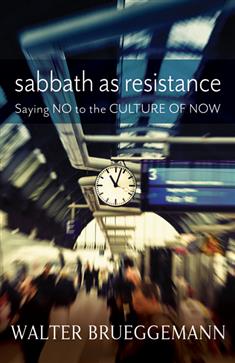
Sabbath as Resistance - A Review

We live in world that never stops moving. There are more options than ever for activities to spend our time. We have access to seemingly unlimited activities, many of which are harmless or even in some way good. Our jobs seem to claim more and more of our lives each week. The special effort for a big project begins to be the every week demand because we, and our employer, has realized if we can make the sacrifice sometimes we can make it all the time. The endless stream of entertainments and opportunities has led many cultural critics to describe Westerners as exhausted, bored, and overworked.

With that motif in the background, Walter Brueggemann’s recent book, Sabbath as Resistance: Saying No to the Culture of Now, has an interesting appeal. As an Old Testament scholar, an interpretation of the 4th Commandment would seem to be exactly in his realm of expertise. 

The book is a brief 90 pages or so, which makes reading it a sort of Sabbath in itself. This volume actually began its existence as a Bible study series that is available as a download from www.thoughtfulchristian.com for a higher price than this book. However, the original format of the volume explains the construction of the book and some of its characteristics.

Sabbath as Resistance has a brief preface followed by six studies on different aspects of the Sabbath. Brueggemann considers the Sabbath in relation to the first Commandment, and the Sabbath as resistance to a series of modern vices, namely anxiety, coercion, exclusivism, and multitasking. The book concludes with a discussion of Sabbath and the Tenth Commandment. Each of these topics is important and potentially helpful to Christians in a frantic world.

Brueggemann, interacting positively with Michael Fishbane’s work, argues the Sabbath “concerns the maintenance of a distinct faith identity in the midst of a culture that is inhospitable to all distinct identities in its impatient reduction of all human life to the requirements of the market.” He goes on to say that the celebration of Sabbath is “resistance because it is a visible insistence that our lives are not defined by the production and consumption of commodity goods.”

For Brueggemann, Sabbath is much less doxological and much more economic. He certainly has a point here. When the original practice of Sabbath is considered, it largely differentiated Israel from the surrounding nations on an economic basis. It is easy to find support in Scripture for the argument that resting from economic activity on the Sabbath reflects a trust in God which has a doxological element.

Unfortunately, this book never really makes such an argument. Sabbath as Resistance is much more a diatribe against market economics than it is a theological argument for worshipful rest. The rhetorical rejection of a market economy is an undercurrent that runs just beneath the surface of the entire volume, occasionally bubbling to the top. Through all this, Brueggemann does not appear to consider the possibility that consumerism is an abuse of market economics. 

I tend to agree with Brueggemann that Christians need to practice a form of Sabbath. The 10 Commandments are a part of the moral law, and as such, still in play since they reflect God’s very nature. The fact that God himself practiced Sabbath after creating the world demonstrates that resting and enjoying the fruit of one’s labor is a part of the proper cycle of the created order. The reality that a failure to constrain our desires often leads us to overwork and under-worship is another argument for restoring a healthy practice of the Sabbath that resonates with Brueggemann’s book.

However, Brueggemann’s simplistic view of a market economy––that it “mandates that one must sink or swim by one’s own effort, and it is never enough simply to tread water”––reflects a confusion of an unhealthy attitude that has cropped up in our current consumerist economy rather than a cry for a rejection of the system out of hand. The problem may not be the system as much as it is the sinful people living and working within the system. Therefore, I agree with much of Brueggeman’s application, but not with his motivation.

A weakness in this volume is that it never deals with some important questions: 1) How is Sabbath to be practiced? 2) How did the Sabbath transfer to the Lord’s Day in the NT fellowships? 3) What do we do with Jesus’ teaching on the Sabbath? Brueggemann appears to be so interested in presenting opposition to a free market economy that he misses obvious biblical data and practical questions that would make this a more helpful volume.

In the end, I appreciate some of what Brueggemann is doing here, but he has an axe to grind and does not support some of his conclusions well enough in this context. This is worth reading as one perspective on the contemporary practice of Sabbath in Christianity, but it has too many flaws to be helpful as a Bible study resource.

Note: A gratis copy of this book was provided by the publisher with no expectation of a positive review. The opinions above are entirely my own.

Prayer: Experiencing Awe and Intimacy with God

If you are Christian that struggles with prayer, then Tim Keller’s recent book, Prayer: Experiencing Awe and Intimacy with God, is for you. Of course, this means that I am recommending this book to every Christian on the planet because we all struggle with prayer at some point in our lives.

I like Keller’s stuff. I have read most of his books and have listened to many of his sermons. This is, perhaps, his best book so far. That is really saying something.

Despite my appreciation of Keller’s work, I wasn’t sure what I was going to get when I picked up this book. Most books with the word “prayer” in the title end up being glorified self-help books that present a moralistic vision that guilts the reader about not praying enough or not praying correctly. Other books provide simplistic formulas for prayer that may be helpful in the short term, but which fall short of helping the reader construct a theology of and methodology for personal prayer.

Prayer is a masterpiece on this very important spiritual discipline. In a world filled with a myriad of views on the nature of prayer, the methods of prayer, and the efficacy of prayer, Keller’s book stands above the rest.

This book critiques the most common popular errors about prayer. Keller disabuses his readers of the notion that an omnipotent, omniscient, sovereign God would not expect his people to pray. Keller writes:

“If we believed that God was in charge and our actions meant nothing, it would lead to discouraged passivity. If on the other hand we really believed that our actions changed God’s plan––it would lead to paralyzing fear. If both are true, however, we have the greatest incentive for diligent effort, and yet we can always sense God’s everlasting arms under us. In the end, we can’t frustrate God’s good plans for us (cf. Jer 29:11).”

With arguments like these, Keller eradicates the notion that theology–-understanding what God is like––is unimportant to prayer. This book convicts the reader of the importance of prayer, but reminds the reader of the reality and availability of grace.

Keller seeks to present a vision of prayer that is theological, experiential, and methodological in one book. He does this well.

The theological frame for this volume is built from Scripture. Keller emphasizes that the Psalms are largely a collection of prayers. They provide examples of how God’s people have prayed in the past, which can be appropriated by God’s people today. Keller also explores what great theologians of the past have written about Prayer. Augustine and Luther both wrote letters to parishioners on the topic of prayer. In The Institutes of the Christian Religion, Calvin has an excellent treatise on prayer. Keller summarizes and shares the pith of these pastor-theologians’ writing on prayer. The depth and breadth of the research are part of what makes this new volume a classic text.

The experiential aspect emphasizes the nature of prayer as a conversation with God. We speak to the God who hears and he communicates to us. Contrary to more theologically enigmatic perspectives on prayer, Keller rightly acknowledges that “if prayer is to be a true conversation with God, it must be regularly preceded by listening to God’s voice through meditation on the Scripture.” In other words, Keller’s vision of prayer is more holistic than others, because it includes substantial reflection on the Word of God as an essential part.

This book would be incomplete if it did not provide some helpful specifics that teach the reader to pray. He has chapters dedicated to theological and practical discussion on prayer as worship, as communion with God, and as a means of seeking help from God. Keller also provides some down to earth suggestions for making progress in this important spiritual discipline.

In a world where being Christian and popular at the same time often requires compromise, Tim Keller has managed to shatter the stereotype. Keller’s books sell well because they are well-written, thoughtful, and deal with culturally important topics. Keller’s books are worth owning because they winsomely communicate orthodox truths with depth and accuracy. This book is no exception on either count.

Note: A gratis copy of this book was provided to me by the publisher. There was, however, no expectation of a positive review. All opinions above are my own.

Some additional helpful links:

1. A 1990 sermon by Keller on Prayer from Redeemer Presbyterian.

2. A host of resources on prayer from Redeemer Presbyterian.

3. An index of Tim Keller resources from Steve McCoy's personal site. Multiple linked sermons, interviews, articles, etc.