Darwinism as Religion - A Review

Although most of the time I’ve encountered Darwinian evolution as a theory it has been within the context of apologetic debates, I’ve never before heard someone from the other side of the debate admit the truth that is very obvious to many Christians. This truth is, namely, that Darwinism functions much like a religion.

To many, the assertion that Darwinism has religious traits is offensive. After all, the reason some adhere to Darwinism is not because they have rationally examined it and accepted it over alternatives, but because it provides a set of defeater beliefs against traditional religions, especially Christianity. In fairness, some have examined Darwinism in comparison to the creation story in Scripture and believe that atheistic evolution better explains the universe than does the possibility of creation by a deity, no matter how long it may have taken. However someone who affirms a form of Darwinian evolution should recognize there are faith structures at work.

Michael Ruse is no proponent of creationism or Christianity, but his thesis is pretty simple: “I argue that evolutionary thinking generally over the past 300 years of its existence, and Darwinian thinking in particular since the publication of [his] two great works . . ., has taken on the form and role of a religion.”

Ruse is not claiming that evolutionists believe in a supreme being, but rather, “in the way that evolution tries to speak to the nature of humans and their place in the scheme of things, we have a religion, or if you want to speak a little more cautiously a ‘secular religious perspective.’”

What Ruse does argue is that the are ordering principles and moral demands that people have derived from evolutionary thought during its rise and sustenance. Just as deities have inspired beautiful poetry and prose, so, too, have authors used the muse of random chance plus time to serenade the world with their art. Darwinism has become for some a suitable replacement for the Christian God.

Summary

This volume is an analysis of pre-Darwinian and Darwinian evolutionary thought. He begins with the rudimentary ideas of evolution that preceded Darwin. He offers a quick summary of Darwin’s theory and its early reception, emphasizing the many of those who heard his theories early on recognized the potential for them to serve in replacement for the creator God. These are the first four chapters. The sub-thesis of these chapters is that Darwin’s most signal contribution was being able to transition evolutionary thought from pseudoscience to popular science.

In Chapter Five, the emphasis shifts. Beginning in this section through the end of the volume, Ruse is demonstrating that through Darwin, evolutionary thought “became a secular religion, in opposition to Christianity.” Ruse recognizes that evolutionary thinking requires faith just as Christianity requires faith; it posits thinking in traditional theological categories just as Christianity does. In fact, because of its competition with Christianity for dominance in the world, Ruse spends the remainder of the volume outlining, to some extent, a systematic theology of evolution.

He begins with God. Ruse argues that evolutionary thinkers like Thomas Huxley active sought to replace God with evolution. Thus, he and others had to deal with topics like suffering and meaning in life. Something had to be used to fill the God shaped vacuum and some evolutionary thinkers sought to do that through Darwinian evolution. Meaning, then, becomes not about glorifying the creator God, but fulfilling your evolutionary destiny. For some that appears to have been enough.

Evolutionary thinking is largely seen by some Christians as a theory of origins. It is, in fact, on these lines that the greatest Christian criticism of non-theistic evolution is levied. Instead of seeing God as the eternal creator, they tended to begin with the material as inexplicable and eternal. This left some, like Thomas Hardy presenting the world in somewhat pagan terms in order to avoid the hopeful message of Christianity.

Ruse traces literary evidences of other doctrines, like humanity, race and class, and ethics. Another sharp critique against evolutionary thought from Christians has been the difficulty in founding morality. Thus, Ruse’s efforts to explain how Darwinian thinkers produced a new formula for ethics. It is basically that morality is founded in the evolution of pro-social behaviors in culture. This explanation worked for the likes of Herbert Spencer, George Eliot, and Thomas Huxley, but it worked in part because of the Christian ethos of the culture. There was division even among evolutionary thinkers on the foundations of morality, as Ruse shows that even Jack London anticipated some source for morality besides a properly evolved human nature. Whether one agrees with the foundations of morality developed by evolutionary thinkers or not, Ruse’s chapter is invaluable in showing how they attempted work it out in their literature.

There are similar formulations for topics such as sex, sin and redemption, and the future in Ruse’s book. His exposition of these themes, which are direct answers to Christian questions, are well done. Ruse effectively shows how evolutionary thought has developed in categories that correspond to most theistic religions. He closes out the book with chapters on Darwinian theory as it developed and is developing and reflects on the continued strife between traditional Christian understandings of the world and Darwinian thought.

Analysis

The summary above does not do justice to the subtlety and significance of Ruse’s demonstration of the religious aspects of Darwinism. He is working from the works of poets, novelists, and playwrights. While they might not be as ideologically precise as a professional philosopher, artists tend to reflect a more full-bodied, authentic expression of ideas than the careful, precise, sometimes defensive words of those engaged in philosophical fencing. In other words, writers tend to say what they actually think something means, not just the pieces of the puzzle that are defensible. Apologists tend to be more coy and to phrase their counter-arguments less clearly when they are difficult to defend.

As Ruse covers his selected topics through literature, it becomes clear that the sense of religiosity that Christians tend to find in evolutionary thinking is actually there. In other words, Ruse exposes that Darwinism is really a religion, with tenets of faith, concern for orthodoxy and the like.

Demonstrating the religiosity of Darwinism doesn’t automatically discount its credibility, but it does put it on an even footing with Christianity in terms of its content. In other words, instead of being able to claim that evolutionary theory is an impartial, scientific truth, Ruse shows that as it is often proclaimed—by Darwinists, neo-Darwinists, and other evolutionary apologists—evolutionary theory is simply a competitor to other religions.

This is an important step, because if this reality is accepted, it means that Darwinian thinking and its later evolutions should be subjected to the same sorts of rationalist critique as revealed religions such as Christianity. It means that apologists for evolutionary faith over against Christianity must do their leg work to engage the Christian faith and demonstrate the value of their own faith system. Ruse is helping the discussion to be more honest.

Such a calling to honest self-evaluation and openness to legitimate discussion is a good thing for the dialog for evolutionary thinkers and Christians. Recently proponents of unguided evolution have come to ridicule anyone that presupposes a divine being who is engaged in design and creation. They claim this is because of science, but as Ruse shows, the basis of their assertion is really a serious of quasi-religious faith assumptions.  After all, evolutionists must still grapple with where it all came from and why there is something rather than nothing. That isn’t science, it needs religious thinking to explain it. Simply positing that aliens sent life to earth is really just cheating, because it isn’t far from aliens to God in reality—at least not as far as the need for belief. In fact, given the possibility of revelation, there is much less evidence of aliens than there is God.

Conclusion

Darwinism as Religion does not end any discussions. It is a solid literary analysis by a well-read, fair-minded author. Instead of killing discussions or proving anyone’s point absolutely in the whole evolution vs. Christianity debate, it shows that the debate is necessary and that those who dismiss Christianity as irrationally faith based need to pay attention to the faith assumptions that got them where they are.

Ruse has done a great work to produce this volume. It adds to the field of scholarship on the topic and is a great addition to the library of both Christians and atheists seeking to understand the historical and literary presentation of evolutionary thought.

NOTE: I received a gratis copy of this volume with no expectation of a positive review.

Every Waking Hour - A Review

Every Waking Hour is the third installment of volumes published as part of the Economic Wisdom project at Southeastern Baptist Theological Seminary. This brief volume, written by Benjamin Quinn and Walter Strickland, focuses on the doctrine of vocation and presents it at a level accessible to the average church member.

The book consists of five content chapters in addition to its introduction, conclusion, and three brief appendices. Chapter one presents an overview of the theology of work. The next two chapters outline the concept of work as it is presented in Old and New Testaments, respectively. Chapter four focuses on the relationship between Christ, wisdom, and work. The last content chapter synthesizes the biblical data and relates it to the idea of working for God’s kingdom, being on mission, and being a good disciple. The three appendices answer the potentially sticky question of how to work with and for non-believers, describe how to evaluate your job in relation to your vocation, and offer suggestions for further reading.

Every Waking Hour is a clear, basic introduction to an important topic. After all, people spend a great deal more time working for a living than they do in church or actively praying. If we cannot redeem those hours spent on the job for the kingdom of God, then one wonders how Christianity is really valid as a totalizing worldview. The text begins with Scripture and remains close to that touchstone throughout. This is a volume that does not seek to baptize vocation, but to explain what the Bible says about it.

Strickland and Quinn exhibit a pastoral concern for Christians trying to figure out how to reconcile their workaday roles with their Christianity. They reinforce the reality that the pastor’s work is not holier than the janitors. The lowliest employee on the job has the potential to bring about redemption of some part of the world through his work. Upon reading this, one can hope readers will respond with gratitude as they have the value of their vocations affirmed beyond their ability to earn a paycheck and fund the church’s various endeavors.

For those well read in the faith and work movement, this volume adds little that is new. It is not a scholarly volume designed to stretch the field or innovatively explain the topic. Rather, it is a basic primer for the uninitiated. At just over one hundred small format pages of text, this is the sort of book that can be devoured in an airplane ride. It could also serve as a resource for a several week Sunday School elective on the intersection of faith and work.

Southeastern Baptist Theological Seminary has produced three volumes like this, which offer simple, clear, and basic introductions to important topics. Although such resources lack the scholarly weight of a technical monograph, this sort of resource created for the Church is likely to contribute to the welfare of a significantly larger number of Christians. As such, this book and the entire series are a welcome addition to a pastor’s library.

Political Church - A Review

As C. S. Lewis once wrote, “A sick society must think much about politics, as a sick man must think much about his digestion.” By this metric our society is very diseased. Even given the special focus on politics caused by it being a Presidential election year, society is excessively focused on politics because our society is a festering wound of dislike and division.

One might think a book on political theology would simply contribute to the excessive focus on politics and the sickening mix of politics and religion that we are seeing with the Religious Left openly lobbying for their flawed candidates and the Religious Right arguing for theirs, too.

However, in the hangover from this election, the church will do well to pick up Jonathan Leeman’s recent book, Political Church: The Local Assembly as Embassy of Christ’s Rule. This is the book on nutrition for the glutton suffering from indigestion after binging on junk food.

The thesis of Leeman’s book is that “the church is a kind of embassy, only it represents a kingdom of even greater political consequence to the nations and their governors. And this embassy represents a kingdom not from across geographical space but from across eschatological time.”

This would be a dangerous theory if Leeman were arguing that the church has the same political purpose as a parliament or congress. There is a difference between the church and the state; they have overlapping magisteria but different means of influence. Leeman’s vision of the church and the state is not of two kingdoms, but of a single kingdom with state and church reflecting the authorities of the current kingdom and the future kingdom, respectively. Leeman stands well within the Augustinian tradition via a deep interest, though not uniformity, with Oliver O’Donovan.

Summary

This is not an introductory volume on political theology. Leeman’s discussion is a distinct approach to the place of the church in contemporary politics, but understanding this volume requires a fair understanding of the various political theologies that he is critiques and is building upon.

At the same time, Leeman’s volume begins a step before many others do by addressing some of the basic questions that one must understand before attempting a political theology. The first two chapters of the volume address the important questions, (1) What is politics? and (2) What is an institution? The various meanings of these terms are discussed in some depth before moving on. Though Leeman leaves some flexibility in the terms for his own use, his discussions of historic definitions provide context for the remainder of the book.

The next four chapters outline a positive political theological using a biblical theology as a foundation. The chapters run along the progression of creation, fall, redemption, and restoration.

The chapter on creation places God at the center of all politics. He made this world and is the just and righteous judge of all things. It is his authority that is represented through the work of both the government and the church. The nature of politics is shaped by the nature of the creator God.

In dealing with the fall, Leeman goes beyond the actual original sin of the primal couple to discuss how falleness has influenced all human interactions since that time. Leeman walks through the biblical storyline to show how sin has influenced government and increased the need for its justice.

The chapter on the politics of the new covenant focuses on the ongoing need for the work of the cross to be done in public. This means repentance, forgiveness, and good natured striving for the common good. Leeman is careful to distance his view from theonomy. In fact, he notes that attempts to bring about the eschatological kingdom on earth now never end well. Instead, Christians should work to apply the gospel as much as possible to earthly situations as one would expect of citizens on the new covenant kingdom.

The last chapter deals with the politics of the kingdom. However, this doesn’t refer to the eschatological kingdom, but is an especial focus on the polity of the local congregation. Leeman exercises his Baptist muscles in talking about the importance of church membership, credo baptism, and right practice of the Lord’s Supper. These are elements of the church that prefigure the coming kingdom. By being faithful to justly administer its own borders, the church stands as witness to the kingdom that is to come. The church is a political body because its policies and ministry influence the world, though it begins at a very local, individual level.

Analysis

Leeman’s book is a helpful approach to political theology because it begins with the narrative of Scripture and asks what the text says about the church’s political engagement. By beginning with the ideas of Scripture and working out, he formulates a much more distinctively Christian political theology.

In other words, political theology generally begins with a vision of what good is, which is often derived from an interpretation of Scripture. However, most political theologies then apply an extra-biblical method to achieve the desired goods.

For example, the Social Gospel movement sought (or seeks) to bring about the kingdom largely through a Rawlsian approach to government that favors strong individualism and a preference for government engagement in solutions at nearly every level. This approach then creates an implicit need for the church to pursue justice by seeking greater government control and introducing more radical human freedoms. The church’s main role in this vision of political theology is as a lobbyist to influence the state’s earthly authority.

A similar criticism could be levelled against movements that are more theologically conservative, as well.

The point is that Leeman’s volume offers an approach that is designed to constrain the Church to her proper role in pursuing a right polity within her own area of influence. The message of the gospel as it is preached in the church should affect all of life, but the authority of the Church in the present age is somewhat limited. Leeman’s biblical theological approach to political theology helps to keep the church in her lane, and rightly focused on the gospel.

Leeman’s point is that the church is an inherently political institution. When it is functioning well, it cannot help but influence the world around with the message of the gospel. If the church fails to equip people and influence communities toward justice, as it is biblically defined, it has failed in its mission. However, when the church begins to engage in politics to increase redistribution of wealth through taxation or enforce certain moral codes through judicial means, then the church has exceeded its authority. Between these failures is the proper political role of the church.

This is a helpful resource for those who are familiar with the general content of political theology. Leeman’s approach is innovative and fresh. It is distinctly biblical. As such, it is a useful resource for those seeking to live rightly in our fallen world.

Note: I received a gratis copy of this volume from the publisher with no expectation of a positive review.

Making Sense of God - A Review

Tim Keller has done it again.

Not too long ago his book, The Reason for God, hit the presses and it was quickly described as being in the same league as Lewis’ Mere Christianity. That praise was justified, as Keller had studied the zeitgeist well and understood the questions people were asking. There was a large swath of young people who needed to read exactly what Keller wrote at that time.

However, time, tide, and formation wait for no one. As the polls are revealing, a larger number of people are identifying as “nones.” These are people who have no religious affiliation. As one “none” explains in her book, it often isn’t that the nones are opposed to religion, they just don’t see the point.

On the other hand, judging by the commenters on the internet, there are a large number of people who find religion repugnant. According to this view, religious people are ignorant, naïve, or perhaps even simply evil. They argue that religion is inherently irrational because it relies on faith; in contrast, non-religion (or whatever they try to label their faith commitment) is based on objective science. Therefore, rejecting religion is the only logical solution.

Keller’s recent book, Making Sense of God, will speak to either of these groups.

Much like any book, the antagonistic skeptic will be unlikely to dig into this volume and glean anything from it. However, Keller is irenic, so anyone who is actually looking for a credible case for Christ can find a good representation of it in Keller’s book.

Summary

The book begins with a preface, which introduces a reality many are unaware of: secularism is based on faith. Although the question of religion vs. non-religion is often pitched as faith vs. reason, Keller announced that isn’t the case. The reader must be patient as he carefully unfolds his argument over the following chapters.

Keller explains that, contrary to the popular myth of secularists, religion isn’t dying. It may be on the decline in the Unites States, but in the world at large, the number of faithful are growing. Thus, it isn’t that the secularists are paving the way into the future by resisting religion, rather, they are simply resisting the inevitable growth of faithfulness.

The next chapter explains that secularism relies on just as much faith as any religion does. No one is purely rational, and most professional philosophers recognize that. Everyone has certain basic assumptions that must be taken on faith. You can’t, for example, empirically prove that the scientific method is the best--never mind the only­­--way to understand more about the world. This doesn’t mean that religion is necessarily correct, but it means that religion should not be immediately dismissed as something intrinsically different that secularism.

Having established the possibility of rationally considering religion as another competing worldview to secularism, Keller shifts into a shift into a defense of religion itself. Throughout the beginning of the book, he argues for the possibility of religion generically, but the informed reader will see that Keller is moving toward Christianity as the best and only viable option for all problems.

Keller argues that religion provides meaning that suffering can’t take away, satisfaction that is not based on circumstances. He shows that “do no harm” is an insufficient ethical principle, because it fails to represent the true complexity of our interconnections. The modern concept of the autonomous self is an unworkable, unjust myth. Something must be added to secularism to answer these problems, and that something is the Christian faith.

Similarly, Keller shows that the modern idea of the self is incoherent and insufficient. Humans cannot find their identity from within, because that is self-defeating. In contrast, belief in the Christian faith offers an eternal, unchanging identity that does not crush the individual nor exclude all others. This leads to a hope that cannot be eliminated based on circumstances. There is an eschatological future of joy for the human that has faith in the one true God.

Traditionally atheists have resisted the concept that they can’t be moral. It is true that atheists are often nicer than Christians, but more and more secular thinkers are recognizing that despite their many flaws, Christians tend to be much more active in doing the good things that need to be done. This is because they have a morality rooted in God. This is something that religion adds to the secular conversation. At the same time, Keller critiques many churches that have morals for being legalistic. He offers his critique, but at the same time encourages the skeptic to recognize that this is a failing of particular congregations, not of Christianity. True Christianity has morality that enlivens and does not crush the soul. The cross shows how that can happen.

The last few chapters are a more traditional apologetic for faith in Christ. Keller presents the gospel winsomely and in a way that someone who has journeyed so far into the volume will recognize the sincerity of the invitation.

Analysis

It’s a sign of the times that Keller would have to lay the groundwork so carefully for faith in Christ. This is the shape of evangelism in the future. We need to begin farther and farther back in our conversations with many people. It becomes less safe to assume that someone knows the story already and we are just calling to repentance.

More and more, when people are told they need to repent, they are likely to ask from what. Our age is secular, religion has been maligned by its enemies and misrepresented by many of its adherents. Keller provides the necessary dialog to bridge the gap between a skeptical world and Christianity.

I commend this volume to the skeptic as a good argument for faith, especially faith in Christ. For the Christian, this book should be read, digested, and studied in preparation for answering the questions of unbelieving friends. This is more likely to answer the necessary questions than the memorized outline of Evangelism Explosion. For the parent, this is the sort of volume you should read with your children, so that even after they’ve prayed the prayer and walked the aisle they understand the reasonable basis for their faith.

Making Sense of God is a masterpiece. Having read it, I will read it again. It is well-written, well-researched, and on point. Keller has done a service to the Church in writing this volume. My hope is that many will read it, both those inside and outside of Christianity.

NOTE: I received a gratis copy of this volume with no expectation of a positive review.
The Marvelous Pigness of Pigs - A Review

God created nature so that it has integrity. Different pieces of creation have purpose according to the way God designed them. These differences are part of God’s design. There is a moral order in the created order that should be honored.

When humans distort the moral order of the created order, it results in evil, suffering, and sin. This is true whether it is the distortion of human reproduction, relational development, or farming practices.

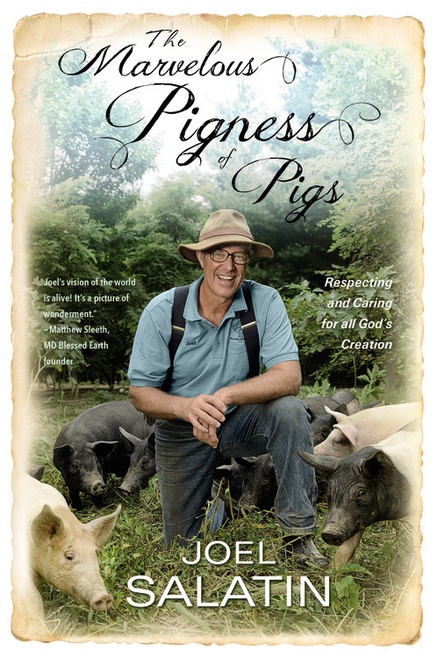
I share this understanding of the moral order of the created order with Joel Salatin, who recently wrote The Marvelous Pigness of Pigs.

Forgiveness Farming

Salatin is a libertarian farmer. He runs Polyface farm, practicing what he calls forgiveness farming. His method of farming entails stewarding his farm, with both crops and animals, in a way that mimics natures patterns and harnesses the processes of nature. Therefore, he eschews monoculture, but instead rotates crops and animals on a regular basis.

Farming for Salatin is about feeding his family while making the world a better place. He is careful to emphasize that maximizing profit by outpacing the ability of his land to replenish itself is not a goal. In fact, it’s exactly the sort of thing that Salatin works to prevent.

Salatin is a somewhat more modernized version of Wendell Berry and Gene Logsdon. He recognizes that the farm should only produce at nature’s pace and that farmers need to take the long view of economic stewardship. At the same time, both Berry and Logsdon are strong proponents of more rustic farming methods. In particular, they both advocate horse farming.

In contrast to Berry and Logsdon, Salatin does not eschew innovation, but he still keeps a close eye on the patterns in nature. Find what makes a pig healthy and allow it those conditions. In this manner, Salatin's perspective on farming is much less romantic and much more realistic than that of Logsdon and Berry. As a result, his vision of farming has a better chance of implementation.

Preaching to the Choir

For those already questioning the factory farm methods, The Marvelous Pigness of Pigs. Even for those who are just skeptical and wondering if there is another way, Salatin presents a case that will seem like common sense.

This volume, however, offers more eloquent argument than compelling data. Those committed to agribusiness will not find The Marvelous Pigness of Pigs very convincing. This is a nice book full of anecdotes, not a scientific argument.

Though Salatin is a farmer, the subtitle of the book seems to indicate the topic of the book includes a broader environmental ethic. It’s certainly present in Salatin’s writing for those equipped to find it. Respecting the integrity of creation is the beginning of a robust Christian environmental ethics. However, the focus of the book quickly slips into Salatin’s wheelhouse: the evils of the factory farm, the benefits of his methods of farming, and the importance of good quality food.

Some Points of Weakness

Overall, the book is an engaging read. Salatin is nothing if not an interesting writer. There is a theological point in the book that is well worth listening to.

At the same time, this volume falls short of excellence on several important levels. First, Salatin’s writing style is raw. In trying to make the book entertaining he significantly overwrites in places. There are exaggerations, sandbags, and linguistic flourishes that would have made good blog posts, but make reading several hundred pages tedious. Good editors should have assisted Salatin in writing better. Toward the end of the book, Salatin repeats himself a lot. Statistically speaking, most people don’t finish books. However, those of us who do finish books like to find original content at the end, too.

Second, the book is theologically anemic. There is no doubt Salatin is an engaged and faithful Christian. However, the book lacks awareness of basic doctrinal teaching. Salatin has familiarity with Scripture, but his repeated misuse of texts to make points is grating. In many cases Salatin makes a sound, biblical point, but uses an unrelated proof text to support it. Additionally, the translation of Bible quotes seems to have been selected for words that match his point, rather than faithfulness to the text and context of Scripture. These are the sorts of weaknesses I expect to find in independent blogs on the internet or self-published e-books, not in books from established publishing houses.

Third, the thesis of the book undermines a holistic environmental ethics. According to Salatin, “The thesis of this book is simple: all of God’s creation, the physical world, is an object lesson of spiritual truth.” (pg. xiv) This sort of matter-spirit dualism is the cause of much of the heartbreaking failure of many fundamentalist and evangelical Christians to engage in environmental ethics. The physical world is not merely an object lesson for spiritual truth. It is not even mainly an object lesson for spiritual truth. The basis for a Christian environmental ethics must include the inherent value of the present creation. Minimizing that value by describing God’s creation as a mere object lesson does not provide the best or most biblically faithful foundation for Christian environmentalism.

Some Points of Strength

Despite these critiques, Salatin should be applauded for engaging in a discussion of environmental ethics from a conservative Christian perspective. As my own doctoral research has shown, there is too little positive engagement by conservative Christians on the topic. As a Bob Jones University graduate (and previous alumni of the year), Salatin may help some Christians who have written off environmental concern as “earth worship” see that there is value in caring for the environment.

I also celebrate Salatin’s continued efforts to recognize the unnecessary suffering of animals that occurs in some modern factory farms. In particular, Salatin’s call to utilize the market to entice meat producers to change their methods is a healthy approach. If people begin to demand meat from animals whose God-given value is recognized during their lives and in their deaths, then some unjust practices can be eliminated without the inevitable secondary consequences of additional governmental regulations.

Conclusion

There is much to be praised in this book. Salatin does well to show that one can be an orthodox Christian, committed to the fundamentals of the faith, and still be concerned with proper, loving stewardship of creation. However, there were significant opportunities for a more theologically robust case for creation care in this text. Salatin failed to take them. The book is only moderately successful as a result.

Note: I received a gratis copy of this volume from the publisher with no expectation of a positive review.

What Christians Ought to Believe - A Review

Are you looking for a solid, theological book that you can read devotionally? If you’re not, you should be. If you are, then pick up Michael Bird’s latest book, What Christians Ought to Believe: An Introduction to Christian Doctrine through the Apostles’s Creed.

 Everything Bird writes is entertaining. His punchy prose springs from the page, even when he’s writing deep theology. He intentionally uses attention grabbing language and examples to make important points memorable. The purposefulness of Bird’s exuberant writing is what keeps his books from being over the top. He uses snappy rhetoric only to punctuate the most important points, not merely to entertain.

 Summary

 What Christians Ought to Believe is divided into fourteen chapters, so a chapter by chapter summary would be tedious and unproductive. However, an overview is in order.

 Bird begins with a basic defense of creeds and their relation to a biblical faith in four chapters. This is a necessary discussion for Free Church Christians (such as myself) who have historically questioned the place of creeds. After giving sound reasons to study the creeds—though certainly not slavishly—Bird shifts to a discussion of the nature of faith. This section outlines what biblical faith is in contrast to the generic call to believe that culture issues. Faith is substantive. Faith requires a solid object. Faith is a gift from God. Faith is enhanced when it is placed in the God who is carefully described in the Apostles’ Creed.

 Having laid the groundwork for the remainder of the study, each of the remaining ten chapters picks up a phrase from the Apostles’ Creed and explains why proper belief in that element of traditional Christian doctrine is necessary for a healthy orthodoxy. It's a simple structure, but effective.

 Application

 Each of the chapters has from twelve to sixteen pages. I read a chapter a day in the morning as part of my daily devotions for a couple of weeks. The rich theology, solid history, and entertaining prose make this an excellent way to begin the day. There are enough clear divisions within the chapters so that slower readers could easily make this a longer study without losing the flow.

 This is the sort of volume that I would love to see used as college level book study. I am giving it strong consideration for use in our homeschool curriculum, when my oldest gets to high school. It would also be a worthwhile resource for the discipleship of new adult believers. The reading level is moderate, so for the right audience, this would be an excellent tool.

 I could also see this being used as an auxiliary volume in a systematic theology course. Bird references sections of his Evangelical Theology after each chapter, but What Christians Ought to Believe could be used apart from his systematics.

 Whether the book is included in a course, used as a small group tool, or simply for personal edification, this is a volume that warrants attention.

 Conclusion

The one potential weakness of this volume is that there are a few cases where some readers may find Bird's illustrations to be excessively shocking. This will depend on the audience. One example is in Bird's account of first hearing the gospel, he relates a humorous story that includes monkeys giving themselves testicular exams. Many readers will find it funny and move on, and the story serves to wake the reader up to get the gospel in the same paragraph. However, some readers may find a few such flourishes to be a little too much locker room talk for a serious theology text.

What Christians Ought to Believe is a great addition to a theological library. It is well-written, theologically sound, and expresses the Christian faith positively. Instead of making a case against heresy, Michael Bird lays out his case for orthodoxy. If we continue to get books of this tenor and quality, there will be a lot to cheer about in the near future.

Note: I received a gratis copy of this from the publisher with no expectation of a positive review.

Every Good Thing - A Review

Some Christians seem to doubt the goodness of the world around. They take the opposition of “the world, the flesh, and the devil” to mean that somehow the material world around is sinful and must be repudiated.

This position has its roots in an exaggerated application of Jesus’ commands to seek the kingdom first and store up treasures in heaven. These commands are intended to call Christians away from the this-worldly focus that tends to consume our minds by virtue of proximity.

The anti-world attitude has been popularized in Christian hymns like, “This world is not my home, I’m just a-passin’ through.”

We have reason to hope in the coming restoration of all things. This is an eschatological hope. However, that hope should inspire action in this world, not cause Christians to withdraw into a bunker mindset.

The balancing act between hoping in heaven and working in this world can be difficult, but it is absolutely necessary.

The recent book from David W. Jones, Every Good Thing, is a valuable resource for Christians seeking to balance heavenly mindedness with this-worldy goodness.

Every Good Thing is an intentionally introductory volume, which has as its main goal the reunification of the Christian life. We are called to be seven-day Christians, who apply biblical ethics to each decision, and every situation. We are driven, because of the demands of a biblical worldview, to see each area of our life as subordinate to the lordship of Jesus-Christ. Jones’ recent book helps with that reunification.

Summary

The book is brief, with a little over 100 pages of text, but in a small format. It is designed to be easily read, digested by a wide audience, with clear lines of application. The format is ideal for a short term book study in a small group or use as a text in a discipleship context.

The first of six chapters provides a foundation for the remainder of the volume, defining terms and outlining how Jesus’ life and ministry fits into the discussion of goodness and the material world. Chapter two deals with work and vocation. The topic is en vogue in conservative Christian circles, but mainly because it has been neglected for a number of years. This chapter charts a course for reuniting the Christian life through a better understanding of calling.

The third chapter seeks to balance out the idea of work and vocation with a discussion of rest and Sabbath. One of the possible side-effects of viewing work as an opportunity to serve God is that it will cause a restless, relentless push for productivity. That isn’t the point, as Jones stresses in the third chapter. Rather, rest and Sabbath are gifts from God to balance the goodness of human productivity with the joy of God’s provision.

Chapter four outlines a biblical theology of wealth and poverty. Here, Jones pushes back against attitudes that see spirituality as necessarily connected to financial prosperity. He fights the errors of the so-called Prosperity Gospel as well as the competing errors like asceticism. Christians need to value the world properly, which generally means walking a narrow road between extreme errors.

In the fifth chapter, Jones takes on the idea of valuing creation and stewardship. Environmental ethics has generally gotten a bad rap among conservative Christians. Part of this is that much of the environmental movement has gone head over heels for anti-human attitudes that run contrary to Scripture. However, there is a strong place in Christian theology for rightly caring for the creation God has entrusted to humans. Jones makes a good case for that in this chapter. He then closed in Chapter Six with some summary comments, pointing toward areas for further study.

Analysis and Critique

This book’s greatest limitations are in its format. The accomplished scholar will pick up this brief volume and wonder what it adds to the scholarly discussion. The answer to that is simply, nothing. No chapter is comprehensive. There are no footnotes. Every rabbit trail is not chased. A particular set of assumptions about Scripture and theological method are made and not defended. That is the nature of this book as an introductory volume.

Conversely, the greatest strengths of this book are in its format. The layperson or young theological student can pick this book up and gain a quick understanding of a conservative perspective on the relationship between Christianity and the surrounding world. It is grounded in a distinctly orthodox worldview, and intended to bring people into the conversation that might otherwise not be exposed to these important ideas. 

This book fills a desperate need for the Church. It helps form the connection between a Christian worldview and the world around. Jones has written winsomely and carefully. This is a book that would serve well in a number of settings in the local church, and would be a particularly useful tool in discipleship activities with young Christians.

Note: I received a gratis copy of this volume from the author with no expectation of a positive review.

Public Faith in Action - A Review

If this election cycle has revealed anything, it is that there is a drastic need for improvements in the way public dialog occurs. It has also revealed the need for Christians to engage in political discourse in a distinctly Christian manner: informed by Scripture, reasonably argued, and carefully expressed.

Miroslav Volf often exhibits the gracious demeanor in public discourse that is exemplary for Christians. His recent volume, Public Faith in Action: How to Think Carefully, Engage Wisely, and Vote with Integrity, offers an example and encourages such political engagement. The book was co-written with an associate research scholar at Yale, Ryan McAnnally-Linz, based on a series of Facebook posts Volf published.

The book claims to be non-partisan. That claim is fair, though it is clear that the political leanings of the authors are center-left. In most cases the positions presented are well-reasoned and have the reasoning explained. Each topic is put forth with some foundational discussion, followed by some proposals for non-negotiable points for Christians, and then examples of points that are open for debate. Notably the authors provide no non-negotiables for the topic of marriage and family, since their position reflects a revisionist concept of those institutions. For the most part, however, there is a pattern of consultation with Scripture, tradition, and reason.

One major concern that this volume creates is that the authors call for greater government intervention for nearly every social issue. There are times when more laws and additional spending are necessary. However, one of the solutions for most of the problems they discuss is more government funding. At the same time they call for a wise stewardship of both personal and national finances. The necessary conclusion is that increasing taxes is necessary for justice. This is an opinion that many contemporary Christians on the left and center-left share, but the continual growth of the government is not necessarily the only Christian response to these difficult issues.

It is possible that this volume will find readers who already lean left and convince them that Volf and McAnnally-Linz present a case that is truly reasonable to all Christians. This risks continued ostracization of right-leaning Christians who are unwilling to accept some of the authors’ supposed non-negotiables, though they may resonate with the need to deal with the issues. This perception is aided because nearly all of the recommended resources of the volume are from sources that range from center-left to radically left in their politics and theology. There are only a handful of conservative sources offered, only increasing the false perception that right-leaning Christians are not discussing some of these issues.

These concerns aside, the volume is valuable. The tone of the volume is reasonable and non-accusatory. The authors have succeeded in presenting their case in a way that is inoffensive and engages the big ideas in culture without demeaning people that do not hold the same positions. The style of communication is exemplary for real public discourse.

One of the keys that makes this volume helpful in creating legitimate dialog is that for each chapter Volf and McAnnally-Linz explain the question they are seeking to answer. Public discourse often falls into shouting matches exactly because participants do not define their terms or engage the same question. This book is to be commended for seeking to diagnose and respond central questions related to significant public concerns. In the case of marriage and family, the integrity to identify the questions they are addressing and the vision of the common good they are pursuing make clear why they arrive at a revisionist answer.

Another strength of the volume is that it works from the understanding that the Christian worldview touches every aspect of life. Much of the discourse in the public square seems to be divorced from the notion that Christianity has anything to say about the common good. Although their solutions are often based on philosophical and political predispositions that are not distinctly Christian, their identification of the problems and the need to respond reflect the influence to a holistic Christian worldview.

This book is worth reading and sharing. Although some of their conclusions are debatable, the general approach to each topic is exemplary. This volume will not end the discussions, nor be the foundation for a definitive Christian approach, however it is a worthwhile example of faithful engagement of important issues in a non-contentious manner.

Note: I received a gratis copy of this volume from the publisher with no expectation of a positive review.

Kierkegaard - A Review

Sometimes it seems like the Church is asleep at the wheel. Some Christians cheerfully abandon cherished beliefs and live as if the gospel didn’t matter. Others act like forgiveness is for wimps and neighbor love is best expressed by yelling arguments to someone securely wrapped up in a headlock. Søren Kierkegaard may part of an answer to some of these problems.

I know that the answer to many modern conundrums can be found in Church History. However, I must say that I’m surprised to find so much that speaks directly to the present situation in Kierkegaard.

Like many evangelicals, I have avoided Kierkegaard. First, there is the eternal problem of how to say his name without sounding like an idiot. Second, I’m really not a big fan of philosophy. This is mainly because I see a lot of philosophy that has abandoned the pursuit of knowledge and has drifted into a pursuit of esoteric and sometimes solipsistic niggling. Third, everyone has always told me that Kierkegaard is a liberal. Combine these three things together and you have a recipe for bypassing Kierkegaard.

But Kierkegaard may be just what the doctor ordered for 21st century Christianity. According to Mark Tietjen, he’s much more orthodox than I’ve been led to believe and he’s always trying to be faithful. Most importantly, the main thrust of his work was intended to revive the gospel in Denmark. It had simply become too easy to be a Christian and play along. One became Christian by simply by being Danish and occasionally participating in churchish activities.

In addition to the laity presuming their Christianity, the clergy seemed to have lost sight of the purpose of preaching. The Danish church leaders talked about the Bible, but were ineffective in bringing it to bear on the lives of their congregants. There are some circles even among my strongly orthodox peers where that is the present condition. Frankly, it’s the sort of error that I am drawn to.

Enter Kierkegaard

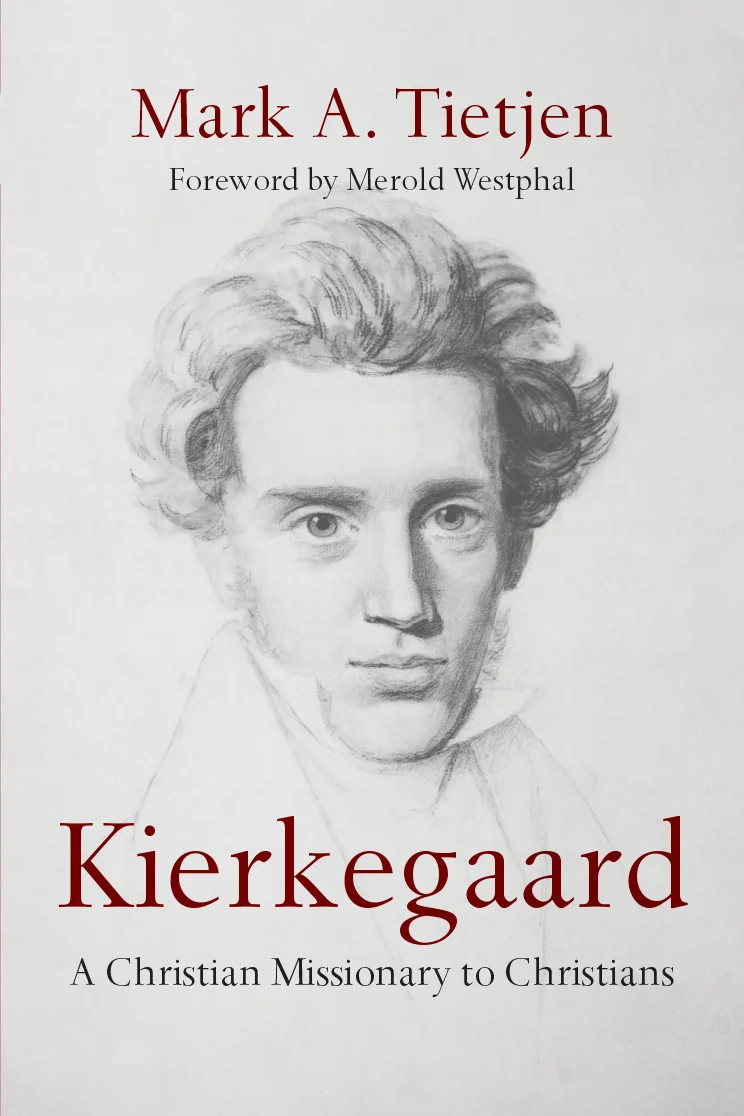
In his recent book Kierkegaard: A Christian Missionary to Christians, Mark Tietjen shows how Kierkegaard’s writing can be used to help call Christians back to a more faithful life in Christ. According to this book, Kierkegaard can be best understood as a prophet explaining the weaknesses of the faith of the people of God. This is not an introduction to Kierkegaard’s work, but an apology for his usefulness for the contemporary Christian Church.

After a brief introduction, the book contains five chapters. In Chapter One, Tietjen gives a biographical overview of Kierkegaard, an apology for philosophy, an apology for Kierkegaard, and a brief overview of his work. In the second chapter the topic of conversation is Kierkegaard’s Christology. Tietjen highlights the fact that Kierkegaard was calling his readers to understand the radical, offensive truth of Christ as God-man. This is a truth that was being (and is again) overwritten by the redefinition as sin and.

Chapter Three discusses how Kierkegaard is helpful in showing what it is to be human. The psychological influence of Kierkegaard is highlighted here and the sinfulness of despair. Kierkegaard calls for the Christian to hope all things, even when things are hard. In the fourth chapter the topic is the Christian witness. Kierkegaard’s work was designed to rouse Christians to live rightly and allow the gospel to permeate their every day lives. In fact, as Tietjen describes it, Kierkegaard felt that right living was the most effective apologetic. In Chapter Five, Tietjen outlines Kierkegaard’s position on Christian love built around the three theological virtues. In a world that tends to misunderstand the nature of love, the refined nuance of Kierkegaard’s position could well be valuable.

Summary and Conclusion

As someone who has read a little of Kierkegaard, I cannot evaluate how accurate Tietjen is. I’ll leave that to other reviewers. However, Tietjen states that his goal “is to convince Christians as I have been convinced that Søren Kierkegaard is a voice that should be sought and heard for the edification of the church.” In my opinion, he has met his goal. I am encouraged to read more Kierkegaard and will recommend that to my friends.

This book met my expectations. I am intrigued by Kierkegaard and will read him soon. Tietjen provides a suggestion for secondary sources that introduce Kierkegaard, so there is a place for me to begin my understanding. In reading this book, I was encouraged, once again, by a figure from Church History that there is nothing new under the sun. The Church has been down this road before and, in this case, Kierkegaard helps to provide the necessary answer. This was an encouragement in a time when I needed some, so I’m thankful for the book.

Note: I received a gratis copy of this volume from the publisher with no expectation of a positive review.

Thing Explainer: A Review

One of the cool things about studying science and engineering is finding out how things work. One of the neatest things about being a parent is teaching my kids about the wonders of the world--both natural and technological--around us. However, having done the first does not necessarily equip me to do the second. Randall Munroe’s recent book, Thing Explainer: Complicated Stuff in Simple Words provides a partial solution.

In some circles Munroe is much better known for his internet comic xkcd, which boasts a lot of geek jokes. He’s also a former NASA roboticist, so he brings that background to the table, combining technical acumen with strong illustration skills to present a unique offering to the curious of the world.

The basic premise of Thing Explainer that many technologies are a mystery because of the terminology used to explain them and not because the technology is overwhelmingly complex. Munroe carefully diagrams 44 different things and explains them using only the 1000 most common words in the English language.

Among the objects explained are a nuclear reactor, elevators, weather maps, a tree, the U.S. Constitution, the USS Constitution, a human cell, a submarine and more. The list is long and varied and extends to many different types of interest.

I do not have the technical acumen to evaluate all of the descriptions and explanations that Munroe provides. However, having been a submariner, I can say that his diagram and explanation of a nuclear submarine is sufficiently accurate and informative. Also, having been an instructor at a commercial nuclear power plant, I will attest to the quality of his description of that technology. There are a few places where I could quibble, but generalizations are necessary and sometimes the differences between the modes of operation explain the apparent inaccuracies. Overall, I think that this book is remarkably accurate and informative.

Thing Explainer is entertaining. The diagrams are engaging. The level of detail is high so that as we flip through the volume it continues to delight with new discoveries. This is not a book that will be once read and quickly discarded. There are detailed explanations of the various labeled parts of all the diagrams, which give opportunity for reading and rereading. The adults in my house have both enjoyed reading this book.

The entertainment value extends to our children. My son (6) thoroughly enjoys looking at the pictures and as an emerging reader is able to figure out most of the words. The girls haven’t been as interested, but it’s there when they want it. This is a really great volume to have on the shelf for kids to pull out when they are bored or curious. I’m hoping that it inspires a growing interest in engineering for all of our children.

Munroe’s explanations are good, in that they reasonably accurately depict the function and operation of the various objects he is describing. This is helpful in breaking through the technical jargon into real understanding. The weakness of this approach, however, is that even if the reader understands the technology she will not be able to communicate with experts in the field. Since Munroe doesn’t give the actual names of the components, but uses roundabout ways to describe them (Intercontinental Ballistic Missile = Machines for Burning Cities), this means that someone can understand how something works and still sound silly when trying to explain it to someone else. Given the option, I’ll still use this as an introduction and a means to increase curiosity in my kids, but the approach brings its own limitations.

NOTE: A gratis copy of this volume was provided by the publisher with no expectation of a positive review.