Recapturing the Wonder - A Review

We are lost in a world that has largely lost its wonder. Small rectangles of sand and copper steal our attention from sunsets, changing leaves, and the very image of God that sits before us at the dinner table. The chemical composition of our food, often merely the presence or absence of some ingredient, is more interesting than its savor and preparation. The many little natural spectacles deemed near-miracles by previous generations have been explained scientifically, and are thus bore us. We are jaded and blind to the spectacular in a world filled with wonder.

4506.jpg

This should never be, especially for the Christian, but most of us fall into the malaise of modernity that saps the glamour from the glory-saturated world around us. We succumb to the continual bombardment of media, entertainment, and fragmented attention that reduces our ability to perceive the holistic wonder of creation.

Mike Cosper’s book, Recapturing the Wonder: Transcendent Faith in a Disenchanted World points us solidly in the right direction to fix what ails prevailing culture.

Summary

The book is broken down into seven chapters with a distinct introduction and epilogue. Each of the chapters consists of a prose explanation of what the problem is with a paired pathway that provides practical steps to diffuse the damage done by our loss of wonder. Cosper identifies seven problems: (1) disenchantment; (2) religiosity; (3) excessive self-awareness; (4) busyness; (5) unwarranted feelings of scarcity; (6) lack of community; (7) unregulated lifestyles. The pathways offer solutions: (1) re-enchantment; (2) grace; (3) seeing Scripture as alive; (4) withdrawing with God; (5) practicing abundance; (6) holding feasts; (7) creating a rule of life.

The bare lists in the paragraph above do little to convey the helpfulness of Cosper’s book. He really gets the wasting sickness that is modernity and its wayward children. His suggested solutions are not novel or New Age solutions, but delves into historical practices of the church to find solutions that were and are intended to make us more human.

Analysis and Conclusion

Few, if any, will apply Cosper’s program in whole. However, even if a reader gleans one or two selected practices, the benefit is likely to be significant. Re-enchantment has the potential bring joy back into life because trees are beautiful and the sky is alive. Understanding grace renews the sense of hope and lifts the weight of guilt. Experiencing the liveliness of Scripture blesses the reader who encounters a living God. All of these are very helpful.

One of the more intriguing practical suggestions in the volume is to hold a feast. Not a potluck, as most Baptists have experienced in full, but a massive meal with few distractions, bountiful food, and a purposed focus on the goodness of the One who gave it all.

Perhaps the most powerful idea in Cosper’s arsenal is of creating a distinct pattern of life that intends to inculcate godliness and communion with God. Here Cosper relieves the medieval monastic practices of their dutiful obligation and supplants it with the original purpose of the formal structure, which was to form the character of the monks. A rule of life doesn’t earn salvation; it furthers sanctification.

Recapturing the Wonder is a book that warrants reading several times. A first pass, perhaps, to diagnose and gain a sense of the whole. A second, deeper exploration that is supposed to determine which practices will be most helpful and can be best applied in your situation. It may be helpful to digest the book slowly with a spouse or with a group of friends with the intention of implementing practices incrementally that can restore a sense of humanity.

This is an excellent book. It can be read quickly and dismissed, but it has potential for enduring value. This is the sort of book that provides just the sort of remedy our harried society needs.

Note: I was given a gratis copy of this volume by the publisher with no expectation of a positive review.

To Be Where You Are - A Review

I’ve wrestled for years with my thoroughgoing enjoyment of Jan Karon’s stories about Mitford, NC and the hijinks of the population of that mythical town. After all, I’ve got an undergraduate degree in English literature and now a Ph.D. Certainly I should prefer cutting edge masterpieces that might someday find their way into the literary canon and are laced with esoteric symbolism. It might be alright if I dip my toes into the mystery stories of someone like Dorothy L. Sayers, who has the academic respectability of an MA from Oxford, but it can’t be ok to enjoy light fiction like Karon’s. Can it?

51uQBo5C+BL._SX331_BO1,204,203,200_.jpg

I’ve decided there is good reason for all of us to like Karon’s stories, even if they don’t rise to the level of literary sophistication of a postmodern novel. (And, perhaps that is another solid reason for us to enjoy them with integrity.) Karon’s stories tell a beautiful story well, reveal something of what it is to be human, and leave us longing for a better world. She has created a world that struggles with the same sullied circumstances that surround our reality, but she weaves in an ever-present theme of hope. Karon shows us what life with hope looks like.

Her latest book, To Be Where You Are, picks up very shortly after her 2015 novel, Come Rain or Come Shine, which told the story of the wedding of Dooley and Lace. This story seems to focus on Lace and Dooley, too, but it weaves in significant story lines from Father Tim and Cynthia. For those who have followed the series from the beginning, this volume manages to involve most of the major characters and bring memories to surface through brief vignettes and casual comments about their activities. In that sense, this volume is like comfort food that reminds us of home and makes the reader feel warm inside.

Much like In the Company of Others, there is no major movement in the plot of To Be Where You Are. However, unlike the novel set in Ireland, Karon’s latest effort is a page turner. Every chapter leaves the reader wondering what will happen next and earnestly wanting to know. The difference is that To Be Where You Are deeply explores that sense of longing for companionship that unites the human experience. Her exploration of this primal theme through people at many stages of life pulls the reader in and makes this a thoroughly enjoyable book.

Without giving some of the more intriguing plot twists away, the theme of companionship comes through on many levels. We see the struggles of newlyweds, Dooley and Lace, as they try to figure out boundaries, communication, and all the things that tend to lead to tension after weddings. The continue with the process of adopting the young child, Jack, who first appeared in the previous story. J. C. Hogan has to work on his level of romantic effort to avoid losing Adele due to indifference. Father Tim and Cynthia explore their unique roles post-retirement, but continue to grow together. These are just some of the many relationships that continue to highlight the desire of friendship, love, and family.

To Be Where You Are reminds us that it is just about enough in life to have someone that loves us. We need food, clothing, and shelter, of course. But humans are social creatures who continually yearn for a sense of belonging. The message is fairly clearly revealed: company is better than accomplishment and the comfort of love needs to be enjoyed, cultivated, and treasured.

In this volume, Karon again explores some of the difficult life issues many of us face. Money troubles, family tension, professional stress, death, infertility, and longing. Writing as a Christian, Karon could easily give in to the temptation to simply pray the struggles away. But she doesn’t. The gospel is evident, both through explicit statement and repeated examples, but it is seldom presented in a heavy-handed way.

Instead of simply making every hard-hearted character experience salvation by the end of the book, Karon just keeps providing illustrations of what the gospel might look like in life. She keeps pointing toward what it looks like to live with hope. That is true throughout the Mitford novels, but in this volume she shows us how living with a sense of gospel hope can help us to love other people—even the unlovely.

That’s the power of this volume. Karon does a masterful job in showing the readers a small piece of what it might look like to be an authentic gospel-saturated Christian. Not the sort who has his or her likeness enshrined in a cathedral window, but the sort of Christian who lives a regular life and wakes up one day to hear the Master say, “Well done, thou good and faithful servant.” That’s the sort of gospel hope that the world needs to see so much more of.

Note: I was granted a gratis copy of this volume with no expectation of a positive review.

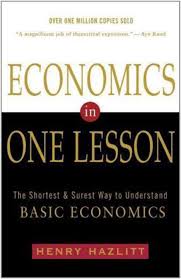
Economics in One Lesson

If I could recommend one book for everyone to read to grasp the connection between economics and public policy, it would be Henry Hazlitt’s volume, Economics in One Lesson. It offers a basic, accessible explanation of why so many attempts to regulate the economy don’t work. Though laws are certainly necessary, the failure of many laws is due to a focus on the legislature’s immediate intentions rather than the long term impact of the proposed policy.

Though the book is not a theology of economics, its main thrust resonates with scriptural principles. The reader does not have to agree with all of Hazlitt’s policy preferences to recognize the value of his long-term view of the universal good and see how they help fulfill authentic justice.

Hazlitt’s One Lesson goes like this:

“The art of economics consists in looking not merely at the immediate but at the longer effects of any act or policy; it consists in tracing the consequences of that policy not merely for one group but for all groups.”

Basically, Hazlitt’s lesson boils down to two principles: 1) thinking about the long term good instead of the short term good and 2) taking everyone’s good into consideration. Both of these principles resonate with Scripture.

First, let’s look at taking the long view on economic decisions:

Some advocates of so-called social justice, including some Christians, argue that immediate action to change significant economic policies in order to provide a rapid solution to a perceived economic problem is necessary. In many of these cases, however, the long term impacts of the new policies are not fully considered.

Looking for long term consequences instead of focusing on short term effects is biblical.

For example, Proverbs 21:5 states: “The plans of the diligent lead surely to abundance, but everyone who is hasty comes only to poverty.” (ESV)

Interpreting Proverbs is a bit tricky since they are not absolute, universal laws, but general truths that may have apparent exceptions. However, without pushing this text beyond its primary meaning, it is clear that long term planning is being lauded by the author of this proverb.

download (11).jpeg

For another example, consider Luke 14:28–30: “ For which of you, desiring to build a tower, does not first sit down and count the cost, whether he has enough to complete it? Otherwise, when he has laid a foundation and is not able to finish, all who see it begin to mock him, saying, ‘This man began to build and was not able to finish.’” (ESV)

The context of these verses is about the cost of discipleship, but Jesus is urging his audience to consider the long term costs of their discipleship, not just the apparent immediate benefit. That Christ uses an economic example to illustrate his spiritual point demonstrates the validity of the economic principle.

Second, the concept of the good of all, not just a favored group, should be considered:

Some Christians try to argue that social structures should be preferential toward the poor or others who have real or perceived disadvantages. For example, in the minds of some activists, social justice requires progressive taxation and redistribution of wealth in order to benefit the poor. The rising tide of socialism among the “young and woke” crowd seeks to confiscate and redistribute wealth according to their desired social order, which is intentionally designed to harm the rich (or those that they choose to label as such).

The Bible, on the other hand, indicates that social structures should be oriented toward even-handed justice. Consider Exodus 23:2–3: “You shall not fall in with the many to do evil, nor shall you bear witness in a lawsuit, siding with the many, so as to pervert justice, nor shall you be partial to a poor man in his lawsuit.” (ESV)

The passage then goes on to explain that you can’t passively ignore the good of your enemy by failing to return his lost property (vv. 4–5), that you should not lean toward the benefit of the rich against the poor in seeking justice (v. 6–8), and that the sojourner, the foreigner in your midst, should not be oppressed. Justice is the main theme.

As a second example, consider Proverbs 22:16: “Whoever oppresses the poor to increase his own wealth, or gives to the rich, will only come to poverty.” (ESV)

It is apparent that manipulating social structures for the benefit of a special interest group is not a path for universal justice. This means that creating a system that benefits the rich is bad (and this is a major danger of our current system of crony capitalism), but that attempting to punish the rich through taxation (as socialism tends to do) is also evil.

The basic thrust of these passages is that social systems, including economic systems, should be oriented toward even-handed justice.

Though more could be said about Hazlitt’s One Lesson, I have come to the conclusion that there is warrant for claiming that Hazlitt’s principles resonate with biblical justice. His examples help show why some of the well-intentioned policies proposed by so-called social justice advocates are really detrimental to a holistic system of justice.

It is important, therefore, that we begin to seek a system that does not intentionally harm one group for the benefit of another and that we look at long term consequences, including systemic incentives created by social programs or convoluted tax systems. Only when we begin to ask these important questions will we be able to find legitimate answers to them.

Toxic Inequality - A Review

In the last decade or so, economic discourse on the left has begun to focus on inequality rather than poverty alleviation. Thomas Shapiro’s recent book, Toxic Inequality: How America’s Wealth Gap Destroys Mobility, Deepens the Racial Divide, and Threatens Our Future, explores that theme. Analysis like that in Shapiro’s volume relies on catching people at the stage after the Great Recession before they had fully recovered and blaming their lot on insufficiency of government regulation. Books like this do well for their cause to claim a crisis for their advantage.

51N71QJlUEL._SX327_BO1,204,203,200_.jpg

There are basic ideas that Shapiro relies upon that are flawed. He speaks of “tax expenditures” when dealing with exemptions, cuts, and other deductions in the tax code. This is indicative of an underlying assumption that the state is the primary owner of all property and has the right to determine who should get to keep it or not. He also simply assumes that inequality is fundamentally immoral, which he makes no effort to defend.

Despite these assumptions, the book does highlight problems that deserve common concern, even if the solutions differ from those that are likely to be successful in the long run. The fundamental problem is not that rich people have too much, but that the poor are significantly disadvantaged by their poverty. The poor are, in many cases, cut off from adequate (there will never be equal) opportunity to flourish merely because of their poverty.

That should raise concerns among people across the political spectrum. Some of the case studies that Shapiro highlights reflect the logical outcomes of choices made by the subjects of the study. There are several instances that his subjects made irrational decisions and reaped the whirlwind during the financial crisis. However, there are many more cases where circumstances beyond the control of the individual or family drove negative outcomes or closed doors.

Shapiro’s book emphasizes the ongoing changes in the job market, which should be a significant concern to us all. Upper and lower skill jobs are increasing in number while middle skill jobs are largely being outsourced or automated. This is creating a narrower window for people to climb the social ladder, as the gap between low and high skill often involves a significant capital investment for a college education. This represents a challenge our factory-style schools need to adapt to, but also one which lower income, lower funding districts will increasing have difficulty overcoming.

The data in this book is sound and points toward the need for meaningful action on the part of society to seek to increase opportunities for success for those on the bottom end of the financial spectrum and their children. Some of the means that Shapiro suggests to solve the dilemma are likely to lead to worse conditions and be financially unsustainable. For example, Shapiro argues for the creation of make-work jobs by the government designed to inspire full employment. He also argues for increasing the already often unsustainable defined benefit pension plans, like those offered by many municipalities. Additionally, increasing the ability for unions to force people to join is a proposed solution. This assumes that unions always use their dues well, represent the interests of their members effectively, and facilitate authentic human flourishing. In short, many of Shapiro’s suggestions are more likely to exacerbate the negative attributes of our present economy, though they are well-intentioned.

Although the solutions are questionable, Shapiro reveals are real societal problems that need to be addressed. These are just the sorts of issues Ben Sasse was attempting to address in his recent book, The Vanishing American Adult. This conversation needs to continue as we work together across political lines to address the significant problem of the dissociative impact of poverty in our society.

The Road to Serfdom - A Review

One sign of a classic book is that the critiques it offers remain valid for years after being penned. F. A. Hayek’s famous book, The Road to Serfdom, demonstrates that quality. As the battle continues to rage between advocates of free market systems and various forms of socialism, Hayek’s diagnosis of the likely end of directed economic systems—namely, tyranny—illustrates why advocates of markets have not simply rolled over and played dead, despite the economic and social realities of economic problems.

41Cjd718ofL._SX331_BO1,204,203,200_.jpg

Another sign of a classic book is that it has explanatory power and offers brief summaries that could have been expanded to book length treatises. The Road to Serfdom contains dozens of examples of succinct statement of a deep, complex economic and social problems that arise from attempts to plan the economy.

The book, overall, is a masterpiece that deserves to be read and that contemporary supporters of socialism should be forced to reckon with. A few points, however, arise from the wider tapestry of the work that deserve especial note.

First, contrary to popular representations that attempt to associate free markets to National Socialism, Hayek shows that the fascism promoted by the Nazi’s was an exacerbation of the socialist ideals that had been embedded in German society for several generations rather than a market response. This, of course, violates Godwin’s Law by invoking the Nazis. However, to be fair, the volume was written during World War II. However, the close connection between the totalitarianism of Nazism, much like Italian fascism and Stalinist communism, is a significant point of the entire volume. Attempts to plan the economy centrally lead to tyranny of various degrees.

Second, Hayek is careful to differentiate the welfare state from economic socialism. He actually lauds the work of the British safety net in helping to ensure the basic needs of people are met when they are out of work. At the same time, he cautions against welfare efforts that that undermine the market.

An element that is missing from Hayek is a discussion of why liberty is a worthy end. That is, after all, the great advantage he lauds in the market system. Despite its inequities, the market system enables a greater freedom of choice for people. He argues for individualism, which is not quite the bogeyman contemporary opponents of markets make it out to be, but an effort to value the individual and to assert the rights of the individual even amidst the collective. Because of this lack, this work by Hayek is open to criticism that it can result in atomistic selfishness, but there are answers that are implied by the context. Hayek represents there are limits to human freedom, which should be enshrined in law. He is, therefore, not arguing for a Randian version of anarcho-capitalism. Hayek also recognizes there are externalities (like pollution) that may need to be regulated apart from market influences.

In short, despite the lack of explicit reasoning about certain moral assumptions, the market economy that Hayek lauds in this text is a far cry from the strawman constructed by many of capitalism’s critics. It is also quite a distance from the dangerous individualistic vision of market participation that is offered by some of the free markets popular supporters. There is a moral thickness to Hayek that, while still falling short of biblical adequacy, represents a better foundation than many, both supporters and detractors, assume.

A strength of the text is that Hayek shows that good intentions in economic planning do not make up for the inability of humans to adequately plan. The range of social goods that are valued by different people make it impossible for central planners to prioritized the preferred goods of the population, since there will always be competition between those goods. The priority of goods must, therefore, be imposed rather than derived and will thus lead to the constraint of reasonable and warranted freedoms of many to meet the goods of the empowered few planners.

Here again, the lack of an ethical consensus that can drive the social action of the planners reveals that economic reasoning is second order. That is, moral virtue must precede the economic system. Any economic system is doomed to reveal the moral failings of its constituent members. Hayek’s argument and historical economic evidence reveals that markets have the best internal mechanism for mitigating vices apart from centralized planning. Still, a market driven by an immoral people will merely enlarge their immoralities. There is, perhaps, greater danger in enforcing evil as an intended “good” in collectivist economics that makes the ability in a market system of to refuse to participate in immorality preferable.

Hayek also reveals that today’s arguments that “socialism must be implemented because of impending doom” is nothing new. There is nothing new under the sun. Human nature is consistent in any economic system. Our task is to work toward the best possible system of economics that will encourage human flourishing. There are many who believe, as Hayek does, that free markets tend to do that better than various forms of collectivist economics.

Protestants - A Review

Alec Ryrie’s recent volume, Protestants, is an immense project that attempts to survey the impact of Protestantism over the past five hundred years. Ryrie is, himself, a licensed lay preacher in his Anglican church. He is also a professor of the history of Christianity at Durham University.

Attempting a project this broad in scope is brave. In five hundred years, Protestantism has gone from a local attempt to correct theological errors of Roman Catholicism to a worldwide movement that has strong theological, social, and political emphases. Any project of such expansive scope will be subject to common criticisms that it makes generalizations, skips key points, and does not satisfy the desires of those with a pet theory about a topic. To cover every possible topic in perfect detail would have made this book tedious and impenetrable. Some of those criticisms are valid, however, and I will point to some areas of particular weakness in this review, but the book deserves consideration beyond such simple dismissals.

Summary

51IkUai+KPL._SX258_BO1,204,203,200_.jpg

Ryrie attacks his enormous task in three movements. In Part I he deals with the contours of the Reformation Era, beginning with Luther and considering the various reformations that spread through Europe. This was the strongest section of the volume, as Ryrie weaves together the threads of history into a representative tapestry. Part II focuses on what Ryrie calls the Modern Age, which includes Pietism, the sin of human slavery, American Protestantism, the rise of liberalism, the German Nazi crisis, and American religious politics. Clearly in this selection of topics, there is a great deal Ryrie skips. His selections show something of his intentions through the volume. In Part III, Ryrie addresses a handful of examples of Protestantism in various corners of the globe, including South Africa with a focus on Apartheid, Korea and its evolution of a prosperity gospel, Chinese Protestantism, and Pentecostalism. His Epilogue attempts to tell the future, revealing his hopeful anticipation of changes in Protestantism to come.

With such an expansive topic and, possibly, a strong desire to get the volume finished during the year of the 500th anniversary of the Protestant Reformation, it is little surprising that Ryrie relies much more strongly on secondary and tertiary sources to write his volume. He includes some primary sources, but there are clear cases, as with his depiction of Zwingli’s understanding of the Lord’s Supper, that Ryrie sticks to the mainstream theories, which are obviously inaccurate to those who have read the primary source. Such an approach is understandable, but it severely limits Ryrie’s ability to deal with topics about which he is apparently largely unread.

One such example is in Ryrie’s treatment of Fundamentalism. Though he opens the volume professing to attempt to treat movements fairly, writing, “Condemning ugly beliefs is easy, but it is also worth the effort to understand why people once believed them. If we are lucky, later ages might be as indulgent toward us. We all live in glass houses.” However, he dismisses Fundamentalism as a “mood” and not a doctrinal movement. In other words, Fundamentalism is a psychosis. These are the marks of someone who is critiquing a movement that he despises, has not bothered to research, and thus has not adequately considered. To say there are excesses in negative attitude among Fundamentalism is certainly true, but to dismiss the doctrinal heart of the Fundamentalist dispute with modernism is sloppy.

Analysis and Critique

Significantly absent from Ryrie’s lengthy tome is a chapter focused on the influence of Protestant missions. He engages in occasional discussions of the topic, but the central thrust of the volume is the sociological impact of Protestantism on history rather than on the concern for conversion. In fact, most of the discussions of missions in this volume are negative, describing missionaries in largely imperialistic terms, which is a sometimes-fair, but incomplete depiction. He largely skips the positive impacts that Protestant missionaries have had through their social reforms, and he certainly does not talk about the concern of so many Protestants to preach the gospel that many may not suffer the fires of Hell. Whether it is by design or default, Ryrie’s presents a Protestantism that is entirely devoid of the gospel which compelled Luther to seek reformation of faulty doctrines and inspired many to give their lives for their faith.

The portrait that emerges from Ryrie’s Protestants is one of an ever-adapting religion that lags somewhat behind the cultural winds, but always follows. In fact, his Epilogue is a hopeful prediction that will be exactly the case. However, it should be clear that Ryrie’s portrait is not of the forms of Protestantism that still feel strongly connected to their roots in the Reformation. Rather, Ryrie argues that Protestantism “is not a doctrine or theology. Defining it that way is usually an attempt to exclude people. . .” That approach enables Ryrie to trace out the influence that Protestantism has as it has morphed and migrated throughout the world. If the purpose of the book is to survey how people who have been impacted by movements that were influenced by those who attempted to reshape Christianity half a millennium ago, then it has accomplished its purpose. Such a book would say little about the content of Protestantism and a great deal more about the social influence of an event. However, Ryrie’s purpose seems to be something more than that.

The story that Ryrie is telling has a moral that begins to appear in his recounting of the evolution of liberalism. Ryrie makes his point explicit in the final pages of the book. One central theme is that it is not necessary to take the Bible too seriously to consider oneself a faithful Protestant. (His repeated bashing of inerrantists, whose actual beliefs he never considers, and Fundamentalists reveal this early on.) This leads to the more significant idea that Protestantism is descended from orthodox Christianity, but not significantly moored in that. Ryrie sees the liberalizing trend of culture as the final destination of all Protestant Christians. Thus, he seems to be saying, ethical revisionists should feel free to patronize churches (in both senses of the word) while the amorphous religion comes around to contemporary, culturally compatible doctrines. By ignoring evidence to the contrary, his conclusions are entirely plausible. And, by ignoring the possibility that extensive changes can actually sever a movement from rightful claims to a historical root in the Reformation, Ryrie’s conclusions may indeed salvage an anemic form of Christianity in the eyes of those who long to see it shaped by the waves of culture. Ryrie is telling a story that sounds a great deal like Niebuhr’s category, “Christ of Culture.” If Protestantism is primarily a social movement, the Ryrie’s predictions may be accurate, but those seeking a theological interpretation will likely question his prognostications.

Ryrie’s book is well written. The first part is quite well done, with engaging prose and even-handed interpretation. This is the sort of volume that will likely find its way onto a public library shelf, and which may serve as a launching point for a conversation. It will provide comfort to the culturally comfortable Protestant Christian, and potentially fuel criticism among those who want Christians concerned with historical orthodoxy to evolve faster. As such, this is the sort of volume one should read because of its potential for conversation in the plane or over the water cooler rather than as a normative interpretation of the history of Protestantism.

NOTE: I received a gratis copy of this volume with no expectation of a positive review.

The Unreformed Martin Luther - A Review

There is no time like the year of the 500th anniversary of the Reformation to read up on Martin Luther’s life and legacy. In the midst of the plurality of celebrations and denigrations of Luther, there are dozens of myths, incubated over the past five centuries, that portray the man as much greater or much worse than he actually was. Some of them have even found their way into discussions of Church History through reputable sources.

Andreas Malessa’s book, The Unreformed Martin Luther: A Serious (and Not So Serious) Look at the Man Behind the Myths, is an honest attempt to bust some of the myths that have helped make Luther’s legacy larger than life. Some of them are confirmed while others (some of the most fun ones) must be consigned to the dust heap.

Among the many topics covered in the twenty-five chapters of this volume are Luther’s famous quote about planting an apple tree, even if he knew the end of the world was coming. (Not true.) Or, that Luther was consistently a heavy drinker by his culture’s standards. (Also not true.) Similarly, Malessa takes up the idea that Luther’s best theological thinking came while he was relieving himself. Alas, this, too, must be set aside as a myth that is just true enough to be believable.

The common theme of many of the myths is that they are usually not too far from the truth. Luther did drink beer and sometimes joke about getting drunk. However, in a world where the water was of questionable purity, beer was probably a safer bet. Luther was certainly constipated and wrote to his friends of the miseries caused by a diet with too little fiber, but the idea that his theologizing was tied to his bathroom habits was fomented by his foes to discredit his work.

Malessa also takes on some of the other basic historical misconceptions around Luther. He never wanted to start a new denomination. He did, sadly, fall into putrid anti-Semitism in his later years, though not in quite the way it is sometimes portrayed. He actually wasn’t the first to translate any of the Bible into German. The brief volume does good historical work in setting some of these myths to rights, too.

Christians should be known as people of truth, which makes The Unreformed Martin Luther a welcome addition to the host of volumes on the Reformation. It will certainly not appeal to everyone in every local church, but it has a place in the library of seminaries, Christian schools, and those interested in Church History.

A book like this would make an interesting auxiliary volume in a course focused on the Reformers. It also is an entertaining read for those who enjoy a bit of Church History after a hard day’s work. The chapters are concise, the prose is lucid, and the subject matter is entertaining. Reading this book is a fun way to spend a few hours.

NOTE: I was given a gratis copy of this volume by the publisher with no expectation of a positive review.

The Poverty Industry

Perverse incentives woven into the fabric of systems have the tendency to undermine positive outcomes and exacerbate abuses of the most well-intentioned programs. In his 2016 book, The Poverty Industry: The Exploitation of America’s Most Vulnerable Citizens, Daniel L. Hatcher, a law professor, exposes the manifold perverse incentives of our various contemporary aid systems.

From the start, it should be clear that Hatcher is not an angry Republican bemoaning money wasted on the bottom end of the social scale. In fact, the book is published by New York University Press, which is not known for being a bastion of conservativism. Also, Hatcher especially highlights as many as Republicans who are abusing the intent of various Federal aid programs, while being much less intrusive and accusatory toward Democrats. Toward the end of the volume, he makes it clear that he is not calling for an end to the Federal programs or a reduction in their expenditures, but rather a deeper look at abuses that prevent the programs from achieving their ends.

There are several examples, but Hatcher spends a great deal of time walking through abuses that are endemic in the child protection systems. In an attempt to recoup funds, these government departments often confiscate property from their wards, seek ways to maximize streams of income from the Federal government, and fail to use the resultant funds for the benefit of the children. It becomes advantageous, given the current arrangement, for agents to terminate parental rights from poorer kids, refuse to place them, and lengthen adoption processes because the lower the income the child’s parents have, the larger the aid income stream the state can harvest.

Similarly, Hatcher highlights Medicaid programs in which states transfer large sums of money to hospitals to garner matching grants from the Federal government. The state “expenditures” are then funneled back into state coffers via bed taxes or ledger transfers. This means that the state actually does not spend the money that the Federal government was intended to match. It also means that the intended recipients of the redistribution—the poor—do not receive the intended benefit.

51bKFQyK3BL._SY346_.jpg

Clearly, Hatcher is highlighting abuses, which may be representative, but likely are not normative. Much of the social work done by agents of the state is heartbreaking and hard, so we should not read his book in a condemnatory manner. However, there are fundamental systemic flaws and, more significantly, failures of virtue in the people overseeing the systems.

The vast majority of the abuses Hatcher cites are, in fact, legal. If a hospital is owned by the government, then a ledger transfer is a legitimate means for it to transfer excess funds back to the parent government. However, when such transfers are examples of playing shell games with money, since money is fungible, then it undermines the sense of fair play and incentivizes everyone to misuse the system.

Some of the systemic failures Hatcher highlights can be remedied by law. For example, the practice of the state receiving child support on behalf of its wards and then attempting to collect debts from often poverty-stricken “dead beat dads” can lead to the permanent estrangement of fathers from their children and warrants for the arrest of men and women who simply cannot pay the demanded support. This is, in one sense, the criminalization of poverty, which may lead to parents in arrears on their support payments fleeing from officers and, perhaps, being shot repeatedly in the back. Welfare is an indication of a failure of our economic system, so at some point, the law should simply recognize that much of that money is sunk and stop trying to claw it back from the poor.

The greater problem, however, is an absence of virtue in society. (This is my conclusion, not Hatchers.) When legislators, governors, and administrators do legal, but unintended things to maximize their take from the Federal government it represents a failure of virtue. Economists and politicians can debate the relative merits of various social programs, but people should have the integrity not to attempt to game the system. Or, at least, if they do choose to milk the system for every advantage, they should pass those advantages on to the targeted recipient. Unfortunately, there is a too broad acceptance of the equivalence of legality with morality, which is intellectually sloppy and spiritually damaging.

Hatcher’s book is an important one for understanding some of the reasons the so-called war on poverty has been so ineffective. The problem of poverty is not going away, and it may be that systemic flaws and a lack of virtue are contributing as much as the oft-cited lack of funding.

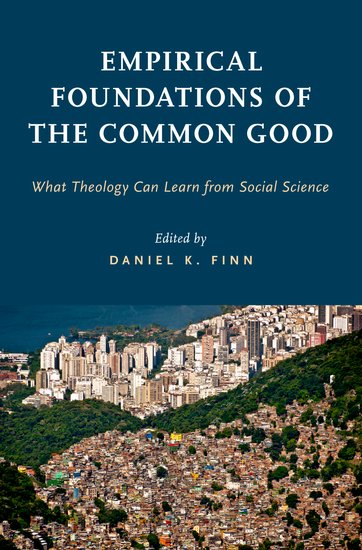
Empirical Foundations of the Common Good - A Review

Empirical Foundations of the Common Good is the sort of project that offers hope for interdisciplinary dialogue. The premise of the book is to provide a response to the basic question how social sciences can inform theology. For the most part, the essays are helpful in this regard, especially for those who rely on traditional Catholic Social Teachings as a foundation for their theology.

With a few exceptions, the non-theologians’ explanations of their contribution to theology are helpful. The majority of the authors avoided the assumption that theology should conform to the findings of their discipline; instead they argued that their disciplines could inform the application of theology.

For example, Christian theology makes the moral claim that Christians should be engaged in seeking the welfare of the poor. Economics provides evidence for how best that should take place. Or, to state it differently, theology provides the telos for the method of economics. When political science, public policy, sociology, and economics claim to provide both the definition of the common good and the method for attaining to the common good, they transgress into the area of applied theology, or ethics. When discipline failure like that happen, the result is the current elevation of politics, economics, and sexuality to the status of summum bonum for society. That, as we see around us, is a guarantee of the pursuit of anything but a true common good.

After Daniel Finn’s editorial introduction, the volume contains eight essays by experts in a variety of disciplines, all making arguments about how their particular discipline contributes to theological arguments about the common good. Chapter One is political scientist, Matthew Carnes, showing how his discipline contributes to a cross-disciplinary discussion through four emphases within Political Science. In the second chapter, Andrew Yuengert asserts that economics can help theologians understand the role of individual choice in seeking the common good. Mary Jo Bane, a public policy specialist, argues in Chapter Three for the contribution of her discipline in helping theologians understand trade-offs implicit in pursuing the common good. In the fourth chapter, Douglas Porpora argues that sociologists have little to say about the constitution of the common good, but have a great deal of expertise in showing how to measure and evaluate the pursuit of those theologically identified ends.

Charles Wilber, an economist, echoes Porpora in his essay in Chapter Five. He argues that economics can help measure progress toward human flourishing, while acknowledging the failure of most economists to separate economic metrics from a holistic understanding of the common good. The sixth chapter puts bureaucracy in perspective, as Gerardo Sanchis Muños dissects the failure of public service to serve the common good. Theologian David Cloutier critiques contemporary iterations of Catholic social teaching, pointing to less individualistic emphases in earlier stages of the tradition in Chapter Seven. The eighth and final chapter, theologian-economist Mary Hirschfeld reasserts the importance of theology for the social sciences, so that a proper understanding of the common good may develop.

The clear message of this volume is that theology needs social sciences to understand how to accomplish its moral ends, while the social sciences need theology to inform them of the nature of the common good. In the present fragmented state of academia, there is too much isolation in separate ivory towers. That is unhealthy for students and tragic for the development of robust worldviews that have a defined end and cogent methodology.

Somewhat surprisingly, this volume is favorable toward markets, though critical of market economics untethered to a moral foundation. However, the various authors regularly affirm the improved possibilities for flourishing that come from enabling market economics. Given the use of Catholic Social Teaching by some to argue for forms of economic socialism, this is volume that deserves careful attention. It may be that proponents of various forms of socialism are, in fact, conflating a pursuit of the common good with discredited means to achieve it.

Like other volumes that Finn has edited, this collection of essays reflects careful conversation. The essays refer to one another and show signs of having been shaped by the arguments in various chapters. This makes the volume easier to read and more helpful for classroom instruction or dialog than many edited volumes that appear to be a random collection of voices shouting in the wilderness.

If there are two things clearly explained in this volume it is (1) that we need more interdisciplinary dialogue, else theology and social sciences tend toward tyranny, and (2) we need not abandon the methodology of market economics for central planning to better approximate the common good.

Note: I received a gratis copy of this volume from the publisher with no expectation of a positive review.

Church History: A Review of Some Introductions

During my preparation for teaching a four-week Church History survey I read several single volume books on the topic and am here doing brief reviews to highlight the particular emphasis of each.

Bruce Shelley, Church History in Plain Language, 4th edition (2013)

Shelley’s book is one of the classic single volume Church Histories. It has weathered well and sold well. The book is very accessible and reads quickly. It is intended to introduce people in the pew to the topic. I’ve heard of it being used as a High School text for homeschoolers, so that is a plus. Shelley focuses on the history of the Western Church, which is the traditional approach, but which is a place where other volumes may have improved since he wrote this book. Still, this is a solid volume that would be a good place to start on the topic. Shelley passed away in 2010, so it unlikely this volume will be updated for too long in the future with other excellent entries into the field.


Gerald Bray, The Church: A Theological and Historical Account (2016)

Bray is an excellent writer and historian. His single volume introduction the Church History is a bit more theological than Shelley’s, which fits because Bray is a Historical Theologian. His interpretations are fair, though Bray’s Anglican bias comes through on multiple occasion when dealing with the issue of baptism. This is an intermediate volume, but could be helpful for pastors and those with some background in Church History to gain a deeper knowledge. One downside on Bray’s writing is that his chapters and sections tend to be excessively long, which makes interrupted reading somewhat more difficult.


Joseph Early, A History of Christianity (2015)

This is a solid volume from B&H, which present Church History in a very traditional framework, like Shelley. He improves on Shelley in two ways: (1) He retells history from a distinctly baptistic perspective, while still maintaining a reasonable balance in critiquing other traditions; (2) His volume is shorter than Shelley’s, with no apparent downside. In all, Early’s volume is an accessible volume should be useful in churches, secondary schools and introductory college courses.


Ian Shaw, Christianity: The Biography: 2000 Years of Global History (2017)

Shaw’s approach is unique. He lines up the various stages of change in the history of the Church in parallel with stages of human life. The analogy works better earlier in the book, but it is entertaining. A major strength of Shaw’s book is his emphasis on global Christianity rather than just the Western tradition. This means that, in the abbreviated format Shaw uses, there is sometimes less information about Western Church History than I would have liked. However, I think the tradeoff was in the whole worth it. I would recommend this one over other volumes because I think it better represents a broad picture of Christianity.