Is Charles Finney the Prototype for Evangelicalism?

With the recent publication of the second edition of a book from the 1970’s, Douglas M. Strong has repackaged Donald Dayton’s theory that evangelicalism is defined by faith experience and right living, rather than by doctrinal fidelity. 

 Dayton’s book uses Charles G. Finney and those closely tied to him as the exemplars of this trend. While it cannot be denied that Finney preached the gospel (or at least a form of it) widely and pointed many to Christ, there is significant doubt that Finney’s belief system is a viable foundation for a sustainable Christian faith, much less being at the heart of historic evangelicalism.

Charles G. Finney

Charles G. Finney

 Finney’s intellectual hubris was his theological undoing. As a trained lawyer, and by all accounts a very intelligent man, Finney assumed that he could, without cultural influence, rightly interpret Scripture. Based on a likely limited library at his teacher’s house, Finney rejected all historical Christian teachings because he did not like the way they were argued. Instead, he committed himself to a “no creed but the Bible” approach, without the aid of theological conversation with contemporary or historical peers. This unfortunate confidence was enabled by Finney’s quick wits and premature promotion to public ministry. In truth, Finney’s belief that he could rightly interpret Scripture without any external influence affecting the outcome rests very close to what is known as the “fundamentalist fallacy.”

Misunderstanding the Atonement

 In his autobiography, Finney records his opportunity to debate with a Universalist while he was still in his ministerial training. His teacher was ill and Finney stood in, ostensibly to defend orthodoxy. Finney writes,

I delivered two lectures upon the atonement. In these I think I fully succeeded in showing that the atonement did not consist in the literal payment of the debt of sinners, in the sense in which the Universalist maintained; that it simply rendered the salvation of all men possible, and did not of itself lay God under the obligation to save anybody; that it was not true that Christ suffered just what those for whom he died deserved to suffer; that no such thing as that was taught in the Bible, and no such thing was true; that, on the contrary, Christ died simply to remove an insurmountable obstacle out of the way of God’s forgiving sinners, so as to render it possible for him to proclaim a universal amnesty, inviting all men to repent, to believe in Christ, and to accept salvation that instead of having satisfied retributive justice, and borne just what sinners deserve, Christ had only satisfied public justice, by honoring the law, both in his obedience and death, thus rendering it safe for God to pardon sin, to pardon the sins of any man and of all men who would repent and believe in him. I maintained that Christ, in his atonement, merely did that which was necessary as a condition of the forgiveness of sin; and not that which cancelled sin, in the sense of literally paying for the indebtedness of sinners. (Charles G. Finney, Charles G. Finney: An Autobiography [Westwood, N. J.: Barbour Books], 38)

Finney rejected the notion of election, divine calling, and substitutionary atonement in Christ’s death on the cross.

In truth, Christ’s death on the cross as a human in human form was only necessary because it is substitutionary. If all Christ did was make possible salvation in a general way, it could have as simply been done by fiat as by self-sacrifice. Without extending this post with further discussion on the atonement, it is clear that Christ came as a redeemer not as an enabler. Even taking a thematic view of Scripture, rather than pursuing a verse by verse defense, it does not seem that Finney’s perspective on the atonement is helpful. In short, even without accepting a fully Calvinistic theological paradigm, Finney’s reasoning seems better suited to win an argument against Universalism than to be considered biblically faithful.

An Unsound Foundation for Evangelicalism

 In all this, I am not making the claim that Finney was not converted, nor that he did not have a profound impact on many people. Finney preached a form of the gospel that enabled many to come to faith in Christ through repentance of sin. He was also instrumental, as Dayton and Strong rightly argue, in ending the evils of American slavery.  All of these things could have been, and were otherwise, done while still maintaining doctrinal integrity.

 By basing their image of historic evangelicalism on individuals on the fringe of orthodoxy, more subject to their culture than to Scripture, Dayton and Strong have undermined their own case.

 In fact, most of the organizations and theological movements cited in this volume have tended to cut their mooring to Christian orthodoxy in the years since Finney’s influence. Wheaton University has maintained fidelity to its evangelical doctrine. On the other hand, the Salvation Army is no longer concerned with salvation in any meaningful sense. Oberlin College, where Finney was president, is no longer distinctly Christian.

The track record of Finney’s theology demonstrates a failure to thrive in the long term. In the first generation, the theological content is assumed, in the second it is unknown, and by the third it is rejected.

This should point present day evangelicals toward the need to be active in pursuing social justice while adamant about maintaining the doctrinal orthodoxy of our Christian heritage.

A Defense of Nuclear Power

In the decade or so that I worked in nuclear power, I never found a comprehensive apologetic for nuclear power that was published in the marketplace. All of the arguments were available piecemeal or in a more unified manner from people inside the nuclear power guild, but none from someone who didn’t have a clearly vested interest in keeping nuclear plants running.

 Michael H. Fox is an emeritus professor in the Department of Environmental and Radiological and Health Sciences at Colorado State University. Here is an individual who is outside of the commercial and nuclear power world who has access to the best science about the most concerning aspects of the risk of nuclear––radiation and cancer.

 Fox’s conclusion is that compared to imminent risk of climate changes, the risks of nuclear power are worth it. He spends nearly three hundred pages making his case by considering the basic arguments for and against nuclear power, as well as the case for and against other forms of non-fossil energy.

 The beauty of this volume is that it is written at a level that can serve as an introduction, but it also ramps quickly into the explanations for the more technologically adept. With the clear structure of each chapter, I was able to skim past those explanations that I am familiar with based on my experience as an operator and instructor. By the end of each chapter, however, the progressive development of each explanation had me reading carefully to follow his explanations. Even regarding the topics that I am less familiar with––such as the mechanism of cancer development in cells––Fox’s explanations were sufficient for me to understand the more complex aspects based on his earlier explanations.

 This volume is, therefore, both a suitable introduction and a valuable reference on the topic of nuclear power.

Summary 

The book is divided into three nearly equal parts. The first part deals with Fox’s explanation of the global warming and the contribution of Carbon Dioxide from coal and natural gas. He also explains the limitations of solar power and wind power. Fox is positive toward the benefits of renewable sources of energy. However, unlike many of the rabid proponents, he is realistic about the limitations in terms of capacity and footprint required, and he recognizes the ongoing need for baseline energy generation that fossil or nuclear will provide. Thus the future is in nuclear power, if real changes are to be made to limit greenhouse gas emissions.

 The second part is a discussion of radiation and its biological effects. This is the section that plays to Fox’s strength, as he explains some basic physics, then digs quickly in to a realistic analysis of the dangers of radiation. He doesn’t hide the real risk, but he also doesn’t overplay it. The reality, as Fox explains, is that any radiation exposure increases the risk of cancer, but the amount of additional exposure due to nuclear power is negligible compared with naturally occurring background.

 This is the most significant argument against nuclear power and Fox handles it well. However, the scientifically ignorant will continue to persist in their argument that any risk is unacceptable. For some reason this argument is powerful against nuclear power when it isn’t for other concerns. The miniscule risk increase of cancer from living near a nuclear plant, even using the conservative (i.e., inflated) estimates required by law, pales in comparison to having a speed limit over 15 MPH.

 The third part focuses on the risks of nuclear power. Fox deals with concerns about nuclear waste, which have been overblown by opponents. He deals with the real and tragic history of the three significant accidents in the history of nuclear power. He is fair about the consequences, but also notes the real learning that has taken place and points toward the attempts by anti-nuclear groups to grossly misrepresent the consequences. Then he deals with the issue of Uranium mining, also dealing with the failings in early nuclear power to deal appropriately with the risks of pollution. That damage was avoidable and is being avoided in properly conducted mining enterprises now. Finally, Fox concludes with a chapter debunking in summary the five most significant myths used to argue against nuclear power. He does this by accepting the truth in the claims and then showing why the arguments aren’t realistic or persuasive.

Conclusion

 Fox writes well and he is honest in his assessment of risks. In other words, he presents the reality of risks on all sides, without overstating his case. I would have thoroughly enjoyed this book simply because of the robust integrity Fox demonstrates, without having to agree with him. As it turns out, I agreed with the substance of Fox’s arguments, as well. He is realistic and helpful in how he argues. He is looking for solutions to problems instead of trying to manipulate emotions and control people’s lives through excessive regulation. There are points that I disagree with Fox, typically on the political implications of his arguments, but overall the case is well made and reasonable.

 If the modus operandi of environmentalists is followed, where only people that have PhD’s in climatology have a right to speak about climate change, then Fox’s  book will have amazing convincing power. Notably, the majority of anti-nuclear advocates speak from outside of the pool of people that have expertise in the area.  Unfortunately, well-reasoned arguments like that of Fox are much less likely to gain headlines than “Fukushima is leaking, we’re all going to die and the government doesn’t care.” Indeed, that is largely the nature of a recent book which includes the Union of Concerned Scientists among its authors.

 If you have questions about nuclear power, buy this book and read it. If you are a proponent of nuclear power, buy this book and cite it in your arguments. This is, hands down, the best one stop reference on the subject I have encountered.

Note: A gratis copy of this book was provided by the publisher with no expectation of a positive review.

Dress Colors, Social Media, and Questionable Research

Last week on Thursday, there were two hot topics on Social Media that kept many people amused (and somewhat less than maximally productive) for quite some time. The first was a debate on the color of a dress. 

Someone posted a picture on tumblr in mid-February and asked for help determining what color it is. (Here is the link, note there is some questionable language in the post.) 

Given a few weeks and a snow storm in the Southeast of the US, which gave a number of people downtime to try to discover the end of the internet, and presto!, we have a viral debate raging on social media about absolutely nothing. It's sort of like an episode of Seinfeld, only it lasted more than 22 minutes and really isn't nearly as funny.

For nerds (and I include myself in this descriptor), the science behind the confusion is pretty interesting. In fact, I found the post at Wired that explained the nature of the confusion to be enthralling. There is a scientific explanation for the perception of different colors depending on the setting.

The Social Phenomenon

More significant to my mind, though, is the way that such a benign and pointless social phenomenon has been reported in the media. Not only did it inspire Wired to write a post to cash in on the web traffic, but all of the major news network jumped on the story.

To put this in plain English, with everything going on in the world, a story about a social media debate got picked up by the news.

This reveals some of the significance of social media. It isn't just a fad that will be gone like slap-wrap bracelets (which are still around, just not as popular as when I was a kid). Social media is driving the way society thinks.

Is this the way it should be? I don't think so, but that's not the point. This particular cultural event reinforces the reality that we cannot simply ignore the phenomenon of social media or demonize it. We have to figure out how to meaningfully engage this tool without allowing it to cheapen our own way of thinking. To that end, Karen Swallow Prior has written a helpful blog at Christianity Today that details some of the potential lessons to be learned from #TheDress.

I have written previously on some of the dangers of social media, based on their potential to damage personal relationships. I have also written about reasons why Christians should (and should not) blog, which is pertinent because social media is the platform that conveys the bloggers message to a broad audience.

The answers are not immediately obvious, but a debate over dress colors and coverage of escaping llamas drew national attention and broad social media engagement. The church needs to figure out how to use this tool and how it fits into a Christian worldview.

The Research Phenomenon

A second significant issue is the way that informal reporting and researching techniques are being used to promulgate internet news. One example of this is, ironically, this post, which relies on internet searches and cultural artifacts to present a case. Recognizing this irony, and not claiming to be an actual news source, I press on with my opinion.

In a 1995 book, Telling the Truth, Lynne Cheney notes,

From 1968 to 1988, the average sound bite for a presidential candidate on the network evening news had plummeted from 42.3 seconds to 9.8 seconds. In the 1992 campaign the length of time would become shorter still: 8.4 seconds. Meanwhile, the portion of the news taken up by correspondents’ comments rose to 71 percent, with candidates sharing the remainder of the time with voters and political experts. A study of the New York Times showed a similar trend. From 1960 to 1992, the average continuous quote or phrase from a candidate in a front page story fell from fourteen lines to six lines. In both television and print, reporters increasingly had power to turn the candidates’ words and deeds into illustrative material for the stories they wanted to tell.

Twenty years after Cheney wrote this, the problem has not gone away. Indeed, if anything, social media platforms like Twitter have caused people, politicians included, to self-limit to 140 characters and thus strip their own comments of context. We have made it easier for someone to reframe our comments according to their own liking.

But a second significant theme is the prevalence of telling stories. In many cases the point is no longer to reveal truth, but to tell a compelling stories. This allows bloggers and media personnel to look for rapid sources of some credibility that will carry their message in a way that will get clicks and support their narrative.

Often this results in a tight circle self-reference with dubious credibility. This Tweet, captured on the day after the dress color debate went viral illustrates the research phenomenon:

Does this mean that the analysis is not correct? No. It may be correct. In fact, it may be so inconsequential that it doesn't matter if it is correct. After all, do we really care what color the dress is?

However, this is merely an illustration of what I believe to be a broader phenomenon that includes more significant topics. Experts are citing experts citing experts. Who knows that the chain of proof doesn't lead back to my blog, or another similar platform that also lacks credibility on a particular subject? 

We must seek truth. This means that we need to be skeptical of some of what gets conveyed as news. Just because we read it on the internet, even from a widely published source, does not mean it is credible or true. This also means we need to avoid crucifying people because of the way someone presents someone else's opinion on a blog or social media. Learning to do these things well is a critical task for Christians in the 21st century.

Christian Bioethics

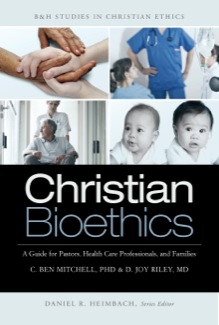
The recently release book by B&H Academic, Christian Bioethics, is a good introduction to a series of very important issues that face the people in the developed world today.

Medical technologies seem to press ahead without regard to ethics. The only question that seems palatable to most people in this day is, “Can we do it?” Very few are asking the important question, “Ought we do it?”

The moral vacuum of the culture compounds this problem, as subjective concerns of emotion and desire are promoted in favor of an ethical schema that anticipates objective answers founded on God’s structuring of reality. Fortunately Ben Mitchell and Joy Riley have a more biblical approach.

C. Ben Mitchell has a PhD in medical ethics and has taught moral philosophy for a number of years in a Christian context. D. Joy Riley is an M.D., with an MA in bioethics. With a strong background in the theory of ethics and the technical arguments related to bioethics, Mitchell and Riley can speak with authority and expertise where many others would need to be more tentative.

The book is written conversationally, which makes it suitable for non-academic audiences. Indeed, the subtitle of the volume is, A Guide for Pastors, Health Care Professionals, and Families. As an academic ethicist, this was one of the things I liked least about the book, but for the primary target audience, the approach is likely to be helpful.

The book consists of four parts. First, Riley and Mitchell begin by laying a foundation for Christian Bioethics. What forms of medicine are out there and how should we view them? How does Scripture speak to contemporary cases that are not clearly addressed? These are important questions that are well answered in the first two chapters.

Next, the authors discuss the sanctity of human life as it pertains to abortion and euthanasia. They explain these things in terms that are intelligible and helpful. In the third part, Mitchell and Riley discuss the ethics of infertility and assisted reproductive technologies. They also address the issues of organ donation, transplantation, and cloning. In the final section, the authors address the issues related to anti-aging technologies and the centrality of understanding and respecting our humanity in the contemporary age.

 The greatest strength of this volume is that it is written for a popular audience. It doesn’t use a lot of technical term, though it occurs in the context of a conversation between two experts. Based on my recent experience teaching ethics to laypeople, resources like this are necessary and helpful. Another strength is that each chapter has a series of references that can be used for further study and elaboration. This is again important as the overflow of information on the internet leaves us often wondering which expert we can trust and how someone got to their conclusions.

I am not a fan of written dialogue as an approach to moral reasoning. Thus, I find Augustine’s early philosophical works rather boring and less helpful than they might be. As such, I would have preferred it had this volume taken a more straightforward approach and presented the material in normal prose instead of relying on dialogue. However, this is a stylistic preference and not a rejection of the substance of the book.

 I commend this to readers who are looking for answers to some very important ethical questions. I plan on recommending it as a resource to people in my church who have questions about this topic. It is up to date and informative. It is written with a pastoral heart and academic acumen. It should be a trusted resource for the church for the near future.

Note: A gratis copy of this text was provided by the publisher with no expectation of a positive review.

A Brief History of Mercy Ministry in the Church - Part Two

This is part Two of Three posts in a series on the history of Mercy Ministry in the Christian Church. Part One is accessible here.

After introducing the topic and giving a brief overview of Mercy Ministry in the Early Church,  today's post emphasizes the Patristic Era, Medieval Era and Reformation Era.


Patristics

Photo by .craig. Used by Creative Commons License.  http://ow.ly/IHw3G 

Photo by .craig. Used by Creative Commons License.  http://ow.ly/IHw3G 

During the Patristic Era, Christianity was the dominant religion in the Roman Empire. This period ended when the Roman Empire fell. The church rapidly went from political underdog to a political favorite. The new found favor led to a convergence between worldly politics and church offices. The bishop in Rome began to have more and more power, eventually gaining more significance in the eyes of the people than the emperor. Notably, it was Pope Leo I who negotiated a treaty with the Attila the Hun, not the Roman Emperor. By the time the Roman Empire collapsed due to repeated invasions in 590 A.D., the Church was a greater uniting force than the vestiges of the Roman government.

 The Emperor Julian, often called “The Apostate,” made an active attempt to remove Christianity from the Roman Empire in the middle of the 4th century. In his diatribe against Christians he wrote, “The impious Galileans not only feed their own poor but ours as well, welcoming them into their agape; they attract them, as children are attracted, with cakes.” Obviously there is some sarcasm here, but the point should be well taken that Christians had a significant impact in their society because they did mercy ministries.

 Ambrose of Milan wrote, “It is justice that renders to each one what is his, and claims not another’s property; it disregards its own profit in order to preserve the common equity.” (Ambrose, On the Duty of the Clergy, i.) So here, the merciful action of Christians is looking after the interests of others even at their own expense.

 For Augustine, the Bishop of the North African city of Hippo, seeking the common good was a demonstration of Christ’s command to demonstrate neighbor love:

Now you love yourself suitably when you love God better than yourself. What, then, you aim at in yourself you must aim at in your neighbor, namely, that he may love God with a perfect affection. . . . From this precept proceed the duties of human society, in which it is hard to keep from error. But the first thing to aim at is, that we should be benevolent, that is, that we should cherish no malice and no evil design against another. For man is the nearest neighbor of man. (Augustine, Of the Morals of the Catholic Church)

In the same work, he urges his readers to care for the physical needs of their neighbors. Drawing an all-encompassing circle around the needs of the human body.

Man, then, as viewed by his fellowman, is a rational soul with a mortal and earthly body in its service. Therefore, he who loves his neighbor does good partly to the man’s body, and partly to his soul. What benefits the body is called medicine; what benefits the soul, discipline. (Augustine, Of the Morals of the Catholic Church)

What we can see in this period of church history is that there was a theological impetus toward mercy ministry. Augustine, who remains a central figure in the development of Christian doctrine, balanced the need for evangelism with the need for meeting the physical needs of the people around. Far from a novel invention of the millennial evangelicals, mercy ministry has been a core Christian practice.

Medieval

The Medieval period runs from the fall of Rome to the beginning of the Protestant reformation. This is a period of time that sees the Papacy as largely the most significant political force in the known world. The Popes are the kingmakers, since according to the theological understanding of the day, the Pope held the keys to the kingdom of heaven while the kings only controlled daily life.

 Monasticism was a leading movement in implementing mercy ministry in the middle ages. Among the Sayings of the Fathers that record the words of many of the early monks, and which were influential in later monasticism, we have such statements as these:

From our neighbor are life and death. If we do good to our neighbor, we do good to God: if we cause our neighbor to stumble, we sin against Christ. (From The Sayings of the Fathers, cited in George W. Forell, Christian Social Teachings (Minneapolis: Augsburg, 1966), 85.)

A brother asked an old man: “There are two monks: one stays quietly in his cell, fasting for six days at a time, and laying many austerities upon himself: and the other ministers to the sick. Which of them is more acceptable to God?” The old man answered: “If the brother, who fasts six days, even hung himself up by his nostrils, he could never be the equal of him who ministers to the sick. (Ibid.)

Thomas Aquinas built on Scripture, church tradition and Aristotelian philosophy to argue: “Justice is a habit whereby a man renders to each one his due by constant and perpetual will.” (Aquinas, Summa Theologica, II/2.58.1.) So internal holiness is not the only goal, because “justice is an external operation, in so far as either it or the thing we use by it is made proportionate to some other person to whom we are related by justice. . . . Therefore the proper act of justice is nothing else than to render to each one his own.” (Aquinas, Summa Theologica, II/2.58.11.) Thomas was operating under a view of nature that held to common natural rights to the earth, and so God’s plan was for the earth to meet all the needs of the inhabitants of earth.

 In addition to these sources, there are many other evidences of active work in ministry done by the church on behalf of the poor. Taking care of the poor was a central pillar in the doctrine of the church. At times it became questionable whether it was consistently central to the practice of the church. However, there is clear evidence that during this period, mercy ministry was viewed as essential to being Christian.

Reformation

For the purposes of this discussion, the Reformation Era runs from 1517 when Luther posted his 95 theses on the doors of the Wittenberg Cathedral to about the end of the 30 Years war. During this time, theological strife was rampant and mixed with political issues as princes and kings were encouraged to engage in wars under religious guise but often for political reasons. This was also a period which saw the rise of the nation-state and a market economy.

 The theological thrust of the Reformation was the recovery of the gospel. In the view of Luther, the gospel had been so misrepresented by the Roman Catholic Church that radical reformation of the church practices and doctrines were required. In that time, though, everyone was “Christian” in the sense that all Europeans were brought into the church through infant baptism. Thus there were few questions about doing good to Christians vs. non-Christians. At the same time, Luther’s 95 Theses were largely driven by a desire to restore just dealings in Europe. Two of the injustices wrapped up in the sale of indulgences were the redirection of economic resources to Rome for improper purposes and the offer of forgiveness without repentance. Theses 43–46 read:

43. Christians are to be taught that he who gives to the poor or lends to the needy does a better work than buying pardons;

44. Because love grows by works of love, and man becomes better; but by pardons man does not grow better, only more free from penalty.

45. Christians are to be taught that he who sees a man in need, and passes him by, and gives [his money] for pardons, purchases not the indulgences of the pope, but the indignation of God.

46. Christians are to be taught that unless they have more than they need, they are bound to keep back what is necessary for their own families, and by no means squander it on pardons.

 Calvin, too, held mercy ministry as a central role of the Christian. These comments come from his treatise on the Ten Commandments, explaining the application of the Eighth Commandment: 

The purport is, that injustice being an abomination to God, we must render to every man his due. . . . For we must consider, that what each individual possesses has not fallen to him by chance, but by the distribution of the sovereign Lord of all, that no one can pervert his means to bad purposes without committing a fraud on a divine dispensation.

Calvin was urging the righteous use of money, which is a form of mercy ministry. In his Institutes, Book 2, Chapter 8, Calvin explains that doing good to neighbors is an essential part of true piety: 

Because a man does not easily maintain love in all respects unless he earnestly hears God, here is proof also of his piety. Besides, since the Lord well knows, and also attests through his prophets, that no benefit can come from us to him, he does not confine our duties to himself, but he exercises us “in good works toward our neighbor.” The apostle consequently has good reason to place the whole perfection of the saints in love. Elsewhere he quite rightly calls it the “fulfillment of the law,” adding that “he who loves his neighbor has fulfilled the law.”

 More could be said about the function of the external works of righteousness in the life of the Christian, but from these evidences it is clear that the Reformers held mercy ministry as a central function of Christians.

A Brief History of Mercy Ministry in the Church - Part One

Original photo by Alex Proimos, The Hand. Used by Creative Commons License. http://ow.ly/IHuJH

Original photo by Alex Proimos, The Hand. Used by Creative Commons License. http://ow.ly/IHuJH

Over the past few decades, conservative Christians have had to “rediscover” the biblical doctrine of mercy ministry because many had retreated from the application of the gospel to society.

Aside from the clear theological error, one reason for this abandonment was a reaction to the strong push by many theologically liberal Protestants to do practical social ministry without proclaiming the gospel. Those who advocated social ministry over the gospel felt that meeting physical needs was the primary function of Christianity and teaching doctrinal truth was a divisive non-essential. 

The somewhat predictable overreaction led many doctrinally conservative Christians to overemphasize theological truth to the exclusion of practical ministries. Additionally, in the 19th and 20th centuries a particular view of the end times became very popular, teaching that the world would be annihilated and an entirely new kind of creation would be made by God. This form of eschatology tended to deemphasize the importance of good works done in this life that were not of an explicitly “spiritual” nature.

 In the middle of the 20th century, there was a rise in a stream of theology called Missional Theology, which tends to focus on a broader view of God’s working in the world. This movement has influenced evangelicals, even those outside of the Missional movement, to return to the earlier Christian patterns that emphasized both proclamation of the gospel and meeting people’s physical needs.

 In a series of three posts on the history of mercy ministry in the Christian tradition, I will attempt to show in very broad terms, that social activism is deeply rooted in the history of the Church. This is something that should characterize the way the church lives in addition to doctrinal orthodoxy.

 In order to gallop through this expansive history in a short time, I have divided Church History into five basic periods. We will look at the role of the church in doing mercy ministry during the Early Church, the Patristic era, then the Medieval era, the Reformation era, and finally the Modern era.  

Early Church

 The Early Church is generally defined as the period from the death of the Apostles to the acceptance of Christianity as a legal religion in the Roman Empire in the first decades of the 4th century. This is a period that was characterized by periodic and regional persecutions of Christians by the pagan Roman Empire. The Christian Church was often marginalized, but more socially than physically in most cases. During this time Christian theologians were fighting to establish legitimacy of the Church and to obtain permission to continue to exist as a Church “above ground.”

 Waldo Beach and H. Richard Niebuhr note that the early church was most known for the assistance provided to fellow Christians. They write, “The most striking quality of the Christians was their agape in the care of their own group, as seen in their assistance to the bereft, to orphans and old people, in the care for prisoners and the sick and those condemned to the mines, and in their hospitality and the sharing of economic goods.”[1] This is likely largely because it was illegal to be Christian and because the church was too small in the early days to be a significant social force.

 However, in the earliest Christian writing after the New Testament, the pursuit of justice on a broader scale is evident. The Epistle of Barnabas, the author (not Barnabas) speaks against the prevailing Roman practice of exposing children: “That we may avoid all injustice and impiety, we have been taught that to expose the newly born is the work of wicked men––first of all because we observe that almost all [foundlings], boys as well as girls, are brought up for prostitution.”

 The author of the Didache writes, “Give to everyone that asks, without looking for any repayment, for it is the Father’s pleasure that we should share His gracious bounty with all men.” This points toward mercy being shown to those around and not merely the Christian community.

 This attitude is described by Tertullian, “One in mind and soul, we do not hesitate to share our earthly goods with one another. All things are common among us but our wives.” This he included in his Apology for Christians. However, Tertullian makes it clear that their acts of mercy were not focused solely on Christians:  

“We have no respect of persons in doing good, because by so doing we do good to ourselves, who catch at no applause or reward from men, but from God only, who keeps a faithful register of our good works, and has ample rewards in store for this universal charity; for we have the same good wishes for emperors as for our nearest friends.”[2]

 Based on the historic evidence, neighbor love was a central aspect in the lives of the Early Church. Largely based on their position as (generally) lower class individuals outside of the usual power structures, it seems that often a great deal of effort was directed within their faith community before pursuing mercy ministry on a public scale.

[1] Waldo Beach and H. Richard Niebuhr, Christian Ethics: Sources of the Living Tradition, 2nd ed. (New York: Knopf, 1973), 53

[2] Tertullian, Apology, chapter XXXVI.

Dorothy Day for Armchair Theologians

Dorothy Day holding up a prison dress. Photo courtesy of Jim Forest through a Creative Commons license.

The Armchair Theologians series from Westminster John Knox is, as one expects by the title, designed to be an accessible and entertaining approach to the biographies of some of the most significant theologians. The authors for these volumes are always fans of the biographical subject. Therefore, there tends to be a bias toward the views of the subject, with a very minimal critique offered.

Elizabeth Hinson-Hasty’s recent contribution to the series on the socialist Catholic, Dorothy Day fits into the series well. On the whole, Hinson-Hasty celebrates the life and work of Day, only stopping to critique Day in those places where she was not sufficiently feminist. Therefore, Day’s negative view of abortion, willingness to get married, and traditional views on sexual orientation are noted as blemishes on her record and excused based on chronologically inferior cultural influence.

Setting aside the somewhat hagiographic aspects of this work, and the series in general, which are native to this approach, this volume in particular is a very helpful means of getting introduced to the lives of significant theologians. In fact, the whole series by Westminster John Knox is enjoyable because the authors like the subject. This makes the prose more lively in many cases.

At just about 200 pages, Hinson-Hasty provides an overview of Day’s life and work that covers the major epochs in her life, the main thrust of her work, and helps to place Day in her cultural context. Additionally, the author shows how Day’s ideas have been appropriated and applied to contemporary social justice movements. This makes the book a useful introduction into the topic.

Before reading Hinson-Hasty’s book, Dorothy Day was relatively unknown to me. In fact, this is one of the reasons I requested this book for review. I have read excerpts of her writing in my time as a seminary student, but had learned very little about her. 

Dorothy's last meeting with Mother Teresa. This occurred in Dorothy's room at Maryhouse in Manhattan. Eileen Egan is on the left. The photo was taken in 1979, the year before Dorothy's death, by Bill Barrett. (Marquette University Archives) Photo Cr…

Dorothy's last meeting with Mother Teresa. This occurred in Dorothy's room at Maryhouse in Manhattan. Eileen Egan is on the left. The photo was taken in 1979, the year before Dorothy's death, by Bill Barrett. (Marquette University Archives) Photo Credit to Jim Forest through a Creative Commons license.


Dorothy Day was not a professional theologian or ethicist. In fact, she had no academic credentials to speak of. She was, however, a writer and a social activist who was key in the labor movement in a particular era of American history. Day’s life demonstrates that all the degrees in the world do not make one influential, and that influence can be gained by continual, faithful witness.

Day was nothing if not a legitimate practitioner of her views. She was a socialist, and so she lived in community. She was a strong advocate of a “peace ethic” and so she went to a great distance not to have hierarchical relationships, or even rules, in the open communities in which she lived.

Dorothy Day was influential for some of the liberation theologians. Her writing in the Catholic Worker, as pro-socialist newspaper, helped to shape the thinking of many of the Latin American liberation theologians such as Gustavo Gutierrez. Much like Gutierrez would later do, Day lived in poverty in the slums rather than doing her philanthropic theologizing from a distant suburban neighborhood.

It is for her integrity that Day deserves the most praise. She authentically lived in community with people from any and every social background. She sought to do her work for the poor from among the poor. This helped keep her faithful to her message, and lends credibility to her writing. Hinson-Hasty helped me gain a new appreciation for Dorothy Day through her presentation of Day’s life in this biography.

In the end, while I do not agree with the author’s theological positions, this is a helpful book. In fact, all of the Armchair Theologians are worthwhile reads when you are trying to get a quick overview of the life of a significant Christian thinker.

I commend this book and the entire series to readers because, in a world awash with information, such brief biographies provide engaging and informative introductions. While not suitable for academic research, they are beneficial for personal edification.

Dorothy Day for Armchair Theologians
$14.56
By Elizabeth Hinson-Hasty
Buy on Amazon


Note: A gratis copy of this book was provided to me by the publisher with no expectation of a positive review. All opinions expressed are my own.

An Ethical Primer on Wealth and Poverty

Along the spectrum of understandings of Wealth and Poverty among Christians, there are two common errors. The first is asceticism, which presents the idea that the poor are more holy than the rich. The second has recently been labeled the Prosperity Gospel, which equates material wealth with spiritual blessing. 

Asceticism

It is easy to figure out how people fall into the trap of asceticism. Some key passages from Scripture point toward wealth as a trap that can lead to sin; Jesus and his disciples lived a very minimal lifestyle, with no concern for possessions to speak of; Jesus himself taught that following him implied self-denial (Luke 9:23). The result of this has been the error of asceticism, which is the teaching that self-denial is the key to holiness and that owning possessions is sinful.

There are some problems with this position. First, there are a number of materially wealthy individuals in Scripture who are presented as heroes of the faith. Examples include Abraham, David, and Job (at times). The key is that their possessions were not the ultimate purpose of their lives. Second, there are passages that show that God provides material wealth to some people as a blessing. 

Prosperity Gospel

The opposite extreme from asceticism is known in our day as the prosperity gospel. The prosperity gospel teaches that being holy necessarily results in material blessings in the form of health and wealth. There are a number of contemporary teachers who offer us our best life now, but there are biblical examples of this found in people like Job’s friends (who assumed his sickness and impoverishment were a direct result of sin in his life) and the Pharisees (John 9). 

There are many, many problems with this position. First, Job was “faultless” and yet God allowed Satan to test him by taking away his wealth. Second, Paul was poor and he told Timothy to be content with basic necessities for life (1 Tim. 6:6–10). Third, Jesus was poor (cf. Matt 8:20).

Biblical Witness to Wealth and Poverty

Scripture has more to say about the subject of wealth and poverty than about any other specific topic. By most counts there are over 2000 verses in Scripture that talk about wealth and poverty. This means that we will certainly only cover a small minority of the verses in Scripture about wealth and poverty.

First, we should understand that God is sovereign over the quantity of our material possessions:

You shall remember the LORD your God, for it is he who gives you power to get wealth, that he may confirm his covenant that he swore to your fathers, as it is this day. (Deut 8:18)
The LORD makes poor and makes rich;
he brings low and he exalts. (1 Samuel 2:7)
The rich and the poor meet together;
the LORD is the maker of them all. (Proverbs 22:2)

Next, we should understand that the love of wealth, either gaining or maintaining it, is a sin problem:

‘And you shall not covet your neighbor’s wife. And you shall not desire your neighbor’s house, his field, or his male servant, or his female servant, his ox, or his donkey, or anything that is your neighbor’s.’ (Deut. 5:21)
For the love of money is a root of all kinds of evils. It is through this craving that some have wandered away from the faith and pierced themselves with many pangs. (1 Tim 6:10)

Wealth isn’t an ultimate good in itself, and we should pursue holiness as our primary goal: 

Better is a little with the fear of the LORD
than great treasure and trouble with it (Proverbs 15:16)
Let the lowly brother boast in his exaltation, and the rich in his humiliation, because like a flower of the grass he will pass away. For the sun rises with its scorching heat and withers the grass; its flower falls, and its beauty perishes. So also will the rich man fade away in the midst of his pursuits.” (James 1:9–11)

However, poverty is not a good thing. We should work diligently and enjoy the benefits of our labor:

How long will you lie there, O sluggard?
When will you arise from your sleep?
A little sleep, a little slumber,
a little folding of the hands to rest,
and poverty will come upon you like a robber,
and want like an armed man. (Proverbs 6:9–11)
A rich man’s wealth is his strong city;
the poverty of the poor is their ruin. (Proverbs 10:15)

Ultimately, whether rich or poor, we should trust in God’s sufficient provision:

And he said to his disciples, “Therefore I tell you, do not be anxious about your life, what you will eat, nor about your body, what you will put on. For life is more than food, and the body more than clothing. Consider the ravens: they neither sow nor reap, they have neither storehouse nor barn, and yet God feeds them. Of how much more value are you than the birds! And which of you by being anxious can add a single hour to his span of life? If then you are not able to do as small a thing as that, why are you anxious about the rest? Consider the lilies, how they grow: they neither toil nor spin, yet I tell you, even Solomon in all his glory was not arrayed like one of these. But if God so clothes the grass, which is alive in the field today, and tomorrow is thrown into the oven, how much more will he clothe you, O you of little faith! And do not seek what you are to eat and what you are to drink, nor be worried. For all the nations of the world seek after these things, and your Father knows that you need them. Instead, seek his kingdom, and these things will be added to you.

“Fear not, little flock, for it is your Father’s good pleasure to give you the kingdom. Sell your possessions, and give to the needy. Provide yourselves with moneybags that do not grow old, with a treasure in the heavens that does not fail, where no thief approaches and no moth destroys. For where your treasure is, there will your heart be also. (Luke 12:22–34)

Even in the heavens and new earth, different people will have degrees of responsibility and blessing:

When he returned, having received the kingdom, he ordered these servants to whom he had given the money to be called to him, that he might know what they had gained by doing business. The first came before him, saying, ‘Lord, your mina has made ten minas more.’ And he said to him, ‘Well done, good servant! Because you have been faithful in a very little, you shall have authority over ten cities.’ And the second came, saying, ‘Lord, your mina has made fi ve minas.’ And he said to him, ‘And you are to be over five cities.’ (Luke 19:15–19)

There is a great deal more that could be said about the topic of wealth and poverty, but here are a few principles we can find in the passages we just read:


1.    The degree to which we are wealthy or poor is dependent on God’s sovereign plan.
2.    God will always provide us what we need to do his will. (Sometimes his will is for us to glorify him through suffering.)
3.    There is nothing wrong with possessing material wealth as long as we view it as a tool for serving God.
4.    However, material wealth should never be pursued as an end in itself nor for selfish gain.