Immigration and Unbiblical Reasoning

Politics brings out the worst in people. It really does.

A picture of the Alabama Baptist newspaper taken from Twitter. The author's name was smudged intentionally.

Sometimes it also brings out the worst people, but that is another topic for another day.

At times, politics can cause people to speak up who shouldn’t because they haven’t given time to fully vet their ideas or allow someone else to help them think through the implications of their reasoning. This if forgivable when someone is at the open mic at a townhall meeting—we’ve all said things poorly when we were on the spot. However, when you write something for publication—perhaps in the state Baptist newspaper—it should really be carefully considered by some friends so you don’t say anything foolish.

Recently a pastor in Alabama wrote an ill-conceived letter to the editor of the Alabama Baptist newspaper where he demonstrated a ridiculous level of biblical ignorance.

The letter is a call to block Syrian refugees from entering the U.S. I happen to disagree with a wholesale restriction of immigration based on religious grounds. However, I accept that other people can get to a different answer than I do within the bounds of orthodox Christianity. That question is not the point of this post.

It is the letter writer's reasoning that is both dangerous and questionable. It displays a blatant ignorance of clear Scriptural teaching.

The Position and Argument

The basic position: “I am against allowing the refugees the rights to America’s soil and my neighborhood.”

He uses several points to support his argument:

1.           The Old Testament called for putting the Canaanites under the ban because of the impact of intermingling with idol worshipers on the people of Israel.

2.           The Syrians are not the author's neighbors because they don’t “value the same standards of life and way of life that I value.”

3.           Allowing Syrians into the country will destroy our children’s future because (at least these) Muslims hate Christianity and America.

4.           The increase of an American Muslim population will not lead to a growth in or of Southern Baptist Churches.

I don’t think I am misrepresenting his arguments as they are written. See the article in the picture in this post.

America and Israel

Let’s assume for the sake of discussion that the position to exclude all Syrian refugees is acceptable. Even so, his basis for the argumentation is unbiblical and in danger of subtly conflating America with Israel, if it doesn’t do that overtly. This is bad hermeneutics.

With regard to God’s call for the Israelites to be the instrument of divine judgment on the Canaanites, and not to intermingle or intermarry with them, the letter writer gets the biblical facts right but the application wrong.

America is not Israel. Post-1948 Israel is not identical to the Israel of Scripture. The idea that God’s command to destroy the Canaanites or not to settle near them or make alliances with them applies to contemporary Christians in a religiously plural nation-state is unquestionably false.

I don’t think the author is calling for the extermination of non-Christians living nearby, but even seeking an underlying principle in the passage that there is a Christian mandate to pursue religious homogeneity through political means is unsupportable.

Christians should participate in the political system, but Christianity is not a political entity. Nowhere did Paul (for example) call for such an application of the OT law for contemporary believers because many of those commands were part of the civil law, which was given to the nation-state of Israel for a specific purpose at a specific time.

By introducing this as support for a ban on immigration of individuals from a particular religious tradition, the writer is introducing a strange hermeneutic that would be very difficult to apply consistently.

Are You My Neighbor?

The author didn’t have to make it all the way to the Bible to eradicate the error in his letter regarding who is his neighbor. VeggieTales would have sufficed. However, had Pastor the man chosen to consult his Bible before making a statement on politics in public, he would have discovered that Jesus already gave a pretty clear indication of what constitutes a neighbor.

Luke 10:25-37 is Jesus’ explanation, by way of a parable, of who someone’s neighbor is. Without going into full-blown exegesis, I can say with confidence that Jesus utterly rebuts the notion that, to use the words from the Baptist newspaper, “My neighbors are the people that value the same standards of life and way of life that I value.”

Now, it may be that the people who live in the geographical region surrounding the letter writer indeed fit his description. However, the ethical mandate to care for the neighbor applies to people that don’t look like us. Therefore, the author is dead wrong when when he says that helping refugees “is not a matter of loving your neighbor.”

Again, there are different ways of doing this that don’t involve allowing immigration to the U.S. But at no point can a Christian affirm the truthfulness of the Bible and and properly affirm such a statement as it stands.

The Hatred of Muslims

The third argument is that we shouldn’t let Syrians in because of their “unknown background but known hatred for Christianity and America.” Letting them in will be bad for future generation because they “will destroy any future our children may have.”

First, not all Syrians are Muslims. That may not be true in the long term, based on the reports of slaughter and persecution of Christians by ISIS. However, this assumption is just factually wrong.

Second, all Muslims do not hate Christianity and America. This is like saying that every Christian acts like a member of Westboro Baptist Church. Or like saying that every Christian (or any Christian) thinks that people should be stoned for adultery.

It is aggravating when atheists and others make stupid accusations about Christianity based on the actions of sub-Christian groups like Westboro Baptist Church. I argue that WBC’s actions are not representative of what the Bible teaches. And yet, the people at WBC believe they are doing what God wants them to do because they misread the Bible. Still, I deserve not to be judged for WBC's bad theology.

Similarly, when atheists ignore hermeneutics and argue that contemporary Christianity is bound to the OT civil law, it is frustrating. They often lack the nuance (or concern) to read Scripture through the lens of the Christian tradition. Their argument is annoying because it misrepresents my position due to their ignorance.

If this misrepresentation is unacceptable to us as Christians, we should be careful about similarly misrepresenting others, including Muslims.

I do not deny that acts of terrorism have been perpetrated by Muslims. I do not deny that those violent Muslims believe they are interpreting their holy writ properly. I do not deny that I can read pieces of their scriptures and come to the conclusion that Islam is an inherently violent religion. However, I am also not steeped in their tradition and hermeneutics, so I’m not qualified to adjudicate who are the normal Muslims and who are the crazy fringe. I am capable of discerning by comparing it with the Bible that it is a false religion that does not save, but for me to make absolute statements about the political nature of Islam in its present expressions is inappropriate.

In fact, many Muslims vocally decry the violence of the Muslim extremists.  To be fair to them (just as I’d like the atheist to be fair to me as a Christian) I should accept the fact that Islam has diverse manifestations and I should not, based on my inexpert Koranic hermeneutics, reject all Muslims from entering into the U.S. due to their religion.

A third rebuttal of this point is a simple call to common sense and a hope for religious liberty. We cannot have religious liberty for some and not for all. By arguing for excluding Muslims from American based on their religion, this pastor is feeding the anti-religious bias that is growing in the U.S.

All religions are not equally true, but if religion is to have a place in our society we cannot pick and choose who gets favors and who doesn’t. That is exactly what the non-establishment clause of the Constitution was designed to protect against.

Exclusion for Church Growth

The last argument in the letter is that allowing Syrian refugees to enter the U.S. will increase the number of mosques and not SBC churches.

He is likely correct here. If there are more Muslims in the U.S. (recognizing that many of the Syrian refugees are, in fact, likely to be Muslim) there will be more mosques. And, they are unlikely to build or plant new SBC churches.

So what?

The argument that we should expand immigration because it will bring the nations to hear the gospel in the U.S. is weak. It is likely true if Christians are living faithfully, but it is a shaky foundation for a political decision.

The refugees are likely to bring their religion with them to a new country. But that in and of itself is not a reason to ban them from entering.

This goes back to a fear of legitimate religious freedom, which necessarily results in plurality of (but not necessarily within) religions. It also points toward the misconception of America and a Christian nation analogous to Israel.

America is not a new covenant incarnation of old covenant Israel. Certainly there is a strong heritage of Judeo-Christian thought in the U.S. that we all benefit from. I do not deny that many of the Puritans intended to build a theocratic society and likened their settlement to Israel.

However, the founding documents of the United States were not inspired by God. We do not have a charter to bring Christianity to the world through political means. In fact, to do so is to abuse our government and to seek the sort of Messianic kingdom that Christ expressly refused to establish during his sojourn on earth.

In short, the final argument is his weakest, but the most revealing. He displays a sub-Christian nationalism that conflates Christianity with America and misapplies the gospel to political rather than spiritual redemption.

Conclusion

As I have said, I think there are legitimate ways to arrive at an immigration policy that excludes victims of the ongoing violence in Syria. I recognize there are legitimate concerns for mass immigration based on recent events in Europe. (On the other hand, I think that Alan Noble’s recent article in Christianity Today helps to explain a way forward that accounts for those concerns.)

Arguing for restrictive immigration policies is one thing, but the writer shreds his Bible and puts himself in an untenable position with his reasoning. His conflation of American nationalism and Christianity is a more dangerous concern than potential religious influence of Syrian refugees.

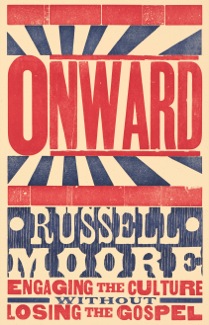
Onward: Engaging the Culture without Losing the Gospel - A Review

If you are a Christian struggling with how to find a way to positively engage the world around you while remaining orthodox, then Russell Moore’s book, Onward: Engaging the Culture without Losing the Gospel, is for you.

Moore has been on various news outlets over the past few years as a spokesman for conservative evangelicals, particular for the Southern Baptist Convention. If this has caused you to wonder what he is doing and why he says the things he says, then this book will be helpful for you, too.

Avoiding Twin Dangers

Moore is outlining the twin dangers of Christian engagement in the public square. On the one hand, it is easy for Christians to become like grumpy old people telling kids to get off their lawn. On the other hand, it also easy for Christians to leave unexamined many of the ills of society as long as it doesn't directly impact them. We can’t afford to fall into either one of the errors if we are going to reach the world with the good news of the gospel.

The thing that keeps us from falling into either of these errors is a proper understanding of the gospel. Moore begins by discussing the culture shift that has pushed Christians from the center of the cultural conversation to the prophetic edges. He is careful to note this reality reflects the fact that the values coalitions of previous decades sounded very Christian without actually being converted by the gospel. As the conversation shifted away from something that resembled a Christian ethic, the Christians that remained faithful to the gospel seemed to have two options: either compromise or get left out of the conversation. This is a false dichotomy.

Gospel Foundation, Contemporary Issues

Early on in the volume, Moore digs into the meaning of the gospel. He makes it clear that the gospel isn’t about either personal salvation or social justice; it’s about both. If the Christian church loses its understanding of personal conversion and individual redemption, she loses one of the cornerstones of the gospel message. Salvation is not based on redemption of the whole, but on Christ’s atonement for the individual. At the same time, if Christian individuals miss the central redemptive themes of historic Christianity, which offers a strong dose of the pursuit of justice in society, then they miss out on some of the key implications of their own gospel conversion; redeemed individuals seek to redeem society.

With both these aspects of redemption in mind, Moore addresses a number of major issues that are central to the contemporary cultural discussion: immigration, religious liberty, and family stability. These are social issues that tend to divide Americans from each other and are the topics that commonly lead to calls for compromise and accusations of a lack of compassion.

Convictional Kindness

This is where Moore’s call for convictional kindness comes in. Convictional kindness is standing firm on ethical norms without shame, while confronting the angry accusations of the surrounding world with a gentle spirit. The conviction is birthed from confidence in the objective moral order in creation that is witnessed to by the special revelation found in Scripture. It requires rational, well-thought through positions that are both coherent and correspond to the truth in God’s creation. Kindness is built on the understanding of our own personal need for redemption. We, too, are growing, learning people who have pasts that we may have forgotten. Those that we disagree with, even those waving fingers and shouting in our faces, are people made in the image of God who deserve to hear the message of redemption. That’s a message they won’t be able to hear if we are shouting back. In fact, joining in the shouting will keep our “conversation partners” from hearing both our arguments on the issue and the message of the gospel.

Moore’s overall argument is hugely important as Christians seek to be salt and light in a world that (still) desperately needs the gospel. He also makes subtler points that are even more significant for Christians to hear. For example, in discussing the issue of gun control or gun rights he explains that there is no single Christian position. He has a position, which he does not articulate, but he notes more significantly that no one can speak for an official Christian position. There are certainly moral elements to the question, but at the same time the bulk of the argument is prudential and legal. It would be unethical to leave loaded guns within the reach of toddlers, but the capacity of a magazine and the process for background checks for weapons are prudential questions. This doesn’t mean that the question is not significant, but that we should be careful about promoting our preferred position as a gospel truth when it isn’t. Doing so encourages wrangling within the body of Christ and it largely discredits the message of the gospel because the faulty logic is apparent to any who care to see it. In this example, the Second Amendment is a benefit of being American, not a right imbued by the gospel.

Conclusion

Onward has been published at a time that conservative Christians in America feel like they are under assault because anything resembling a Christianesque ethic is being pushed farther toward the margins. Moore helps by explaining that Christianity has always been strange and that we should continue to cling to our strangeness. We have to articulate the gospel in our homes, in our churches, and in our culture if we are to have an impact. Moore’s book is an encouragement to continue to live faithfully in private and in public, but with a confidence founded on the truth of the gospel not fueled by a majority in the polls. 

The Prosperity Gospel: A Constant Danger

Last weekend I heard the prosperity gospel, in a soft version, preached from the pulpit. We were visiting a church and the pastor declared (I paraphrase), "If you follow God's plan, you will prosper." It was toward the end of the sermon, when he was tacking on some duties that the congregation should perform (pray more, witness more, etc.). He certainly wasn't going full prosperity gospel, but it reflected the notion that if you do the right things, then God's got your back and will make everything work out.

That formula is an easy one to slip into, but it is so very dangerous. 

God doesn't usually make it easy for his most faithful servants, at least not according to what Scripture tells us. In fact, there is a regular pattern in Scripture that those whom God uses most suffer the most deeply.

Our hearts long for ease, but our usefulness to God requires a constant striving, which inevitably entails struggle. There is danger of a soft prosperity gospel in our lives each day because, in reality, we all want it to be true.

The problem with the prosperity gospel is that it teaches us that only when we are comfortable are we being blessed by God. That teaching can lead to despair when things aren't going our way.

The Hardcore Prosperity Gospel

The soft prosperity gospel is a constant danger to most believers, particularly American Christians, but there is a bigger, darker problem that has arisen in the heart of the wealth of America. That problem is the full-fledged, all-out prosperity gospel.

Most proponents of the prosperity gospel have learned to mask their message carefully, at least in public forums, since there has been a tendency among orthodox theologians and pastors to call them out. However, recently Creflo Dollar made the mistake of being open about his understanding of Christianity on Twitter.

He, or someone who has the keys to his account, posted a Tweet that read, "Jesus bled and died for us so that we can lay claim to the promise of financial prosperity. #ProsperityInChrist #WealthyLiving"

Dollar deleted the Tweet after being bombarded by negative comments. This screen capture was taken in anticipation of that on 8 Oct 2015.

Dollar deleted the Tweet after being bombarded by negative comments. This screen capture was taken in anticipation of that on 8 Oct 2015.

The tweet was retweeted by many, responded to by numerous critics, and generally drew a negative reaction from orthodox Christians on Twitter. As a result, Dollar deleted the tweet. Thankfully screen captures last forever. (Which is a warning for those who use social media to vent.)

Sometimes people delete tweets because they are ambiguous and can be misinterpreted. Sometimes they are deleted because of typos or because they have a dead link in them.

Dollar, or someone on his team, deleted this tweet because it was not sufficiently ambiguous. The veil was drawn back on the prosperity gospel. The message was made more clear than simply a promise of living "your best life now" and the true belief system was brought to the surface.

Deleting this tweet was an admission of guilt on the part of Creflo Dollar.

The purpose of this post is to point out the potential error and to point toward some resources for understanding and dealing with the theology of the prosperity gospel. The prosperity gospel, in many forms, is alive and well; we need to kill it in our hearts and help others to see what it really is.

Resources for combatting the prosperity gospel

Here are some helpful resources for understanding and confronting the prosperity gospel in your own heart and in the world around you.

What is the Prosperity Gospel, by Andrew Spencer.

Is the Prosperity Gospel Biblically Sound, by Andrew Spencer.

The Importance of Rejecting the Prosperity Gospel, by Andrew Spencer.

Errors of the Prosperity Gospel, by David W. Jones.

The Prosperity Gospel in My Own Heart, by David W. Jones.

The Poverty of the Prosperity Gospel, by Vaneetha Rendall.

Six Keys to Detecting the Prosperity Gospel, by John Piper.

The Prosperity Gospel: Decietful and Deadly, by John Piper.

Why I Abominate the Prosperity Gospel, by John Piper. (Video)

How to Help Friends Escape the Prosperity Gospel, by John Piper.

Confronting the Prosperity Gospel

Whenever someone writes a blog in opposition to the prosperity gospel (assuming anyone reads it), a backlash always comes from supporters of the individual criticized or the movement as a whole. Accusations are launched something to the effect that "Christians shouldn't attack other Christians," or "Have you followed Matthew 18?" The irony of commenters on blogs posting questions about Matthew 18 is often overlooked.

True enough, I haven't approached Creflo Dollar in person to confront him with his sin. However, he posted it on Twitter, which means that he put his thoughts out there for public critique.

For the first point, Christians should critique other people who claim to be Christians when they preach false doctrines. And when they do so publicly, that critique needs to be public. Paul (who was way more sanctified than I am) seems to have done just that to Peter when he was in error (Gal 2:11-13) with the hope of helping Peter and the believers that were caught in the theological error.

Frankly, this latest tweet by Dollar is only a recent proclamation of what he has previously clearly stated in his sermons and books. In other words, this tweet isn't the issue; it's the broader theological movement. (A more sustained critique of Dollar and the prosperity gospel movement can be found in David W. Jones' book, Health, Wealth, and Happiness.).

shai linne's song "Fal$e Teacher$" from his newest album, "Lyrical Theology Part 1: Theology".

The move toward defensiveness of a person or a movement is natural for those deceived by the prosperity gospel (or any other false teaching). Dollar is a charismatic preacher and he offers hope of wealth to many that strongly desire it. But it is a hope built on false doctrine, so it isn't a true hope.

However, maintaining doctrinal orthodoxy is vital to the health of the church. There is a reason that liberal denominations a dying. It's because their theology lacks the nutrients necessary to sustain them. Unfortunately, the prosperity gospel continues to flourish because of continued spiritual blindness by its adherents and much more careful (except with this tweet) presentation of the true nature of their message.  However, it remains a mushroom religion--kept in the dark and fed on manure--that can't survive when trials come.

Ultimately, the reason we should confront the prosperity gospel movement is not to win points on the internet, but because it is a false gospel. It presents the idea that Jesus came to make us wealthy. In reality, he came so that we could become holy. To lose that message is to lose the essence of God's gracious hope for the world.

This is all the reason we should need to publicly and openly oppose this movement of false teaching. It reflects true neighbor love to those trapped in the movement or susceptible to its clutches.

Review of Evangelical Ethics: A Reader

The recent anthology, Evangelical Ethics, from Westminster John Knox Press seemed promising. There has been no such collection focusing on scholarship from Evangelical Christian sources in wide circulation in recent decades. This is not due to a lack of ethical writing, but no one has previously taken up the mantle of chronicler to produce a volume. This lays a groundwork of expectation for the recent release from David Gushee and Isaac B. Sharp.

What Kind of Evangelical?

Unfortunately, this book suffers from excessive editorial interference. In the introduction, the editors acknowledge there are different understandings of Evangelicalism.

This dates back to the sociological versus doctrinal understandings that have formed a fissure between so-called progressive Evangelicals and conservative Evangelicals. The main qualification for the sociological understanding of Evangelical is claiming the title and being from a historically Evangelical tradition.

Often there is a residual discussion of the centrality of the gospel, but the many times the personal impact of the gospel is obscured by an emphasis on social activity. For conservative Evangelicals, the qualifications for the title are primarily doctrinal.

Doctrinally centered Evangelicals ask question like: Is Scripture understood to be the supreme norm? Is the gospel, including its impact on individual salvation, central to the life of the Christian? These are the primary concerns.

Gushee and Sharp acknowledge the division and then largely dismiss those who hold to a doctrinal understanding of Evangelicalism.

As a result, the most clearly identifiable Evangelicals in the list of included authors are Carl F. H. Henry and Francis Schaeffer. The selection from Henry is from The Uneasy Conscience of Modern Fundamentalism, which was chosen to illustrate how Henry had an interest in social ethics. A valid selection and a good one. Schaeffer’s selection is from How Should We Then Live. This, too is a worthy selection, though the introduction notes that his tone is “declinist” and that it seems to center on the issue of abortion, as if that was unwarranted in 1976 with Roe V. Wade a distant memory of three years previous .

Emphasis on Social Ethics

The volume is structured to minimize the significance of personal ethics. In fact, the only social issues considered in any depth in this text are economics and race. These are two worthy issues, but by avoiding personal ethics including abortion and sexual ethics, a false portrait is painted.

The image represented is also one of support for only one position on the issues discussed, as if there had been no ongoing conversation with differing views. Additionally, the issue of environmentalism is largely ignored, which is not representative of the last several decades of Evangelical thought, whether progressive or doctrinally centered.

Missing Voices

Instead of selecting texts that represent Evangelicalism as it is, the editors have selected texts that represent Evangelicalism as it is in their idealized world.

As such, minorities are significantly over-represented. This is not to discount the voice of those minorities, but if the major voices of a movement are mainly white men, then a reader that purports to describe that movement should represent the reality not the rosy vision of the chroniclers. The selections in this volume amount to historical revisionism.

The book is only about 160 pages. Most readers are at least twice that length. There was no lack of source material, so it is unclear why the volume turned out so unbalanced.

Missing from the relatively slim volume are John Stott, Oliver O’Donovan, Daniel Heimbach, the Feinberg brothers, John Jefferson Davis, John Frame, Cornelius Van Til, Wayne Grudem, Arthur Holmes, Stanley Grenz and others. Instead, a crowd of individuals who have largely rejected the inerrancy or infallibility of Scripture, which has typically been a hallmark of Evangelical theology.

In other words, this is a misrepresentation of the actual history and content of Evangelical ethics. If, as the title implies, the intent was to provide representative samples of the field, then it has largely failed.

Mixed Voices

That being said, some of the essays included are powerful. John Perkins’ testimony of being beaten and through that experience seeing the need for white men to hear the gospel is powerful. Nicholas Wolterstorff’s essay on the holistic power of the gospel for changing and redeeming the world is helpful.

Both the essay by Henry and the one by Schaeffer fairly represent a significant segment of doctrinally faithful Evangelicalism. There is some quality, but it is such a corpus permixtum that the volume has lost its center in Evangelical identity.

Certainly this highly massaged image will please those hoping to pull the Evangelical movement away from their traditional reliance on Scripture and interest in orthodoxy. That is exactly why the volume drew praise on the back cover from Lisa Sowle Cahill, who is theologically liberal. If the goal is to try to “redeem” the perception of Evangelical ethics from an emphasis traditional concern for doctrinal orthodoxy, then this book is a masterpiece.

Tragedy of homogeneity

One of the most beneficial aspects of my seminary education, both at the graduate and postgraduate level, have been the opportunities to read opposing viewpoints and figure out what makes those thinkers believe what they do. In other words, it is good to read people you don’t agree with.

This is why I read what David Gushee writes, as a general rule. He is generally sound in his reasoning even when I find his premises or conclusions unacceptable. Here I think he, along with Strong, have deprived future progressives of the benefit of an accessible, curated volume of primary sources that reflect historical reality.

The editors have thus increased the likelihood that some progressive Evangelicals and more liberal thinkers that read this volume will remain in the echo chamber of their own tradition and remain unexposed to conservative theologians. This minimizes the potential benefit of what could have been a significant volume for the long term.

Note: A gratis copy of this volume was received from the publisher with no expectation of a positive review.

Environmental Stewardship - A Review

It is a rare thing to be well-read in a discipline and to come across a book that is strikingly different. The experience is refreshing, but it happens only exceptionally.

Wipf and Stock released a new translation of a book by J. Douma, a Dutch ethicist, this year. His volume, Environmental Stewardship is sufficiently distinct from other treatments of the topic that it was a pleasure to read and genuinely novel.

Although the book was released in English in 2015, it was originally published in 1988. This means that Douma’s volume is not “current” in the sense that it includes all of the latest literature. It is academically valuable, however, because it introduces a number of German and Dutch sources that are not often considered in English writing on the topic of Environmental Ethics.

Additionally, because Douma was outside of the main discussions of Environmental Ethics in the United States, he provides a strongly alternative perspective that is neither right nor left of others, but different. This makes the reader rethink existing paradigms because he approaches the same old issues from a unique perspective. Still, Douma’s perspective is both well-reasoned and biblically faithful.

Summary

The book has five chapters. In Chapter One Douma surveys the issues of Environmental Ethics and begins to consider who could be at fault for the problems in the environment. Douma interacts with Lynn White’s famous thesis, which is that Christianity is to blame for the world’s environmental ills. However, Douma also interacts with the earlier and apparently more strident critique of Claus Jacobi, another Hollander. Douma’s critiques of both men are strong and much more helpful than many others who have interacted with them. In particular, Douma notes that White’s thesis is really that the ecological crisis is the product of a democratic culture. He is the first to make that assertion, but it rings true. Douma also notes that technology is most strongly critiqued only when it has a negative impact on the environment. In contrast, however, often technology is very good for the environment. Douma is shaking his finger at the hypocrisy of many environmentalists.

In Chapter Two Douma explains the biblical case for environmental stewardship. He undermines the dominion concept and offers an authentic stewardship model. There is no doubt Douma sees humans as part of yet unique within the created order. The correct attitude toward nature is neither anthropocentric nor cosmocentric but theocentric. Yet Douma’s theocentricity recognizes the special place humans have as alone being made in the image of God. Douma argues for a critical understanding of the cultural mandate. Humans are to cultivate the garden, but to do so with a long future in view.

The third chapter outlines Douma’s proposed solution to the environmental issues of the day. He calls for a right attitude to be inculcated in people, such that technology is embraced for its beneficial properties and personal restraint is exercised well. He argues for a common sense approach to improving environmental conditions instead of a romantic plea for a return to a previous day. Those days weren’t better for a number of reasons. In this chapter Douma moves quickly through a number of issues from nuclear power to animal rights. Douma is dealing with attitudes, which means the nearly thirty years between his writing and the present do not undermine the value of his proposed solutions.

The final two chapters deal with the particular issue of genetic engineering. Chapter Four discusses it in general, while the final chapter discusses it in relationship to humans. Douma is careful to note the potential consequences of genetic engineering. Many of those consequences will not become apparent until long after the first steps have been taken. In principle, however, Douma is not opposed to genetic engineering, though he insists it should be done for the right reasons, with particular controls, and within limits. He discusses in detail some of the risks and benefits of genetic testing for early diagnosis and potentially creating designer children. Some of what Douma foresaw as potentially adverse conditions from genetic engineering has come to pass. So too have many of the positives. Still, Douma’s perspective is worth reading despite its dated content.

Conclusion

This book is worth reading because it is so far outside of the stream of environmental ethics that it reopens settled questions and has the potential to improve dialog. For the scholar writing on the topic of environmental ethics, Douma’s footnotes and bibliography are a goldmine of sources from well off the beaten path.

This book is part of an answer to a growing concern in my mind of the need of a well-written, deeply considered environmental ethics that is consistent with an evangelical theology. In general, Douma provides that. At worst, Environmental Stewardship should enhance the conversation by reopening “settled” questions by forcing consideration from a new angle.

Note: A gratis copy of this volume was provided by the publisher with no expectation of a positive review. 

Is There Really Anti-Christian Bias?

Are Christians a persecuted minority or just a bunch of whiners? The answer you get to that question depends on who you ask. In some cases the answer is that both are true. In other cases the reality is that Christians overreact to other people’s dislike of their positions. However, according to sociologist George Yancey, there really is an anti-Christian bias in the United States, though it does not yet amount to persecution.

Both because of the question he picks up and the manner in which he answers it, Yancey’s latest book may be one of the most significant popular level books published this year. This is a book that will be a helpful resource for many pastors and laypeople for years to come.

Summary and Analysis

Yancey’s recent book from IVP Books is a popularized version of his co-authored academic tome, So Many Christians, So Few Lions. In Hostile Environment: Understanding and Responding to Anti-Christian Bias, he repackages the peer reviewed statistical research with careful analysis and thoughtful applications of the lessons learned. This is a book that pastors, professors, seminary students, and any Christian seeking to live and work in our culture should read.

A key term in Yancey’s book is Christianophobia. Personally, I dislike the word because the “phobia” tag has been co-opted and misused for people that have rational objections to the position or behavior of a minority. Yancey, however, carefully defines the term and uses it consistently throughout; this makes his usage palatable. His chosen definition is that Christianophobia  is “an irrational animosity towards or hatred of Christians, or Christianity in general.”  This definition seems fair. It captures what should be a fairly narrow slice of people that act irrationally negative toward Christians.

The research Yancey presents demonstrates that Christianophobia is not nearly as rare as we might hope. In fact, Yancey has showed that in academia in particular more than half of academics believe they are justified in rejecting Christians from tenure applications or simply not hiring Christians for academic positions to begin with. Yancey asks the pertinent and obvious question: Would it be OK to say you wouldn’t hire another demographic category or deny them tenure because of their inclusion in that demographic? The answer right now, according to Yancey’s research, is that most people refuse to consider that a valid question.

Yancey is not claiming there is an active conspiracy to ruin the lives of Christians: American Christians are not experiencing persecution like that of Christ-followers in other nations. Neither is he claiming that it is impossible for Christians to get jobs, earn a living, or be in some ways accepted in society. He is, however, claiming there is often an overt and acknowledged bias against Christians in society. He also argues that in general those who demonstrate Christianophobia view anti-Christian as acceptable. In other words, there are a number of people that just don’t like Christians and they think that is perfectly fine. 

Unlike some of the other societal biases, like anti-Semitism and Islamophobia, Christians in the West rarely have to fear for their physical safety. Yancey argues this is because “those who tend to have Christianophobia are in a better position to punish Christians in nonviolent ways because they possess more social power than those who tend to exhibit overt racism, Islamophobia or homophobia.” This makes anti-Christian bias more difficult to track, yet the surveys Yancey conducted demonstrate it is a real thing and relatively widespread.

Yancey salts the chapters with comments excerpted from the surveys conducted as a part of one of his academic studies. He chose them because they were representative, not because they were the most extreme examples of anti-Christian bias. I won’t quote them here, but the bile of them is rather telling. It is worth noting that the comments were from an anonymous survey, but that may eliminate some of the sugar coating that might otherwise exclude clear expression of opinions. The frankness of many of the comments is revealing, because it demonstrates an overt dislike of Christians that would be unacceptable for any other demographic.

Analysis and Conclusion

Hostile Environment is balanced in pointing out the inconsistencies in the Christian witness in the public square. Christianity is divided with many who claim the label being largely assimilated to the ethics of the culture. Or, on the other hand, many of those who are doctrinally orthodox are often shrill and inconsiderate when making their arguments. Sometimes the bias against Christians is deserved. However, Yancey points out, that bias goes much deeper than internal problems between self-described Christians can explain.

Toward the end of the book Yancey offers suggestions on how to remain a faithfully orthodox Christian and educate people about what that really means. He also provides some practical suggestions on how to deal with anti-Christian bias. These final two chapters are perhaps the most significant of the book, though not the most eye opening. There is room for further development and discussion on these topics, but Yancey does well to begin that discussion.

Yancey’s book is a must-read.  It appears that anti-Christian bias will remain a real thing and it is becoming even more politically acceptable to publically declare discriminatory beliefs against Christians and celebrate practicing such discrimination. If the Church is going to avoid capitulating doctrinal ground because of social pressure, we must think through how we are to live. If our children are going to learn how to be faithful in society, they must know something of the resistance to their beliefs. 


Note: A gratis copy of this volume was provided by the publisher with no expectation of a positive review.


A Review of the Mythology of Work: How Capitalism Persists Despite Itself

Peter Fleming writes a bitter screed against a version of capitalism and the concept of work in his recent book, The Mythology of Work: How Capitalism Persists Despite Itself. His basic purpose is to prove that, “We work, pay taxes, take care of the bills and commuting costs for one single reason: not to ‘survive’ but so that the governing elite gains its priveleges for nothing. Our labour is designed to provide freedom to the rich. Our work exists in order to subsidize the costs of their existence.”

The book, then, is largely a critique of what Fleming sees as an oppressive class system, where the middle and lower classes are firmly squashed by managers and owners of capital. This is a book that demonizes work and profit. It is essentially a moral complaint, although Fleming denies that in his conclusion. It is not a cheerful book, or one that provides real hope of change. In fact, in the conclusion, Fleming seems to abandon hope that even his critique can change anything. He labels his work inoperative, because he is both benefiting from and participating in the very system that he intends to critique.

Analysis

There are deep layers of irony in this book. Fleming is careful to note some of them in his own conclusion. As noted above, he recognizes that he, as a middle class university worker, benefits from the so-called oppression of others who are in a class below him in the economic food chain.

There are other clear ironies, though. In some ways, Fleming has an exceptionally high view of human nature. He believes that the economic system would continue and human flourishing would exist if only the managers and owners of capital would be replaced by a democratic body of workers. Thus the workers, executing the daily job, could replace the vision and ordering function that managers and corporate bureaucratic methodology provides.

At one level I am sympathetic with him. In previous jobs, I have often felt that I had a better view of the problem and a better hope of devising a solution than the administrators above me. However, sometimes my best solution was the best only for a limited population. The broader corporate perspective required a different approach or there was another solution that worked best for the company as a whole, though it was less than optimal in my small sphere. There were times I think I was right, but others that I was certainly wrong because I did not have the whole picture.

Fleming’s assumption is that everything would work out alright because the workers would make good long term decisions if they were only given the power. He fails to note that in many situations this is not the case. Although corporations sometimes make frustrating choices for short term benefit, the same is true for workers. Union strikes are nearly always couched as striving for worker’s rights or some absolutely necessary good. And sometimes this is valid. Sometimes, however, strikes and discordant negotiations are designed merely to extract the most near term gain for the workers. In other words, greed is sometimes still the motivation, and sometimes the fault is on the side of the workers.

Another basic assumption in Fleming’s calculus is the inherent goodness of humans. Yet, at the same time, he sees humans as pathetically weak. He describes debt as a form of slavery and faults banks for people’s consumer debt. There certainly are (and have been) cases of predatory lending, but the kind of consumer debt that Fleming describes as slavery is largely the result of excessive spending due to a lack of self-control. Fleming seems to argue that there is a deterministic force that is driving people to make bad choices. He ignores the fact that in many cases, these are bad choices that were made voluntarily for short term gain in recognition there would be a later price to pay.

A major problem with Fleming’s view of human nature is that he wants to have it both ways. Workers would make good choices if they had the opportunity despite the reality they have made poor choices when they have had the opportunity. This seems a bit sketchy.

Another problem with The Mythology of Work is that Fleming seems to be jousting a strawman. He has constructed a caricature of neo-liberalism (a term for a free market economic perspective) which closely represents crony capitalism in his portrayal. He assumes that the socialistic U.K. context that he is operating in is somehow an ideal situation according to a neo-liberal.

As someone who resonates with neo-liberal economics, I was not offended by Fleming’s critique because he was obviously not talking about me. It isn’t clear, however, whether he recognizes there is another option out there.

I was thankful that at the end Fleming proposes some solutions that would help resolve his critique. These solutions include: 1. A guaranteed minimum income with a max 1:3 ratio to top earners; 2. More mediating institutions; 3. Government ownership of utilities and other similar monopolies; 4. A three-day work week; 5. Eating less meat; 6. Providing non-monetary incentives.

Some of these suggestions are more helpful than others. Perhaps in another post I will engage with some of them. Some of them seem doomed to fail and unrealistic. For example, the guaranteed minimum income with a max income limit assumes that diminished returns (and unearned baselines) wouldn’t significantly undermine economic flourishing in society. In other words, there are some jobs people won't do for only a little more than the lowest skilled workers make. He anticipates this criticism, and dismisses it, but he never deals with it. Simplistic solutions like this rely on assumptions about human nature that seem invalid given human history.

Conclusion

Overall this is not a cheerful book. Fleming’s view of work is so negative that it seems he doesn’t recognize any redeeming benefits to work. What if our purpose is to serve one another through faithful work? What if the real problem is not work itself, or the system, but our idolization of money and our improper valuation of work? Fleming tries to resolve the problem created when workers identify themselves by their job by eliminating work instead of correcting the attitude. In the end, while some of his critiques are helpful, this volume left me looking for a more realistic solution.

Note: A gratis copy of this volume was provided by the publisher with no expectation of a positive review.

Some Thoughts on Scripture, Theology, and Climate

It doesn’t matter if the issue is economics, the environment, human sexuality, or liturgy, when we ask what the Bible says about a topic we need to asking the question of the Bible. We should not try to construct our preconceived notions out of biblical material.

For some, this is an obvious statement, but as I read theology texts and Christianesque articles on various issues from all angles, I consistently get frustrated with the authors’ well-meaning attempts at eisegesis. It is especially frustrating to someone, like me, who views Scripture as the final norm in all matters of life and faith to fight  through an attempt to contort the text to fit their perspective.

Theology and Climate Change

One recent example is a book on Systematic Theology and climate change. Recognizing that climate change is a big deal, and that I expect Pope Francis to affirm anthropogenic climate change in his forthcoming encyclical, I am still puzzling over the approach of this book.

Scripture affirms an earth-positive ethics. That is, an environmental ethics can be built that has strong support from Scripture. What Scripture doesn’t help us with is the particulars about the data that relates to climate change or what to do about it.

This is something we are going to have to watch for in the near future, as the forthcoming papal encyclical encourages growing concern for the environment. We need to be more concerned with the environment than we are. However, we also need to balance our method of response to environmental concerns so that we do not ignore our responsibility to care for the poor, advance medical technologies, and advocate for the life of the unborn.

In other words, not everything that comes under the mantle of environmentalism can be matched up with Christianity. This is true despite the fact that we can develop a thoroughgoing environmental ethics from Scripture.

More particularly, we cannot blindly jump onto a policy bandwagon when issues like climate change come into play, even if they are entirely human caused. There are elements in the platform of many climate policy advocacy groups that don’t match a Christian worldview. We need to navigate these waters very carefully.

Challenges for Contemporary Theologians

This is what makes trying to derive a theology of climate change from Scripture. The Bible doesn’t actually say anything about the specific nature of climate change. Therefore, any theology that deals specifically with climate change will have several layers of interpretation between the text and the theology.

There is nothing wrong with applying a biblical worldview to contemporary issues. In fact, I am an avid proponent of this. However, we must do so with care so that the issue does not overshadow the text. In other words, we cannot backfit a theological paradigm to our sense of justice.

Backfitting is exactly what some theologians are doing when they construct their paradigms. They build the foundation under the existing problem.

The answer to the problem, though, isn’t to stop talking about the problem. It’s to come at it the other direction. Scripture is sufficient for every question about doctrine and life. This doesn’t mean that there is a verse in Scripture to answer every question someone can ask. We shouldn’t try to make the Bible be any more exact than it is.

Instead, this means that Scripture has the information we need to construct a worldview that will allow us to receive and apply truth that comes from the world around us. God created the world in an orderly fashion, thus all truth is God’s truth.

The main idea, then, is that we need to be cautious when we claim something as a Christian position. If we do, then it really ought to be built on a carefully formulated framework derived from Scripture. After all, that is the revelation God gave us and by which we claim to judge all ideas.

Photo credit: Bible, by Adam Dimmick. Used by permission. http://ow.ly/OqNhh 

Memorial Day

According to many, today is the beginning of the summer season. It marks the time when many people break out white shoes, begin grilling in earnest, and generally celebrate the changing seasons. For many people, the most significant thing about this weekend is that they get an extra day off.

For Memorial Day, by Storm Crypt. Used by CC license: http://ow.ly/NmW3Y

For Memorial Day, by Storm Crypt. Used by CC license: http://ow.ly/NmW3Y

That isn’t the point of Memorial Day. The holiday was originally invented as Decoration Day, a day to honor the many dead of the American Civil War by decorating their graves. After the devastation of Work War I, it was renamed Memorial Day and was shifted to honoring all American dead from all wars.

 This is the point in Memorial Day. The point is honoring the sacrifice of those who died in the service of the country. Thus, “happy Memorial Day” is something that should not be said.

 In many churches, the Sunday before Memorial Day is a time where churches publicly honor those who have served. Often they restructure their services toward patriotic themes and some sort of recognition of the holiday. In general, I am not a fan of this approach because I think it lends itself to blending Christianity with our political loyalties and risks forming, or giving the impression of, a sort of civil religion. While I am not opposed to using a portion of the service in a prayer of gratitude, it would be hard to preach an expositional sermon that is truly patriotic in theme. Additionally, singing traditionally patriotic-themed songs in church tends to point people’s minds outward instead of upward. I think there are better ways we can be faithful citizens than incorporating such elements into our services.

 However, it is another thing for Christians to participate in Memorial Day services. In reality, we have much to be thankful for. Especially as we remember the men and women who have served our country and died in that service. Although our nation is far from perfect, we do still have freedom to gather for worship together and, for the most part, to live out the convictions of our religious beliefs. Additionally, we have a degree of physical safety even today because men and women have been willing to die in service of their country.

 In short, while some people go to Memorial Day services to honor the dead through a form of civil religion, it is entirely appropriate, in my mind, to go to a community gathering to express thanksgiving to the One True God for his faithfulness and provision through those who died in our nation’s service. This isn’t syncretism; it’s community. There will be parts of the ceremony that will be more or less consistent with my worldview, but that’s okay. This is not an expression of my faith in particular, but of community remembrance.

 Additionally, this is an opportunity to illustrate to our children the cost of war. Armed conflict isn’t just a game or an adventure. When there is discussion of sending troops in to stabilize a region or as retribution, we should recognize the hellish cost of war and think many times over, counting the cost. War is hell. War is always the result of someone’s sin. War costs many people everything they have in this life and even those that return home safely often pay a steep price.

Solemnizing this day publicly teaches children something important, and can instill a sense of the deep tragedy of human sin.

My disappointment this year is that there isn't a ceremony at the local veteran's memorial, but we'll probably pass that way anyway to pay our respects.

 I hope you have an enjoyable Memorial Day. May you be productive, get a nap, and take pleasure in having time with your family. However, I hope you also take some time to contemplate what exactly is being memorialized on this day. I also hope you will pray for the coming time when such days of memorial will be no more, when suffering is at an end.