Books Aren't Dead Yet

Sometimes it seems we are being constantly bombarded by news of the death of the book.

In some cases, the concern is the rise of the internet, which has cultivated a reliance upon shorter and shorter articles. Some folks seem to expect 140 characters to sufficiently capture the complexities of an argument.

In other cases, people (like myself) lament the rise of the e-book, which tends to reinforce the addiction to screens, undermine the reliance upon actual physical books. There is good evidence that e-books are both not as likely to replace real books as some fear and that they actually have the negative effects that traditional reading advocates ascribe to them.

Despite the worries of real book fans, a recent Gallup study indicates that the future of reading in general and real books in particular continues to look positive. This is encouraging and matches the findings of a study published by Pew Research in the Fall of 2016.

On one hand, the number of people who claim to not have read a book in the past year has doubled since 1978, from 8% to 16%, but it hasn’t changed much since 1990, which is well before the internet was widely available.

The study actually shows a fairly steady percentage of readers, with some slippage in some of the higher consumption categories. Still, the overall number of people actively engaged in reading books is quite high and far from the dire warnings that some technophobes issue. At the same time, it is worth noting the question for “reading” of a book includes listening to audiobooks. This inclusion may mask a phenomenon that still reflects a lower consumption of printed words for the same ideas being read on a commute, a run, or family vacation.

Screen grab from http://ow.ly/BHDz308l8Bg

Screen grab from http://ow.ly/BHDz308l8Bg

At the same time, the study also showed that 73% of people pick up a printed book more often than other formats. Only 6% of people rely on audio books as their primary means of engaging books. The news is not all that bad for those that value reading. Books appear to be holding their own against the flood of other entertainment options.

One caution, though, in this study—as in all of the studies I’ve seen on this topic—the nature of the books is never considered. In other words, people may be reading as much, but if they are reading prairie fiction instead of literature, that makes a difference. If book sales skew toward popular punditry and away from well considered arguments about policy, then reading is of much less value. It would be interesting to see a study that reflected on both the quality and the frequency of reading.

In the meanwhile, rest assured the reports of the death of the book have been greatly exaggerated. That should be cause for a cautious celebration.

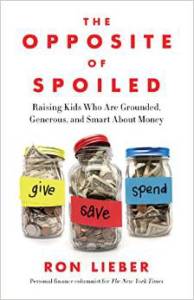
The Opposite of Spoiled - A Review

When I found the 2015 book, The Opposite of Spoiled: Raising Kids who are Grounded, Generous, and Smart About Money, on the shelves of my local public library, I expected a book pitched to the average, middle class U.S. citizen. The city I live in is in middle America. Certainly there are some people with some money in town, but the majority of the population is a long way away from the economic stratosphere. I was surprised, therefore, to find this book pitched to the top layer of the coastal suburban middle class on the local library's shelves. When I read it, therefore, I got a vision into the economic world of another class of people rather than much for helpful advice.

The author, Ron Lieber, is a personal finance columnist for The New York Times. That probably should have tipped me off, but I read the political commentary in NYT and the paper is supposed to be pitched to a national audience, so I picked the book up.

I didn’t gain a lot of good advice on how to help my kids be grounded, generous, and smart about money. I would have to multiply my salary by a whole number greater than two to be able to implement most of the money saving and responsibility teaching tips in my life. What I did gain, however, is a better understanding of how the rich in the United States live and the troubles that too much money can bring.

Lieber’s primary audience are the very well-compensated suburban professionals who view giving their child hundreds of dollars a month for an allowance as normal. Lieber is writing to help his readers teach their kids to be sensible while they go out to eat for lunch with their friends and live a life of socialization and recreational activity that much of America only sees on television.

The intent of the volume is very good. Lieber wants parents to raise financially savvy, realistic children. The trouble is that to those in the lower-middle and lower class, the world he describes is an impossibility. Frankly, this is the sort of volume that must have been purchased because of its title alone or as an automatic subscription, because it just doesn’t belong on the shelves of the public library of Shawnee, Oklahoma.

There is still something for the average reader to gain from Lieber, despite the fact he has significantly overshot most of our income brackets.

One key takeaway is the power of advertisement to inspire covetousness. He notes that once presented with a Madison Avenue-style vision of a particular toy, experiments show that children will choose to play with the toy-possessing kids that are anti-social jerks over nice kids that don’t have the toy. In other words, advertising works and it gets children (and probably adults) to forsake their best interests to get the advertised goods. Part of our responsibility as parents, then, is to develop a resistance to advertising in our children to keep them from getting sucked into materialism.

Another strong argument in The Opposite of Spoiled is that people like to work and earn money, but that our society continues to take away opportunities for that. One way that we have done this is by creating laws that prevent kids from working. This has been done with good intent—no one wants kids working in dangerous vocations. However, the same laws that keep kids out of mines also keep them from doing deliveries for the local store, sweeping floors, or doing other menial, but value adding labor during their spare time. (Note to any haters: No one is talking about a 12-year-old quitting school to work at JiffyMart. However, an after school job would be a completely different issue.) Lieber notes that kids look for ways to earn money, like picking up pop cans and asking for paid labor around the house. This is a good thing and Lieber rightly encourages it.

A third strength of this volume is that Lieber encourages talking about finances with kids. We are too secretive as parents about how we spend, save, and give. Lieber encourages bringing kids into the conversation about which charities to give to. Of course, Lieber’s framework for what generosity is is very low (he calls one family charitable for giving about 3% of their sizeable income). However, the process of talking through giving has been good for my own family and is a good practice that others might benefit from.

In short, there is some good advice in this book. However, Lieber has pitched it for an audience that lives so far in the stratosphere that most of the people in my circle will be unlikely to benefit from reading it.

Note: I checked this one out from the library, so there is no need for me to make any claims in this space.

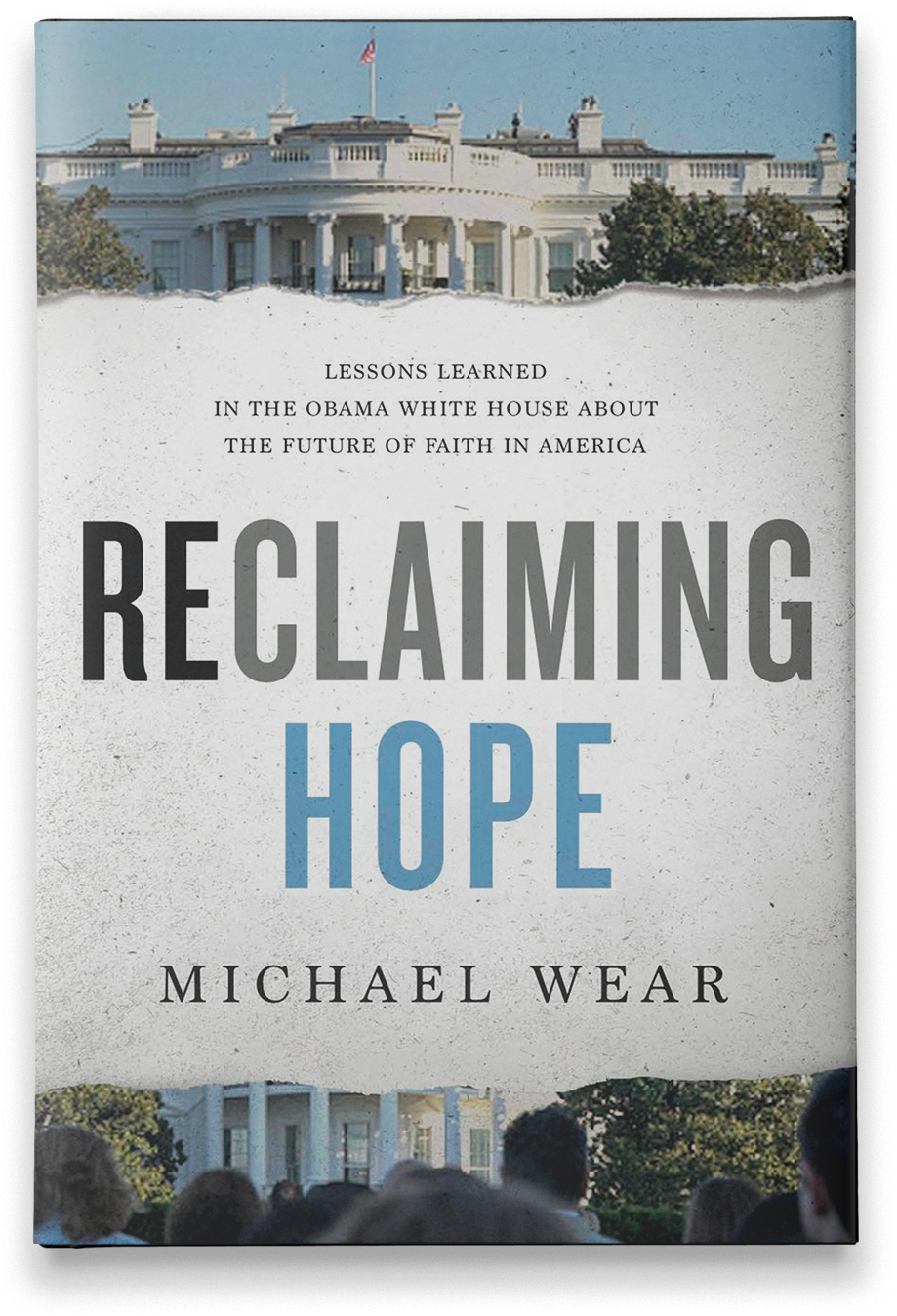
Reclaiming Hope - A Review

Michael Wear’s recent book Reclaiming Hope is a call for Christians to remain hopeful about the future, despite the misuse and abuse of religion in politics in recent years. Although similar messages have been promoted and led to failure, Wear’s message is a worthwhile one: authentic Christian hope should lead to Christians continuing to participate in politics as Christians. This means that we need to seek the good of the city in which God has placed us and remain critical of both political parties.

Wear is one of the many in the millennial generation who believe that greater government participation in redistribution of wealth is a good thing. The front half of the book recounts his alignment with the Obama White House on the good of passing the Affordable Care Act, which has made purchasing medical insurance legally required with financial penalties for those who choose not to participate in the market. Wear recounts Obama’s use of religious language in supporting things as way that faith can influence policy. For those that oppose the seemingly ever increasing growth of the government through programs like the Affordable Care Act, the front end of the book seems like a bit of tedious hero worship of President Obama. Those who find themselves so frustrated should continue on through the volume. Wear is recording the events as he saw them at the time, though he appears to more critically examine those events later in the volume.

Aside from Wear’s bias toward the government as a means for achieving economic justice, a portrait of the President Obama’s faith begins to emerge. Wear, a socially conservative evangelical Christian, participated in both of Obama’s campaigns and in the first term White House Staff as part of the faith outreach. Part of Wear’s job was to counter the attacks on Obama’s faith, which came from more conservative Christians based on Obama’s apparent support of the continued legalization of abortion and other causes supported by the platform of the Democratic National Convention.

The portrait of Obama’s faith that emerges is of an authentically faithful, liberal Christianity. In this sense, I am not using liberal as a dismissive insult, but to qualify the form of Christianity that Obama appears to hold and to have held. That is, a Christianity that truly holds to certain tenets of the orthodox faith, but sees fit to accept other elements that do not accord with biblical Christianity when historical orthodoxy appears to conflict with modern understandings of the world. This is the sort of Christianity that sees the gospel as primarily a call to social justice rather than personal conversion that leads people to pursue true justice in society in response to God’s justice. Wear, whose doctrine appears to be more consistently orthodox than Obama’s, paints a portrait of a President who sees the impetus toward apparent goods from within Christianity and finds motivation from that, but who may not have accepted the authority of Scripture over all areas of life and practice.

The first half of the book recounts the Obama political machine’s pursuit of doctrinally conservative Christians and efforts to enact a unifying vision for politics. The second half of the volume, however, outlines the ways that the Obama White House subverted those processes, discarded efforts to meaningfully work for a common vision of the good. This failure to seek common cause is highlighted by the Obama Administration's refusal to drop the contraceptive mandate despite the large number of Roman Catholic Bishops who would have otherwise have supported the measure. Wear documents his frustration that the White House staffers were unable or unwilling to understand that prohibition of contraception is a longstanding, significant tenet of Roman Catholic doctrine and to unnecessarily impose a violation of conscience on Roman Catholics in the marketplace would result in alienation of a large base. Additionally, Wear recounts the instant amnesia sexual revolutionaries developed in their efforts to excoriate and persecute those who held a vision of marriage that even Obama held until 2011. Wear reveals a political machine that, at least in part, did not (and likely still does not) understand the place and power of faith in the lives of the faithful of many religions.

Later chapters document the anti-religious influences in the White House overcoming the efforts of Wear and other faithful staffers. This was punctuated by the DNC’s overt pushing of social advocate, shock-value entertainer Lena Dunham’s video comparing voting for Obama in 2008 with her first sexual encounter. Also, the Obama campaign in 2012 used profanity laced e-mails to rally support. The shift into a post-religious White House (which is not to say a post-religious Obama) could be seen in the demonization of Louie Giglio prior to the 2013 inauguration, whose 20-year-old sermon expounding traditional sexual morality was sufficient to result in many public attacks and his ouster from praying at the inauguration. As Wear notes, “In 2009, our diversity demanded we accept that there will be voices we disagree with in public spaces. In 2013, diversity required us to expel all dissent.” (pg 190) This is the reality that many have experienced, which has alienated many of the faithful from the Democratic National Convention, and has helped to push some to vote against Hillary Clinton in the most recent election.
Wear closes the volume with a constructive appeal to a biblical concept of hope, which Christians alone can bring to politics. Whatever policy disagreements I have with Wear, these chapters are helpful. The loss of real hope is detrimental to politics, it leads to fragmentation, hatefulness, and eventually a politics that must win at all cost for fear or retribution. If nothing else, this last section is worth the price of the book, since it reveals the reality of socially conservative, faithfully living evangelicals who have participated in politics with the Democratic National Convention and don’t hate orthodox Christianity. Wear’s willingness to communicate his basis of support for some of the DNC’s policies while seeking to effect change from within. He should be honored for such efforts.

This is a helpful book in many respects. It undermines the notion that being a faithful, socially conservative Christian prevents engaging in politics with the DNC. It provides a glimpse to some of the machinations of the political machine, which should cause both the right and left to question exactly who wrote and how sincerely are meant statements that seem faithful from politicians. It may be that people like Wear are, in good faith, helping politicians craft statements that allow them to seem rather than be truly faithful. Finally, and perhaps the most important lesson in this bleary eyed post-election season, Wear’s volume reminds the reader that we cannot cease participating in politics even when both parties hold positions repugnant to faithful Christians. We must, necessarily, seek to gracefully engage in politics for the common good as we best understand it. We must also seek to be gracious with those with whom we disagree and seek to critique their policy, not their faith.

Note: I received a gratis copy of this volume as part of the launch team for this book. There was no expectation of a positive review.

Biblical Authority After Babel - A Review

In the year Protestants are commemorating the 500th anniversary of the Reformation, many tend to review the Reformation as either an unchristian schism or a tragic necessity. These sentiments tend to obscure a more positive view that the Reformation was a much needed liberation of Christendom from the hegemonic theological and doxological distortions of the Roman Catholic branch of Christianity. As a result, a common mood is for Protestants to wring their hands and confess to divisiveness while Roman Catholics wag their finger at the destructive individualism and doctrinal plurality they argue is the necessary result of the five solas Reformation and the theological recovery movement known as the Reformation. Liberal Christians, both those who claim continuity with Roman Catholicism and those who chart their course by revising other theological traditions, tend to see the interpretive plurality that resulted from the Reformation as an indication that the main principle of the Reformers—namely, sola scriptura—is a fundamental failure and that Scripture is an insufficient foundation upon which to build Christianity.

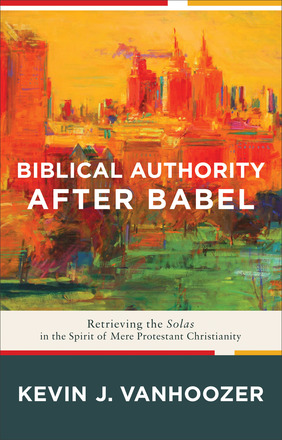
In Biblical Authority After Babel: Retrieving the Solas in the Spirit of Mere Protestant Christianity, Kevin Vanhoozer makes a positive case for Reformed Christianity built upon a robust development of the five solas. Vanhoozer unpacks his apology for Mere Protestant Christianity in five chapters with a separate introduction and conclusion. This book is a modified version of a series of lectures given a Moore College, the result is a more conversational and accessible volume than some of Vanhoozer’s other work, which is to say that this volume combined Vanhoozer’s academic rigor with clear, readable prose to create a much-needed tool and treasure for contemporary Protestants.

The body of this volume is comprised of five chapters in addition a substantive introduction and conclusion. Each of the five chapters highlights one of the five solas of the Reformation, though, as is clear from the title of the book, there is one sola to rule them all. Since sola scriptura is at the heart of true Protestantism, that idea functions as the glue that holds the entire volume together.

In the introduction, Vanhoozer begins by addressing the elephant in the room in considerations of contemporary Protestantism: Can separating from “The Church” ever be considered a good thing? He addresses some of the more common historical critiques of the Reformation, but remains confident that Protestantism was not fundamentally schismatic in its origins. Rather, Luther sought to reform Roman Catholic dogma because of severe errors in it and the Roman church forcefully rejected attempts at theological correction. Thus, Luther’s actions were not simply a protest against the error of the papacy. Instead, Vanhoover notes, “To protest is to testify for something, namely, the integrity of the gospel, and, as we will see, this includes the church’s catholicity.” (pg. 15) That catholicity includes more than the claims of Rome’s devotees to sole stewards of unqualified, universal truth. At the same time, Vanhoozer is critical of versions of Protestantism that have been divisive and individualistic in their interpretation, that is why he pursues the concept of “Mere Protestantism,” which is the sort of Protestantism that “encourages the church to hold fast to the gospel, and to one another.” (pg. 33). That vision, which Vanhoozer explores through his exposition of the five solas, is exactly why the Reformation was both necessary and good.

In Chapter One, Vanhoozer focuses on sola gratia, and by virtue expounds the gospel to his readers. Grace in the gospel is what ignites the Christian to God exalting praise, allows Christians to see the good in the world, and focuses the believer’s gaze eternally on the procurator and source of all grace—the Holy Trinity. It is God’s grace alone that enables fallible humans to have access to God’s infallible word and be able to comprehend any of it; the Spirit illuminates Scripture because of grace alone, which provides understanding of the path to salvation. Vanhoozer argues it is God’s grace alone to give Scripture and also to illuminate it that keeps the accusation of autonomous interpretation from being true among authentic believers.

The second chapter covers sola fide, which Vanhoozer uses to counter the argument that the Reformation begat skepticism. This accusation seems a bit strange, since the meaning of sola fide is “by faith alone,” which is used in reference to the sole necessary response to God’s gracious offer of salvation. In its original context, the term was meant to differentiate the gospel faith of the Reformers from the myriad of religious duties foisted on believers by the Roman hierarchy. Returning to the central theme of the place of Scripture, Vanhoozer is careful to show that the reading of Scripture encouraged by the Reformers was not one of skepticism, but of faith. Vanhoozer then considers several different hermeneutical methods and epistemical failures that are not consistent with biblical faith. Instead of subverting the authority of the church through private readings of Scripture, Vanhoozer argues the faithful reading of Scripture requires the authority of the God, working through the historic community of believers. It is God and his gift of Scripture—not the hierarchy of the Church—that are ultimately affirmed by faith alone. As Vanhoozer sums up, “True faith has to do not with anti-intellectual fideism or private judgment, then, but rather with testimonial rationality and public trust, the trust of God’s people in the testimony of God’s Spirit to the reliability of God’s Word.“ (pgs. 106-107)

Chapter Three digs into sola scriptura. Vanhoozer notes, “Sola scriptura is perhaps the most challenging of the solas to retrieve. Even many Protestant theologians now urge its abandonment on the grounds that in insisting on Scripture alone, it overlooks or even excludes the importance of tradition, the necessity of hermeneutics, and the relationship between Word and Spirit.” (pgs. 109-110) It is in the reliance on Scripture alone that those who regret the Reformation find the root of division. As Vanhoozer points out, however, divisiveness is driven more by solo scriptura rather than sola scriptura. The distinction is clear and obvious for those willing to consider it. Sola scriptura refers to relying on Scripture only as the primary authority in theology. There are other sources that inform theology, but those sources must be normed to the overarching authority of humans. This, of course, presumes the clarity, sufficiency, and coherence of Scripture. Vanhoozer discusses these, then he surveys other understandings of authority, but concludes that a robust understanding of sola scriptura brings Christians together, even simply in conversational disagreement, and that rejection of the concept through naïve biblicism and covert traditionalism is what leads to division.

The fourth chapter interprets solus Christus, which is the affirmation that Christ alone is the only mediator between God and humanity. In all practicality, this has sidelined the parish priest in Protestantism, since a sanctioned representative of the church is no longer needed for forgiveness of sin or receipt of grace through the eucharist. However, Vanhoozer argues that the priesthood of all believers has not minimized the significance of the local Church, as some claim (and as some flawed interpreters have posited). Rather, it has sanctified the lives of the lowly congregant, giving him or her a part to play in the divine drama coequal with ecclesial leaders in community with Christ. This means that local congregations have the right, privilege, and responsibility to rightly interpret Scripture and minister as the local instantiation of the body of Christ.

Chapter Five celebrates the final sola: soli Deo gloria. This is a fitting climax to the volume as Vanhoozer notes, “Soli Deo Gloria, like the other solas, is partially intended to exclude an error. In this case, what is excluded is not human works but the end for which we work: human glorification.” (pg. 182) The failure of the Reformers and their spiritual heirs is partially explained by the loss of unity around this concept, and the sometimes unwillingness to unite or work together due to human turf wars. Vanhoozer does not decry denominations; rather he rejects divisiveness due to human pride. Instead, he commends legitimate, gracious division of matters of interpretation, with an ongoing dialogical argument toward truth. Such dialog, conducted for God’s glory alone is a recognition of the authority of Scripture and the unity of the one, holy, catholic church. According to Vanhoozer, “The glory of mere Protestant Christianity is the conference and communion of holy nations, itself a gift that glorifies God in magnifying Jesus Christ.” (pg. 212)

This volume is just the sort of book needed for our present time. The term “evangelical” is quickly becoming meaningless as progressives deny the doctrinal content of the term and reject biblical authority. At the same time, it is being used as a vague political label that refers to a supposed conversion experience, but represents right wing politics. What Vanhoozer presents is a positive case for a properly evangelical, Mere Protestant Christianity, that rejects the divisiveness of the Roman Catholic tradition and pursues unity in the core of Christianity, which is the gospel.

Biblical Authority After Babel may be, without exaggeration, one of the most important books to be released in celebration of the 500th anniversary of the Protestant Reformation. Though Protestantism is not perfect, Vanhoozer explains the beauty and necessity of standing for truth against error and preserving the gospel for the sake of all.

Note: I received a gratis copy of this volume from the publisher with no expectation of a positive review.

More than Enough - A Review

Most of us live in this world unaware of how wealthy we are. We have much more than what we need. As people in the United States, or even much of the so-called developed world, we have more resources available than royalty in previous ages.

More-than-Enough.jpg

Lee Hull Moses seeks to address this condition and provide a Christian approach to living in our state of wealth. Her book, More than Enough: Living Abundantly in a Culture of Excess is an attempt to navigate through the tangle ethics of a global economy, with a myriad of decisions each day. This book is focused on showing how Christians should live in light of their situation.

Moses is Senior Minister of the First Christian Church in Greensboro, NC. The congregation she leads is part of the left-leaning United Church of Christ. A liberal approach to Christianity significantly colors the volume, and helps to explain where she lands in so many ways.

The volume is comprised of thirteen chapters, in addition to an introduction and conclusion. In the first chapter, she begins by calling the reader to desire to live well as Christians; she wants her readers to delight in daily existence. Chapter Two offers the assertion that we (middle class Americans) have plenty and need to learn when to accept we have enough. The third chapter decries the complexity of living a simple life: it just isn’t as easy as the books usually suggest. Chapter Four is a lament for injustice in this world.

In Chapter Five, Moses uses two texts of Scripture to commend generosity and self-limitation to the reader. Zacchaeus and the rich young ruler represent this paradigm for her. The sixth chapter offers a confession of her own wastefulness and indulgences, like buying candy that she fears may have chocolate sourced by child slaves, and taking a vacation trip to Barcelona, Spain. Chapter Seven addresses the plague of stuff—too much of it, more of it than needed, and much of it never really appreciated. The eighth chapter speaks of the Sabbath, the theory of which Moses pulls from Walter Brueggemann, with a call to practice it in contemporary society.

The ninth chapter calls for people to pursue social justice, particularly to seek the good of neighbors. In Chapter Ten, Moses celebrates hope and finds energy for her pursuit of justice in the future reconciliation of all things. The eleventh chapter documents Moses’ work to increase government expenditures on social programs some see as necessary to bring about justice. Chapter Twelve calls the reader to delight in the good things in life, which is about where the volume began. In the thirteenth chapter, Moses discusses participation in Christianity—particularly the mainline denomination—and finding continuity and future meaning related to her God’s goodness. The conclusion ends with plaintively, with a statement that there is good and bad in the world, but she hopes it gets better.

There are several strengths to this volume. First, Moses avoids the trap of idealism all too common with volumes on the topic of social justice and excessive wealth. She recognizes that sometimes we make decisions that are considered by some to be less than good because we don’t have time to research more, drive farther for a product, or simply walk instead of driving. By including a confession of her own failings and the sometimes murkiness of her own decisions, Moses captures the complexity of life in our contemporary world. This makes he volume more convincing than some advocates of a certain version of social justice.

Second, Moses recognizes the very apparent reality that the United States is awash in wealth. Much of the perceived financial pressure middle class families feel is self-caused, as they pursue a lifestyle that is just a little beyond their means. Life really is more delightful if we desire less and delight in what we have. Additionally, her assertion that Christians should be exemplars for others living in contentedness on less than others is biblically sound.

Despite these strengths, Moses’ approach has some deficiencies. The most striking is the absence of a real gospel, of propitiation, of actual forgiveness of sin. Moses does define sin in the volume, but she describes it as human action that interrupts to flow of God’s love rather than an offense against a holy God. (52) The deepest weakness of this volume is that Moses senses her own guilt, but does not seem to understand that the solution to the guilt is not marching in the state capitol or buying so-called fair trade products, but in throwing herself on the mercy of God and receiving relief from her guilt through Christ. Instead of building her faith on the completed work of Jesus Christ, Moses claims, “The faith we affirm is built on the hope of a future reconciliation, a promise that the world will be made whole.” (97) This is vastly different than Paul’s claim that the resurrection is of first importance. We have to have the resurrection before we can have that future reconciliation.

The missing gospel is due as much to the absence of a real, personal God through the volume. It appears that for Moses the most significant relationships on earth are those between her and other humans. In fact, the entire volume reflects an attempt at self-justification by attempting to mitigate human suffering. Moses puts herself at the absolute center of her Christian experience, and seems to believe others should view themselves as the center of their own. Therefore, she does not ask whether what she does pleases an almighty, holy, personal God. Rather, she asks whether she’s done enough to assuage her guilty feelings about her wealth and privilege. The book is built on a foundation of what appears to be moral therapeutic deism.

The efforts Moses suggests to bring about equality of outcomes tend to be built on growing the government and forcefully redistributing wealth. Moses claims that the government’s role is to “make sure nobody gets left out or left behind.” This is a far cry from pursuing justice, which is what Scripture repeatedly affirms as the role of government. By calling the government to enforce equality, Moses is asking it to do something that it simply cannot do in concert with pursuing justice.

In addition to a questionable definition of government, Moses also falls prey to the popular myth of a zero-sum economics. She views her own consumption as morally dubious because she sees whatever she uses as taking away from others. This approach to economics is common, but is certainly not universally accepted. It is also undermined by the fact that the percentage of the world’s population living in poverty is declining, contrary to her assertion that the “rich get richer and the poor get poorer.” (43) While there is too much poverty in the world, Moses fails to recognize the vast improvements in human welfare that have been made possible very recently, and that many who own nearly nothing in this world’s goods are among the most wealthy.

This book holds out a great deal of promise. There is too much injustice in this world. There are structural biases in our nation that need to be addressed. Many times companies and politicians are motivated by selfish gain rather than the common good. Individuals and families waste too many resources and ignore too much evil in this world. The topic is a worthy topic.

However, Moses’ approach is unsuccessful because it lacks the potency of the gospel, which motivates the regenerate to do justice, and love mercy in this world. It is the gospel that should inspire Christians in the West to work toward economic systems that recognize the goodness of human contributions and the justice of protecting private property. It is the holiness of God that should enflame the hearts of the Church to action. What Moses offers is a motivation built on a feeling of sadness due to personal guilt. Thank God that he provided a way for so much more through the cross.

Note: I received a gratis copy of this volume from the publisher with no expectation of a positive review.

A Plea for Reading the Bible

One of the greatest tragedies in the Christian life would be to believe that the Bible is God’s word and not take steps to read and understand it.

In contrast to the many years prior to the Protestant Reformation when the Roman Church worked to keep reading the Bible in the vernacular language illegal, we now have more access to the Bible for less money than ever. The problem is that we simply are not reading it.

Consider this video from the United Bible Society, which shows a people group in Indonesia getting the New Testament in their language for the first time. Compare their excitement over access to God's Word with our apathy despite the overflowing availability of it.

Choosing a Translation

There are so many versions of the Bible available right now that it can becomes confusing to figure out what you need. Here are some tips for choosing a version:

1.         Find out which translation your local church uses in its regular worship services and Bible studies. If they are consistent, it may help to have the same translation as you worship.

2.         Consider your reading ability. One of gifts of having multiple translations is that you can find a version of the Bible that is easiest for you to comprehend. This guide from the publisher, Cokesbury, may be helpful for your decision. Even if you aren’t sure what your reading level is, the guide will give you a relative understanding of the differences in difficulty.

3.         Before you buy a Bible, go to www.Biblegateway.com and read the same passage in several versions. If you are familiar with a particular passage, you can compare between translations and get a feel for the language in it.

4.         Ask one of the leaders in your local church for a recommendation if you aren’t sure. A good Bible can cost a significant amount of money, so ask your pastor or a trusted ministry leader what they recommend.

After you’ve picked a Bible, or if you’ve already got one, then the most important thing you can do with it is read it and begin to learn it. If you’ve read this far in this post, I’ll assume that you have a desire to read your Bible and are looking for ways to break down this monumental task into smaller chunks.

An Argument for Bible Reading Plans

Many contemporary Christians set annual goals of reading through the Bible each year. This can be a great practice for a number of reasons.

a.          It exposes you to the whole counsel of God. It may take a year and you won’t remember all the details, but making it through Scripture will help shape your understanding of God if you work at it.

b.         The practice of reading all of Scripture in a year ensures that, if completed, most days you will have spent time in God’s Word.

c.          You will begin to see patterns, recurring themes, and connections in Scripture that you were not aware of. Reading the Bible helps you become a better Christian.

At the same time, simply going through the motions to move your bookmark 3 chapters each day or check of the day's box can become a form of legalism. It is important to find a reading plan that meets your commitment level, your ability, and the time resources you have available.

For example, a mother with several young children is going to find setting aside even 20 minutes a day for Bible reading exceedingly difficult on a consistent basis. Therefore, choose a Bible reading plan that keeps you moving, but doesn’t kill you.

It is also possible to skim through the Bible each day in a year and never latch on to anything. It is possible to read the Bible without getting anything from it. This is a danger with some of the 1 year plans. Find a reading plan that matches your reading ability and time commitment. 

But by all means, please read the Bible.

Some Basic Reading Plans

Here are a few different Bible reading plans that are available for free online. I’m linking to a few of them here:

1.         The simplest option is to read the Bible from cover to cover. In order to do this, you will need to read about three chapters each day every day.

2.         Another option is to read through the Bible in chronological order. Our Bible doesn’t necessarily flow in a straight timeline from the first page to the last, so someone has put together a reading plan that puts the minor prophets (for example) in order and shifted Paul’s letters to the order that we believe he wrote them. If you are trying to understand the flow of the Old Testament history (for example), doing this reading plan may help.

3.         For those looking some flexibility in their schedule, but who still want to get through the Bible in a year, a five day a week reading plan like this one will give you two catch up days in the week. This is an option that might appeal to busy professionals or parents.

4.         Some may want or need to use a slower pace. For those who read a bit slower, there are plans that will walk you through the Bible in two years.

If you have never read through the Bible, I recommend that you start with one of these plans and get a broad sense of Scripture. Do this for a couple of years, then consider a more in depth study method or selective reading plan.

One example of a focused study method is the plan suggested by Joe Carter, writing for The Gospel Coalition. He suggests reading each book of the Bible twenty times straight through. This, he argues, will begin to change your worldview through Scripture saturation. His method is pretty simple:

1.         Choose a book of the Bible.

2.         Read it in its entirety. 

3.         Repeat step #2 twenty times. 

4.         Repeat this process for all books of the Bible.

I have not tried Joe's method myself, but it stands to reason it would be beneficial if simply because it would help the reader be very comfortable with the content of the Bible. Moving through all sixty-six books of Scripture would take some time, but at the end, I imagine the reader would have developed a depth of familiarity that would serve well for the remainder of life.

A Call for Gracious Persistence

Photo Credit: Bible Reading by Cristeen Quezon. Used by CC License. http://ow.ly/CZMj307AJ0y

Photo Credit: Bible Reading by Cristeen Quezon. Used by CC License. http://ow.ly/CZMj307AJ0y

Whichever method you choose to increase your Bible intake is not nearly as important as simply reading the Bible more deeply. You will benefit more from reading a third of the Bible this year than in reading none. You will benefit from picking up after you have missed a few days and continuing on, even if it puts you “off schedule.” Falling short of your goal is no sin. Failing to take time to engage with God’s word can lead to sin, as you enter life's battle unarmed by the sword of the Spirit.

Therefore, don’t wait until the New Year to start a plan. If you decide to start in February, that is fine; there is nothing magical about the first of January.

If you miss a month, don’t sweat it. Just pick up where you left off and keep going.

If you don’t get it all, keep moving. Ask questions of your pastor or ministry leaders. Just keep moving.

The Wealth of Humans - A Review

There is little question that economic structures and human participation in economy have shifted over time. With shifts from feudalism to mercantilism to forms of capitalism to the present blend of socialism and capitalism that exist in most democratic societies today the humans engaged in the economy have adapted to the changes or fallen by the wayside.

Consider, for example, the difference between the expectations for work in the mid-Twentieth century and today. People anticipated working for the same company for the majority of their careers not too long ago. Now, it is surprising when someone stays with one employer for the duration of their working years. The tenure of some employees at many corporations is measured in months instead of years and there is no promise of a pension, only an employer match in a 401K.

Discussions of work and vocation haven’t always kept up with the shift in working conditions, which makes Ryan Avent’s recent book, The Wealth of Humans: Work, Power, and Status in the Twenty-First Century, a helpful contribution to the discussion of work and economics. Avent is a senior editor and columnist for the left leaning magazine, The Economist. As such, some of his analysis supports ideas more at home in democratic socialism than in a more consistently free market economics; there are several occasions where Avent argues for Keynesian solutions to stagnation and increases in government spending on social benefits. However, overall, Avent’s analysis of the changing workplace in the Twenty-first century is helpful and adds to the literature in the field.

Summary

Avent surveys the topic in twelve chapters in addition to the introduction. The chapters are grouped into four parts with three chapters each.

In Part One, Avent surveys the shifting employment landscape. The rise of digital technologies have served to increase productivity, which has in turn created a glut of labor. This means that many low skilled workers find themselves either automated out of work or in a precarious situation. He continues by discussing the effect of automation: the glut of labor. Avent notes that although there is a real possibility of a short term disruptions in the workforce, either opportunities will open up, people will re-tool for new careers, or some mediating stasis of working hours and income will be attained. However, the potential for a significant societal disruption exists and could be significant if society fails to make preparations for the upcoming shifts. Avent predicts wage stagnation and income inequality; he also predicts that the lower economic strata will demand a different means of wealth distribution in light of their limited opportunities.

The second part outlines the changing realities in the digital economies. With the glut of labor on the market, there is little to push wages higher, which he predicts will increasing lead to calls for government solutions. He also notes that while labor is plentiful, the contemporary marketplace has increased the value of corporate culture over machinery and other traditional capital resources.

Part three discusses some of the shifts of the digital economy. He notes that there is an increase in income inequality among individuals, which he classifies as a sort of injustice. He also argues that on an international level, there have been some nations that are seemingly perpetual winners and some seemingly consigned to a permanent developing status. Avent then argues that the digital, demand based economy leaves economic systems at risk of self-perpetuating periods of low demand, such as has been witnessed in the slow-recovery after the recent Great Recession. His solution to this problem, consistent with his Keynsian presuppositions, is an increase in government spending and stacking on national debt. He does, however, recognize some of the ways government interventions have increased the recent economic turmoil.

The fourth part discusses the economic and political problems of the digital revolution. He discusses the increasingly popular solution for redistribution of a government facilitated Universal Basic Income. He argues that such a solution is unlikely to success in the longterm, and that work has value for enhancing a human sense of wellbeing. He rightly recognizes that the problems of income and economic inequality relate not simply to wealth, but also to social structures and attitudes. Economic contentedness depends as much on the definition of the good life as the actual income. He also notes that the economic conditions and growing instability and insecurity present and opportunity for both the radical left and right to provide populist solutions to problems; a reality that is being realized in the U.S. and in the U.K. among other nations. He concludes the section rather inconclusively with an expectation that some sort of seismic shift will occur, though he doesn’t know exactly what. Given the complexity of predicting the future, this is probably a fair way to end.

Analysis and Conclusion

Overall, Avent’s arguments and analysis are well thought out and nuanced. He avoids simplistic analysis and one size fits all solutions. Though he begins from a Keynsian foundation, he remains critical of certain typical aspects of that system. This is, overall, a well reasoned and informative book.

In particular, his recognition that work is not merely a way to put bread on the table, but a part of having human agency, of feeling valued, and of contributing to society is healthy. Where some who predict the coming disruption of the digital economy see Universal Basic Income as a silver bullet solution, Avent recognizes there are significant flaws in that as a final solution.

Whatever your preference for economic systems, Avent’s book is worth the time to read. He argues carefully, presents his case clearly, and acknowledges basic truths about human nature.

Note: I received a gratis copy of this volume with no expectation of a positive review.

Christmas - It's Going to Be Alright

It’s going to be alright.

That’s the message of Christmas.

It isn’t toys, tinsel, and turkey.

It’s going to be alright.

Whether it happened in December or not, God came down to earth and took on human flesh. He was born in poverty, worked with his hands, and lived a perfect life. He did this to repeal the curse laid on all creation due to Adam’s sin. He did this to reconcile all things to himself and restore all things on our behalf and for his own glory.

Used by CC License. Photo Credit: http://ow.ly/Docz307pVri

Used by CC License. Photo Credit: http://ow.ly/Docz307pVri

It’s going to be alright.

We take this celebration and make it about stuff. We ratchet up the anxiety by trying to make it perfect and make sure our house becomes paradise for our kids and our families for a day. We get together with people we rarely see and who we may not like. We make it about so much that isn’t the point.

It’s going to be alright.

God knew. He knew what Pontius Pilate would do to his son. He knew what would happen to Christians in Rome. He knew what we would do to one another, sometimes in his name. He knew what we would do even though we know it dishonors him. But he sent his son anyway.

It’s going to be alright.

Jesus knew that for a moment it would feel as if he were separated from the the Father and the Spirit. He knew that as the righteous wrath of God was poured out on him on our behalf that the earth would tremble and the sun would go dark. He knew that the world would stand on a knife’s edge of existence as he who knew no sin became sin so that we could become the righteousness of God.

It’s going to be alright.

Jesus knew that though he had paved the path for sinners to be redeemed, many would hear the gospel and ignore it. He knew that many would find the pearl of great price and yet not tell anyone about their joy. He knew that he was giving a mission to unworthy servants bound to fail him. He came. He died. He did it anyway.

It’s going to be alright.

He knew you. He knew me. Even in our mother’s wombs, he knit us together. It was for our sake that he was slain before the foundation of the world. He knew exactly what you need. His divine power has given us everything we need for life and godliness. He prepared good works in advance that we should walk in them.

It’s going to be alright.

He gave us this ministry of reconciliation. He gave us the gospel. He gave us testimony of his humanity. He lived a human life just like ours, tempted in every way we are but without sin. He gave us faith, hope, and love. He called us to be holy as he is holy.

It’s going to be alright.

It’s Christmas. It’s a day to celebrate the alrightness from God. It’s a day to rejoice in his goodness and mercy. It’s a day to celebrate the future hope we have in our redemption, the redemption that all creation eagerly longs for. It’s a day to celebrate the majesty of undeserved, unconditional, irresistible, hallelujah inspiring grace.

It’s going to be alright.

Hillbilly Elegy - A Review

I’ve now read the much discussed book by J. D. Vance, Hillbilly Elegy: A Memoir of a Family and Culture in Crisis. It was promised to be a gritty read, revealing the reality of poverty in the Appalachian region that is often overlooked. The book largely lives up to its reputation.

Vance notes early on that it seems odd for someone his age—he’s in his early thirties—to write a memoir.  Unlike the biographies of young Christian athletes that seem to lurk on the shelves of Christian bookstores, Vance’s memoir is not presumptuous but worth the time it takes to read it.

So much time and effort is spent in explaining urban poverty. The breakdown of the urban family. The overloading of the urban school systems. Often the term “urban” is a code word for racial minorities.

While cyclic poverty is an issue in cities, Vance exposes the reality of rural poverty and shows that in many ways it may just as severe a problem as the urban variety. In fact, for some, rural poverty has a strong potential to be more severe. One reason for this is that many of the resources the urban poor rely upon are simply unavailable for the rural poor, or they are located too far away to be useful.

Vance succeeds in painting an accurate picture of some of the worst off among the so-called hillbillies. Having grown up in the foothills of the Appalachians, surrounded by people that fit the description of Vance’s hillbillies, I’ve heard some of the stories, seen some of the stress on kids, and smelled some of the misery he’s talking about. Thankfully I’ve never lived it, but it was close by. (I’m thinking about, for example, my friend whose dad was in jail for killing his mom with a hammer while high on some form of drugs.) Reading Vance describe what he went through gives me a bit more empathy for some of my acquaintances who were surviving bad situations.

If there is one key takeaway from reading this book, it should be empathy. It is likely that Vance’s story represents both the low end of hillbilly culture with the drug addicted mother, revolving door father-figures, and unawareness of the outside world. At the same time, it also represents an atypical result where someone was able to overcome the difficult start and had the talent to make it to and graduate from Yale’s law school. However, reading about the domestic abuse and social stigma Vance dealt with should work to kill some of the unforgiving dismissal of hicks, bumpkins, and swamp people that is common in suburban and urban culture. (I state that it is common based on anecdotal data, rather than empirical evidence)

Just as telling the stories of ethnic minorities suffering simply because of their ethnicity are part of the narrative of identity politics on the left, so might listening to stories of legitimate hardship among the many white, rural poor are a necessary part of understanding the perspective of a large swath of the nation.

Vance’s story helps explain why it took me years to be able to understand the racially stilted form of identity politics common among some of my more liberal and well to do friends at the Naval Academy. I knew that poverty, broken families, and systemic disadvantages were not solely owned by today’s preferred protected classes. Thankfully, I’ve had good people patiently explain why systemic injustice is still largely a racial issue instead of screaming at me. I’ve also known enough ethnic minorities to hear their stories to understand the biases against them and lived in the South long enough to recognize the historical proximity of Jim Crow to today.

At the same time, many more cosmopolitan Americans still fail to recognize that being among the rural poor can be nearly as socially damning as being an ethnic minority, but without the protection of the media, the judicial system, and the cultural left. Hillbilly Elegy helps explain why some people don’t believe in “White Privilege” and think that affirmative action is a form of vile racism. They feel feel like they are on the bottom of the social ladder and the zero-sum game policies of the political left keep them down. In some cases, that’s likely the case. As Vance explains, being white doesn’t grant as much social capital as those who equate whiteness with established families and well-positioned social networks seem to believe. It’s not that there is no benefit in some segments of society to being white, but that it isn’t quite the pass to an easy life that some seem to describe.

Hillbilly Elegy doesn’t answer every question about the white working class and its struggles. It doesn’t offer a master theory that will unite the nation politically after a turbulent election year. The book is not an academic treatise that considers all potential historical causes, nor does it reconcile all of the possible sociological implications of rural poverty. However, this memoir of a kid who lived rough but is doing pretty well so far helps to give a view into a world that many people never see from the interstates. It challenges racial narratives and, if read for empathy’s sake, could break down some of the bubble many appear to live in.

Note: I received a gratis copy of this volume with no expectation of a positive review.

Martin Luther - A Children's Biography

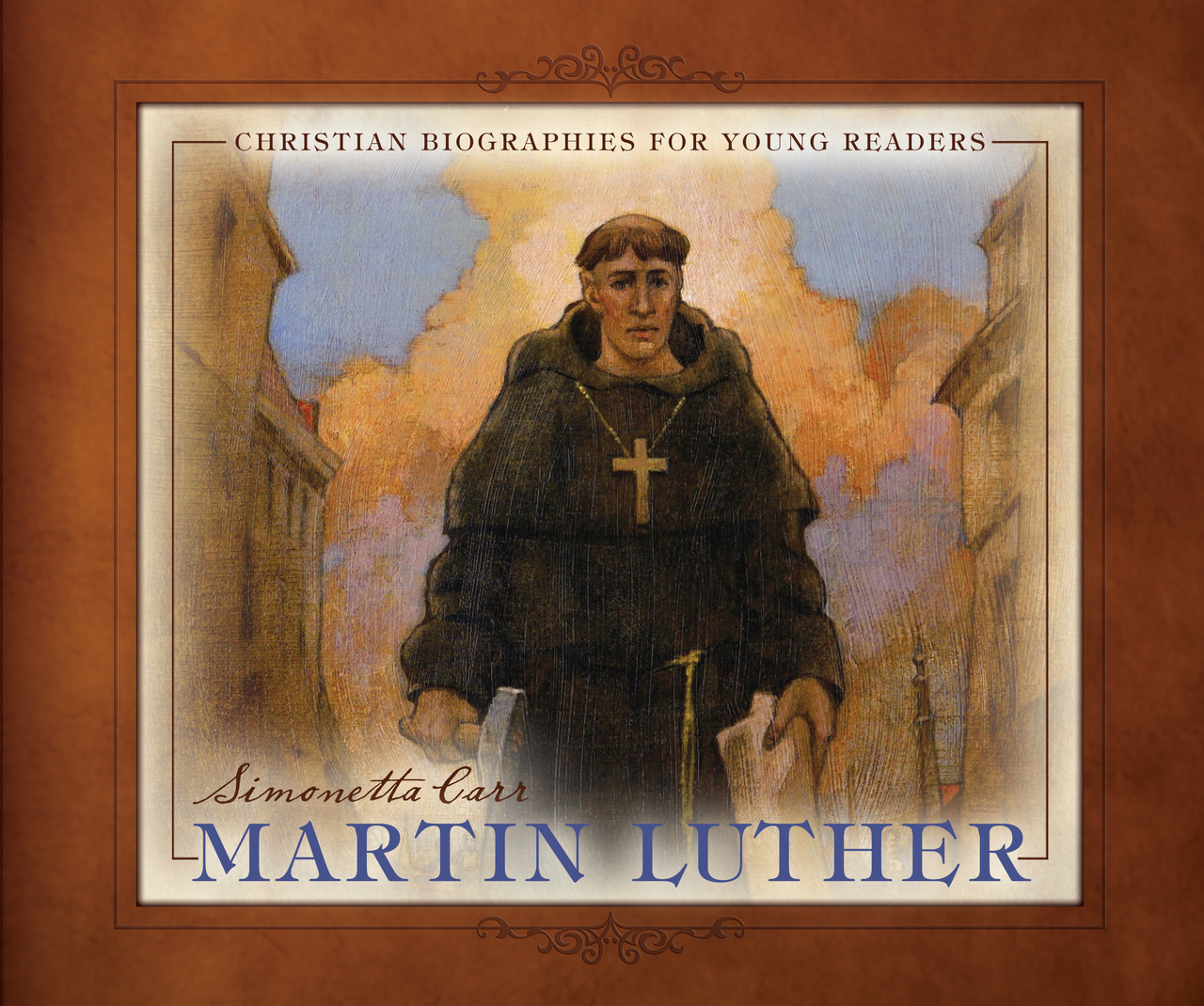
October 2017 will mark 500 years since Luther published his famous 95 Theses, which are often said to have kicked off the Protestant Reformation. A recent children’s biography on Luther by Simonetta Carr provides a delightful way to introduce the early German Reformer to children.

This volume is the latest edition in the series, Christian Biographies for Young Readers, which is published by Reformation Heritage Books. It is a beautifully illustrated, full color volume, that is likely to delight the reader even as it instructs.

Often children’s biography falls into the trap of hero worship. Obviously, a publisher like Reformation Heritage views the Protestant Reformation in a positive light. Thus it stands to reason they would celebrate Luther’s life and contribution to Church History. Carr, however, manages to avoid the pitfall of hagiography by presenting Luther’s story with its good and bad points.

This book critiques Luther for his coarse language and diatribes against the Jews later in his life, but it does not let those real, yet unfortunate failings diminish the impressive and exciting story of the monk turned Reformer. Roman Catholics or others who view the Protestant Reformation as a tragedy, and thus see Luther mainly negatively, will likely balk at the generally positive view Carr presents of his life and work. However, for most Protestant Christians, this volume strikes the proper note.

In recounting the life of Luther, Carr celebrates the recovery of the gospel from the twisted medieval traditionalism espoused by the Roman Catholic Church in the 16th century. Unlike many histories, this volume rightly argues that indulgences were the presenting problem, but the deeper issue was the loss of the gospel in the regular teaching of the Roman Catholic Church. That is why Luther’s ministry was so important; he was not dividing the universal church, he was seeking to preserve the gospel and was subsequently attacked by the traditionalists who elected to remain in error.

Some biographies work best if told as a story. Because of Luther’s wide range of activities and overall significance, Carr chose to tell his story in roughly chronological, but mostly topical chunks. There are seven chapters with 4-7 pages each. The chapters discuss his early life, clerical training, desire for reform, alienation from Roman Catholicism, attempts at Reform, marriage and family life, and broader ministry. The volume also includes a timeline, a collection of interesting facts about Luther, and a selection from Luther’s Short Catechism. Even young readers will walk away with a sense of the importance of Luther and an understanding of his life and work.

Much like other biographies in this series, Carr’s book about Luther is full-color throughout. Carr combines new illustrations from Troy Howell with historical engravings and paintings, along with photographs of some of the sites as they appear now. This breaks up the text and makes the book as a whole a feast for young eyes. (Older eyes will appreciate it, too, and may have to be reminded this book is for the kids.)

Whether you are looking for a gift for a child, seeking a volume for homeschool history, or simply building your library, this volume is worth purchasing. It is historically accurate, delightfully illustrated, with an appropriately critical tone. It represents both a celebration of the recovery of the gospel with a recognition of the pervasiveness of human sin, even among our heroes. Reformation Heritage Books should be applauded for continuing the series and publishing excellent children’s volumes like this one.

NOTE: I received a gratis copy of this volume from the publisher through Cross Focused Reviews with no expectation of a positive review.