Exalting Jesus in Isaiah - A Review

As we recently celebrated the 500th anniversary of the start of the Protestant Reformation, we have also been celebrating the recovery of the authority of Scripture within Christianity. Technology and scholastic influences combined to create a cocktail of circumstances that enabled the spread of Scripture in common languages and an eruption of preaching of the Word of God in the church. To read the history of the early Reformation is to read a love story of Christ’s bride for the Bible.

9780805497380-200x300.jpeg

That fervent affection for Scripture is alive and well in our day, particularly among those who practice expositional preaching. The Christ-Centered Exposition Series of commentaries from Holman Reference is both the product of and a contributor to the renaissance of expositional preaching. The series also encourages the conviction that all of Scripture tells about Christ: He is anticipated in the Old Testament and more clearly revealed in the New Testament. The whole Bible is a story of redemption, with Christ as the central hero.

The latest volume in this series – Exalting Jesus in Isaiah – is by Andrew M. Davis, pastor of First Baptist Church of Durham, NC. Davis is well-known for his love of Scripture, most clearly demonstrated by his faithful practice of memorizing whole books of the Bible. He has even previously memorized the entire book of Isaiah, which is the subject of this volume. Davis has also recently completed the arduous task of preaching through Isaiah in his local church; those sermons help give shape to this volume.

All of the volumes in this series of commentaries are intended to be preaching commentaries. That is, the authors emphasize the sorts of information that are most helpful to the pastor as he is shaping his sermons. For example, instead of a lengthy introduction about the various theories of scribal interjections and textual composition of Isaiah, Davis jumps right into illustrations, background, and textual outlines that are helpful for giving a congregation a sense of the main point of the text.

Davis wrote this book in approximately sixty short, easy to manage chapters. Each chapter is designed to cover a passage of Scripture that is about the right length for a sermon. Within each chapter, Davis highlights a key verse, provides a textual outline, and then offers commentary according to that outline. This makes it an invaluable resource for someone preparing a series of sequential expository sermons or those preaching a stand-alone sermon from the book of Isaiah. The chapters are self-contained, making it useful for a consecutive preaching through the book or occasional sermons on a particular text.

Although this volume is closely connected to Davis’ own preaching of the book of Isaiah, it is not a collection of his sermons. Davis habitually manuscripts his sermons, and the page total would be much greater had he simply compiled those manuscripts into a single volume. Instead, the reader is given the gift of a distillation of Davis’ careful study of Scripture, with insightful examples and illustrations scattered liberally throughout.

The greatest strength of this volume are the intertextual connections that Davis makes as he outlines the contents of Isaiah. Since he has memorized so much Scripture, his mind is alive with allusions and cross-references in and to books through the entire canon. For example, in his commentary on Isaiah 6, Davis explains how Christians can know that Isaiah’s vision of the glory of God in the throne room of heaven is, in fact, a vision of Christ himself. John 12:41 makes this plain. Other commentaries may make the connection, but Davis shows how that revelation fits into the exegetical flow of a sermon on the passage.

Davis also provides a number of helpful illustrations throughout the volume, which are insightful for sermon preparation, and also reflect Davis’ unique personality. Readers are offered references to Luther, Calvin, Bunyan, and even poets like Robert Frost to illuminate points. Davis, a former engineer, even uses the recycling of metal from the World Trade Center into the keel of an amphibious transport ship, the USS New York, to illustrate how redemption can come through destruction to introduce Isaiah 3-4. Or, perhaps more characteristically, Davis cites a report on port activity to make a connection between the vanity of seeking economic domination and God’s judgement, which helps bring Isaiah 23 into focus for the modern reader. These detailed, fact-based illustrations are useful resources for sermon preparation.

This entire series of commentaries is an excellent tool for pastors. The structure of these volumes makes them easy to use as a reference during sermon preparation. The tone of the volumes is formal, but not stuffy, which makes them accessible to pastors with a wide range of academic preparation. The content has been adequately resourced to be reliable, but does not fall into the trap that some academic commentaries do of engaging with every divergent perspective to the detriment of clarity and flow. These volumes are preaching commentaries as they are meant to be: tools to assist the people on the front lines of exposition as they seek to rightly divide the word of truth.

NOTE: This post was previously published at B&H Academic Blog, which has since been archived due to a change in communication strategy.

Ethics as Worship - A Review

The very first question of the Westminster Shorter Catechism asks, “What is the chief end of man?”

The simple, but profound answer is, “Man’s chief end is to glorify God, and to enjoy him forever.”

In other words, the chief end of humankind is to worship God and delight in his goodness. But “to glorify God” or to worship means more than singing songs at the appointed time each week or having a daily quiet time. Rather, as Scripture makes clear, “Whatever you do, in word or in deed, do everything in the name of the Lord Jesus, giving thanks to God the Father through him.” (Col 3:17)

The sum of the life of the Christian should be to give God glory by living rightly unto him. This brings us to the place of ethics in the Christian life. Ethics is about worship—it’s about living rightly on earth according to God’s design and pointing others to his truth in righteousness.

Mark Liederbach and Evan Lenow bring the concept of worship through moral living to the forefront in their recent book, Ethics as Worship: The Pursuit of Moral Discipleship. The volume, which is a hefty tome of about 750 pages, presents the authors’ particular focus on the nature of ethics as well as providing much of the standard fare for an introductory ethics text.

This volume has some similarities to other ethics texts in that is explores particular ethical questions (especially those that are cultural pinch points) after surveying alternative approaches to ethics. This is a book that reflects significant research, taking into account the major voices in ethics in the past few decades, along with relevant technical data on questions like reproductive ethics. The arguments within the book are well-thought out, as they have been honed over combined decades of teaching by both authors.

9781629952628.jpg

The premise of ethics as worship is so basic that it seems obvious when it is introduced. As the authors explain, “Ethics is about God. It is about maximally adoring him and rendering to him all that he is due from all that he has made. And it is about our doing so both individually and corporately.” (xxi)

While this approach to ethics seems like it would go without saying, it is less often said in ethics texts (even those by orthodox, Christian authors) than is warranted. And, even among those purporting to do Christian ethics, there is often a failure to make God’s character and value the summum bonum.

Ethics as worship means that the Christian worldview is the beginning of the moral quest. The foundation of the Christian worldview is properly Scripture, which anchors the method and content in the reveal Word of God. But a purely “scriptural” ethic can lead to casuistry. After all, Scripture does not say that we cannot use cocaine or tell us precisely what to do about global warming. An alternative, which includes various forms of philosophical ethics attempts to get at truth apart from Scripture and then looks for passages that can illustrate. Still other forms of so-called Christian ethics are more like weather gauges that check the cultural climate and decide write and wrong to try to maintain respectability. Viewing ethics as worship puts God at the center, with Scripture as the foundation, and delight in God and holiness as primary signs of success.

Ethics as Worship is a thoroughly theological volume with a reformed outlook. Liederbach and Lenow see the call to worship beginning in the garden of Eden. Building on the somewhat esoteric work of John Sailhamer, they call for a retranslation of Genesis 2:15 as a call for humanity to “worship God and obey his commands” in paradise before the fall. This is a debatable claim, which has little support in common translations, but whether or not their translation option is correct, there is no question that obedience and worship were central to human purpose before sin came into the world. One need not to agree with this emphasis to see the value in the approach Lenow and Liederbach follow. After the fall, the priority of worship and obedience remained, but it was frustrated by the effects of sin. The authors continue to explore how worship is essential through the remaining phases of the universe: fall, redemption, and restoration.

This is a volume that adds to the field of ethics, especially among evangelicals, by effectively summarizing much of the literature of the field and offering a new emphasis for the moral task. It is not wholly foreign, but the emphasis being on worship rather than righteousness—the process of decision rather than the personal outcome—is refreshing and helpful in many ways.

Ethics as Worship could be used at the college or seminary level. It would be a useful pastoral reference, with up-to-date data on very important cultural debates. Thankfully, the authors tend to focus less on edge cases and so-called dilemmas than providing sound principles that can guide faithful moral decisions. There are several good ethics texts on the market, but this is another worthy one that deserves attention, adoption, and utilization.

NOTE: I was provided a gratis copy of this volume from the publisher with no expectation of a positive review.

SBC Politics, the Sexual Abuse Investigation, and Waiver of Attorney-Client Privilege

In June of 2021, nearly 15,000 messengers from Southern Baptist Churches from around the country voted overwhelmingly to commission an independent, 3rd party investigation into the handling of sexual abuse allegations by the Southern Baptist Executive Committee officers for the period of 2000 to the present.

It should be clear that the investigation was not into accusations of abuse by the SBC’s Executive Committee officers, but that members of the Executive Committee had handled accusations about local churches poorly and in some cases potentially bullied or manipulated those who claim to have been abused in a local church.

One particular accusation in the past few years turned into a lawsuit against the SBC with a former LifeWay (an SBC entity) employee who made a public accusation of abuse that was misrepresented as a consensual affair. The fallout of that misrepresentation was public abuse (with names hurled that should be unthinkable for confessing Christians) leading to her resignation from LifeWay. The misrepresentation was compounded by an unwillingness to correct the misrepresentation in the SBC-controlled newspaper long after the misrepresentation was identified, which contributed to the abuse hurled at the woman. After a change in leadership, the report was corrected and an apology issued, but a great deal of financial, emotional, and spiritual damage had already been done.

This case, a Houston Chronicle article detailing over 700 cases of sexual abuse in SBC churches over a period of 20 years, along with evidence of serial abuse by individuals who had bounced from local church to local church, often as paid staff, raised concerns that the SBC was doing too little to curb abuse. All of this came at a time when sexual harassment and abuse were a particular public concern in society, but there is little question that concern about abuse is more than a secular movement being imported into religious clothing. These sins should not be tolerated among Christians! (1 Cor 5:1–2)

The Polity Issue

Given the loose association between churches affiliated with the Southern Baptist Convention, there has been resistance to many movements of reform on the basis of our polity and local church autonomy. It is true that some actions are not possible for the SBC. However, as Keith Whitfield has argued:

“We’ve hidden behind false fronts and convenient excuses. Appeals to the autonomy of Southern Baptist churches have derailed various proposals, like creating a Southern Baptist offenders' registry. While our polity may render some proposals nearly impossible to carry out, the appeal to autonomy doesn't justify inaction. Rather, we must use our autonomy to covenant with one another, “to stir one another to love and good deeds” (Heb. 10:31). Our family of churches must find a meaningful and culture-shaping mechanism that leads us to commit to best practices as we strive to prevent abuse in our churches and entities.”

There is little doubt that many critics of the SBC will be dissatisfied with the efforts to curb abuse within the association of churches. This is largely because they misunderstand the nature of the SBC. However, the fact that the demands of some critics cannot be satisfied should not prevent the organization from taking what steps are appropriate within our context. After all, if the SBC can disfellowship a church for ordaining a female pastor or affirming ungodly forms of sexual practice, then the SBC can disfellowship churches for failing to deal with gross sin in their midst. There are likely additional steps that can be taken to prevent or, at least, minimize serial sexual abuse that can be facilitated at the national level without violating basic Baptist polity.

A Turning Point

The June 2021 meeting of the SBC seemed to be a turning point toward addressing concerns over sex abuse in our churches, given the overwhelming vote by the messengers, who are the sole members of the SBC and its entities.

Getting the independent investigation underway has proved difficult for the Executive Committee because of concerns over legal and financial exposure due to the investigation. One contentious aspect of that motion as approved by the messengers was the request that the Executive Committee waive attorney-client privilege for the investigation.

Waiving attorney-client privilege is, indeed, a big step. On the one hand, it provides unimpeded access to documents that may be legally damning, but which could have been kept out of the public eye because they were protected by the confidential relationship between an attorney and her client. There is legal and financial risk to waiving this privilege, which may include the Executive Committee’s insurance company refusing to pay out on settlements related to cases whose evidence is exposed by this waiver. Additionally, evidence may become publicly available (as through the investigator’s report) that would have otherwise have been hidden to litigants or prosecutors. If there has been wrongdoing, it may well be exposed and bring penalty that could have been prevented by non-disclosure.

On the other hand, waiving attorney-client privilege exposes issues to the light of day that would otherwise be left to fester and left unaddressed. It would leave the investigators without all the information needed to bring problems to light, uncover weaknesses in practices, which could lead to greater liability down the line. It would diminish the trustworthiness of the final, public report, because the world would be left wondering what secrets remained hidden behind the veil.

Contributing to the need to waive attorney-client privilege on this issue, the long-time general counsel for the SBC Executive Committee has been in the midst of many of the controversies within the SBC. He has, for example, been part of a plot to misappropriate money from one SBC seminary and has been subsequently banned by judicial order from serving non-profits within the state of Texas or any Southern Baptist entity. The same individual has been deeply involved with another major figure within SBC life who was eventually terminated for mishandling his stewardship of an SBC entity along with public accusations related to covering up abuse. Some of these accusations have not been corroborated, but the risk that communications related to the issue would be kept confidential due to one of the key individual’s role for the Executive Committee made this selective waiver of attorney-client privilege essential to having a transparent, independent investigation. Given that the same individual testified as a character witness for a convicted abuser using his SBC official title, and also called the concerns over abuse a “satanic plot,” there is a reasonable basis for assuming his correspondence may be important to the investigation into handling of sexual abuse.

The Will of the Messengers

In June of 2021, the messengers voted to have the Executive Committee waive attorney–client privilege and form a separate (not approved or appointed by the Executive Committee) task force of Southern Baptists, who would hire a firm to conduct the third-party investigation. This vote was a rare move for the Southern Baptist messengers. Unlike resolutions, which do not have normative force, the motion from the floor was a directive to the members elected to the Southern Baptist’s Executive Committee.

(For those unfamiliar with the polity, the Southern Baptist Convention exists for two days each year from the first gavel to the last gavel of the annual meeting. It is comprised of “messengers” who are sent by their local congregations to vote on issues raised at the meeting. The Executive Committee exists to oversee the budget of the Cooperative Program, improve cooperation between SBC entities, and make arrangements for the annual meeting. The Executive Committee is comprised of people nominated by the Committee on Committees and elected by the messengers of the convention.)

The expectation of many of the messengers was that at the first Executive Committee meeting after the SBC, which is normally conducted in September (~100 days after the SBC), they would vote to waive attorney-client privilege, approve the funds for the investigation, and empower the Task Force (appointed by the President of the SBC, elected by the messengers at the SBC, who is also a voting member of the Executive Committee) to do the investigation.

Many onlookers were disappointed when the Executive Committee failed to waive attorney-client privilege and approve the third-party investigation as directed, when they met in Nashville on the 21st of September. Although the Sex Abuse Task Force had been named, had identified a reputable group to do the investigation (whom the Executive Committee had tried to hire to do a private investigation without a public report prior to the annual meeting of the SBC), and had the contract prepared for approval, the investigation was stalled. A significant faction within the SBC had worked with some leaders within the Executive Committee to argue against waiving attorney-client privilege, which threatened to put the brakes on the contract and the investigative process.

Though the full reasons for the issue may never be known, much of the information the members of the Executive Committee needed to make their decision was not presented until shortly before the meeting, with insufficient time to review it. Additionally, members of the staff of the Executive Committee had contracted with legal firms to attempt to convince the Executive Committee members not to fulfill the direction of the messengers of the Southern Baptist Convention by refusing to waive attorney-client privilege. However, a motion was made and approved to meet again in seven days to discuss it again.

At the second meeting, on September 14, the motion to waive attorney-client privilege was again defeated. Another motion was made to allow another 7 days to negotiate. The key to the negotiation for the Executive Committee was maintaining control of the investigation, having veto power over the material made available to the investigation, and the ability to control the content of the final report.

The Real Risks of Waiving Attorney-Client Privilege

There are some significant risks associated with waiving attorney-client privilege, especially from a purely financial and legal angle. If the investigation uncovers illegal behavior by members of the Executive Committee in communications that were made regarding legal advice between those EC members and their attorney, then that information would be admissible as evidence in court. Legal advice and surrounding conversations involving an attorney acting in his or her legal capacity can generally be hidden behind attorney-client privilege. The individuals responsible would lose that protection with this waiver. Additionally, in civil lawsuits, potentially compromising communications would no longer be protected legally.

Compounding this legal and financial risk, institutions typically carry robust liability insurance policies to protect them from lawsuits. Waiving attorney-client privilege for a case can become grounds for the insurance company refusing to pay out for damages awarded, because the insured institution failed to defend against lawsuit with full vigor.

The biggest risks here are that the SBC Executive Committee could be open to lawsuits that, if the evidence supports, they will have pay for out of pocket. The current budget does not support those sorts of expenditures and it might bankrupt the Executive Committee or cause funds to be diverted from the Cooperative Program (i.e., away from actual missions and ministry) to keep the Executive Committee afloat.

We should note that these risks are conditional upon (a) there being evidence of wrongdoing, (b) victims of wrongdoing bringing civil suits, and (c) the insurance company electing not to cover the damages. Our best hope—and the one I really want to be true—is that there is no evidence of wrongdoing beyond what has already been settled.

Advantages of Waiving Attorney-Client Privilege

A 2019 Houston Chronicle article about widespread, serial abuse within SBC-affiliated church changed the perception of the SBC inside and out. Since that issue was revealed, I have had people who were otherwise unconcerned about Baptists (or Christianity) make the connection between the SBC and abuse when they found out my connections to the SBC. There have concerns raised by laypeople within local churches (mine included) about why we should remain affiliated with the SBC based on the perception that abuse is widespread and pervasive.

Until we begin to take steps that are appropriate within our context and polity to curb sexual abuse, we will never be able to shake the accusations. The fact is that the abuse happened, we have not taken action to mitigate it, and no complaints about political motivations of #metoo, social justice, or polity will ever change that. Failing to take action makes the offensiveness of being an SBC church something other than the gospel. It sets up barriers to evangelism. Especially outside of the Bible Belt, it makes ministering as an SBC-affiliated congregation more challenging.

The first step in addressing an issue is figuring out the extent of the issue. But we have to be willing to really explore. Waiving Attorney-Client Privilege and publishing a public report are important steps in determining the nature of the problem. “Ripping the Band-Aid off” is painful, but likely the best way to move beyond the issue.

We may also find evidence of ungodly behavior among some leaders in the SBC which, if not illegal, is disqualifying from leadership. In any large organization there will always be shenanigans and insider trading, but there is already public evidence of behavior that does not belong in an organization devoted to getting the good news of the gospel to the nations. This investigation may help reveal that problem, as well, as it relates to the handling of sexual abuse.

Another advantage of having an open investigation with clear access to privileged communications is that it will functionally close the door on spurious lawsuits. If an independent, respected firm has full access to all pertinent records are determines the bounds of the issue (if any exists), then other accusations and lawsuits that may not be defensible will be much harder for accuser to pursue. If we expose some wrong doing, but the process and the final report remain behind a veil, then people who may feel wronged (and may have been wronged, if not by the SBC Executive Committee) but who do not actually have standing (because, perhaps, they had never contacted anyone) would have opportunity to sue the SBC and the SBC would have to defend afresh each individual suit. The open investigation provides both a present vulnerability (if any wrong doing is discovered) and a future defense (we’ve ruled out evidence of certain claims). So, while it may make present lawsuits more damaging, it may reduce risks from future ones.

Finally, we need to remember the reason the SBC exists. It’s not to be a self-sustaining club of Baptists, kept sacred in perpetuity and handed down to future generations. The SBC is a funding mechanism for cooperative ministry—education, disaster relief, political engagement, international missions, and church planting. As such, if the SBC ceases to live up to its calling as a Christian organization, it’s time to disband and find another better way. I believe we will come through this, but it’s always good to remember that if the SBC does not exist after this, then God will raise up another means of getting the gospel to the nations. The SBC can be effective, but it is not essential to God’s mission.

The Waiver

As one of the thousands of messengers that affirmed the call for an open, independent investigation, including the directive to the Executive Committee to waive attorney-client privilege, I am grateful that on October 5th the Executive Committee voted to do so. The margin of the vote was narrower than it should have been, but it is a step in the right direction.

A note of caution is in order here, though. Obviously, I am in favor of having waived attorney-client privilege. There are some members of the Executive Committee who voted no, but did so because they honestly believed it was their duty to do so. There are risks associated with the waiver. The EC members are tasked with protecting the interests of the Southern Baptist Convention and the Executive Committee of the SBC in particular. There are good reasons for having voted no, though I believe the reasons to vote yes outweigh them. I fear that some supporters of the waiver will harass well-meaning, conscience-bound individuals for doing what they believed to be right. That should not be.

We will see how the investigation plays out. It is a sad thing that the investigation is necessary, but, in my view, it is a good thing that both the process and the final product will shine light in some dark places and help the SBC move forward into the future with better practices or reallocate resources to do the mission God has called all Christians to more effectively.
Removing the Stain of Racism from the Southern Baptist Convention - A Review

When people get nostalgic for their childhood, they are usually remembering a time when things seemed simpler. That does not mean life was actually less complex, typically just that they were shielded from some of the twists, confusions, and injustices in the world.

download (48).jpg

My life was simpler before I knew about the powerful impact racism has had in our nation. Even in my early years in the Southern Baptist Convention (SBC) I was unaware of the racism that is at the very root of our denomination’s founding. I did not recognize that the racial homogeneity of my church was not simply a function of different preferences in music, but often because my denomination had not done enough to remove the stain of racism.

I previously attend a church that is dually affiliated with the SBC and the National Baptist Convention (NBC). The SBC is the largest Protestant denomination in the U.S. and is slowly becoming more racially diverse. The NBC is the largest predominantly African-American denomination in the U.S. My church has historically been predominantly African-American, but is becoming more diverse as we reflect more closely the demographics of our surrounding community. This is, in part, because my former pastor has made significant efforts toward encouraging racial reconciliation.

Being involved in a truly multi-racial congregation has caused me to develop a new perspective on race relations and racism. Hearing some of our oldest members tell stories, I can no longer argue that the Civil Rights struggles were “a long time ago” and ignore the legacy of racism in our nation. Listening to conversations around me, I can never again claim I don’t know that systemic biases exist.

A few months ago, my pastor asked me to teach church history to the congregation on Wednesday evenings. In four sessions, I skimmed the surface of the major themes of our Christian past. I spent more time talking about African-American church history in part because of my context and in part because I needed to learn more about it. One of the most painful parts of teaching that lesson was tracing through this history of race relations within the SBC; clearly, we’ve made progress, but it is also apparent we have much more to do.

Removing the Stain of Racism from the Southern Baptist Convention is a volume that tells the story of the SBC’s past, provides a theological basis for moving beyond it, and makes practical recommendations for future progress. This is a necessary next step in a conversation that the SBC has been having, but which needs to continue in earnest.

This volume is an outstanding resource for Southern Baptists and others to learn about racial reconciliation. The volume opens with a collection of SBC resolutions about race, which show the convention has been talking about race—sometimes using the right language—but making insufficient progress toward healing longstanding division. In the first chapter, Albert Mohler recounts the historic origins of the Southern Baptist Convention, which were grounded in the misguided beliefs of slave owners that they could participate in race-based chattel slavery and still be effective missionaries for Christ.

Chapter two is an essay by Matthew Hall, which follows the ongoing participation of some Southern Baptists in racist rhetoric and sometimes political activity. As much as we might wish otherwise, there were many “good Baptists” who argued for Jim Crow laws. The third chapter, by Jarvis Williams, provides a biblical argument for racial reconciliation.

The next six chapters outline suggestions from theologians, pastors, and editors at our denominational publishing house for removing the stain of racism from the Southern Baptist Convention. The body of the book ends with a summary of the state of racial reconciliation within the SBC: we have made progress, but have a long way yet to go. Dwight McKissic and Danny Akin offer epilogues explaining further why the stain of racism remains in the SBC. In a postscript, Vaughn Walker commends readers to continue the work and offers encouragement that the stain of racism can be removed from the SBC.

Although published by the academic arm of B&H, this volume is accessible to the average reader. The writers and editors worked together to create a book that can inform a wide swath of members of SBC churches. More importantly, the contributors to this volume constructed a compelling testimony that (a) racism still exists in our society and our organizations, and (b) there is something we can do about it.

The uniting metaphor of this volume is “removing the stain.” In the preface, the editors explain what that means and their definition is important. To some advocates in racial politics, the stain of racism is like the blood stains on Lady Macbeth’s hands: invisible to living eyes, but indelible to the psyche. The only solution for some is for organizations once complicit in racism to self-destruct. This volume offers a greater hope, recognizing that just as people are redeemable through the gospel, so are organizations.

The metaphor is apt because it also reflects the significant and often time-consuming effort required to remove a stain. Many of us have invested a great deal of time in stain treatments and washing garments by hand to save something treasured from a permanently embedded stain. Rarely are significant stains eradicated in the first attempt, but must be scrubbed repeatedly as by degrees the offending pigment is removed. That is the sort of effort required to continue the work of racial reconciliation in the SBC.

The formal apology for the racist origins of the SBC, affirmed as a resolution in 1995 is important. Electing Fred Luter as the first African-American president of the SBC in 2012 is significant. The resolution opposing the flying of the Confederate battle flag in 2016 takes another step forward. These are important efforts in removing the stain of racism, but they are not enough.

Removing the Stain of Racism reminds readers, with voices from both African-Americans and whites, that though the SBC has made great progress, there is a lot of work to be done. The memory of the racism in the SBC will never be erased, but the stain of racism can be removed. The challenge for the white majority of the SBC is not to attempt to declare victory on our stain-removal efforts too soon. As many have experienced, once you throw the stained garment into the dryer, the stain is often made permanent. We still have scrubbing to do.

Racial reconciliation takes work. While we may remember a time in our denomination’s history when efforts toward removing the stain of racism were not at the forefront, those days only seemed simpler because we were unaware of the problem. Talking about race and racial reconciliation is hard, not least because of the extreme rhetoric on the right and the left of us. The gospel demands we work toward racial reconciliation—no matter how nostalgic we are for simpler days, the work before us cannot be ignored.

NOTE: This article was previously published at B&H Academic Blog, which has since been archived due to a change in communications strategy. I have moved and am no longer a member of the same church that was referenced in this article, but I have left the references from the 2017 publication date.

Recovering the Lost Art of Reading - A Review

Mortimer Adler’s How to Read a Book is a classic introduction to the art of reading. It’s a favorite among homeschoolers and careful thinkers who have wanted to learn how to wrestle with ideas critically and thoroughly. Decades after the first edition was published, there is still a lot to commend it to readers. There is still much to be commended.

But I now have a new top book to recommend for those seeking to learn how to read better and to teach others to read better.

Leland Ryken and Glenda Faye Mathes teamed up to write Recovering the Lost Art of Reading to provide both encouragement and instruction in the practice of consuming literature in various genres.

The book begins with an explanation of the problem. Fewer people are reading books and they tend to read them carelessly. It’s not that fewer people are reading, because the flood of short internet articles ensure that people are taking in information and ideas through words. At the same time, the careful perusal of literature and well-written nonfiction in longform is an artform that fewer seem to be mastering.

Anecdotally, I have met more and more teens who have never read a single book in full, and I have had adults brag they haven’t cracked open a volume in a decade. Meanwhile, total sales of books are up, but I have to wonder what part the frequent sales on ebooks and the habits of prolific readers have to do with that trend. There is evidence that reading on screens is less effective than reading actual books.

The chief problem with a reduced rate of reading good books well is that books that have stood the connect us to our shared human heritage. In many cases these volumes are being ignored because of cultural concerns or because reading them is simply hard work.

 When the culture loses touch with the artifacts of its past we lose voices that can keep us from making old mistakes again, voices that call us to a deeper sense of beauty, and voices that connect us to minds from the past. As Alan Jacobs notes in his book, Breaking Bread with the Dead, when people stop reading “classics” (for whatever reason) we could be dragged back toward the past we long to avoid.

Recovering the Lost Art of Reading helps to remedy the lack of reading by providing accessible instruction about how to read well. So, the second (and far longer) part of the volume offers something of a primer on reading. It begins with a discussion of literature, its significance, and its benefits. Next, introduction to various genres with helpful instructions for reading each type of material well. After these helpful chapters on theory, Mathes and Ryken shift gears in Part Three to a mix of practical instruction and exhortation on recovering the art of reading, where they connect reading to the true, the good, and the beautiful. The pursuit of these is foundational to a well-lived life and a Christian life that seeks to recognize God at work in the world across cultures.

One of the notable features about the book is that there is a focus on a particularly Christian approach to reading. So, their chapter on the Bible as literature describes the process of reading Scripture for its beauty, form, and creativity as something that is spiritually significant. Similarly, the persistent concern for the moral exercise of reading is not primarily about academic virtue, but about putting on the mind of Christ by encountering truth, goodness, and beauty in transcultural forms.

The self-description of the book is apt. The authors write, “[This is] a guidebook by two season and enthusiastic reading travelers, who show all readers . . . how to discover more delight in the reading journey.” This is not an academic volume, though it has academic value. It is not a prescriptive “how to” like Adler’s book. It is filled with instruction, but it is not purely didactic. It’s the sort of book that can be read piecemeal as someone tries to grow in the art of reading. It’s also the sort of book that can be used as a textbook in a high school or introductory college literature class. It would also be useful as a companion to a reading group. Most significantly, it’s a book that will help its reader grow in their love of the better things in life.

Recovering the Lost Art of Reading-PB-9781433564277-02 (Sq).jpg

The unfortunate reality is that those that really need to read this volume—the truly reluctant readers—are unlikely to pick it up. But the casual reader can benefit and the seasoned reader can deepen their love for the practice. With so many distractions, in the form of funny internet videos and short blog articles, this book may not win as many as it should. However, the audience that it does reach will be improved and deepened in their understanding of literature, their love of reading, and their love of God.

As someone who loves reading, I found this book refreshing. Instead of providing rigid rules about book lists, types of reading, etc., we get a volume about taking delight in reading and growing through the process.

The self-description of the book is apt. The authors write, “[This is] a guidebook by two season and enthusiastic reading travelers, who show all readers . . . how to discover more delight in the reading journey.” This is not an academic volume, though it has academic value. It is not a prescriptive “how to” like Adler’s book. It is filled with instruction, but it is not purely didactic. It’s the sort of book that can be read piecemeal as someone tries to grow in the art of reading. It’s also the sort of book that can be used as a textbook in a high school or introductory college literature class. It would also be useful as a companion to a reading group. Most significantly, it’s a book that will help its reader grow in their love of the better things in life.

The unfortunate reality is that those that really need to read this volume—the truly reluctant readers—are unlikely to pick it up. But the casual reader can benefit and the seasoned reader can deepen their love for the practice. With so many distractions, in the form of funny internet videos and short blog articles, this book may not win as many as it should. However, the audience that it does reach will be improved and deepened in their understanding of literature, their love of reading, and their love of God.

As someone who loves reading, I found this book refreshing. Instead of providing rigid rules about book lists, types of reading, etc., we get a volume about taking delight in reading and growing through the process.

Population Control and the Moral Order of the Created Order

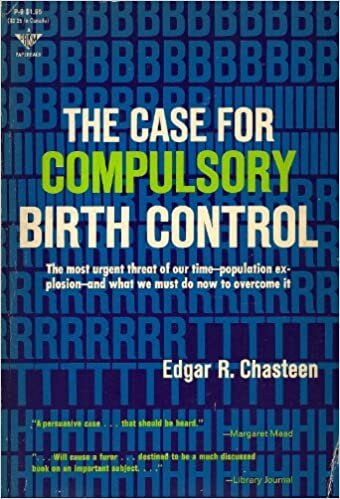
In a previous post I worked through some of the worldview of Edgar Chasteen, a one-time Southern Baptist professor of Sociology who advocated for compulsory birth control. Along the way he put some spectacularly anti-human ideas on display, including advocacy of abortion, regret over medical advances reaching the developing world. He also advocated for an individualistic morality including a sexual ethic redefined around the therapeutic. In short, he got a lot of stuff wrong.

However, in his book, The Case for Compulsory Birth Control, there is a paragraph of that shows he recognizes there may be light behind the clouds. It’s a moment when it seems he realizes the horror his worldview is capable of. He writes:

“The control of population size is of the utmost urgency, but we must understand that control is only a means to an end––that end being survival, both of humanity and humanness. I say this because some of those currently recommending population control measures have obviously forgotten it. Their proposals read like a catalogue of horrors. While they might preserve life, they would destroy the reasons for living. To survive, we would have to abandon most of the virtues and values which sustain us.” (192)

The man affirms the legalization and promotion of the killing of children in the womb through elective abortion, so it isn’t like this gives him a crown to toss at Christ’s throne, but it is telling that he recognizes that there must be a point to morality, a purpose toward which ethical action is aligned.

For Chasteen that end is humanness and survival of the species, which is a fairly low bar. But he recognizes that certain actions would take away that humanness.

And yet, Chasteen’s ethics allow no basis for preserving humanity or humanness. He summarizes his metaethics by this statement: “An action is moral only when prompted or hindered by what is right as defined by the individual conscience.” There is, therefore, no reason for survival of the species or a nebulous notion like “humanness” to be retained based on his summary of ethics; it’s all about what each individual feels is important.

Chasteen’s argument plays out in much the way C. S. Lewis describes in The Abolition of Man. Lewis writes,

“The Innovator attacks traditional values (the Tao) in defense of what he at first supposes to be (in some special sense) ‘rational’ or ‘biological’ values. But as we have seen, all the values which he uses in attacking the Tao, and even claims to be substituting for it, are themselves derived from the Tao.” (41)

Those trying to change morality often do so by declaring one “big idea” of utmost importance:

“The Innovator may place economic value first. To get people fed and clothed is the great end, and in pursuit of it[,] scruples about justice and good faith may be set aside. The Tao of course agrees with him about the importance of getting the people fed and clothed. Unless the Innovator were himself using the Tao he could never have learned of such a duty.” (42)

In the case of Chasteen, the “big idea” is survival of humanity, but justice toward the unborn and good faith toward particular humanity is less important than that end. And yet, the end is derived from outside his system of ethics. There is no basis from within Chasteen’s individualistic, subjectivist morality for concern about the preservation of humanity.

Lewis demonstrates what this looks like in his novel, That Hideous Strength. One of the leading villains argues:

“Existence is its own justification. The tendency to developmental change which we call Evolution is justified by the fact that it is a general characteristic of biological entities. The present establishment of contact between the highest biological entities and the Macrobes [i.e., supernatural beings] is justified by the fact that it is occurring, and it ought to be increased because an increase is taking place.” (295)

Furthermore, Filostrato (a villainous character) asserts:

“In us organic life has produced Mind. It has done its work. After that we want no more of it. We do not want the world any longer furred over with organic life, like what you call the blue mould––all sprouting and budding and breeding and decaying. We must get rid of it. By little and little, of course. Slowly we learn how. Learn how to make our brains live with less and less body: learn to build our bodies directly with chemicals, no longer have to stuff them full of dead brutes and weeds. Learn how to reproduce ourselves without copulation.” (173)

And, then:

“Nature herself begins to throw away the anachronism. When she has thrown it away, then real civilization becomes possible. You would understand if you were peasants. Who would try to work with stallions and bulls? No, no; we want geldings and oxen. There will never be peace and order and discipline so long as there is sex. When man has thrown it away, then he will become finally governable.” (173)

It may not be necessary to throw away sex itself, as long as sex can through technical means make the natural purpose of sexual intercourse unavailable or punishable. That was the goal of the Population Control movement, it is the goal of parts of the environmental movement, and it is a dangerous goal to have shaping moral decisions.

Chasteen did not attain the degree of rejection of the Tao that Lewis’ character did in That Hideous Strength, but he is well along the path, based on his 1971 book. More significantly, society is well along the pathway to the abolition of humanity, and we ourselves can easily be carried along with it if we don’t watch our step.

There are reasons why sexual ethics has become the primary fulcrum of our society and that there is increasing pressure to reduce human population. There is implicit within those arguments a denial of God’s goodness and the moral order of the created order. But the goodness of sex and humanity cannot be established apart from the moral order of the created order, thus the movement is parasitic and transitory. We need to recognize it, remain free from the errors of its thinking, and communicate a better way to our friends, family and neighbors through the gospel of Christ.

A Look at One Case for Population Control

In the deep, dark corners of the Southern Baptist Convention’s theological past is a sociologist who taught at a Missouri State Convention affiliated college, wrote for the Christian Life Commission (the precursor to the ERLC), and advocated for abortion, forced sterilization, and legal penalties for exceeding an approved number of children. Since that point, his college disassociated from their denomination and Chasteen went on to form a non-profit organization dedicated to affirming the equal validity of all religions. Just how Baptist or even Christian Chasteen is or ever was is up for debate. There is little in his 1971 book or his various websites that can connects him to anything like Christian orthodoxy.

The thesis of Chasteen’s book is “that unless we act now to legislate a limit of two children per family, we have little hope of solving the other problems that beset us.” (vii) That problem Chasteen describe as an insidious disease: “The cancer of runaway population growth has eaten away both heart and soul of the body politic. We are on the verge of anarchy with only our will to survive and our determination to act staying our fall.” (33)

For Chasteen, every problem was driven by overpopulation. He writes, “If, as a nation and as individuals, we can summon the intelligence and the courage to bring population growth under control, we will find ourselves still faced with problems of race relations, crime, alienation, apathy, environmental degradation, and so forth, but with one big difference. The problems will then be capable of solution, whereas now they are not.” (33)

Chasteen echoes Paul Ehrlich’s popular book, The Population Bomb, in his concern for the growing number of individuals on the planet. His book, The Case for Compulsory Birth Control, was written while the Rockefeller commission was composing their report, which was commission and subsequently rejected by Nixon. Like Chasteen, the Rockefeller commission affirmed eugenic policies, widespread birth control funded by the government, and the expansion of access to abortion. Unlike Chasteen, the Rockefeller Commission only advocated for voluntary sterilization.

The entire tenor of Chasteen’s book is anti-human. He expresses concerns that “Death rates in the industrializing nations began to drop while birth rates remained at their previously high levels.” (25) Which leads to complaints that Americans shared medical technology with developing nations with a false sense of compassion and without permission.

Argues Chasteen:

“America has shared its medicines with the world, thinking that by doing so it was saving millions of people from early death, and so it was. . . . [However,] we were operating on a foundation of mistaken morality which made keeping people alive and end in itself. We inoculated, immunized and sprayed, and we felt good about our actions. . . . Motivated by benevolent ignorance of social forces and human desires, America played unintentional havoc with the destinies of nations and peoples. . . . In some parts of the world death rates were cut in half in only a decade, and sometimes without the consent or knowledge of the governments affected.” (26–27)

There is more, but it does not get much better.

At the root of Chasteen’s ethics is an individualistic, subjectivistic presumption: “An action is moral only when prompted or hindered by what is right as defined by the individual conscience.” (187)

In light of that naked assertion, Chasteen argues, “What this means is that a new rationale for sexual responsibility and exclusiveness is needed.” (187)

Chasteen demonstrates a full-throated adoption of the sexual revolution:

“Contraceptive technology has made it possible to separate sexual intercourse from conception, making it possible (and necessary) for us to rethink the philosophy of sex worked out before contraception. A very simple formula can be stated:

coitus – contraception = procreation

coitus + contraception = expression” (184)

He celebrates the individualism and autonomy of human sexuality because sex became disassociated from procreation, so that a woman on chemical birth control “can express her sexuality as she expresses her opinion––because of the meaning it has for her as an individual.” (184) He makes a similar argument for males who have had vasectomies.

Chasteen makes clear what contraception has done for sexual ethics in contemporary society:

“Contraception makes it possible to view sex as voluntary, interpersonal behavior rather than a necessary act of survival. Sex becomes a special method of communication between male and female. Sex thus loses its exclusively biological meaning and becomes more social. Like all social relationships, sex can be made constructive or destructive, depending upon the attitude and behavior of those involved. Sex can become a dialogue between two people in which comes to understand and appreciate the other. It can be an expression of the mutual dependence to human existence. Sex can be an enriching and compassionate human encounter or simply another opportunity for exploitation, satisfying a biological urge but destroying humanity socially and spiritually. It’s up to us.” (189)

There are a lot of strands to unwind in Chasteen’s writing on the subject, but he makes explicit the arguments that are assumed in our culture regarding the purpose of sex. The autonomous self is the champion of Chasteen’s moral vision, with no reference to the Christian faith, historical or otherwise. It is the individual alone who determines what is right. (A belief that undermines Chasteen’s plea that his perspective is the correct one, but whatever.)

Several lessons can be gleaned from reading books like Chasteen’s, The Case for Compulsory Birth Control.

1.       There were good reasons for the Conservative Resurgence in the Southern Baptist Convention. Chasteen advocates for multiple anti-Christian positions that are untenable with anyone remotely committed with the content of Scripture. The convention had to rid itself of the cancer of those like Chasteen to survive as a gospel-focused entity.

2.       The population control movement, which is now growing because of concerns over climate change, has its roots in a dark movement that has to find a way to mourn the decrease in suffering due to premature death. It has not, as far as I can tell, found a way to do so, it has simply tended to skip over the assumption that it would be better if the superfluous people didn’t survive past their age of usefulness.

3.       Beware people who see one big social problem as the key to all other problems. A big idea like overpopulation, systemic racism, or climate change can be used as a way to blind listeners to the moral evil being proposed on one front for the perceived good result on another. Society is complicated. Solving climate change won’t fix poverty. Eliminating systemic racism won’t reduce our carbon footprint. Limiting population growth will not eliminate crime. It is impossible to attain a good society through persistent evil.

Dignity for Back Row America

God created humans in his own image. (Gen 1:26–27) There is a great deal of honor and dignity that comes with that blessing. We all subconsciously recognize our status as made in the image of God, which gives everyone an innate desire for dignity.

In 2019, former Wall Street trader, Chris Arnade, left his day job to photograph and interview people from what he calls “Back Row America.” This group includes individuals on the political left and right, but who have all been effectively left behind by polite society and the economy.

Arnade’s journeys took him across the United States to areas with mixed histories, ethnicities, and economic struggles. As he notes in his introduction:

“What they had in common was that all were poor and rarely considered or talked about beyond being a place of problems. All had been described as left behind, despite some, like Hunts point, being adjacent to rich and successful neighborhoods. Residents growing up in these communities faces immense structural obstacles, and some, like minority neighborhoods, had for a very long time.

Despite their differences––black, white, Hispanic, rural, urban–they were all similar to Hunts Point in one important way: despite being stigmatized, ignored, and made fun of, most of the people I met were fighting to maintain dignity.

They feel disrespected––and with good reason. My circles, the bankers, business people, and the politicians they supported had created a world where McDonald’s was often one of the only restaurant options––and we make fun of them for going there.”

And if you’re reading this, you (like me) probably fall into the category who have fallen into unfounded assumptions about people and ignorant attitudes toward them because they looked down and out, were at a McDonalds, especially if they were a bit loud or out of place in public. Very few middle class and up individuals are exempt from having experienced this in themselves.

Dignity is a raw look at the desire for respect. It’s a reminder that everyone has a story. There was a commercial that ran when I was a kid during the height of the drug wars. It reminded the audience that “no one wants to be a junkie when they grow up.” The message was clear: if you use drugs, you are a loser and the way you get there is by making bad choices.

There is some validity in that argument, but it fails to take into account social and cultural pressures. It neglects the influence that the frustrations about systems that are designed for people with resources.

Think about how it is nearly impossible to apply for a job without a home address. Or consider what it is like to fill out a background check application when you’ve bounced from apartment to shelter to relatives’ homes for the past three years. Furthermore, ponder what it must be like not to have a working smart phone, tablet, or computing device in a timeframe when apps, websites, and email are primary means of communication. There are many people who live close to the line of success and failure, where a blown-out tire, a medical problem, or a couple of mistakes between paydays can start ripples that spread into disfunction. Eventually, the comfort of a drug-induced high can seem like a blessing that takes away the pain and stress for a little while. It doesn’t make anything better, but it can make someone feel better for a little while.

dignity.jpg

Arnade reminds us that the person who has fallen into the hole of addiction may not have known anything different or may have been set on the path by a personal disaster. They are worth respect. They deserve dignity. They are made in the image of God.

There are unhealthy aspects of this book. Arnade admits that his involvement in the night life of the streets contributed to his own drug issues and problems within his family. There is also a level of voyeurism in reading the accounts of prostitutes, drag queens, dealers, unemployed, and underemployed. If voyeurism can be justified, at least Arnade’s Dignity carries out the purpose of reminding readers that the weathered, bedraggled, odd-behaving individuals we often avoid in public are people, made in the image of God who have stories, hopes, dreams, and a desire to be recognized for the goodness of being human.

Dignity should help remind readers that the unwashed “other” are not a problem to be dealt with, but people to be engaged with as worthy of respect and honor. As well, Arnade issues a warning that the same group is not a social project that exists to make the middle class feel good about their beneficence. There aren’t a lot of particular solutions in Dignity, but recognizing the inherent value of those on the edge of society is a big step toward spanning some of the fissures in our divided country.

The End of Our Exploring - A Review

If what I see on social media is to be believed, all the cool kids are deconstructing the faith of their childhood. It’s all the rage, but it’s not really a new thing.

For some, kissing dating goodbye was a traumatic experience, though for many of the most vocal critics, I suspect Josh Harris’s book provided a solution to a problem they only wish they had. Nevertheless, the experience turned too much for Harris’s faith, as he has recently abandoned Christianity and begun selling “deconstruction kits” along with a series of webinars for $275.

Other deconstruction workers are less entrepreneurial, but there is a steady stream of people who were once overt, professional Christians who have transitioned to making money off of deconverting and encouraging other people to do the same.

One response to the deconstruction/deconversion movement is to provide answers to the cultural defeaters of the day. Standard apologetics books like Lee Strobel’s Case for Christ or Josh McDowell’s More than a Carpenter provide helpful aids to those with general struggles regarding particular questions about Christianity. Other books like Tim Keller’s The Reason for God and Making Sense of God tend to focus on bigger picture problems and defeaters. Recently books like Alisa Childers’s Another Gospel? tell the story of starting down the path of deconstruction and ending back a Jesus. These assume that someone is either outside of Christianity looking in or already down the road of deconversion and need pulling back. It is a helpful approach for many.

But what about those that stand on the fuzzy border between faith and doubt and wonder which way to turn?

end of.jpg

Matthew Lee Anderson’s 2013 book, The End of Our Exploring: A Book About Questioning and the Confidence of Faith, provides a helpful resource for those with questions or who want to create a space for legitimate questions within the faith community.

Anderson is a pastor’s kid who was (by his own confession) the insufferable know-it-all who was too cocksure to ask good questions or hear good answers. He has come a long way, and this book can help readers make significant progress without some of the awkward relationships.

The book begins by exploring the nature of questioning, identifying that many questions are not good questions because they presuppose an answer. They key message is that good questions can be helpful as we seek to recalibrate our faith—knocking off the pieces inconsistent with Scripture and keeping the parts that fit with an integrated biblical understanding––but most people are not well-equipped to ask good questions.

Anderson goes on to note that our information economy that values data rather than wisdom contributes to shallowness of discourse. So does the shallowness with which much of the Christian community in the West actually holds their Christian convictions. The result is that young people often either fail to ask good questions or encounter hostility when questions are asked.

Questioning is viewed as dangerous in some churches because too few people know the answers. In some churches, questioning is taboo because it leads to the uncovering of inconsistencies between faith and practice. Sometimes questioning is unwelcome because the people being questioned have the same questions, fear they are wrong, but are clinging to faith in the face of that prospect.

Some see questioning as an act of faithlessness, but Anderson shows how good questioning can be a catalyst for a deeper faith, because there are valid answers to the hardest questions that can be tossed at Christianity. The End of Our Exploring explains why that is so and also helps the reader begin to formulate better questions.

As a parent of children who “know all the answers” because we have spent a lot of time on discipleship, I find Anderson’s faithful but open approach to questioning helpful. This is a book that I will have my children read toward the end of high school. Sometimes it is frightening that my kids have the ready answers to theological questions. I worry that they have borrowed my authority, as it were, because they have seen me teach through an abbreviated systematic theology, several books of the Bible, and other topical lessons. They know that I have read the books and explored the questions, but it is important that they do some of their own exploring, too.

The way that Anderson encourages exploring is critical to the outcome achieved. The nature of this exploring is clear from the title of the book, which comes from a T. S. Eliot poem:

And the end of all our exploring
Will be to arrive where we started
And know the place for the first time.

That perspective marks the fundamental difference between faithful questioning and deconstructing. When people deconstruct they are seeking to tear down because they’ve already decided the thing is wrong. Anderson’s questioning and exploring is an attempt to know the truth better. It does not presuppose the truth, as if the conclusion is foregone and the exploration is simply a sowing of wild oats, but it does not begin from a posture of skepticism and caustic disbelief.

 The End of Our Exploring is a warm, personal book. It is thoughtful, rigorous, and challenging. Above all, it is helpful as I continue my exploring and seek to point other explorers toward a deeper understanding of truth.

Why Doesn't Everyone in the SBC Simply Reject CRT Openly?

In the tribal warfare of the internet age one of the hot disputes is over Critical Race Theory (CRT). In my own circle—evangelical Christians in general and Southern Baptists in particular—the fire of war over CRT is hot, though little light has been produced.

In this brief post I will tackle the simple, but repeated question, “Why doesn’t everyone within the SBC simply reject CRT openly?”

The answer to that question seems relatively simple and obvious to me. However, since people don’t seem to see it, I am going to try to explain it without getting myself caught in the blaze of controversy.

What is CRT?

The heart of the debate over CRT should be the definition of CRT. The problem with the debate is there are many definitions of CRT. I will list two of the edge definitions, but there are a million shades between.

Some proponents define CRT as method of studying the outcome of racially biased laws and cultural trends that have had and continue to have a disparate impact on ethnic groups. That is what proponents like Delgado set out to expose. It’s simply the attempt to ask the question, “How have laws intentionally or unintentionally led to poorer outcomes for ethnic minorities?” or “How has race (or ethnicity) impacted social outcomes and why?” Let’s call this “CRT A”.

To others, CRT is the process of explaining why contemporary American Whites are uniquely responsible for current ethnic disparities and ought to continually repent of their privilege that explains the majority of their positive outcomes. To be White is to be tainted. One must repent of being White. Capitalism is White. Western Culture is White. Being White is bad, therefore we must adopt Socialism, reject classical literature, and continually repent of being born White or supporting Whiteness (even if we aren’t actually ethnically Caucasian). This is a caricature of many versions of CRT, but the internet will reveal enough cases of people who say they are advocating CRT proclaiming these things that we need not exclude them from the discussion. Let’s call this “CRT Z”.

One need not agree with either of these definitions to accept that there are people who describe their position as CRT that hold to them. In other words, neither of these may be “true CRT,” but there are proponents of “CRT” that argue these positions.

Recognizing the Difference

It doesn’t take a genius to see that there is a world of different between the first definition and the second. It also does not take much discernment to accept that the first approach may frame a legitimate (even if not correct) mode of inquiry, while the second is another form of racism.

There is, in short, terminological confusion.

Sometimes this confusion is used by the intelligentsia in a Motte and Bailey approach, where they throw out some controversial racial analysis or critique of that analysis and retreat to the safer ground of their polar definition when challenged. Sometimes, I think, people discussing CRT have read so narrowly (not to say they haven’t read extensively) that they legitimately haven’t encountered another perspective or one that represents the harmful extremes. Or, in other cases, they have granted too much grace to “their side” of the debate that they don’t see the encroachment into the unreasonable.

At the very least, as we think about the issue, we should recognize that definitions are the key. CRT is not monolithic, so we should seek to understand before we argue.

Why Not Just Reject the Term?

After the messengers of the Southern Baptist Convention affirmed Resolution 2, On the Sufficiency of Scripture for Race and Racial Reconciliation, there has been an outcry in some subsections of the SBC that the statement does not include a clear rejection of “CRT.”

The statement itself is sound, biblical, and resonates with the various statements on race and racial reconciliation that the SBC has adopted in the past. For those that care to read it, it quickly becomes clear that “CRT Z” and many variants on that side of the spectrum are out of bounds based on that description.

The complaint among some is that “CRT A” is not as clearly anathematized by the statement. Therefore, when individuals ask questions like, “How has race (or ethnicity) been used unjustly in society or resulted in unjust outcomes?”, it is not clearly out of bounds. Of course, it is also not clear that someone asking such a basic question about race (or ethnicity) is necessarily reliant upon the tenets of CRT.

“That Sounds Like CRT”

And that is exactly the reason why it was good to issue Resolution 2 without an explicit rejection of CRT.

In some corners of the internet, it has become increasingly common to argue that any analysis of society, data, or theology that includes a consideration of race or ethnicity is a form of CRT. This is, whether intentional or not, an error that conflates the problems of “CRT Z” with any discussion of race or ethnicity, or its lingering effects.

In opposition to these discussions, some have absolutized statements like Paul’s Galatians 3:28 (There is neither Jew nor Greek, there is neither slave nor free, there is no male and female, for you are all one in Christ Jesus), arguing that it means that there should be absolutely no consideration of differences created by or resulting from race or ethnicity. However, Paul wasn’t arguing that those categories did not exist (otherwise why did he differentiate the circumcised from the uncircumcised in Col 4), but that they should not impact unity in the body of Christ.

It would be funny if it were not so painful, but some of those most vocal about using Gal 3:28 to outlaw any discussion of racial (or ethnic) differences are also the most careful to differentiate the roles of men and women in the church. To be logically consistent, if Galatians 3:28 means that we can never talk about racial disparities in the church, then those that hold that position should not recognize a different function in the church between men and women. In other words, they should be willing to accept female pastors. Most often they do not. That would reflect a consistent, though incorrect, application of Gal 3:28.

Because there are longstanding social impacts due to race—one need only look at the existence of distinct African-American denominations (which were largely formed in response to overt racism in predominately white denominations)––some critics paint any theological or social analysis that recognizes the actual differences related to race (or ethnicity) as a form of CRT, whether or not the accused has any knowledge of or intent to use CRT.

The existence of real and obvious racial (or ethnic) differences means that there are times that examining those differences is necessary and warranted.

The Bigger Problem

The bigger problem with the CRT debate, and a reason why we should not try to anathemize “CRT” wholesale, is that the some of the loudest voices against “CRT” are also the ones who argue that any analysis that includes racial (or ethnic) differences are using “CRT,” whether any form of actual CRT is actually in play. Often, it seems that these accusations are made more on political grounds (i.e., someone supports a different economic or social policy) than on the basis of careful understanding of the ideas under discussion.

Let me simplify: The logic of some of the loudest anti-“CRT” argumentation goes like this:

1.       CRT is a form of analysis that considers racial (or ethnic) disparities.

2.       Scholar or pastor X has cited analysis or made a declaration that takes into account racial (or ethnic) disparities.

3.       Therefore, scholar or pastor X advocates for CRT.

Anyone who has taken basic logic will recognize the problems with this line of reasoning.

Unless ALL discussions that take into account racial (or ethnic) disparities are CRT, then the logic doesn’t follow. And even that logic is based on the assumption that all versions of CRT are irredeemably bad (or at best unhelpful) and inconsistent with the gospel. Some argue that “CRT A” and some similar versions are relatively benign and may actually help illuminate the current situation, but that is a different discussion for a different day. However, it shouldn’t be impossible for us to imagine that an individual may recognize that “CRT Z” is bad, while still being able to glean something of value from “CRT A” even if, in the end, the individual rejects the policy proposals of those who use “CRT A.”

It’s also possible to ask questions similar to those who use and advocate for “CRT A” and yet not be dependent upon their ideas. Simply because one things sounds similar to another does not mean those things are the same.

Sometimes arguments about who is “using CRT” play out in these obvious terms, but often it is more subtle. And yet, many of the attempts to combat “CRT” among inerrantist evangelicals amounts to:

a.       That individual used language or addressed a concept that could be associated with CRT.

b.       Therefore, that individual advocates for CRT.

c.       CRT is bad.

d.       Therefore, that individual must be ridiculed and abused publicly and, if possible, fired.

If we’re being honest, we’ll recognize this pattern. It isn’t universal, but it is fairly common. And, if we’re being serious about being thoughtful, we’ll recognize why it isn’t helpful.

We should also recognize statements that absolutize rejections of “CRT” are a tool for vocal groups within our communities to prevent discussion about important issues, because once the accusation is made that someone is advocating “CRT,” whether true or not, then the person will be forced to defend themselves or risk losing their job. There is an element of McCarthyism to the whole situation.

Conclusion

I set out to answer the question, “Why doesn’t everyone within the SBC simply reject CRT openly?”

There is no question that more discussion is needed, but I think I’ve begun to explain why absolute statements on CRT are unhelpful, especially when “CRT” means radically different things to different people and that, for some people, simply raising questions about race lead to accusations of “CRT.” The kind of pseudo-thoughtful analysis that has replaced honest engagement with ideas, especially around concepts like “social justice” and “CRT,” is not helpful.

Significantly when some voices assume CRT is at the root of any discussion of race (or ethnicity) that arrives at different conclusions than those of another group, we have a problem. Additionally, if the simple recognition that one’s cultural background shapes one’s understanding of a context is a version of CRT, then it is an unhelpful label.

Since the label “CRT” is so ambiguous, it is better to identify the aspects of “CRT” that are objectionable and explain why they are inconsistent with Scripture. Then we can all examine the statements of scholars and pastors in comparison to those tenets and argue against objectionable content rather than making accusations of things that “sound like” or “are not sufficiently opposed to” whatever “CRT” is in the mind of this or that cultural commentator. Based on the statement of those on the SBC resolution committee, this sort of action—to make clear what is inconsistent with biblical orthodoxy—is exactly what was being attempted with Resolution 2.

Will this scratch the itch of the culture warrior? No, but usually they live for the denunciation and the battle rather than the truth. But for those that are being honest and careful in their pursuit of truth, statements like Resolution 2 are a step forward in identifying the guardrails for civil discussion.