The Method of Christian Theology - A Review

If there is a list of people’s favorite topics in religious studies, theological method is probably not on it. Theological method is like exercise fundamentals for sports—it’s the drill, the stretching, the knowledge of warmup and cooldown technique. Theological method is learning the optimal stride length, the number of strokes per length, or the way to hold your head when you are trying to fake the defender out.

In other words, theological method is extremely important for being really good at theology, but it’s the part of the process that most people like to skip right by. In reality, unless there is something quite wrong, you can produce what appears to be reasonably sound theology without a lot of thought to method. However, when the fundamentals are wrong it limits your future prospects, makes it harder to fix problems later on in your development, and can lead you in unhelpful directions.

Theology method is not sexy, but it is very important.

Rhyne Putman’s book, The Method of Christian Theology: A Basic Introduction, provides an accessible, engaging entry into the fundamentals of the discipline.

Summary

This book is divided into four different parts, unevenly sized, that walk readers through the prolegomena––the foreword, so to speak––of theology. Part One begins by providing an overview of theology, its nature as a process of describing truth, its components and purpose of making disciples, followed by an overview of the various ways that people approach theology—biblical, systematic, etc. Part Two emphasizes the need to be the right sort of person to pursue theology and have a mind ready to receive God’s word and think through that. The third part shifts to the practical by considering method-proper. Putman begins with Scripture, which is the supreme authority for Christian theology. He then considers the place of tradition, philosophy, and experience within the theological project. Only then does he sketch a basic procedure for doing theology. Part Four lands the book with the important, but oft neglected practical aspects of theology: proper contextualization, writing a research paper, and preaching a doctrinal sermon. The conclusion of the volume again emphasizes the importance of making disciples.

Analysis

There are various ways that a book on theological method could be approached. Some authors do primarily descriptive work, showing how various theologians have approached the task of theology. Some focus on a critical approach, outlining, diagnosing, and seeking to correct the work of others. Putman’s approach includes some of those aspects, but his primary focus is on helping the prospective theologian be the sort of person who can do theology well and to outline an approach that will help that budding teacher to make disciples.

There are other good books on theological method on the market. In fact, in terms of the raw content, Putman’s book is a standard work that stays cleanly between the lines of orthodoxy, especially as it is expressed in the Protestant evangelical tradition that most Baptists call home.

The emphasis on the character of the theologian is a strength of this volume. At the heart of Putman’s arguments is the belief that “The end goal of critical theological study is not building an academic program impenetrable to people in the pews but building the kingdom of God through seeing transformed lives, churches, and cultures through Christian disciple-making.” (44) Elsewhere he writes, “I grow frustrated with professing Christians who don’t seem content until they have something to be angry about. With their own ‘outbursts of anger,’ they police the thoughts and behaviors of others but seem blind to their own quarrelsome and bullyish ways.” (92)

Putman is not interested in raising up a generation of warrior children of the conservative resurgence, who tend to confuse contending for the faith with being contentious about the faith. Neither is he looking to increase the nerd-quotient of the local church. Instead, he sees the method of theology as becoming a better disciple of Christ that is equipped to make disciples for Christ. This is a significant and vital difference.

Conclusion

The Method of Christian Theology would be a good course text for an undergraduate or intro-level seminary course on systematic theology. It would also be an excellent resource for training a group of elders or simply encouraging doctrinal thinking among the laity in a local church. The book is beyond what might be useful in most contexts for Sunday school. However, my intention is to use it as an introductory text for a high school systematic theology course.

As someone who has studied theology for a number of years, this was a refreshing and encouraging book. For the pastor seeking to deepen his understanding of doctrine or refocus his interest in theology, this would also be a helpful resource.

A New Look into the Crisis of Epistemology - Untrustworthy - A Review

How do we know what we know? What criteria do we use to determine what is true? When sources of information conflict, how do we come to a resolution?

Epistemology––the way that we know things––is among greatest challenges of our day.

There is no question that humanity’s greatest need is the gospel, but epistemology is a significant barrier to communicating the gospel and for others to receive the gospel message.

The epistemological crisis is not an “out there” problem in the world, as we were told for years with postmodernism. We have an epistemology crisis in the church. And not just “those liberals” who deny the resurrection, affirm sexual revisionism, or whatever. The crisis provides different symptoms on the left, the right, and in the center (doctrinally speaking), but it is no less severe.

Bonnie Kristian is a journalist who writes for The Week, a news digest magazine that summarizes current events from around the world. She has also been a columnist for Christianity Today.

In her recent book, Untrustworthy, Kristian tackles the crisis on knowledge in US Christianity. She begins by outlining the problem, digs into its various instantiations, and concludes by proposing some basic steps to begin to iron out solutions. This is an introductory volume with plenty of illustrations to keep the reader engaged in a discussion about an important topic.

The first step to dealing with any problem is to recognize there is a problem. When epistemology is the issue, it is difficult for people to identify for themselves. As David Foster Wallace pointed out in his well-known commencement address, “This is Water,” we make a million assumptions about the world and usually cannot see our own weaknesses and failures.

For cultural progressives, who tend to congregate on the political left, the epistemological flaws may include basic assumptions about truth—that truth is dependent upon one’s experience and identity. (Chapter 7) It may include conspiracy theories that a cabal of old, rich, white men have rigged the economy against a whole host of oppressed minorities. It includes assumptions that anyone who does not affirm the appropriate culturally progressive theories of humanity––even ones that would have earned a horse laugh a decade ago––without question is somehow a knuckle-dragging neanderthal.

For those on the political right––I will not call them conservatives, because they usually are not––there are insidious conspiracy theories about the “deep state,” child trafficking rings, and pending arrest of specific political figures. Even those that have not fallen into the deep well of QAnon nonsense have probably seen, heard, or been impacted by adjacent conspiracy theories. The mantra “Do your own research” has been used to invalidate any perspective that does not accord with the starting opinions of the “independent thinking” individual who is generally getting his or her research threaded together by a Reddit poster or a YouTuber. (Chapter 5)

The epistemological crisis is not a problem that was caused by people minding their own business.  It hasn’t even really been caused by social media or the traditional media, per se. (Chapter 2) Twenty-four-hour cable news has certainly accelerated the problem. Ideological isolation of many individuals—especially journalists and experts—has contributed to the epistemological crisis. Decades of intentional erosion of a belief in an external, objective truth (even if we can’t perfectly describe it) has added fuel to the fire. This is a whole culture problem that has many contributors. Anyone who tries to blame just one group or medium of communication is probably selling something.

Kristian’s analysis does not cover every possible contributing factor to the epistemological crisis. She tends to focus on non-academic elements of epistemology. This is understandable, because there is a lot of navel gazing that goes on among philosophers about what it takes to form justified true beliefs (see Alvin Plantinga’s book, Knowledge and Christian Belief for a reasonably accessible intro). She also does not propose simple solutions, which is good, because there are no simple solutions. However, Kristian’s Untrustworthy does provide a reasonable introduction to the philosophy of knowledge for someone for whom “epistemology” might as well be a term for a vestigial gland in New Zealand marsupials.

One potential weakness of Untrustworthy is that it seems to punch right more than it punches left. This makes sense, for a least two reasons. First, Kristian has joined an Anabaptist sect (she says because of their pacifism), which tend to be more doctrinally conservative. Therefore, Kristian is more concerned about the problems on the “Right” side of the Christian spectrum. Second, the epistemological crisis among evangelicals and fundamentalists comes to the cocktail party in overalls, while the progressives bring their epistemological distortions in tuxedos laced with hallucinogens. Twisted metaphor aside, it is often much easier to identify the problems of QAnon and adjacent theories than it is the slippery arguments for progressive relativism. (The fact that many can’t seem to differentiate between trying to not be overtly racist and actual Critical Race Theory tends to support that fact.)

What Kristian makes clear is that the epistemological crisis of our day is not just due to “liberals” or “progressives” that can’t tell the difference between a biological male and female. The world has become liquid for those that identify as conservatives and progressives. Some of the people who have ardently argued against postmodern epistemology have fallen into the snare of it. Kristian’s book helps to show the reader immersed in the river of Western culture what water is. Perhaps by recognizing the problem we can begin to take steps to shore up the foundations of knowledge and rebuild a stronger society.

NOTE: I was provided an advanced reader copy of this volume by the publisher with no expectation of a positive review.

God's People in the Western World - A Review

One of my regular critiques of many contemporary books is they are about 100 pages too long. Authors have often sufficiently explained their point, but because of contract stipulations or a lack of discipline, they continue writing after the book is done. This can be true of shorter books, but it is often true of longer books. Sometimes, however, long books have good cause to be long.

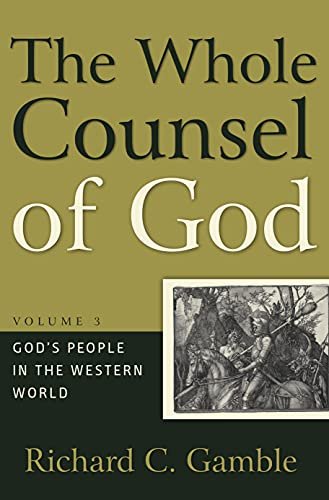
Richard Gamble’s book, The Whole Counsel of God: God’s People in the Western World, is a mammoth book that comes in at just under 1,100 pages. Despite its length, this volume is packed with valuable content from start to finish.

This latest book completes an impressive trilogy of theological writing. The first two volumes, God’s Mighty Acts in the Old Testament and The Full Revelation of God wrestle with the relationship between systematic and biblical theology, with a sound understanding of historical readings of the whole Bible. Volume three, God’s People in the Western World, is part historical theology and part church history. Gamble concludes the set by shifting from his more direct discussions of the text itself by setting the debates and efforts of Christian theologians in their cultural context for the whole of church history. This is an impressive feat.

Though there are certainly signs for concern within the church, there are also signs of hope. Among those signs is a growing interest in biblical theology that is often constructed along the framework of the Creation, Fall, Redemption narrative arc that provides shape to so much of Scripture. There are also pockets of increased engagement in systematic theology. However, historical theology tends to remain the neglected theological sister.

God’s People in the Western World provides a comprehensive overview of historical theology, tracing out the intellectual development of Christianity. He begins with a survey of the Greek philosophy that influenced the cultural context of the early church. These were the conversation partners early exegetes encountered and whose ideas had to be accounted for. The volume moves all the way through postmodernity, broader 20th century debates, and even into ongoing debates within Reformed circles.

Large volumes like this are often imposing and serve more as ballast for the bookshelf or, in the era of zoom calls, as trophies on the shelf to demonstrate one’s theological prowess. This is, however, a book that deserves to be read. It is not a fast read (what 1,100 page book is?) but it is a very readable volume. God’s People in the Western World moves through a vast sweep of history deliberately, but it does not drag. Neither does the volume depend on a strong background in theology. This may not be first place that an interested student should go to get an overview of church history and historical theology––a more concise overview might be a better place to begin that quest––but this a book that a student of theology can come back to time and again as a helpful reference.

Given that the book is published by P&R, it is not surprising there is a greater emphasis on the Reformation and Post-Reformation eras than on earlier thought. It is also not unexpected that there are discussions of theologians in the Reformed tradition that will be less familiar to those who haven’t attended one of the Reformed seminaries. This is a volume rooted in a particular tradition. That being said, the selection of these figures to discuss helps illuminate the debates that were ongoing during the time under discussion. All authors make choices of what to include and elide. Gamble’s choices make perfect sense within his tradition and context.

I found reading this volume slowly in the evenings an enjoyable exercise. This is the sort of book that is best consumed in chunks if one is to read it from cover to cover. Even having studied historical theology and the trajectory of Western thought in multiple formats previously, I found new insights in Gamble’s analysis from time to time. Often I was reminded of ideas I had previously encountered.

The most helpful use of this book will be as a reference volume. It has been meticulously researched and points to a great deal of primary literature. At the same time, it is a synthesis of those primary sources that can provide an entry point for readers trying to understand the thought of a particular era. Gamble provides a toe hold for understanding the intellectual context and situation within the broad sweep of Christian history.

God’s People in the Western World will be a solid resource for decades to come. The analysis is fair, the prose is readable, the scope is comprehensive. This is a real accomplishment and well worth the investment for pastors, homeschoolers, Christian schools, and lay people simply trying to figure out the trajectory of Christian thought throughout generations.

NOTE: I was given a gratis copy of this volume with no expectation of a positive review.

Stop Reading the News - A Review

There are thousands of companies and people that have you on their mind right now.

Maybe not you in particular, but they are thinking about a category of people that you belong to. They want your attention. They want to have you read their article see the advertisements on their pages and get hooked on their product.

Sometimes we act as if manufacturing drama for the news is a recent phenomenon. Jeffrey Bilbro helps debunk that in his book, Reading the Times. He goes back to Henry David Thoreau’s concern that newspapers of that day were exaggerating claims, inflaming situations for the sake of sales, and disrupting people’s ability to see the integrity of the world. The issue, though, goes back before that to pamphleteering after the invention of moveable type for the printing press, which drastically lowered the entry cost for authors and publishers. It’s a long-term problem, but it remains a real one.

Rolf Dobelli recognizes the way most people take in media as a significant problem and recommends that, as the title of his little book suggests, we Stop Reading the News. This book is, as the subtitle claims, “A Manifesto for a Happier, Calmer and Wiser Life.”

Dobelli is a popular author of airport books, like The Art of Thinking Clearly. His aim is not to draw people into some mysterious appreciation for only high-brow literature and a contemplative way of life. Rather, he is someone who has likely benefited significantly from attention in various forms of media (especially for the sales of his books), but understands that the way we process the news is bad for our minds.

The ironic setup for this volume is significant to its message and humorous. Dobelli opens the book describing his taking the opportunity to speak to a room full of journalists at the Guardian in 2013 about another book. However, he had also just written a blog post about avoiding consuming the news. In the room filled with people whose livelihood depended on people consuming the news, he was asked to further explain his position. He did. The newspaper employees found something worthwhile in his explanation, subsequently publishing some of his comments. This, in turn, led to the book, Stop Reading the News.

Summary

According to Dobelli, he has nearly entirely avoided consuming the news since 2010. One of the most significant exceptions was when he briefly got infatuated with American presidential politics around 2016. However, he quickly realized that it was a trap and returned to his more careful media consumption habits.

Despite what the media publishers may tell you, it is entirely possible to go through life without reading or watching their content. Dobelli estimates that the average person likely encounters about 20,000 items of “news” per year. He encourages a thought experiment: How many of those news articles have led to meaningful decision in your life that you would not have otherwise have made?

Looking back over the past year, I have to argue that Dobelli is largely correct. The news has not changed my mind, caused me to do something radically different, or really improved my life in any significant way. I may have encountered a few books that I otherwise would not have, but there has been little of significance. For Dobelli, the most significant difference the news could have made is when he would have known his flight was cancelled due to the Icelandic volcano eruption had he read the news. That would have saved a few hours of his life.

The news is largely irrelevant. Not just irrelevant to our daily lives, but actually totally insignificant. Dobelli points out the none of the daily newspapers in the world covered the invention of the first internet browser, which is arguably one of the most significant inventions since the plane. There were other stories of human and political interest on that day, but none of those items were really as significant in a historical sense as the web browser.

The news also encourages us to worry beyond our sphere of influence. It is tragic that there is genocide going on in a distant place, but our understanding every detail of the ongoing drama does not benefit me or the victims of unrest. In fact, when all is said and done, it is highly likely that much of the information distributed as “news” will be determined to be incorrect. Additionally, the news lacks the ability to accurately explain why things are happening, which is, in large part, what people who follow the news faithfully are not experts on issues they have not studied through longer articles and books (despite their confidence on social media). The net result of following the news closely is a false confidence in one’s own expertise and a more unsettled mind.

Another significant point that Dobelli makes is that the average person spends about 90 minutes a day reading this news. This means that about 1 month of the year is invested in reading or watching material that really won’t matter. Avoiding the news opens up worlds of possibility for deeper engagement through books, better conversations, and simply being a better observer of the world around. Imagine adding a month back into every year for rest or more productive purposes.

Conclusion

Stop Reading the News is a short book, about 146 pages long in a gift-sized format. It is about the right size to read on a medium length flight. It is filled with arguments for avoiding the news and ways to get by without reading the news. Dobelli’s point is not that we should be oblivious to the world, but that other media are a better way to really understand what is happening. He also notes that most stories of real import will be brought to your attention in daily conversation, even if you avoid the rapid-fire approach to the news.

This is not a must-read book, but Dobelli’s approach is compelling and the book is an easy read. This is the sort of volume that would be useful in a high school or college course on media literacy as a companion to the course. It is the sort of book that might be worth conveniently leaving at the home of a relative who is consumed by the news and has been transformed by the tone of the news. Personal application of the avoidance of news (and likely social media) might be a beneficial practice that would be worth experimenting with for many of us.

Walkable City - A Review

I have a theory—as yet nowhere near proved—that one of the most significant ways to combat poverty in the US would be to make it easier to walk or ride a bike.

If you look at a map of suburbia or even of development in small towns, it becomes clear that everything has been designed to maximize the convenience of cars. This reality obviously serves me well as I drive my car to and from my home, but it creates the situation that there is no truly safe way for me to get to the grocery store that is 1.5 miles from my house without taking a car. There is a decent shoulder on much of the road, but the last half mile or so is a four-lane road with a turn lane, but no shoulder and no sidewalk. There is a decent chance I could make it every time, but it can be a little nerve wracking given how fast some people drive in the 45-mile per hour stretch of road.

If you see someone walking in many places, the assumption is either that he is homeless or is having car trouble. This is a problem that makes everything more expensive, people less healthy, and life less enjoyable.

Jeff Speck’s book, Walkable City: How Downtown Can Save America, One Step at a Time is an argument for cities that have mixed-use areas and the ability to transit via foot-power to all the necessary resources. He argues that progress toward this end would be good for people, good for the planet, and good for communities.

Step By Step Walkability

Jane Jacobs cast a vision that is still shaping the goals of city planning in our day. Her book, The Death and Life of Great American Cities, set in motion a movement that has come to be accepted as generally correct. Urban centers are less crime-filled when there is activity at all hours, when the usage is mixed between residential, business, and light industry, when the sidewalks are wide and the blocks are short, and when people have to interact because they bump into one another more frequently. Speck points back to Jacobs’ vision as the appropriate starting point for his ideas about walkable cities.

There are ten key steps in Speck’s progress toward walkability:

“Step 1: Put Cars in Their Place” The idea is to allow car access, but not to build the world around autos. Walking needs to be the priority in dense areas, not the passage of cars. Too often, the order is reversed.

“Step 2: Mix the Uses” This is a basic city planning element that encourages walking by allowing apartments, bodegas, offices, and restaurants to mix within a general area. This will offer a reason for walking.

“Step 3: Get the Parking Right” Free parking makes the parking situation worse. Having lots and on-street parking that cost encourages people to value their parking decisions. If off-street parking is expensive and on-street parking is cheap, then parking and traffic will become a problem as people circle blocks or double park to get cheap parking. Making parking expensive often makes parking more available and solves a number of issues.

“Step 4: Let Transit Work” Speck is a fan of mass transit, especially into and through neighborhoods. He argues that it raises the value of the neighborhoods it serves. Though it often runs in the red on the city ledger it can often put the city in the black.

“Step 5: Protect the Pedestrian” People need to feel like they aren’t going to die if they are going to walk. Speck offers some suggestions that would seem to counter our instincts, but has evidence they work.

“Step 6: Welcome Bikes” Obviously, if you can walk, you can bike. He argues that measures that improve bikeability will make life better overall, especially for walkers.

“Step 7: Shape the Space” Speck’s research shows that large, open spaces tend to discourage walkers, so some creative structure and planning to right size walkways can encourage that behavior.

“Step 8: Plant Trees” The shade, the oxygen, and the pleasure of being around trees all encourage walking.

“Step 9: Make Friendly and Unique Faces” Various in facades, especially facades that have some life to them are good for walkability.

“Step 10: Pick Your Winners” Choose the sections of the city or town that will be walkable. It isn’t plausible to make the entire space perfect for the pedestrian, so a little triage is the way to make things work.

Conclusion and Analysis

Obviously, there is a lot more to the book than the summaries I offered for each of the steps to walkability. Even if you don’t come to full agreement with Speck on every point, there is a lot in this to think about.

One of the limitations of the book is that it is particularly focused on larger urban areas. Some of ideas, like having mass transit, may not be feasible on a smaller scale. However, there are aspects of design and planning that could be worth considering even in less populated areas.

Speck’s approach is refreshing because it is balanced and realistic. He recognizes that taking a purist approach to city planning is bound to lead to failure. He also understands that many plans take decades to implement. This is not a book about fixing everything right away, but about setting in motion a change in expectation that will allow conditions to improve in the future.

This is an interesting book to consider as a conservative that values community and livability for the world. It is a book that provides helpful insights into design and planning that could make the world greener. It is also a book that demonstrates how poverty could be mitigated to some degree by making some areas of cities and towns more livable and walkable.

You're Only Human - A Review

Billions of advertising dollars are spent each year to tell us which products can help us break through our own limits or the limits of human existence. They tell us that we can be all things at all times. The world is open to us with unending possibilities.

It is a powerful message. When we see the ads it seems empowering, because we all want to feel like heroes––like superhumans––as if there is no end to what we can do.

But what if it’s all a lie? What if we are really limited as human beings and as individuals with specific gifts, responsibilities, and experiences? What if the result of trying to live as if all boundaries are fake, all limits are self-imposed, and all desires for more are good is not a good thing? What if wanting to be more than what we were created to be is not a secret to a fulfilled, happy life but the recipe for a life of constant angst and stress?

Kelly Kapic explains the goodness of the limits that God has designed into our humanity in his book, You’re Only Human. This is a theologically rich and pastoral book that can serve people in every stage of life. This is a book for the pastor trying to do it all. It’s a book for the teen heading out to take over the world. It’s a book for the middle-aged church member lamenting the things they didn’t accomplish in their life and wishing that so many windows had not already closed.

The epigram at the beginning of the first chapter sums up the book: “Many of us fail to understand that our limitations are a gift from God, and therefore good. This produces in us the burden of trying to be something we are not and cannot be.”

Kapic is right. We are all tired as a result of our unnecessary burden.

Summary

The book is divided into two basically even parts. Part One has five chapters and wrestles with the fact that we have each been given by God a particular location, situation, and calling as well as limits that are unique to us. He shows how the gospel changes us and sets us free from sin, but it does not make us superhuman. He reflects on the goodness of the limited body, the importance of physical touch––an important reminder in light of our recent isolation––and the ways that our identify is formed by our community, not just by an act of the will.

Part Two also has five chapters that explore the nature of a healthy dependence. All five chapters help remind readers that God put us in community for a reason and that we were not meant to be self-contained dynamos for everything that God desires to do in this world. He explores the way that humility is sometimes misunderstood as simply being willing to admit mistakes, showing that humility also means acknowledging our own inability to know or do everything. Kapic outlines the way our time-driven world increases our anxiety and saps us from the joy of now-absorbed existence. We are always late or waiting for something, it seems. This section also delves into reasons God may have for taking time to perfect us and grow us, rather than just zapping us to holiness. Kapic also explains why being part of the church (and not having to do everything within the church) is very important. The book concludes with a chapter on learning to live within our finitude, which is, in part, a reminder of our need to rest.

Discussion

The “always on” nature of our world is inhumane. Kapic recognizes this and he is hoping to help you recognize it, too. Historians like to point out that there is no era that is totally unlike others. They are certainly correct. Political polarizations, violence, abusive systems, and weird and ungodly social fads have existed throughout history. Each age may have its own favorite perversion, but there really is nothing new under the sun. And yet, we all have the sense that we are in a video game with tense music and someone turned the difficulty level to expert. I think that is because we really are trying to do too much that is too hard. That reality helps explain why You’re Only Human is so powerful.

Many people are struggling from burnout. Every moment of a child’s life is often filled with some sort of stimulus: television, playdates, school, quality time with the family. There is no time to sit and be bored. It’s a joke among middle aged parents to say that life is really just saying “maybe next week things will slow down” until you die. This sort of grim humor reveals the truth that we are all tired and stretched thin.

This is bad for us and it is not a good way to grow in godliness. Sanctification takes time. It can’t be programmed into a 20-minute morning blog of prayer and Bible reading, the verse of the day calendar, with a sermon playing during the commute home. Boredom is an important ingredient to sanctification, because it allows us to stop focusing on the things we have to do, or trying to get sufficiently recovered to chase our next challenge, and really consider what it makes to be holy. The problem is we never get bored.

You’re Only Human is a gentle reminder who we are. It is an encouragement that we are not enough for everything, and that is ok. It is a helpful book that points readers toward real solutions. They may be challenging to implement, but they may change the way we live as Christians in the world in a meaningful way.

This book would be a great gift to pastors during the month of October to let them know that it is okay not to be able to do everything. This book would be a powerful help to a recent graduate who is anxious about what is to come and worried about not being enough to rise to the top. This a book that is a balm to the aging saint who realizes what they didn’t do in life and wonders if what they accomplished is really enough. Take up this book and read it. It is good for what ails us in this over-scheduled century.

A Mind for Numbers - A Review

I have heard many people argue they can never succeed in a certain field of study because, they say, “I’m just not a math person.” The idea is that there are fields of knowledge that it requires some innate set of skills to gain any sort of foothold.

For the sake of debate, we might set aside those who are obviously especially gifted at some academic skill. One may, indeed, need to be specially gifted and then extensively trained to discover new proofs of mathematical ideas or originate create solutions to scientific problems. However, not having the capacity to be at the top of a field should not be confused with being unable to grasp the rudimentary aspects of it.

One of the central theses of Barbara Oakley’s book, A Mind for Numbers: How to Excel at Math and Science Even if You Flunked Algebra is that with due diligence, anyone can do well at Math and Science.

The examples tend to be oriented toward technical disciplines, but the reality is that this book is simply trying to teach habits that lead to academic success in any field. In fact, to someone who has done any significant research in metalearning or study habits, there is very little that is not known. Most of the information Oakley outlines is fairly intuitive for the experienced student.

That qualification is the key, though. Experienced students may have struggled through difficulties on their own, had a mentor who provided them guidance (like a parent, sibling, or neighbor), or simply have naturally fallen into a helpful set of habits related to study because of their environment.

Not everyone has the advantage of being homeschooled, having parents who teach and emphasize learning, or that have excelled in school and are able to help break down mental barriers when they arise. A Mind for Numbers is a treasure for those who are trying to figure out studying on their own, attempting to help a student grow when they aren’t really good students themselves, or looking for ways to restructure curriculum to set students up for success. The target audience of the book is high schoolers, but this is the sort of volume that is useful for college students or adult learners trying to retool for a better career, get a new certificate, or conquer a challenge that previously defeated them.

Oakley’s story is intriguing. Though she is now and engineering professor, she once believed she was incapable of doing math. At some point along the way, a family crisis led to an untimely move with an unhelpful teacher in a new school, all of which resulted in Oakley missing some key links in her mathematical understanding that made it hard for her to follow along in later efforts in the subject. Her natural reaction was the “sour grapes” approach, where she decided that math just wasn’t her thing and that was ok because it was a dumb subject anyway. She later enlisted in the Army, became a language specialist, earned a degree in Slavic languages, but came to realize that the career opportunities in that narrow field were quite limited. So, she decided to see if she could retrain herself to love math, and she pursued a degree in engineering. The end result being a lot of work to learn how to learn, a PhD in engineering, and a deep interested in the learning process.

Much of A Mind for Numbers is really just a plan to become a better student through better time management and prioritization techniques. There are no gimmicks about doing special online puzzles to improve spatial reasoning or whatever. Oakley offers explanations on why starting with easy problems, working examples in the textbook, and doing least-liked jobs first are part of getting through new or difficult subjects. There is a mix of practical wisdom and scientific data, along with the fact that the advice does not come from a parent or teacher who is already in an adversarial role. As a result, this might be a book that a struggling student may find helpful. Oakley digs into the brain science of procrastination, of test stress, and overconfidence. She offers some real, proven processes that will benefit most students in most subjects, even if it does not open up doors to a PhD for everyone.

The trick with any methodology is that the individual who needs the new technique has to want to apply it. There is no magic wand to shake over a student who is entirely uninterested in learning or overtly hostile to it. However, in many cases, those who are obstinate about studies often got that way because they weren’t particularly good at it, so Oakley’s book may offer a way to break a stalemate. Or, for the marginal student in a difficult situation, finding A Mind for Numbers in the library (or having it presented by a well-meaning mentor) may provide the beginning of a framework that can change their life.

One of the things I most appreciate about this book is that it does not make excessive promises. Oakley doesn’t promise that everyone can be a quantum physicist. She does, however, offer real hope that everyone can master even difficult scientific and mathematical concepts if they are willing to exert due diligence, apply themselves systematically, and given some of the basic resources necessary to be successful. That’s an honest claim that the book is entirely capable of delivering on.

The Serpent Slayer - A Review

How do you get biblical theology to your children?

For those of us committed to discipling our children by helping them understand the big picture of Scripture as one narrative of God’s providence from creation to the fall, then through his redemption and final consummation, this can be a daunting task.

Sunday school is a powerful tool, with excellent curricula like LifeWay’s The Gospel Project pounding away at the big picture, reminding youngsters (and the adults that use the curriculum) that every story in the Bible whispers Jesus’ name. It’s good that curricula that teach biblical theology exists and are readily accessible to churches.

But what about the spaces between Sundays and Wednesdays when the Boxcar Kids, Harry Potter, Encyclopedia Brown, and the Animorphs capture our children’s attention? Should we try to backfit some Jesus ideas into those narratives and try to make connections?

There are cases where it can be helpful. Harry Potter is, of course, a type of Christ. J. K. Rowling has admitted as much. But teaching kids about “the Gospel in the Marvel Comic Universe” is a stretch and even the least discerning kids typically recognize it as such.

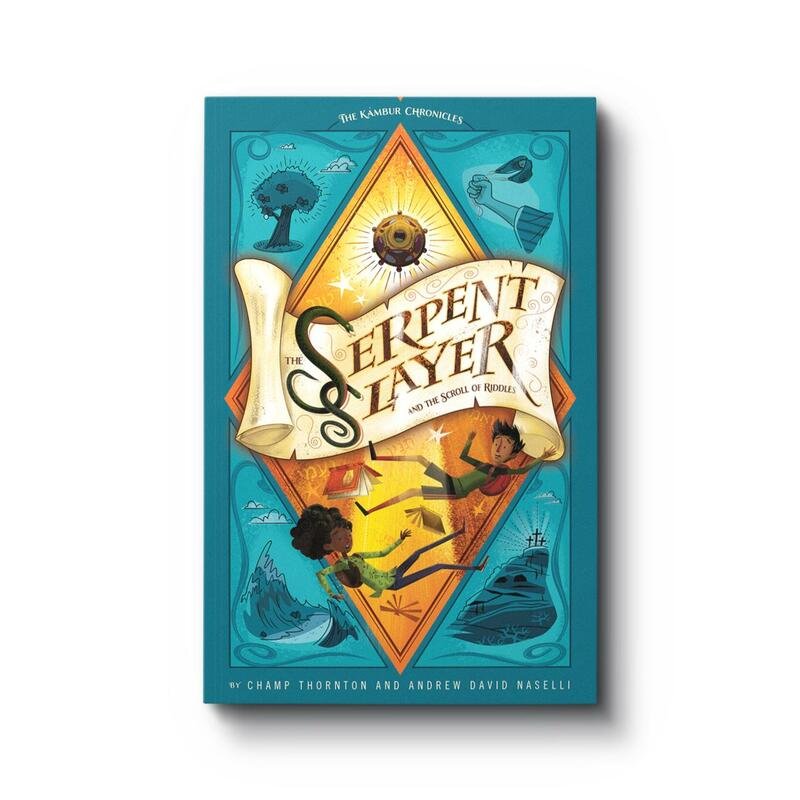
In a recent book Champ Thornton and Andy Naselli attempt a different approach to providing an imaginative pathway to teaching these basic biblical truths. New Growth Press released The Serpent Slayer early in 2022.

The book is a middle grade level chapter book that follows twins, Nomi and Emmet, as they have a wild adventure where they get sucked into stories that turn out to be part of the biblical story line. There’s a little bit of mystery, a little bit of Never Ending Story, some repentance and moral truth telling, along with unmistakable elements of biblical theology.

The story is carried along with riddles that will likely seem transparent to an educated reader, but which will be engaging for the 9-13 year-old target audience. There are twenty-five concise chapters that keep the plot moving along in the 135 page volume. Readers that have cut their teeth on The Mysterious Benedict Society and similar tomes will find this book a light snack in comparison. But there is some meat in the content, so the authors included a Reader’s Guide at the end that helps make clear the symbolism for kids that need a little help putting the pieces together.

There are elements of magic within the book, which may make some parents skittish. But when this is put in context of the theological grounding that Naselli and Thornton have demonstrated in their other works, there is good reason to expect that the mysterious events remain a devise to move the plot rather than a subject to be explored. In order to be interesting, there needs to be something out of the ordinary as a hook.

The book is intended to be the beginning of a series. There is a fair amount of space invested in introducing the characters. Later books may have opportunity for more thorough character development because the foundation is already laid. As far as tone and quality, this has more of the feel of The Hardy Boys than The Chronicles of Prydain, but at the rate many kids devour literature this is a welcome addition to a church book shelf, a home library, or even as something to request for your local library.

NOTE: I received a gratis copy of this volume from the publisher with no expectation of a positive review.

The Medieval Mind of C. S. Lewis - A Review

For some people, another book about C. S. Lewis leaves them scratching their head wondering what else there is to say. For other people, new analysis of Lewis’ grocery shopping habits would be a must read.

I can say that I am much closer to being in the second camp than the first, though I have reached the point in my studies that the mere presence of Lewis’ portrait on the cover or his name in the title of a book are no longer enough to get me excited.

I am, however, excited to have read the recent book on Lewis by Jason Baxter, The Medieval Mind of C. S. Lewis: How Great Books Shaped a Great Mind. It is a relatively brief volume and it takes up questions that have been explored in other volumes, but it also explores them in ways that I have not encountered in my research in the secondary literature on C. S. Lewis.

Allow me to begin by explaining a few reasons why this book is worth your time and money.

First, it is a concise volume at just over 160 pages. Too many books are about twenty-five percent too long these days. They make their case and then they continue to do so well after their point has been well expressed. Baxter avoids that, leaving the reader interested by the end, which is a gift to the serial reader.

Second, Baxter makes Lewis the main subject of the book not his own research. When writing on a subject has reached a certain critical mass it becomes possible to read a book that claims to be about a topic, but it is really about the author’s interactions with books and articles about the topic instead of the topic itself. The Medieval Mind of C. S. Lewis interacts with significant segments of the secondary literature, but the majority of the sources are Lewis’ works and the main thrust of the book’s arguments is an interaction with and exposition of C. S. Lewis. This is a volume that leads the reader to Lewis and beyond the author’s own mind.

Third, The Medieval Mind of C. S. Lewis explores a major aspect of Lewis’ work that is well-deserving of attention. Lewis described himself as a dinosaur, by which he meant that he was really a man of an earlier age, specifically the medieval age. This has been explored to some degree in several biographies of Lewis. It was also the thrust of Chris Armstrong’s book, Medieval Wisdom for Modern Christians. Baxter’s book is distinct from these earlier volumes because it explores some of Lewis’ lesser known works, like Allegory of Love and Discarded Image, while tying those resources to the books that Lewis read, interacted with, and in some cases helped maintain some interest in among contemporary scholars.

The end result is a volume that is a pleasure to read, deepens the readers understanding of Lewis and medieval thought, and connects to some lesser explored aspects of Lewis scholarship.

This is the sort of volume that has significant explanatory power. It helps to explain why Narnia feels different and that when reading Lewis one encounters something deeper than the offerings of much of modernity. Baxter begins by describing the medieval cosmos, then explores Lewis’ deep roots in the scholarship of the era. He then introduces some of the counterpoints between antiquity and modernity, the shifts in the understanding of the human mind and person. Baxter goes on to explore the ways Lewis went beyond the presuppositions of his day to see the wonder of humanity, and the mystery of God. These all contribute to a worldview that tends to tear down barriers build by modern constructs.

The Medieval Mind of C. S. Lewis is an instructive book that may serve for some readers as an introduction to sources often unknown to contemporary readers. For those coming to Lewis anew, being pointed to Boethius and Dante, for example, may open up new worlds for explorations and broader reading lists for continued digging.

Baxter’s book is a good one. It is thoroughly readable and can be consumed by someone without an advanced degree in literature, philosophy, or theology. It is engaging and carefully constructed. For those that love C. S. Lewis, it is a welcome exploration in a cherished topic. This is a book that belongs on the shelf of the Lewis scholar, the teacher hoping to get a student engaged in some deeper thinking. More significantly, it belongs in the hands of a reader hoping to be delighted and broadened through the reading experience.

NOTE: I was provided a gratis copy of this volume with no expectation of a positive review.

A New Edition of Chesterton's Orthodoxy

If you haven’t read G. K. Chesterton, you should take the opportunity to do so.

He’s humorous, incisive, perceptive, witty, and a fierce defender of the Christian faith. Chesterton’s Everlasting Man is one of the volumes that contributed to the conversion of C. S. Lewis. Some find his contrariness and paradoxical thinking grating, but most sense the twinkle in the eye of a brilliant thinker who has been captured by a love of the truth.

Chesterton’s work is out of copyright, so I anticipate (if it hasn’t happened already) many cheap and barely readable versions of the text to pop up in online marketplaces. One of the challenges of reading old books in our age is finding a well-produced edition for a reasonable price.

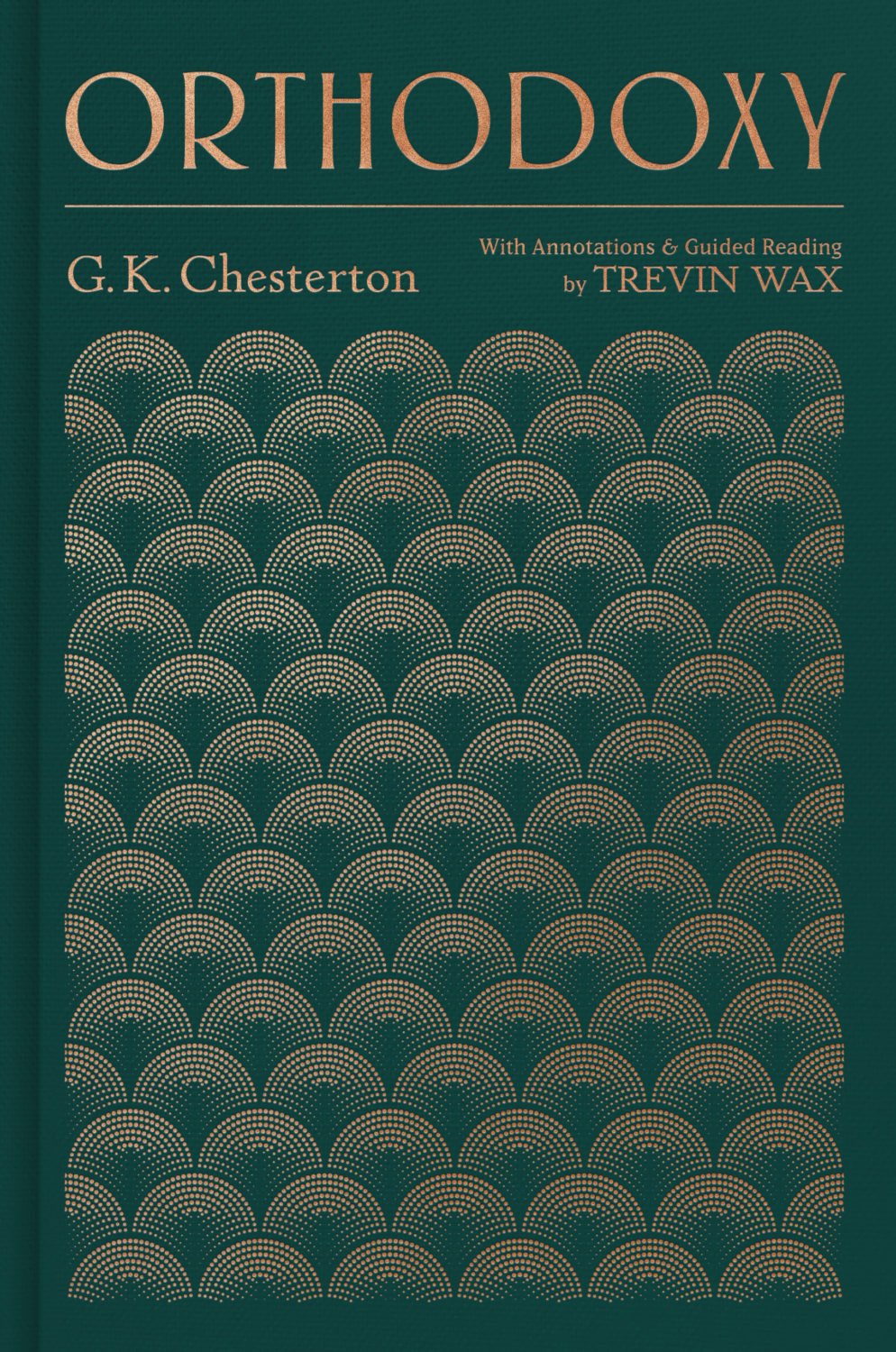
B&H has produced a gorgeous printing of Orthodoxy, with an introduction, annotations, and guided reading from Trevin Wax. The annotations alone are worth the price of the book, because Chesterton drops many names of popular politicians, thinkers, and cultural fixtures without any context. It’s possible to get the general idea of the text without knowing who he is referring to, but the notes that Wax provides at the bottom of the page are very helpful. The guided reading is also useful for those who haven’t encountered Chesterton before, or who are unfamiliar with the conflict of Christianity and modernity. Chesterton is a very deep thinker, so the first trip through Orthodoxy can be tough slogging for the uninitiated. Wax scaffolds the content with a brief introduction to each chapter telling the reader what the gist is and what to look for; at the end of chapter there is a brief summary and some discussion questions. These are all helpful for engaging the book on its own terms.

Orthodoxy itself, of course, is a classic volume. There is a reason it has been in print for an extended period of time. This volume is a follow up to Chesterton’s book, Heretics, where he takes on Christianity’s modern critics directly, and often by name. However, some of those critics did not engage with Chesterton because, they said, he had not outlined his own position in the positive. They recognized that it is much easier to tear down opinions than it is to build them anew. Chesterton agreed and took them up on the challenge. The result was Orthodoxy.

Chesterton was, of course, a Roman Catholic, which shapes his approach to defending the faith. He also grossly misunderstood Calvinism—or at least, he has misrepresented every real version I have ever encountered in life or in print. And yet, Chesterton’s defense of Christianity from modernity is a defense that is appealing even for a low-church Baptist with Calvinistic tendencies. He makes the locus of his understanding of Christianity the Apostle’s Creed, which is a good place to start, if you ask me.

It’s challenging to sum up the contents simply, but it might be fair to say that, having looked at modernity’s answers to life’s most pressing questions, Chesterton is explaining why Christianity provides the best description for the world as it exists. He begins by showing the circularity of materialistic arguments for the world and the better answer he found in Christianity. The argument moves on from there. This isn’t a typical apologetics book, but trust me, it’s worth your while.

The latest edition of Orthodoxy from B&H is worth the money. It is a handsome edition and the notes add value rather than distracting from the quality of the text. If you haven’t read it at all, get some version of the book and pick it up. You’ll thank me later.

NOTE: I received a gratis copy of this volume from the publisher with no expectation of a positive review.