Worth Reading - 9/30

Here are some links worth reading this weekend. I've decided to move the Links Worth Reading series into the regular stream of my blog to simplify the layout.

1. Bruce Ashford, Provost of Southeastern Baptist Theological Seminary, wrote about how Abraham Kuyper has influenced his thinking. A good discussion and a helpful gateway to Kuyper for those that haven't read him before.

Rarely will a reader be trampled by a herd of evangelicals stampeding toward the Abraham Kuyper section of the bookstore. Though there are a number of reasons (like the impediment caused by display stands full of Test-a-mints and Precious Moments figurines), perhaps no reason is more important than this: We Americans rarely read old books, and Kuyper’s books are old.
Kuyper lived in 19th-century Holland, served as a pastor, founded a Christian university, started a newspaper, served in Parliament and as the prime minister, and wrote influential books on theology, culture, and politics. His deepest convictions might be summed up in one sentence:Jesus Christ is Lord of all, and because of that fact, our allegiance to him should shape not only the private but also the public aspects of our lives. If Christ is Lord, he’s not just Lord over private spirituality and church attendance, but also Lord over public affairs like art, science, business, politics, economics, and education. Reading Kuyper got me started on the path toward viewing Christ’s lordship as directly relevant to public life.
I didn’t discover Lectures on Calvinism until I was living in Kazan, Russia, in the late 1990s. I was an embryonic theologue in my early 20s who’d spent my time reading books written in my own day by people just like me. Upon moving to Russia, however, I began to read old books, and Lectures on Calvinism was one of the first. It influenced decisively the way I think and live; I carry its ideas with me today each time I open my mouth to teach a class, pick up my pen to write an essay, or grab the remote to watch the news.

2. Avoiding harm to third parties is often used as the ultimate lever in moral reasoning in contemporary society. The thought is to do whatever you want as long as you don't harm others. That's the basis that people are using to argue for government restrictions on religious faith and practice in the United States. Supposedly, not purchasing potential abortifacient drugs causes irreparable harm to the person who would otherwise be out a few dollars to buy the chemical cocktail. This inconvenience is deemed by some to be sufficient harm that the conscience of people should be violated by the law. In fact, there are some that see any harm (as perceived by the victim) to be sufficient cause to condemn the conscience of others. However, in a careful analysis, one thinker argues that the mere existence of third part harm (actual, not just perceived) is insufficient to warrant curtailing the practice of faithful religion. It's a long article and tightly argued, but well worth your time.

Thus the two arguments, free exercise claims for exemptions and Establishment Clause challenges to exemptions, require looking at similar factors. Both involve examining (1) the nature and seriousness of the burden that the law in question would impose on religious exercise, and (2) the nature and seriousness of the effect on others if the claimant is exempted from the law. But identifying these two considerations does not answer the question how they should be compared with each other. How should burdens on religion and those on others be weighed? And how significant must the third-party harms be to overcome religious claims?
The chief assertion of this article is that harms to others should not be conclusive against religious exemptions under either free exercise or nonestablishment principles. Such harms can certainly be a reason to deny exemption, but they are not the end of the inquiry: a number of factors must be considered. In particular, I argue, Establishment Clause limits on religious exemptions should not be strict. An exemption is not unconstitutional merely because it has negative effects on others: the burdens on others must be significantly disproportionate to the burdens that it removes from religion.

3. Some thoughts on writing for wanna be writers like me. There's more to the writing process than just typing, but certainly not less. A well-framed discussion that's worth your time.

Writing is facing your deepest fears and all your failures, including how hard it is to write a lot of the time and how much you loathe what you’ve just written and that you’re the person who just committed those flawed sentences (many a writer, and God, I know I’m one, has worried about dying before the really crappy version is revised so that posterity will never know how awful it was). When it totally sucks, pause, look out the window (there should always be a window) and say, I’m doing exactly what I want to be doing. I am hanging out with the English language (or the Spanish or the Korean). I get to use the word turquoise or melting or supernova right now if I want. I’m with Shelley, who says that poets are the unacknowledged legislators of the universe, and I am not fracking or selling useless things to lonely seniors or otherwise abusing my humanity. Find pleasure and joy. Maybe even make lists of joys for emergencies. When all else fails, put on the gospel song Steal My Joy refrain is “Ain’t gonna let nobody steal my joy.” Nobody, not even yourself.

4. Aaron Earls discusses the outrage over the infamous Clinton group selfie. It says something about our culture, but it shouldn't be viewed just as an opportunity to castigate millennials. The disfunction goes much deeper. 

I’ll admit there is something disconcerting and unsettling about the photo: Dozens of millennials all seemingly consumed with contorting themselves so that this moment is captured and is captured with them at the forefront.
But perhaps our disgust with those selfie takers goes a bit deeper. Maybe we are just sick of our own self-absorption and pride.
In introducing the topic of pride in Mere Christianity, C.S. Lewis spoke of it as the “one vice of which no man in the world is free, which everyone loathes when he sees it in someone else; and which hardly any people … ever imagine that they are guilty themselves.”
Pride claws at every heart, but few want to admit it. Even more than that, few have any tolerance for it the lives of others.
Again, Lewis wrote: “There is no fault that makes a man more unpopular, and no fault which we are more unconscious of in ourselves. And the more we have it ourselves, the more we dislike it in others.”
If that is indeed the case, I’m afraid it speaks very poorly for those of us in non-millennial generations so off-put by their apparent prideful self-obsession.

5. Here's a podcast from the faculty of Southeastern Baptist Theological Seminary, with my friend David Jones, that discusses the reality of poverty and how we view it.


Here's a couple things that I wrote recently that were published elsewhere:

1. Over at the Intersect Project, I had an article posted on the dangers of trying to become financially independent, which is often seen in the Early Retirement movement.

A lot of people want to play with FIRE. Not literal fire, but the principle of being “Financially Independent, Retire Early.”
There are vibrant communities of eclectic individuals from around the globe, though mainly in North America, who seem to dedicate their lives to getting out of the workforce so they can “be free.” You can find blogs, websites, online tools and resources galore to help you live out this principle.
On the one hand, FIRE advocates’ financial responsibility and aggressive pursuit of wealth accumulation is invigorating. The goal of financial independence inspires them to spend less than they make, work diligently and be creative. It is healthy to pursue a worthy goal.
On the other hand, FIRE advocates often see the cessation of work as a good in itself. Some advocates—though certainly not all—see work as a necessary evil, a means to an end. Once they set their sights on financial independence, they see work mainly as the way to earn a large enough nest egg to allow them to live off the passive income for life.

2. Last week, The Institute for Faith, Work, and Economics posted a short piece of mine that deals with one argument (among many) against Universal Basic Income.

One obvious problem with this is that the existence of U.B.I. might encourage people who could find work to simply accept the income and stay at home. Observation of human nature seems to point in that direction, which may end up making the system fundamentally unsustainable.
Although questions abound about the economics of U.B.I., concerns for the cost should not be the primary concern for Christians. The deeper problem with U.B.I. is that it encourages people not to find ways to add value to their communities. Work adds economic value, but it also adds a deep relational value that will be difficult to replace.
The conversation about U.B.I. will certainly continue in the future, but it must be broadened to consider the nature of humans and the value of work. There are needs for community and contribution that a check from the government cannot fill.
Some Recent Research on Reading

I love reading. I love books.

Anyone who has been in my home will know that I love books, because I have several thousand on my shelves. The vast majority of them are cataloged online. (Sometimes new ones sneak in and don’t get cataloged right away.)

Reading is such a significant part of our household that we have to discipline our children for reading rather than coax them to do so. This is little surprise since my wife and I both grew up as readers and continue to read a lot.

A National Survey on the State of Reading

A recent Pew Research report on reading piqued my interest because, well, I’m a book nerd. They did a study to see what the state of reading in the US is.

On the side of being interesting and somewhat surprising, despite the proliferation of online media, approximately the same number of folks said they had read a book in the past 12 months. About 73% of respondents say they’ve read a book in any format and about 65% say they have read a real book (i.e., not a digital book). Only about 6% of people have transitioned away from real books to entirely reading on screens. This is comforting, since it promises that our local libraries likely won’t get phased out by publicly funded internet kiosks in the near future.

Much less surprising was that the correlation between income, education, and reading seems to support the value of reading. Correlation does not equal causation. Thus, it may be that higher incomes provide more time for reading. Or, it may be that advanced education inculcates improved ability to read books. The data isn’t clearly causal. However, the correlation between apparent material success (as customarily defined) and reading is striking. It may be that there is a correlation between the discipline of reading and other important, higher order skills.

Children and Reading Habits

Findings from another survey, biennial research done by Scholastic, talk about about reading for children. Given that there appears to be a correlation between material success and reading, and that reading is just a great way to improve your mind, the Scholastic study is important as it shows some factors that influence kids’ desire to read. Again, correlation isn’t causation, but it might give hits about what causes it.

Public Domain Photo of Leeds Central Library, taken by Michael Beckwith. http://ow.ly/PpWm304Gs9Y

Public Domain Photo of Leeds Central Library, taken by Michael Beckwith. http://ow.ly/PpWm304Gs9Y

As a bibliophile of the degree that some might describe as being a hoarder, the number of volumes in a library is significant to me. As it turns out, my library is way over the expected average. Of the survey respondents, those with children who were frequent readers indicated they had 205 books in the house; those with infrequently reading children had 129 books in their house.

These findings surprised me. First, I was surprised that the number of books for infrequent readers was not lower. I’ve been in the homes of some infrequent readers and usually they live in a book desert, with an occasional pamphlet, but very little in the way of real literature. 129 books in the home of non-readers is surprising to me; I would have expected many fewer.

Second, I was surprised to see the number of books in the homes of frequent readers at only 205. I have more than 200 books on several distinct subjects. I’ll admit that I have a bias toward owning books instead of borrowing them from the library, but that is because by offering a buffet of books to my children (and myself) I feel that I am encouraging them to read. Apparently the several hundred children’s books are overkill by contemporary standards.

Some other interesting data points that correlate with children being frequent readers are consistent with the usual suspects. Parents that read to their children frequently before kindergarten are much more likely to have frequent readers. School age children whose parents read to them presently are more likely to be frequent readers. Frequent computer use has a clear correlation to forming infrequent readers.

Some Thoughts on Reading and Quality Books

For the most part, the Scholastic survey is informative and interesting. However, there are a few items that might be cause for concern. The percentage of students who say they either like or love readings books has declined by about 10% since 2010. The number of children (about 47% of respondents) who say that the amount of reading they have to do in school discourages them from reading for pleasure is unfortunately high. Additionally, more than 60% of students report that they read less now than when younger because there are other things they enjoy doing. Given the large percentage of students that report spending significant time on electronic devices, this may indicate the distractification of our youth, which may influence later educational outcomes.

Another point of concern, which is admittedly more based on generalization and personal observations of the public library shelves, is that about 73% of children report that they would read more if they could find more books that they like. This is natural, but I think it is having a negative influence on the quality of children’s literature overall.

I’ve read plenty of fluff in my day. I still enjoy a good Louis L’Amour book, or a mystery by Ellis Peters or Alexander McCall Smith.

However, the shelves of the local library shelves are sagging under the weight of junk kiddie lit. I’m not basing that merely on grumpy observations of book covers, but on earlier study of children’s literature and attempting to read some of the stuff my kids bring home. The bulk of recently published stories seems more likely to smuggle attempts to justify restructuring traditional societal norms than to provide substantial benefits to the mind through reading. Sometimes good societal changes come through children’s lit, but surreptitiously sneaking various forms of social engineering into children’s fiction is a bit annoying. Even among the good clean fun kids’ books that I’ve read recently, there seemed to be an emotional and intellectual vacuousness; in many of the current offerings the story line is interesting, but the plot predictable and depth of character are flat.

Parents report that they think it is important for their kids to have strong reading skills and strong critical thinking skills in life. Reading is, arguably, supposed to support those things. Kids report being much more likely to prefer books they pick out themselves (90%) and to want more books that they like. But by providing quick, fun, easy to read stories, publishers and book buyers may be subverting benefits of reading.

This is not a dire warning against the library shelves or a call to ban fun books. There is likely some benefit in reading, even if the reading is light and fluffy. The caution should be in considering what we purchase (for home or the local library) and asking questions about the purpose of reading for children as we select the books to populate the common shelves. The best books both delight and instruct. We shouldn’t let the hope of making cotton candy literature becomes a gateway drug to better literature undermine a main purpose of forming readers, which is to help teach people to think better.

Beware the Sea Lion

I learned a new term recently. It can be a noun or a verb. One may encounter a "sea lion," or someone may "sea lion."

The term is drawn from a cartoon in the Wondermark series drawn by David Malki. I've included the image here for your interest.

When I encountered the cartoon, I knew that I had found an amazingly accurate description of a certain online persona.

This cartoon can be found at:  http://wondermark.com/1k62/ 

This cartoon can be found at:  http://wondermark.com/1k62/ 

A sea lion is the sort of person who cannot allow a balloon to go unpricked. Seeing someone post something in public, the sea lion jumps into the conversation. However, the point is not to add anything to the conversation, it is to waste the time of the person who is making the comment.

To be clear, there are times that online conversations can be meaningful, but by definition, the sea lion is not interested in such conversations. Typically he is interested in a) proving himself smarter or more culturally enlightened than others, b) disrupting a conversation he disagrees with, without acknowledging that another person may simply have a different set of presuppositions, c) just generally being a nuisance all while pretending to be the truly mature and civil one, d) silencing speech that he disagrees with and which rely on a different worldview.

Sea lions are annoying, but they are simply a part of internet life. They can sometimes be confused with people who are legitimately asking questions about a topic that they know little about. Recognizing the difference (and avoiding being one) is important.

Some Characteristics of a Sea Lion

1. A sea lion typically recognizes that the comment was not necessarily about him, but chooses to engage it anyway. Some people simply have too much time on their hands, and being the vigilante of the Facebook wall or comments section seems to be their preferred disservice to the world. Never mind that the comment may have been made in jest, intended as a light hearted generalization, or be entirely tangential to the main point; the sea lion boldly goes where no one cares to hear his opinion.

2. A sea lion often plays dumb, attempting to get their victim to fall into a script that they have carefully crafted a rebuttal to. Online debates are often tedious and they tend to fall into certain patterns. College sophomores spend a great deal of time diagnosing those patterns and learning to rebut them so they can look smart in debates. Often the rebuttals are neither fair nor focused on the main point under debate. However, the sea lion is always ready for the unsuspecting fool to play along.

3. A sea lion is often characterized by attempting to move the argument back several steps or by refusing to accept an assumption the other parties have agreed upon. Rarely does the sea lion state that this is his tactic, but attempts to drag the conversation back to his own presuppositions. Often the sea lion is arguing about elementary level concepts when the conversation is on advanced topics that build on a common set of elementary assumptions already agreed upon.

4. Sometimes the sea lion is unaware he has presuppositions. There is an army of ignorant online warriors who seem to be unaware they have a worldview. All reasoning must be done on their terms, because they and only they have rightly reasoned from first principles to final conclusions. They represent truth and all difference in opinion represents a tainted deviation of their truth. This sort of sea lion asks the Christian to prove God when the Christian is debating theories of the atonement. (Let the Christian recognize that of course the atonement is silly and unnecessary if there is no God.) But the sea lion is oblivious that the faith assumption there is no God requires as much suspension of disbelief as any other faith assumption.

5. A sea lion often takes being ignored or told off as "victory." The other parties couldn't face the crushing logic of the sea lion, therefore they banished him. More likely the sea lion is just a bore and was shushed or blocked for habitually trying to subvert conversations.

6. The sea lion assumes that if someone makes a comment, they must follow up if he replies. This is part of the narcissism of the sea lion. Being the sole mind in the universe and sole arbiter of truth, the sea lion assumes that justice entails dealing with his (often erroneous or ignorant) arguments.

7. The sea lion is usually prepared with links from friendly sources that support his position. (Often he selects his topics by the ones where he's found articles and studies that he can use as irrefutable support.) If the victim does not have rebutting sources at hand, then his argument can be dismissed as being unsupported (and likely unsupportable, of course). If the victim does have rebutting sources, these are dismissed as being hack science, paid for by the Koch brothers (or Soros, depending on the topic and side). The sea lion's sources are, of course, irrefutable because Science and Peer Review. If sources are used from a different field than the sea lion is prepared to defend, then these will be rejected as from a flawed discipline.

Dealing with the Sea Lion

There is no perfect way to deal with the sea lion. Often ignoring them is the best way. Blocking Uncle Bob is probably going to lead to tense times at the Thanksgiving table.

Sometimes the sea lion has a point, your argument may be flawed or in an inappropriate venue. (At this point, the person may actually not be a sea lion, so it's important to evaluate the pattern of the person's interactions.)

However, often the true purpose of the sea lion is to silence dissenting opinions. Often this is perceived as a part of social justice on the part of the sea lion. At its best it is a form of annoying thought-policing, at its worst, sea lioning turns into a form of harassment or bullying.

Sea lions are often attempting to raise the social costs of online interactions by being persistent, argumentative (though in their minds always civil), and pedantic. They are typically off topic or in the wrong forum, but they typically aren't the vitriolic troll.

Unfortunately, there is no good way to avoid all sea lions, except by not engaging in online speech that disagrees with them. That is exactly what they want.

Therefore, the best thing to do, it seems, is to speak well, use evidence appropriately, and ignore the sea lions until they go away. Very seldom do people change their minds based on online arguments (I have no support for this, but I know it to be true). I will venture to suggest that no sea lion has ever changed his mind based on an online debate, however much time the victim has wasted.

However, if someone has a peer reviewed study to show me, I might just change my mind.

Some Lessons from Dissertation Writing

This week I turned in my dissertation. Now I wait for my defense. In the moment of euphoria before I find out everything that is wrong with the project I’ve been working on for a year, I decided to jot down some of the things that I’ve learned so far about the process.

Some of these lessons are based on advice and counsel that others gave me, but that I’ve since found to be wise. We’ll find out how well I did on the final product in a couple of months. Even if there are flaws (there are, trust me) in my dissertation, here are some things that I have learned through writing the longest academic work I’ve ever attempted.

1.         It’s never going to be perfect. – One of the hardest things to recognize just prior to my submittal of my dissertation was that there were still going to be some imperfections in the manuscript. I’ve read the completed manuscript multiple times. So has my wife. I have no doubt that there are still a few typos, missing words, extra spaces, or the like throughout. At some point you have to let it go.

2.         You can’t read every possible source. – I wrote each of my chapters, referencing those volumes and thinkers that best related to my point in the text. However, as I was doing my final read through of the dissertation before submitting it, I kept on thinking of additional sources that could have bolstered my point or that I could have read. There are new books in the academic catalogs that are begging to be included in my bibliography and dozens of articles that I downloaded that I never got to read. I could have tried to read and cite more, but sooner or later you have to turn the project in.

3.         Having someone else read it is invaluable. – My amazingly patient wife also serves as my editor. She doesn’t do style manual stuff, but she does read for grammar, clarity, and typographical issues. Having her read my chapters to tell me where I made no sense or where I had errors made a huge difference in the end, I think. There were a number of places she called my attention to that were unclear and needed simple rewording to make the project better.

4.         This isn’t the best thing you will ever write. – Looking at the 358 pages of manuscript is pretty impressive. It’s the longest piece of scholarship I’ve ever written. In fact, most of the chapters are longer than any paper I’d previously written. What I had to continually fight back was the goal to make this my magnum opus. I will write something better later on, so I need to make a good effort but not think that this is the pinnacle of my scholarship. My scholarship and writing should get better in the future. That’s not a ding against my dissertation, it’s a reflection of academic maturation.

5.         Doing a read-through at the end is important. – Before I had the final proofreading done by my wife, I read through the dissertation from cover to cover in about two days. Since some of my chapters had been written about a year before, this was an important step in the editing process. By the end of the writing process I had developed some key phrases and learned to avoid others. I was able to edit the earlier chapters to reflect the language of the later chapters (chronologically) by the end. This step helps the project read more like a cohesive work of scholarship, instead of a collection of essays. I was also able to find some places where I could clarify my own explanations, which, I think, made the end product more readable for someone else.

6.         Creating a project plan with deadlines is vital. – The internet is flooded with “dissertation writing as project planning” sites. There is value in the approach. I only met a couple of my deadlines, so I had to keep revising and extending the project plan. However, by delineating the steps and what it would take to get there, I could focus on the next thing instead of getting overwhelmed by the size of the project. By having an internal deadline (with plenty of margin built in to the institutional deadline) I had something to keep me moving. Because I had looked at the institutional deadline and built my project plan based on that, I knew what I had to do to get the project in on time. This made it easier to prioritize so that I could know when I needed to lock myself away to write or when I could play another game of Monopoly with the kids.

7.         Stay on topic. – There were about a million times in the process of writing that I found interesting rabbit trails to go down. I even ventured down a few of them. I’ve got extensive notes and footnotes to prove it. However, when I was polishing my dissertation, most of the work of those rabbit trails ended up deleted from the final product. I may use some of the material for essays later on, but I sometimes spent a week on research that was interesting, but did little to support my final dissertation. A bit more discipline would have benefited me significantly.

8.         Keep notes on the side ideas. – I wasted some time along the way exploring rabbit trails. However, one of the things that I think will bear some fruit in the future is using some of that material and the ideas that I got while writing my dissertation to produce journal articles at a later date. I’ve got a list of potential topics with some sources that I can chase down now that I’ve finished my dissertation. These don’t all relate directly to my dissertation topic, but there is room for further research. I now have more ideas for the future than my life and schedule can possibly support.

There are probably more things that I’ve learned. Perhaps after my defense I’ll pick up the topic again. Or, I may discover that some of my lessons learned aren’t as helpful as I thought. I’ll let you know what the readers think.

Purveyors of Doubt

It’s become fairly common among some former evangelicals  to spend a great deal of capital feeding the general lack of confidence of the present age and encouraging currently faithful Christians to hop on the bandwagon of uncertainty.

Certainty is a modern notion born out of the Enlightenment. Or better yet, the Enlightenments, because there really were different streams of thought that appeared about the same time with different beginning points. Speaking of which, can we really say that there was such a thing as the Enlightenment since there appear to be such differences between thinkers and there is no absolute beginning point. Also, since the cultural movement that we once called the Enlightenment was largely a European endeavor and involved mainly males, it is likely that the entire enterprise was oppressively racist and sexist. Better not to study thought of the Enlightenment at all since pluriformity of thought prevents any sort of characterization of the era. At best we should have a high degree of confidence in our uncertainty.

Did I lose you? That’s the point of that paragraph, but it represents some of the sort of argumentation that passes for deep thought. It doesn’t need to be factually correct as long as its moved you to a place of doubt where real learning can take place.

The only thing we can be certain of is our uncertainty according to scholars in some circles. This certainly keeps them safe from criticism—Who can criticize what has no form?—but it does little to promote understanding or, when theology is involved, faithfulness.

Faith Amid Multiple Positions

The thinking in some circles appears to be that it is better to be expressively dubious than faithfully committed.

One of the popular ways to cast doubt on orthodoxy, for example, is to say that there have been people who have disagreed with orthodoxy throughout history. Since there is doubt among some thinkers in history, who are we to believe that we can know what is right belief?

Certainly there is room for humility in belief. We understand that different people have thought differently (and indeed, do think differently) about important doctrines. My faith is not undermined by some people having different opinions.

Image Used by CC License. http://ow.ly/bBeY303XtpN

Image Used by CC License. http://ow.ly/bBeY303XtpN

For example, I have friends who are Presbyterian. They believe that the form of baptism is secondary to the meaning of it, so the evolved practice of sprinkling babies is as acceptable as believer's baptism by immersion. I’ve studied enough church history and read enough theology to know how they get there. However, I think they are wrong. In this case, there is a different set of presuppositions at work. But more important than the position are some simple realities about truth that are revealed by sincere, well-founded disagreement.

First of all, the simple existence of a difference in interpretation of Scripture on the subject of baptism does not imply that there isn’t a right answer. One of us may be right and the other wrong. Or, both of us may be wrong. However, plurality of positions doesn’t mean that there isn’t a correct position.

Second, while I recognize that I have a different position than my Presbyterian friends, I honor them when I acknowledge their positions and take them seriously. What would dishonor both them and everyone else at the table is flippantly saying that the existence of multiple perspectives indicates that none of us should believe anything.

In some ways, that is what the faithless Christian movement is doing. Some people deny objective truth (not just its knowability) to argue against confidence in historical Christian teaching. Sometimes these people argue that since a novel interpretation of a text has arisen within the past several decades from people who argue that they are intentionally rewriting Scripture, then we must reject confidence in orthodoxy.

The False Humility of Doubt

This sounds simplistic. In some cases it may be unfair. However, in many cases the line of argumentation isn’t far off this simplistic summary.[i] Doubt is possible because multiple positions exist. Doubt is preferable to being wrong, particularly when the social costs of being “wrong” are significant. Therefore, doubt is better than certainty. Doubt is humble and humility is biblical, therefore we must doubt.

Most of the time, the doubt that is portrayed as humble is anything but. Such doubt is a way of saying that a previously unthinkable position might be right because the old one might be wrong. In other words, it’s saying that someone’s new and better teaching is probably better than the old one, so those of you who don’t like the new one should be humbler and accept the new teaching. That used to be called heresy.

Think about it another way. The doubt sowers are not being very humble when they essentially call into question thousands of years of belief. “You know all of those people who believed something different than me and held to it despite threat of imprisonment, torture and death?,” they insinuate, “They are just arrogant in comparison to my humble doubt.” Why have faith when doubt is a safer, humbler option?

The thing is that some forms of doubt are a cancer to faith, such as the insatiable doubt that some contemporary marketers are promoting. In order to rewrite Christian ethics and avoid believing traditional doctrines, some people are sowing seeds of doubt in the minds of others. They do it because of “love” or because they are being “kind.” Sometimes they try to revise traditional orthodoxy because they love Jesus and really believe that Christianity has something to offer contemporary people; it just needs to have some of its rough edges shaved off that poke at the citizen of the contemporary world.

Whether the sowing of doubt is done for personal gain or to try to make Christianity fit the popular trends, teaching people to doubt is a bad thing. It’s a bad thing when the people in the church no longer have the ability to believe the traditional teachings of Christianity. It’s a bad thing when people have no trust in Scripture, because if it is wrong on one point, who is to argue that it gets the gospel right? These are significant problems that are exacerbated by the purveyors of doubt.

More significantly, sowing doubt will be a bad thing for some people when their actions are judged by a holy and righteous God. For the Jesus-only hermeneutics people, he alludes to that pretty clearly in Matthew 5:17-20. For those that accept all of Scripture as inspired (even when it disagrees with us), James 3:1 warns us to consider becoming teachers because they will be judged with greater strictness. The context seems to point toward that strictness being in God’s judgment, not just in people’s observations of our social media profiles. That should cause us to rethink how much doubt and discontent we desire to foment.

[i] I’m intentionally not providing specific examples here because: a. It’s unlikely anyone really doubts this point if they have spent any time reading theological blogs. b. The people who are most likely to be offended by this statement and demand an example are probably part of the problem and really know exactly what I’m talking about. c. I blog for fun, not to get into blog wars with people that have too much time on their hands. Many of the doubt bloggers are professional instructors and writers who have more time to wage endless war against belief than I have time to rebut. I’m simply making observations at this point.

Evangelical Politics - A New Hope

If this year has taught us anything, it’s that politics are messy.

All political systems bring together with differing opinions into coalitions designed to pursue an agenda. This means that careful thinkers often find themselves pushing for candidates that represent them in some areas, but not in all. It means sometimes accepting the lesser of two evils, as long as neither evil is that bad.

Christian engagement in politics is even more difficult than for the general population. Our integrity as Christianity is moored to eternal truths with contemporary applications. This means that in some areas compromise is impossible. It means that we will (or should) find ourselves pointing to good things on both sides of a political argument.

Scott Sauls’ book, Jesus Outside the Lines, discusses this conundrum of trying to be gospel-centric and truth-centric instead of power-centric. Contemporary American politics (and all politics, to be honest) have become especially divisive because power has become a greater concern than truth in the postmodern era.

Many times these political divisions split congregations and even individual the viewpoint of individual Christians. A Christian can be both for racial reconciliation and believe the free market is the best option for an economic system. The same Christian might also be confident in the importance of protecting the environment while being certain that abortion is a moral evil. These are all issues that can be supported with reasoned arguments and reconciled with a Christian worldview, but which have tended to fall on either side of the American political party divide.

The lowest of lows of our American political scene, with two intolerable candidates for President from the major parties, may be the source of renewed gospel-centric cooperation between Christians. Instead of insulting someone for a D or an R on their voter registration card, the fact that both parties have played their voters for fools has potential to bring Christians together across previously insurmountable political divides.

A team of socially conservative Christians, with voices from both major political parties, have united for a new attempt to engage American politics with a distinctly Christian voice. The website, Public Faith, represents a hopeful attempt at renewal of evangelical moral witness in politics.

Their vision statement affirms a positive hope of a better political future with an authentic voice for the faithful:

“We invite all Christians and those of good will to join us as we advocate for a perspective that challenges political parties with a better vision. We call on Christians to work within political parties to advocate these essential ideals and to change parties or create new ones when reform is no longer feasible.”

A movement for the common good among Christians is an excellent thing. Let the faithful be for the good of all, not the power of some. It’s early in the history of this new evangelical organization, but I’m hopeful it can begin to give a voice to many of us who have been publicly embarrassed by the compromise of so-called progressive evangelicals who butcher Scripture as they cave to culture on every issue of contention and the embarrassing cavorting of self-described evangelicals like Jerry Falwell who have become Donald Trump supporters.

My greatest concern for this organization is that its founding documents area bit lean on theological content. They affirm a “commitment to orthodox Christian faith” but that is left somewhat loosely defined. I recognize the difficulty in laying out a sufficient theological vision to accompany the high quality political vision, but since theology precedes politics, the statement is very important. Time will tell whether there is sufficient theological cohesion to support this movement’s political vision.

In the meanwhile, I am encouraged by the start and hopeful for the movement’s future.

Speaking of Ethnicity

Race relations in the United States is becoming a third rail topic. Better to discuss politics and religion than to suggest there might be ongoing patterns of systemic racism in some circles.

If social media is any indication, some groups seem to think that by even discussing racial differences, others are fomenting and accentuating racism.

In extreme cases this is true. However, in most cases, the people discussing racial issues are dealing with the real difference between the minority and majority experience in the United States.

The Myth of Color Blindness

One of the arguments against discussing race is the argument that society should be “color blind.” The term means that we should not consider the color of people’s skin when making evaluations of people and their work.

Image Credit: Old Couple, used by CC license, http://ow.ly/oA8T303zFnk

Image Credit: Old Couple, used by CC license, http://ow.ly/oA8T303zFnk

I believe that most people engaged in discussions of race relations see “color blindness” as a desirable outcome in the long term. In Martin Luther King, Jr.’s iconic “I Have a Dream” speech, part of his dream is that people will not be judged by the color of their skin. Someday a future generation may reach that point.

Despite the desire to have a world in which skin color does not matter, that world does not exist now. We have a world in which ethnicity and skin color still do matter much more than they should.

At this point, there are some who will swoop down onto my argument like a vulture to point out certain statistics. What I’m speaking of here is more than just statistics—whether the statistics support certain percentages of killings by ethnicity or disparate academic outcomes.

I’m speaking of the observed reality that my middle-class, professional, African-American friends have on average been pulled over many more times than I have for no more apparent cause. I’m speaking of the reality of my own observations of minority males of color being treated differently than me by authorities even while we were both in uniform. I’m speaking of the internal impulse in my own mind to make snap judgments about people based on their appearance.

I like statistics (in fact they are a fun part of my job), but they don't always tell the whole story. Sometimes they tell a different story than reality.

To claim that skin color does not influence societal evaluations is foolish. It’s like a person ignoring an infection in a limb.

Our Wounded Reality

Imagine if you get a cut in your finger while working a dirty job. You ignore the pain and keep working. You tell your hand that it is OK and that it is just like your other uninjured hand. Both hands are equally valuable to you, therefore it should stop hurting. Meanwhile it gets infected. However, you don’t clean the wound or treat it. You tell your hand that the cut was inflicted a couple of days ago and that it hasn’t been cut recently, so it should stop aching. Slowly the infection may heal, if conditions are right. Or, quite possibly, ignoring the legitimate needs of your hand could cause the infection to spread and perhaps even blood poisoning to set in.

At best, the neglected hand heals itself but may scar significantly or take longer to fully heal due to the lack of medical care. At worst, the blood poisoning spreads and kills the individual with the injured hand. In both cases consequences could have been avoided by taking timely, appropriate action.

Few people would ignore an injured hand. Instead, most people react to a cut by getting first aid, keeping it clean, and treating the injured hand differently for a time. The common sense understanding is that the wounded hand may have different needs for a time.

There is wisdom in recognizing there is a difference between the hands and taking care of the wound.

Our contemporary reality of race relations is something like this analogy.[1]

The Reality of Injury

To provide just one example, African-Americans were economically and socially harmed by American society by being enslaved and later by unjust laws that were in place in the middle of the last century. There are enough evidences of ongoing negative racial bias that we need to accept that such bias continues to exist in some cases. (See: the alt-right movement)

There has been legitimate injury done that will necessarily take time to heal. It may also take focused attention to promote healing, which includes at least being free to talk about racial differences without being accused of fomenting division.

Until healing occurs, we need to recognize that there are differences in society between the experiences of people of different ethnicities. Stereotypes built on generations of observed behavior, depictions in entertainment media, and self-selected identities all impact the experience of people in the United States. It takes time to change these deeply seated societal ideas, but the first step is to recognize they exist. Someday we may be able to be “color blind,” but we aren’t there yet. In many cases we really aren’t that close.

Moving Toward Change

We should long for the day when ethnicity is a point of interesting difference, like discussing where people grew up and what their favorite home-cooked food is. However, the experience of racial minorities in the United States is often significantly different than that of the majority. If you want to know what sorts of differences exist, talk to a few minorities. Their experiences will be unique, but some common patterns will tend to emerge if the sample size is large enough.

Unless we address the injustice of some of those differences, the healing process will not progress very quickly. Unless people are free to explain what is wrong without being accused of hate and division, we can never have meaningful conversations.

We can certainly have meaningful discussions about the best ways to deal with our differences. There is no simple solution for undoing the intentional harm inflicted in and by previous generations. There is no single, easy method of eliminating the often obscure, but deeply seated biases of contemporary perceptions.

However, until people are allowed to have open, charitable conversations about the existence of differences because of ethnicity, society will be unable to move to the next phase of healing.

[1] The analogy obviously breaks down at some point. I am not inferring that racial minorities are somehow infected limbs that should be removed from society. Quite the reverse. I am hopeful that this analogy will illustrate the interconnectedness of society and the value in promoting social healing for overall health. Just as one does not blame the hand for being wounded, we should not blame minorities for past ills inflicted by society.

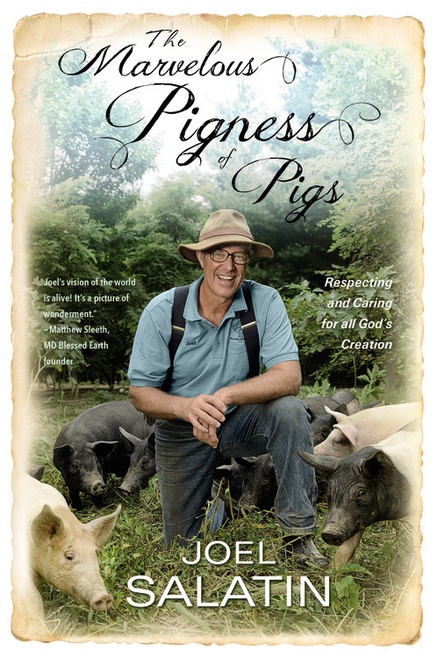
The Marvelous Pigness of Pigs - A Review

God created nature so that it has integrity. Different pieces of creation have purpose according to the way God designed them. These differences are part of God’s design. There is a moral order in the created order that should be honored.

When humans distort the moral order of the created order, it results in evil, suffering, and sin. This is true whether it is the distortion of human reproduction, relational development, or farming practices.

I share this understanding of the moral order of the created order with Joel Salatin, who recently wrote The Marvelous Pigness of Pigs.

Forgiveness Farming

Salatin is a libertarian farmer. He runs Polyface farm, practicing what he calls forgiveness farming. His method of farming entails stewarding his farm, with both crops and animals, in a way that mimics natures patterns and harnesses the processes of nature. Therefore, he eschews monoculture, but instead rotates crops and animals on a regular basis.

Farming for Salatin is about feeding his family while making the world a better place. He is careful to emphasize that maximizing profit by outpacing the ability of his land to replenish itself is not a goal. In fact, it’s exactly the sort of thing that Salatin works to prevent.

Salatin is a somewhat more modernized version of Wendell Berry and Gene Logsdon. He recognizes that the farm should only produce at nature’s pace and that farmers need to take the long view of economic stewardship. At the same time, both Berry and Logsdon are strong proponents of more rustic farming methods. In particular, they both advocate horse farming.

In contrast to Berry and Logsdon, Salatin does not eschew innovation, but he still keeps a close eye on the patterns in nature. Find what makes a pig healthy and allow it those conditions. In this manner, Salatin's perspective on farming is much less romantic and much more realistic than that of Logsdon and Berry. As a result, his vision of farming has a better chance of implementation.

Preaching to the Choir

For those already questioning the factory farm methods, The Marvelous Pigness of Pigs. Even for those who are just skeptical and wondering if there is another way, Salatin presents a case that will seem like common sense.

This volume, however, offers more eloquent argument than compelling data. Those committed to agribusiness will not find The Marvelous Pigness of Pigs very convincing. This is a nice book full of anecdotes, not a scientific argument.

Though Salatin is a farmer, the subtitle of the book seems to indicate the topic of the book includes a broader environmental ethic. It’s certainly present in Salatin’s writing for those equipped to find it. Respecting the integrity of creation is the beginning of a robust Christian environmental ethics. However, the focus of the book quickly slips into Salatin’s wheelhouse: the evils of the factory farm, the benefits of his methods of farming, and the importance of good quality food.

Some Points of Weakness

Overall, the book is an engaging read. Salatin is nothing if not an interesting writer. There is a theological point in the book that is well worth listening to.

At the same time, this volume falls short of excellence on several important levels. First, Salatin’s writing style is raw. In trying to make the book entertaining he significantly overwrites in places. There are exaggerations, sandbags, and linguistic flourishes that would have made good blog posts, but make reading several hundred pages tedious. Good editors should have assisted Salatin in writing better. Toward the end of the book, Salatin repeats himself a lot. Statistically speaking, most people don’t finish books. However, those of us who do finish books like to find original content at the end, too.

Second, the book is theologically anemic. There is no doubt Salatin is an engaged and faithful Christian. However, the book lacks awareness of basic doctrinal teaching. Salatin has familiarity with Scripture, but his repeated misuse of texts to make points is grating. In many cases Salatin makes a sound, biblical point, but uses an unrelated proof text to support it. Additionally, the translation of Bible quotes seems to have been selected for words that match his point, rather than faithfulness to the text and context of Scripture. These are the sorts of weaknesses I expect to find in independent blogs on the internet or self-published e-books, not in books from established publishing houses.

Third, the thesis of the book undermines a holistic environmental ethics. According to Salatin, “The thesis of this book is simple: all of God’s creation, the physical world, is an object lesson of spiritual truth.” (pg. xiv) This sort of matter-spirit dualism is the cause of much of the heartbreaking failure of many fundamentalist and evangelical Christians to engage in environmental ethics. The physical world is not merely an object lesson for spiritual truth. It is not even mainly an object lesson for spiritual truth. The basis for a Christian environmental ethics must include the inherent value of the present creation. Minimizing that value by describing God’s creation as a mere object lesson does not provide the best or most biblically faithful foundation for Christian environmentalism.

Some Points of Strength

Despite these critiques, Salatin should be applauded for engaging in a discussion of environmental ethics from a conservative Christian perspective. As my own doctoral research has shown, there is too little positive engagement by conservative Christians on the topic. As a Bob Jones University graduate (and previous alumni of the year), Salatin may help some Christians who have written off environmental concern as “earth worship” see that there is value in caring for the environment.

I also celebrate Salatin’s continued efforts to recognize the unnecessary suffering of animals that occurs in some modern factory farms. In particular, Salatin’s call to utilize the market to entice meat producers to change their methods is a healthy approach. If people begin to demand meat from animals whose God-given value is recognized during their lives and in their deaths, then some unjust practices can be eliminated without the inevitable secondary consequences of additional governmental regulations.

Conclusion

There is much to be praised in this book. Salatin does well to show that one can be an orthodox Christian, committed to the fundamentals of the faith, and still be concerned with proper, loving stewardship of creation. However, there were significant opportunities for a more theologically robust case for creation care in this text. Salatin failed to take them. The book is only moderately successful as a result.

Note: I received a gratis copy of this volume from the publisher with no expectation of a positive review.

Faith, Hope, and Love

The theological virtues are faith, hope, and love. This trio of attributes, drawn from the very pages of Scripture form the rubric of Augustine’s famous On Christian Doctrine. They are the backbone of a hermeneutical method, which is designed to help people read Scripture more faithfully.

In 1 Corinthians 13:13, Paul writes, “So now faith, hope, and love abide, these three; but the greatest of these is love.”

http://ow.ly/izBE3033jed

http://ow.ly/izBE3033jed

What can he mean? If these three virtues describe the goal of the Christian life, then how can one really be greater than the others?

I believe the answer is that the love is the only one of the three virtues that we will still live out in the new heavens and the new earth.

The point could be made from other texts, but there are two places that limit faith and hope to the present life.

Faith

The author of Hebrews writes, “Now faith is the assurance of things hoped for, the conviction of things not seen.” (Heb 11:1)

There are a number of important conclusions that could be drawn from Hebrews 11, but one of them is that faith is something for this present life. It’s not that we won’t have conviction in the new heavens and the new earth, it’s that we will see the very object of our faith.

Once we see the glory of God in person in heaven, then we won’t have to rely on faith to sustain us. That which we know is real, but believe will no longer be believed, but known.

That isn’t to say that we don’t have confidence in God’s attributes now, but that the nagging doubts we experience and the obscurity of our understanding will be eliminated when we see Christ face to face. It’s a glorious picture of a wonderful day. But is a day when faith, as we know it now, will be no more.

Hope

In a famous passage discussing the renewal of creation that will come when Christ comes again, Paul writes, “Now hope that is seen is not hope. For who hopes for what he sees? But if we hope for what we do not see, we wait for it with patience.” (Rom 8:24-25)

Following much the same logic, hope is an important virtue that Christians should work to develop. It isn’t an ultimate virtue, though, because it will pass away. We hope for what we do not see. We hope for Christ’s soon return. We eagerly and confidently expect it, but we do not see or have it. That is hope.

Once creation is renewed, we won’t need to have hope anymore. That is because the very thing we hope for will have happened. Sin will be eliminated. We will be glorified in Christ. God will be glorified in us. Everything will be right in the world.

At that point in the space-time continuum, we won’t need hope anymore. It will be an artifact of our earthly past.

Love

The greatest of the theological virtues is love. Paul tells us that clearly, and the transience of faith and hope help explain the supremacy of love.

There is, however, another explanation. 1 John 4:8 tells us that “God is love.”

Certainly God is more than simply love. However, the identification of God with one of the theological virtues shows us that love is both permanent and supreme among the three theological virtues.

Conclusion

So what does this mean? Are we supposed to focus on love and neglect faith and hope?

That can’t be, since we see that grace comes through faith, which is a gift of God. (Eph 2:8). We are also called to be ready to give a reason for the hope that is within us (1 Peter 3:15).

No, we’re to pursue all three, but the permanence of love helps to remind us that this world isn’t all there is to life. Good theology is important, but someday there won’t be arguments about theology because we’ll get to meet God himself face to face. 

Pursue all three, but understand that God is the perfect embodiment of the one that matters most and will last forever. It’s not our works, it’s his gifting and glory that matters.

A Place for Christian Creeds

During times of cultural acceptance, Christianity in the United States has grown in many directions, some of which are not healthy. Setting aside the heretical movements of Christianity, like the prosperity gospel, which should be rightly be anathematized, there has been a growing movement toward fragmentation.

Denominations have divided. Often this has been for good cause, as when revisionist tendencies have denatured the gospel by rejecting the clear content of Scripture. However, there have been other cases where new denominations and congregations have been formed over non-essential doctrines or mere stylistic preferences.

As orthodox Christian ethics are more consistently and violently rejected in contemporary society, the resident alien church will need to form coalitions more broadly than in recent years. Congregations that refuse to revise doctrines for the spirit of the age will likely face greater punitive forces in society, which will require consolidation of small congregations.

If this scenario unfolds, a central point of contact will need to be established. One possible point of contact for broader Christian coalitions is the traditional Christian creeds.

No Creed but the Bible

Earlier in my life, I embraced the idea that creeds were an unhealthy addition to the Christian tradition.

I found myself fond of the idea, “No creed but the Bible.” This happens to be a refrain that was uttered explicitly by Alexander Campbell, whose primitivist Christian movement has done some good, but has sown a great deal of confusion by reviving the idea of baptismal regeneration.

As I’ve studied Church History and Historical Theology, I’ve realized that those that argue for no creed but the Bible often end up in heresy. If not them, then their followers have significantly modified Christian doctrines through spurious interpretation.

It’s taken years, but I’ve come around to an appreciation of the creeds. They have a place in grounding contemporary Christians in the great tradition.

The Authority of Scripture

Part of my rejection of the Apostles’ Creed, when I was first exposed to it, was due to the phrase describing Christ’s decent into hell. 

Used by CC license from: http://ow.ly/NzHt302yzkO

Used by CC license from: http://ow.ly/NzHt302yzkO

When I tried to reconcile that passage with Scripture, I simply couldn’t. There might be themes that resonate somewhat with a descent into hell, but there was an insufficient connection between that firm theological statement and Scripture. As a result, my primitivist leanings were validated, and I ignored creeds for another decade.

As it turns out, there is a convincing case to be made for a textual variant in the Apostles’ Creed. It should read that Christ descended to the dead, which is clearly a biblical concept. In this case, textual criticism saves the day. A bad text only cost me a decade of being more strongly connected with traditional Christianity.

My instincts were right. Scripture is the ultimate authority, but when the creeds are rightly presented, they connect us to the theologians who were wrestling with the Bible in light of the controversies of their day. The creeds help me to interpret Scripture rightly to avoid the heresies that drove the creation of the creedal statements in the first place.

Creeds do no replace the authority of Scripture, they help ensure continuity of interpretation of Scripture.

Are the Creeds Enough?

The traditional, ecumenical creeds of the church are documents that reflect the time in which they were written. This is evident as the Christology in the various creeds becomes more complex over time, because the Church was responding to new attacks on a biblical view of Christ.

As a result, the creeds for a common center around which we can worship, but they can’t be used as final guidelines for the extent of Christian doctrine. In other words, they do a great deal to ensure that everyone is worshipping the same God, but there are a whole lot of errors they don’t prevent.

The contemporary church must go beyond the creeds. Even the early church did. For example, the prohibition against abortion was universally accepted in the early church, but since it was not contested within the church, it didn’t need an article in the creeds. Refusing to participate in abortion was also a product of discipleship, which is the result of proper belief in who God is, so it wasn’t necessary to affirm such an obvious ethical claim immediately after conversion.

Although the creeds are not complete, we should consider how we can anchor our worship in the creedal tradition. They provide a strong, common center around which community can be constructed. A creedal center allows others who differ from the majority of the congregation to worship together, even when differing on important secondary matters.

Conclusion

No one knows what the future holds. It may be that the present rumblings in opposition to the free exercise of religion come to nothing.

However, it may be that a crisis due to political machinations can unite faithful Christians around the central doctrines of the church and creeds can help form a common foundation.