
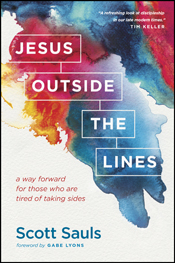
Jesus Outside the Lines - A Review
There are few things more wearying than the ongoing culture wars. Social media, traditional media formats, office conversations, and familial relationships are continually stretched and stressed by one of the many cultural crises that arises with what seems increasing frequency.
More significant for the Christian, however, is the impact that cultural conflict has on the ability to clearly relate the gospel to the lost. Sometimes the gospel gets upstaged by the latest bill in Congress or the most recent violent crime to hit the news.
Resisting cultural changes made in the name of “progress” that are bad for both the individual and common good is, at times, a necessary thing. I applaud the many men and women at front line organizations whose task it is to make an argument for the common good publicly. However, social media has tended to make every Christian a citizen soldier in the battle, or at least to allow every individual to feel as if they are engaged in the battle by sharing posts, making comments, and having lunchroom debates.
Eventually the flood of information and the urge to see one set of ideas triumph over another tends to bleed over into a desire to see one group of people triumph over another. It makes the division between factions deeper and communication of any ideas––including the gospel––exceedingly difficult.
Summary
Scott Sauls’ recent book, Jesus Outside the Lines: A Way Forward for Those Who are Tired of Taking Sides, is intended to mitigate the trend in polarization and move toward gospel reconciliation. As such, this book represents the beginning of a deep conversation that needs to happen in the gospel community whose ideas are increasingly demonized.
Sauls spends the first four chapters discussing the problem of Christian tribalism. He points out the sharp divide between Republican and Democrat Christians, such that sometimes there is an assumption made by political stickers of ones’ status inside or outside the family of God. Sauls then moves to discuss how differing views on some of the more polarizing issues can be maintained: concern for the unborn vs. concern for the poor; participation in Christian communities vs. personal, individualized faith; and the tendency toward loathing vs. loving money.
This section is challenging and thought provoking. I can’t say that I agree with all of Sauls’s conclusions, though I must say that this is in part because of the strength with which I hold my own positions on these issues. However, Sauls does try to show how someone can believe they are a faithful Christian and stand on either side of some of these issues. The benefit of this section is in driving the reader to consider how others might think, which is a first step toward communication.
The remaining six chapters focus on divisions between Christians and non-Christians. In some ways this is an easier task than accepting the strong differences of opinion between Christians. However, it is by no means simple. Sauls gives his thoughts on several aspects of this division.
Recognizing the power of positive words for building relationships, Sauls commends the practice of affirming points of agreement with non-Christians. This is a good start as there is often more common ground than we acknowledge and beginning with points of critique tends to build walls rather than tear them down. Relating to this, Sauls then touches on the importance of leading with compassion instead of judgment. He is not calling for compromise or ignoring gospel ethics, but realizing that sanctification must follow (not precede) conversion.
Sauls continues the section discussing various apologetic concerns that are commonly raised as accusations against Christianity. For instance, the need to continually progress in sanctification, while resisting the accusations by non-Christians of hypocrisy within in the church that is a sign of the need for growth in godliness not a false belief. Christians must also focus on rightly ordering sexuality rather than merely resisting certain forms of sexual expression. The Christian sexual ethic is focused on purity at all times, not banishing the favorite sins of the day. Similarly, Sauls touches on the reality that Christianity has a valid response for the problem of evil, looking forward to ultimate judgment and restoration in the eschaton. Finally, the need to find self-worth in Christ is addressed, which frees Christians to be properly oriented gospel-people.
The book concludes with some practical instructions for living outside the lines, including a list of ten significant practices for living as a Christian in a post-Christian culture. It has a great deal to do with patient faithfulness and compassion overcoming the urge to declaim and decry.
Analysis
This book is not the final word on any of the topics it discusses. It is, however, an important entry into the discussion.
As an ethicist who has studied arguments on both sides of many of the issues Sauls addresses, I have positions that are on one side or the other. That is unlikely to change, and really, Sauls is not asking for that to change. This is not a call to compromise on right belief.
Instead this is a call to live faithfully in a culture that does not share many of those beliefs and to learn to engage the culture with the gospel. After all, eternity hangs on the truthfulness of the gospel, not the extent the government subsidizes school lunch programs. As the divisions between positions seems to grow more severe, Sauls has some helpful suggestions for learning to be Christian in a changing world.
The potential weakness of the volume is that it does not convey fully the difficulty in living this program out. It requires giving space to bad ideas, some of which are truly harmful. It requires being exceedingly patient with destructive activities and having a willingness to help people through the consequences of their own choices, which are often completely avoidable. These things are relatively easy to consider in print, but are much more difficult to enact in real life. It requires a great deal of mental and spiritual preparation. There is a high cost which must be counted to live as Sauls recommends.
All in all, this is a worthy volume at a time when it is needed. It encourages neither triumphalism nor defeatism, but faithful participation in the world. It seems, however, that something like what Sauls recommends will be necessary if the church is to have an impact in the United States in the coming decades.
Note: A gratis copy of this volume was provided by the publisher with no expectation of a positive review.


There’s no reason to doubt that Jesus was nailed to the cross. Ultimately, I trust what Scripture says about Jesus’s crucifixion because I also trust what it says about his resurrection. And that’s what we should be celebrating this week.