A Community Environmental Project

A few weeks ago, I found myself standing with my son, thigh deep in the River Raisin. I had given up keeping my feet dry when the water had gushed over the top of my rubber boot during my struggle to get the used tire out of the muck of the river bed. I held my phone and wallet above my head to ensure a sudden dip beneath my feet did not entail a premature replacement of my iPhone 5. It was a fun day, a productive day, and a day that is symbolically more significant than the moderate sized pile of trash the group piled onto the bank.

The River Raisin runs through the small city of Monroe, MI, where I live. In the mania of damming during the Works Progress Administration’s existence, a number of small dams were put up across it. Throughout the years of growth of population and industry along the river’s banks, the waterway has been polluted by PCBs and other harmful chemicals. In human memory, the pristine, healthy condition of this river is a vague memory.

As prosperity increases, though, people begin to pay more attention to the flourishing of the world around them. Residents whose property borders the river become more vocal about the woeful condition of the natural resource we all share. This has led to the River Raisin Legacy Project and an annual cleanup day.

Environmentalism and Localism

At its worst, environmentalism leads to the centralization of government authority. To solve localized problems, sweeping national regulations are enforced that can unnecessarily harm property owners and even lead to environmentally negative outcomes. Some level of regulation is necessary so that polluting corporations cannot raise to the poorest locality, desperate to have any industry, to spew poison into the water and air. The destruction of acid rain and its eventual abatement in the past century is a test case for the benefits and necessity of regulation. In some cases, that success and the simplicity of imposing regulations at the highest level, have led to attempts to nationalize more environmental rule making.

At its best, environmentalism is a local endeavor. Cities with polluted waterways work to eliminate the hazards. Zoning ordinances require that corporations replace wetlands they pave over. Communities gather on a Saturday morning to fish tires, cups, and chunks of metal out of the river.

The River Raisin Cleanup Project is just that sort of local effort. Though it boasted a relatively small contingent––just 60 people from a population of over 20,000––it is the sort of project that is necessary if we are to see real change in our communities and the environment.

Community Catechesis

Several hours into picking up other people’s trash, one begins to wonder what sort of person throws a Styrofoam cup out their car window. This is the first step in teaching our children that the world is not simply a giant landfill ready to receive their waste.

The reporter from the local newspaper chats with people, joking about the various items recovered from the shallow river bed. She congratulates me on winning my battle with the truck tire, which left me wet and muddy, but triumphant.

People from around the community gather together to hear the instructions about what to pick up and where to put it. We divide into groups with complete strangers, transient teams thrown together with a common purpose. A local man––a stranger––asks about my shirt, which bears the word “Shawnee.” A city of my former residence was named after a tribe of Native Americans. They were residents of this region of the world until they were forcibly relocated to Oklahoma. These conversations chisel away at the barriers we build between ourselves and the community.

After a few hours of wading in the water, a delightful way to spend a warm, cloudy morning, we gather again to share pizza under a picnic shelter. Eating together is a humanizing activity.

With a common focus, there are no arguments about red or blue politics. Unlike the awkward avoidance of a large family gathering there were no sidelong glances or barbered side comments. Instead, since everyone had the common goal of doing discernible good in our community, we were able to do a great deal in a short time and make a visible, positive impact.

Localism Against Tribalism

National political debates have consequences, but they are not everything. By allowing the vitriol of the life and death struggle for power in Washington, DC to take over our lives, we have abandoned the real power of American society.

Over pizza from a local restaurant, we are unlikely to solve the opioid crisis in West Virginia, but a handful of teens that wandered in from the rundown neighborhood next to the park, looking for something to do on a Saturday morning, may make a connection that provides a future opportunity. In a smallish city, it is likely the people gathered on the river bank will see one another at the YMCA, in the store, or at a local festival. Even small connections increase the humanization of the world.

Getting wet and dirty for the local river is much more powerful in teaching the importance of recycling and reducing consumption than a thousand public service commercials. It also costs a whole lot less.

Although some problems require national solutions, much of what ails our nation will not be solved by a federal election. The ability to live and let live, or, better yet, to live and help flourish, can only be nourished through close personal contact. This is the very sort of contact that my introversion, contemporary media, and our community planning are designed to eliminate.

The River Raisin cleanup project happened. It will likely happen again next year. It alone won’t solve the larger problems of climate destabilization or world hunger, but it points us in the right direction and helps to strengthen the fabric of community needed for authentic human flourishing.

The Witness of the Cognitively Impaired - A Review of "Living Gently in a Violent World"

All societies struggle with establishing a place for those who live with some form of physical or mental disability. Although we have not arrived, the modern developed world has made great strides in ensuring reasonable accommodations for those with physical disabilities. Despite some accounts of abuses of the ADA, in general, the move toward finding ways to more fully enable the participation of physically disabled persons in society is a good thing. We have struggled to a greater degree with finding a place for those with cognitive disabilities.

(Before moving on, I should note that I am using the word “disability” in a non-pejorative sense. Rather than attempting to establish some euphemism for a physical or cognitive difference from the majority of the population, I am simply indicating that there are individuals who, due to nature or accident, have different capabilities in one particular area that impact their ability to maneuver our society as easily as others. That there are such differences and that they make life more difficult for those who have them is not disputable. Often creative naming conventions appear to hinder rather than help the conversation.)

3496.jpg

It is the cognitively disabled who are often least to be integrated into society, and those with both cognitive and physical disabilities who struggle the most. As a result of these disabilities many of these people are often sidelined, discarded, and viewed as problems to be solved rather than people to be loved.

In this, our modern, civilized, and inclusive culture is very little different than any other, despite our prideful belief in advancement. This was reinforced to me recently at a community event out of doors. People were lining the sidewalk to watch a parade of WWII era vehicles and reenactors. Much of the best space was covered several tiers deep, with people sitting on the curb, and a second or third row seated behind.

My family arrived after the initial rush and found one section of the curb unoccupied. The reason quickly became obvious because seated in their wheelchairs and camping chairs along the back of the sidewalk were the residents of a group home, likely the local ARC (which once stood for the Association of Retarded Citizens until “retarded” became an epithet rather than a euphemism). These adults made gross noises, talked at the wrong times, and were otherwise disruptive of polite norms. This meant that the curb in front of them was empty, until we sat down. For many, to be sure, the space was left out of consideration to not interfere with any care the group might need. For others, I wonder if the unwillingness to sit in front was not due to a certain level of disgust with these people and a sub-conscious discomfort at these “misfits.” This second hypothesis is reflective of the generally lower value society often places on those with disabilities, especially cognitive impairments.

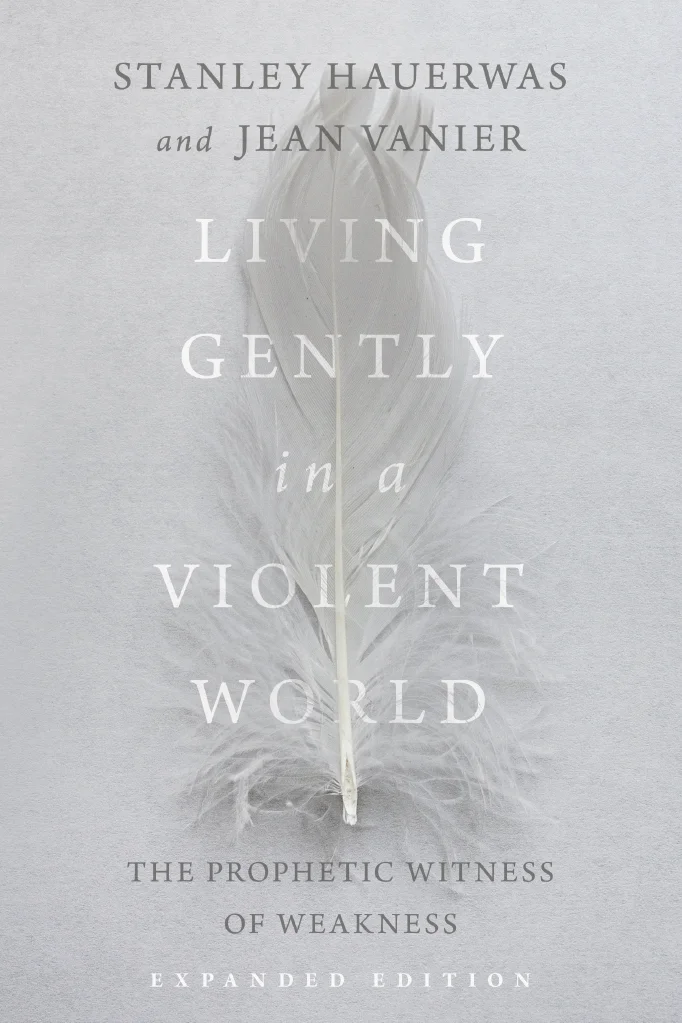
In a recently revised book, Living Gently in a Violent World: The Prophetic Witness of Weakness, Stanley Hauerwas and Jean Vanier use the L’Arche communities, founded by Vanier, as an example of honoring the humanity of all persons, including those with cognitive disabilities. The book is worthy of reading, as it is a brief, but potent example of a better way to conceive of care for some of the least valued persons in our society.

Summary

The book is very short. It has only four chapters, book ended by an introduction and conclusion authored by John Swinton. The expanded edition also includes a study guide, with chapter by chapter questions for review.

Two of the chapters were authored by Vanier and two by Hauerwas. Vanier’s chapters deal with practical and personal accounts of life within L’Arche. These accounts, though theologically muddled, demonstrate Vanier’s real and significant concern for the citizens of our world least likely to be valued. The vision he provides of people with cognitive disabilities being treated as humans, with personalities and flaws like the rest of us, is compelling. Instead of hiding the mentally disabled from view and treating them like patients, L’Arche communities involve co-living with “normal” people who interact with them as neighbors rather than as clients. This process both recognizes the unique needs of these individuals and their distinct value as humans.

Hauerwas’s chapters are more theoretical in nature. As is usual for Hauerwas, they are eminently readable, often very pointed, and sometimes powerfully prophetic. The theological vision presented in this book is an application of his broader pacific ethic, an exposition, if you will, on the structure he outlines in books like The Peaceable Kingdom. The degree to which one finds the whole structure of Hauerwas’s ethics convincing will reflect the degree to which one accepts his theological reflections in this volume. He deals with some of the same obvious inconsistencies in this book as in all his works: e.g., writing about ecclesiology while remaining distant from the authority of a church, and, in this book, writing about gentleness with a somewhat aggressive polemic. This is vintage Hauerwas, both prophetic and conflicted in nature, but distinctly worthy of parsing.

The most significant point of this volume, which is a powerful one, is that among its many ethical concerns, the Christian church must remember the cognitively disabled. Caring for them is a reflection of the church’s gospel witness in the world. Because the cognitively disabled can often contribute very little to society in terms of economic productivity, they are often sidelined and hidden from sight. To some degree, this is necessary to shield them from becoming spectacles and ensuring they receive appropriate care. However, the treatment is often as bad as the condition, resulting in ostracization and isolation that denies the imago Dei in the mentally disabled––as if the primary, and perhaps sole, way that we image God is through rational capability (i.e., functional) rather than in our unmeasurable personhood (i.e., ontological). Hauerwas and Vanier draw attention to the insufficiency of this perspective and the need for deeper theological reflection and practical action for the good of Christian communities and the gospel witness of the universal church.

Conclusion

This book is a short, helpful reminder of a potential blind spot in the application of the gospel. Because we have removed the mentally disabled from view, we often forget about them. Organizations like L’Arche and Shepherds ministry are doing good work in seeking to emphasize the humanity of people with cognitive impairments. Not all of us are called to live in those communities, but all of us would do well to ponder how we have unconsciously adopted an instrumental, functional view of the value of humanity, which is reflected by our revulsion at, discomfort with, or simple desire to avoid the presence of those whose minds lack the agility with which we have been unreasonably blessed.

Note: I received a gratis copy of this volume from the publisher with no expectation of a positive review.

Why We Need Religion - A Review

Some atheists move beyond their objections to religion to a form of frothy mouthed rage that anyone dare believe in something beyond what can be measured, analyzed, and peer reviewed. Famously, Richard Dawkins has asserted that parents teaching their children Christian doctrine is a form of child abuse. And, of course, there are meanspirited gadflies like those in the Freedom From Religion organization who like to attack people engaged in public service for having faith that is not hidden from view. Such antipathy is not universal. Some atheists are more benign. However, there is enough anti-religious emotion among the supposed rationalists that the militant fundamentalist accusations about an “atheist agenda,” etc., etc., are not entirely unfounded (just overblown).

In contrast to such overt hostility, Stephen T. Asma, professor of Philosophy at Columbia College, Chicago, and confirmed atheist, has written a book to argue that maybe religion isn’t quite so bad and doesn’t deserve violent eradication just yet. Accordingly, he offers an intriguing purpose in his recent volume, Why We Need Religion. He writes, “I will endeavor a charitable interpretation of the believer and religion, one that couches such conviction in the universal emotional life that connects us all.” (14)

Summary

The general point of Asma’s book is that scientism is best, but religion helps people feel good, so it should be tolerated by those who know better. While ensuring the reader never doubts his atheistic bona fides, Asma sorts through sociological data that he argues point to the necessity of some form of religion as a “cultural analgesic.”

Asma finds multiple benefits of religion, which he argues are reasons that society should not seek to destroy religion and ridicule believers. In chapter length treatments, Asma argues that religion in general, especially those with a belief in an afterlife, help people navigate sorrow due to death and even personal fear of death. Such myths keep some people from despair, so there is no reason not to allow that beneficial belief.

whyneedreligion.jpg

For some, religion enables the ability to forgive. The belief that there will be justice meted out gives people resources not to seek immediate, personal vengeance. Similarly, a belief in a higher power can help people have mental strength leading to internal peace, resilience, and the ability to sacrifice for others.

Religion also enables people to find communal joy, to channel sexual energy, and engage in forms of imaginative play. These aspects of religion, according to Asma, have evolved in ways that differentiate us from some of the lower animals and help us get by as a society. At other points, religion proves useful in helping people control their fear and anger.

Analysis

Given his assumptions, the argument is reasonable throughout, but the general point is that religion—at least some level of religion—is acceptable because it has socially and evolutionarily beneficial fruit. Thus, even if it is not actively encouraged, certain types of religion should be deemed acceptable, as long as it sufficiently agrees with the moral consensus of society and encourages behaviors approved by enough people. For example, religion that fosters contemporary forms of functional egalitarianism, pursuit of approved economic and social outcomes, and controls unsocial emotional outbursts should be accepted.

At a most basic level, it is nice to have an atheist write something that does not curse every believer for their foolishness and vehemently denigrate their existence for not aligning their faith commitments to those of radical empiricism. Asma’s book shows that the conversation between religion and radical empiricism need not be an out and out street fight at all times, especially if one accepts a version of religion that is palatable for skeptics.

Ironically, though he is an atheist, Asma makes many of the same arguments for religion in general that some versions of Christianity (the religion with which I am most familiar) make. Religion can help you live your best life now. Believing can make you a better citizen. Your kids won’t misbehave as much if you keep them in church. You can have inner peace if you will just believe. There’s no need to fear death if you’ll just pray this prayer. The list can go on and on. This observation shows the paucity of much teaching among Christians of varying stripes. I have heard similar pitches presented as “evangelism” before, and sometimes they succeed in getting people to participate in activities with Christians for a while. There is a pointed lesson here, for those whose faith would be acceptable to an atheist.

The acceptable religion Asma hopes for is the one that nods toward doing good deeds from time to time, talks about miracles as fiction that points to a higher moral, and moves aside traditional doctrines that interfere with the current popular polls. In Christian circles, Asma’s preferred forms of religion align very well with the stated doctrines of many mainline Protestant denominations and lived faith of many Evangelical and Roman Catholic adherents. Lukewarm is the hottest the faucet should go, lest it lead to a failure to go with the flow. Coexist bumper stickers are the main sign of approved faith, rather than rosaries, crucifixes, or fish stickers. Bland is the religion that is properly admissible by the Zeitgeist.

Asma’s arguments also reveal there is no point at which the attempt of liberal Christianity to create a truly minimalist faith will ever really be acceptable in society. As the moral winds shift and the polling changes, there will always be a new doctrine considered anti-social and require abandonment. Whatever vestiges of truth and odor of gospel efficacy is left in an acceptable version of Christianity won’t have much power to save, if any at all in a few years. In other words, Asma reveals that seeking praise from atheists isn’t a worthy endeavor because nothing but utter capitulation will ever be applauded, so those who claim to be orthodox and faithful should focus on doing justice, loving mercy, and walking humbly with our God as we believe and proclaim a rigorous, full-throated, gospel-saturated doctrine.

For faithful, orthodox Christian readers, the best use of this book is to see in it an affirmation of some of the things that we know to be true, though Asma denies the basis. Faith in Christ and the power of the Holy Spirit can help make us better citizens, to the degree that society maintains a true sense of the common good. Basically, Asma is arguing that we aren’t (always) the moral equivalent of child abusers and sometimes actually do good things, which is better than the alternative.

In the end, this is a book that was not written to people who really believe what they claim to believe, whether they are Christian, Mormon, Buddhist, or whatever. This is a book that, despite claiming to offer an olive branch, oozes condescension on nearly every page. It’s a patronizing pat on the head from the person who pretended to listen while you speak to them and then lets you know he was ignoring everything you said by his smug smile and dismissive comment. Most probably, though, the target audience for this book is not people who actually believe and practice their faith, it is the mushy middle and the militant atheist.

One possible positive outcome is that some from the mushy middle may encounter the gospel if they wander into a faithful Christian church on some Sunday morning to find the inner peace Asma highlights; may Asma’s work bear such fruit.

On the other hand, this is a book that may be helpful if it has the socially beneficial result of tempering the fundamentalist zealotry of a few atheists. On that basis, I think that it makes a valuable contribution to the conversation of the relationship between religion and society.

NOTE: I received a gratis copy of this volume with no expectation of a positive review.

On a Vacation Rest

IMG_2290.JPG

I was on vacation with my family recently and I witnessed the amazing inefficiency of a state park in New York. Sitting on 65,000 acres in Western New York, Allegany State Park has a lot of standing timber that could be cut for building and rich soil in valleys that could be put to work growing crops. All of that land sitting idle, with only a few cabins and camping sites for the odd tourist.

It was beautiful to see that inefficiency. The politicians who set aside a large swath of land did a good thing.

There’s nothing wrong with putting land to work for the benefit of humans. God gave us the right to use the land, but at the same time we were given the responsibility to care for it well (Gen 2:15). Sometimes, however, the purpose of the created order is to point our minds toward the Creator (Psalm 19:1-4).

There is something majestic about a seeing hillsides covered with trees in an unbroken field of green. It reminded me that the world isn’t all about sidewalks and subdivisions.

Parks are a reminder of the principle of Sabbath. Rest. Beauty. Delight. These are the sorts of things that land set aside for recreation or simply for preservation can remind us of.

In the end, our lives are not ultimately measured by our productivity, but by how we delight God.

Is the Sabbath Normative?

This post is the second part of a discussion on whether Jesus actually broke the Old Testament Law by healing on the Sabbath. This question was raised in an online argument, which is largely irrelevant to history, but which gives opportunity for worthwhile consideration of the nature of Law, the person of Christ, and, in particular, the place of Sabbath in the life of the contemporary believer.

To recap, the previous post argues that Jesus did not sin, that he did heal on the Sabbath, that this was disliked by religious leaders of his day, and that the OT Law has three divisions: civil, ceremonial, and moral.

Is the Sabbath in Play?

If the Decalogue is still morally normative, then the practice of Sabbath is still in play. The question, then, is how to practice the Sabbath in our contemporary context.

One school of thought believes that Sabbath is still necessary, but that the principle was fulfilled in Christ, so that Sabbath for Christians is a spiritual rest in Christ. This is a biblical concept, seen clearly in Hebrews 4. In particular, verses 9 and 10 declare, “So then, there remains a Sabbath rest for the people of God, for whoever has entered God’s rest has also rested from his works as God did from his.” Some who hold this view believe that the day of rest in the Sabbath was fulfilled in Christ, and therefore spiritualize present application. Although he does not argue for only a spiritualization of the Sabbath, J. D. Greear provides a helpful explanation of the fulfillment of the Sabbath in Christ in this blog.

There are some people, like Seventh Day Adventists, who take a literalist approach to Sabbath and have their worship services on Saturday. This is a consistent application, but it isn’t clear that such a literal approach is necessary. In fact, if we accept the tripartite division of the law described above, then it would seem that some of the particulars of the practice of Sabbath fall into the categories of civil and ceremonial, instead of moral law.

A third category, including much of the Reformed tradition, believe that the Sabbath is still in play and that we fulfill it largely through rest on Sunday, as a Christianized analogy of the Old Testament practices. This is witnessed in the history of the United States through the various Blue Laws. A famous example of this method of practicing Sabbath is found in Eric Liddell’s refusal to run a race on Sunday.

Synthesis

All of these three methods of applying the Sabbath have something to contribute to a robust practice of Sabbath for contemporary Christians. The literalist approach affirms the truthfulness of God’s word. Though we may argue about the actual practice, which deviates from traditional Christian practice and misses the significance of the Sunday resurrection, we can respect the importance of following God’s law.

The spiritual fulfillment is a valuable perspective for Christians because it is true. The practice of Sabbath was intended, in part, to point forward to the future rest that we will enter into by Christ’s blood, when the whole cosmos is redeemed and the toil from the curse (Gen 3:17-19) has been removed. At that time, though we will still work, we will have been glorified, creation will have been renewed, (Romans 8:18-25) and we will enter into the ultimate Sabbath rest. It remains to see whether that spiritual fulfillment eliminates any present practice of the principle of Sabbath.

The third approach, which entails the rigorous of customs adapted to contemporary contexts is good because it highlights the importance of rest, encourages corporate worship, and is an earnest attempt to honor God. At the same time, such an approach runs afoul of Christ’s own interpretation and risks becoming a burden to the people it is intended to help.

A fourth approach to the Sabbath argues, which I have not introduced before, treats the whole of the Old Testament as edifying, but believes that all forms of the Law were fulfilled by Christ (Matt 5:17). That argument is worth carrying, but would push this post beyond the current length. I will, however, offer a few simple objectives: first, those who hold this position generally create their own laws (no movies, no pants for women, ties on Sunday) to substitute for the Old Testament Laws, which put them in a worse position; second, this approach has to deal with the odd fact that most of the Decalogue is reaffirmed explicitly in the New Testament; third, this view raises significant questions about the nature of revelation in the Old Testament, specifically with the close connection between Jesus and the Old Testament (Luke 24:27).

A fifth approach to Sabbath argues that the Decalogue is the moral law and is in play, but that the fourth commandment no longer applies because Jesus didn’t practice it in the passages discussed above. This is consistent with how most contemporary Evangelicals treat the Decalogue, whether or not they can formulate that perspective fully. Not lying is good, but Sabbath is unnecessary. This approach is exegetically inconsistent and seems to be argued more for convenience than otherwise.

Practicing Sabbath

Each of the first three interpretations is helpful, but I believe they each fall short for one reason or another. The fourth and fifth interpretations are less helpful, and I believe create more exegetical problems than they solve.

If we accept that the Decalogue is the moral law, and it reflects the immutable character of our Holy God, then we should see that it is still in play. The question is how to apply it.

In Matthew 12:1-14, Jesus shows that practicing Sabbath was not fundamentally about inactivity. Rather, he argues that doing good work is explicitly lawful (v. 12). Note that he does not argue that the law does not apply, but that doing God honoring work on the Sabbath is a moral positive. There is no category for moral neutrality, either an action is sinful or morally praiseworthy.

Instead, the Sabbath is intended to provide a rest from economic activity during the week, which helps to show our trust in God’s goodness and provision. This is consistent with the statement in the Exodus 20:8-11. Jesus’ own interpretation undermines a strictly literalistic understanding of these verses. Also, considering the expositions of the Sabbath, which focus on giving the land a rest in an agrarian context, it seems that the emphasis is more on stopping ceaseless striving than on a particular form of inactivity. For example, in Exodus 23:10-12, Moses specifically records the purpose of Sabbath being for the provision of the poor and the wild beasts, as well as the refreshment of economic actors.

It is no accident that immediately preceding Jesus’ Sabbath healing in Matthew 12, he calls his hearers into his rest:

“Come to me, all you who labor and are heavy laden, and I will give you rest. Take my yoke upon you, and learn from me, for I am gentle and lowly in heart, and you will find rest for your souls. For my yoke is easy, and my burden is light.” (Matt. 11:28-30)

Note that the rest Jesus proposes entails work—the image of a yoke could mean little else. This is not the absence of activity, but the redirection of activity to restorative purposes. This often includes working at rest, but not a legalistic rest, the fulfillment of which entails greater effort than simply continuing to work for economic gain. In one sense, Jesus is calling people into a spiritual Sabbath, since they can rest in the fulfillment of the ceremonial law through his future propitiation. However, it is not clear that Jesus is alleviating any regular practice of literal rest as an expectation of a holy life.

Mark’s Gospel provides a slightly different telling of the Matthew 12 account in the second chapter. In Jesus’ explanation of David and his men eating the showbread, contrary to the ceremonial law, Jesus illuminates that the purpose of Sabbath, when he says: “The Sabbath was made for man, not man for the Sabbath.” (Mk 2:27)

In one sense this is entirely true in a spiritual sense. The spiritual rest of Hebrews 4 is a great blessing for humans. In another sense, however, a non-legalistic practice of Sabbath is needed now more than ever.

Jesus’ explanation of the blessing of Sabbath for humans ties closely to the ideas in Exodus 23:12, which is a refreshing rest from economic activity. If anything, Christ’s fulfillment of the law was designed to bring a greater blessing to the elect. He fulfilled the ceremonial law so that we can trust in his once and for all sacrifice for sin (Cf. Heb 10:1-18). This is a great blessing. But if the practice of Sabbath rest, particularly in the form of resting from economic activity, is intended as a blessing, then we would expect this to be amplified rather than diminished. Therefore, while the civil and ceremonial trappings of the Sabbath may no longer apply, with their limitations to a single day of rest each week, we should look for our rest to be more varied and greater.

A full consideration of the application of Sabbath would take much more space (and would reveal how terrible I am at this myself), but likely it includes a regular pattern of participation in worship, taking vacations, not being perpetually online, carving out time for physical fitness, prioritizing family activity over work, and other active, but redemptive practices. It is still likely to include simply resting and doing quiet activities, or at least activities that are refreshing to our bodies and our souls, and that differ from our daily economic toil.

Did Jesus Violate the OT Law?

4694541516_92d9b7f635_z.jpg

A recent argument online has raised an important question about the relationship of Jesus to the Old Testament Law, and in particular the Sabbath. I’ll leave the background for interested readers to discover, but the main point that piqued my interest was the argument by some that Jesus violated the Old Testament Law when he healed on the Sabbath. (The whole argument is such a mishmash of bad exegesis, heresy, and improper inference from both sides that it isn’t worth diving into.)

The simple answer is “no.” If Jesus had violated the Old Testament Law, then he would have sinned and would not have been our Messiah. We needed a blemishless sacrifice for our own sin, which only Jesus—who is very God and very man—could provide.

Those who are arguing that Jesus violated the Moral Law of the Old Testament are implicitly arguing that Jesus sinned against God. If we accept the account of the author of Hebrews, then we know that Jesus did not sin (Heb 4:15). Or, perhaps, the Paul’s argument toward that same end might encourage us to accept that point (1 Cor 5:21). If one disagrees with the testimony of Scripture and argues that Jesus did, in fact, sin, then the rest of this argument doesn’t matter because the only real authority for theology is that person’s opinion (or whatever other source he/she deems to be, in his/her opinion worthy of the highest authority).

For those of you with me, we’ve established that Jesus did not sin.

However, Jesus did not follow the customs of the people of his day relating to the observation of Sabbath. This was a major point of contention between the religious authorities of the day and him.

Jesus on the Sabbath

For example, Jesus heals a man with a withered hand on the Sabbath in Matt 12:8-14 right after he explains why his disciples’ eating of gleaned grain was not a violation of the Sabbath (vv. 1-8). This made the Pharisees pretty mad, likely because he both undermined their legalistic hegemony (vv. 11-12) and because he implies that he is Messiah (v. 8).

There are other examples, as well.

Significantly, in John 5, Jesus heals a man at the pool of Bethesda on a Saturday. This leads to a full-scale decision to kill him. John is much more explicit about the complaint of the Pharisees: “This is why the Jews were seeking all the more to kill him, because not only was he breaking the Sabbath, but he was even calling God his own Father, making him equal to God.” (v. 18)

This passage is important because it states explicitly that Jesus broke the Sabbath.

At this point, some might think my argument scuttled. If we read absolutely literally, then John says that Jesus broke the Sabbath. Some infer that a) some portions of the OT Law are more important than others, so Jesus didn’t sin by violating a portion of the Law; b) Jesus sinned (see above); c) the Sabbath Law was not in play for Jesus.

Options a) and c) are in play for orthodox Christians, but I don’t think either one is correct.

Although John 5:18 states that Jesus was “breaking the Sabbath,” we can recognize that John is describing the perspective of the Pharisees. When John is speaking from his own perspective he writes that Jesus “was doing these things on the Sabbath” (v. 17). In contrast, the Pharisees see Jesus’ good works as breaking the Sabbath and “making himself equal with God.” (v. 18) Of the four gospel writers, John is the clearest about announcing Jesus’ deity, so there is little question that he is not actually accusing Jesus of violating the Old Testament Law. He was violating the imposed, unbiblical norms of his day, which had been imposed on the Jews by their religious leaders in order to ensure they didn’t violate the real Law.

The Nature of the Law

There is a solid rabbinic tradition of a tripartite division of the Law in the Old Testament. This division has been largely recognized through Church History, though it is certainly not a universally held view.

Generally, the Old Testament Laws tend to be divided into the Civil, the Ceremonial, and the Moral Law. Civil laws tend to be those laws of the Old Testament that focus on the political and social administration of the people of Israel. These include the casuistic limitations on punishments for idolaters, adulterers, slavers, etc. Such laws, like the various property laws, are helpful in understanding the principles of justice, but our building codes do not require a parapet around the roof because it is no longer technologically or culturally necessary and because the nation of Israel, as a theocracy constituted in the Old Testament is no longer extant. Occasionally, actual theonomists arise (not just faithful people seeking justice in society that doesn’t match the worldview of the vogue “secular” culture) that try to enforce parts of the civil law, but it rarely goes far and is inconsistent with the way Christianity has interpreted the use of the OT Law.

The second category of Old Testament Law is the ceremonial law. These are laws related to the worship of the Israelites, including the various offerings, sacrifices, cleansings, and festivals. Even orthodox Jews do not practice this portion of the Law fully, because they have no temple in which to conduct the various sacrifices. For Christians, it is this portion of the Law that we generally understand to have been fulfilled by Christ (cf. Matt 5:17).

The third category of the Law is the moral law. These are contained in the Decalogue, or the Ten Commandments. According to the Reformed tradition, this portion of the Law is still in play for several reasons. First, it is the only portion of the Law that was actually written by God himself. (Ex 31:18) Second, the Decalogue is considered to reflect the character of God. This is the resolution to the famous Euthyphro dilemma of philosophy. God’s Law is good not by declaration of God or by pre-existence morally prior to God, but because it reflects the character of a good God. Third, most of the Ten Commandments are restated in the New Testament explicitly, and the entirety of them seem to be reaffirmed to Christ when he summarizes them in the first and second greatest commandments. (cf. Matt 22:34-40) The first greatest commandment is generally considered to summarize the first tablet of the Decalogue, with the second summarizing the latter portion of the Decalogue. Those who hold this position generally argue that the civil and ceremonial law are temporal and geographically bound applications of the moral law.

There are certainly objections to this approach to the Law, but that is a topic for another day.

Amusing Ourselves to Death - A Review

Neil Postman’s classic book, Amusing Ourselves to Death: Public Discourse in an Age of Show Business, is an assessment of the shifts in Western culture since the advent of modern communication technologies. This is the sort of book that was prophetic in its day and, although somewhat dated, still communicates significant warnings to readers now.

Amusing Ourselves to Death was published in 1985, during the Reagan presidency. It certainly does not escape Postman’s notice that the ascendency of an actor to the highest political office supports his point that entertainment has become the central purpose of American culture, though that fact is more a capstone illustration of the book’s greater point than the central argument of concern.

What Postman notes, however, is worth paying attention to. His central premise is that the medium is the metaphor. This is an intentional deviation from Marshall McLuhan’s famous slogan that the medium is the message.

81hbo2v7eRL.jpg

Postman’s clarification is helpful, since it separates the content of the message from vehicle that carries the message. In other words, the facts of the news are the same (if written well), but the secondary signals created by the means that the news is transmitted also shape the reception of the news.

For example, Postman notes that prior to the invention of the telegraph, most newspapers focused almost exclusively on local news. The telegraph sped up the spread of national and international news, so that information could be had within minutes rather than days or weeks. The change was not wrought overnight, but the shift of concern from local issues to global ones has completely overtaken us today. Notably, it is much easier for me to find out about the personal lives of political leaders across the globe than to find out what the local city council is talking about.

Not only has news changed, but education has changed. Instead of doing the long, hard work of training minds, much of our educational methodology has shifted to entertainment. Postman notes that Sesame Street is a prime example of this, though certainly neither the worst nor the only platform that does this. According to Postman, whatever good is done by teaching through entertainment is undermined as it forms the learning human to expect education to be exciting. Thus, the endurance to learn and slog through difficult tasks has been diminished by the medium that is very effective in achieving short term gains.

It would be easy to claim that Postman was merely clutching at pearls, if the evidence did not point overwhelmingly toward the aggravation of the problems he identifies.

The point is not that technology is bad, but that technology is most effective if it is used in a particular manner. As a result, it is most commonly used in its most suitable manner, which shapes the media consumer in powerful ways. The efficacy of each medium to convey certain parallel signals effortlessly alters people’s epistemologies.

(Epistemology is the study of the way that people know things. Whether or not we know how to spell it, everyone has an epistemology.)

Not only how we acquire information but how we know is shaped by how information is received. Media is forming our minds to perceive in particular manners.

We need look no farther than click-bait internet articles to see that Postman is correct. There are entire companies that feed off of deceptive headlines that declare one thing in their headline and argue something entirely different in the body of the article. Even news sources that are still considered credible have recognized that few people read beyond the headlines and those who do are unlikely to get past the perspective that the headline has already presented, whatever the evidence is that runs to the contrary.

The reshaping of epistemology is radically important, even more so now than it was in 1985. Our elections have been tampered with by agents from other nations who spread misinformation with just enough truth to cast doubt. Our news sources have recognized this, along with the inability to discern opinion from fact in most of the population, and thus they have largely abandoned anything like an attempt at objective reporting because getting their constructed truth out is more important the facts. Additionally, with the wide array of “news” shows of varying degree of accuracy and political leanings available all 168 hours each week, the presentation of information has to be even more entertaining than before. In our current milieu, there appear to be a fair number of people that get their news through comments on social media rather than any legitimate news source (regardless of its bias). So, the cycle continues and the hole gets deeper.

Postman’s warning is an important one. It may even be easier to accept now that a quarter of a century has passed and the challenges have morphed.

Lacking from Postman’s analysis is an answer the for the disease that ails us. He’s standing athwart history yelling “STOP,” but does not provide a solution.

The truth is that there is no easy solution, and that the simplest solution (i.e., turning everything off completely), is unworkable because we and our children would be functionally disconnected from so much of society. However, we have to figure out a way to throttle the flow, learn how to think and exist without electronic devices, and recover some of the humanity that is being eroded with every flicker of our many screens.

Patrick's Corner - A Review

Poverty today is something like leprosy in the Middle Ages. Most of us are aware of it, but we’re uncertain how it is contracted, terrified to come in contact with it, and hope it stays quarantined geographically so that it doesn’t spread.

For many, the concept of deprivation at any level causes them to lobby against “income inequality,” without acknowledging that the removal of natural incentives for productivity that enforcing income equality would need might well destroy the goods of society they wish were shared more equally.

The Silence of the Poor

To many on the political and economic right, poverty is the divine punishment of losers and lazy people. To many on the left, it is the result of defenseless people being taken advantage of (consider that the most common epithet for those in poverty from the left is “the oppressed”). Both are, at various times. Both positions, when seen in the extreme, are also exceedingly condescending. Seeing poor as perpetrator and poor as victim both do a great deal to undermine the fundamental humanness of those in poverty.

One reason why the poor are often dehumanized is that their voices are seldom heard. Unlike those of us with extra resources and time to host blogs, often the poor are more concerned with hustling to survive. When we hear from them, it is often after they have arisen from poverty. In those cases, they have often been assimilated into the political patterns of the right or the left. It is often hard to hear the real human stories of the poor, unless you are in regular contact with people in poverty.

As a result, balanced memoirs like that of Sean Patrick are helpful. In his book, Patrick’s Corner, he documents the humanity of his large family in Cleveland. It’s the story of the survival and flourishing of six boys and their widowed mother in an ethnically Irish neighborhood. It’s a collection of tales that offer a vision into the real poverty of a real family. While it is certain we don’t get the full weight of the struggles of poverty in this memoir, the overall thread is realistic, hopeful, and compelling.

The Story

The story, which is well told in a journalistic style, is a fundamentally human one about a family’s pursuit of survival, goodness, and joy:

The Patricks, left by God as a family with one parent––a matriarch, at that––shortly after the birth of the youngest child, existed in material poverty. They inhabited for many years, a small, two-bedroom apartment in the tenement district of a major northeastern city on the shores of one of the Great Lakes. Their neighborhood, like most neighborhoods of such cities, was identified by nationalities. (11)

Neighborliness and a sense of place is an essential element in this story. Sean Patrick, as we see in the chapters of this volume, benefited from the geographic limitations of his world. He knew and was known by those in his neighborhood, which enhanced the richness and moral formation of his childhood. This sort of limitedness is, in our world, something foreign, and this is much to our detriment:

The compressed neighborhood of Sean’s childhood has given way, through the miracle of modern transportation and technology, to the expanded world of the shopping mall, the computer, and the television set. Sean’s world was bounded by the distance one could comfortably travel on foot or on the city streetcar. (11)

Because the Patrick’s were limited in their travels, the cast of characters in this volume is rich. There are intergenerational connections that can only form through casual sidewalk contact over time. Poor men who invested a dime into the Patricks each week by getting a shoeshine they couldn’t entirely afford. Old men who needed a bit of help from time to time from the Patricks, but in return who gave them love and spiritual concern. This sort of community would be a miracle in our day.

The Goodness of Work

One of the significant themes in these stories is the goodness of work. The Patrick boys were all pressed into work of necessity, because of their economic station. However, that work was not pure drudgery. It was an opportunity for marketplace engagement with the surrounding world. It provided a chance for entrepreneurial growth and imagination. In short, the work the Patricks did enhanced their humanity, it did not detract from it, as some so often depict.

All of us worked almost as soon as we were able. The positions we held were not exactly what one would consider real jobs by today’s standards. But, for us, it was work and we did it with a vengeance. … As each of us reached our two-digit birthdays, we became Associate Breadwinners. We had to if we wanted a little money to jingle in our pocket or to spend at the neighborhood movie theater on Saturday. (13)
download (2).jpg

From shoe shiner to newspaper boy to working in the poultry shop, the Patrick boys progressed through various jobs. These jobs were managed around their studies and their sports. It did not crush their childlike spirits or diminish the goodness of their waking hours.

Unfortunately, so many of these opportunities have been legislated out of existence. For fear of bringing back the oppressive child labor of the early Industrial Revolution, we have largely made it illegal or financially impossible to allow kids to do the sorts of work they are able to meaningfully do. There are many fewer opportunities to be delivery boy or shop assistance because well-meaning laws have prevented the good in attempt to weed out the evil. It has made the path to adulthood much more difficult for children to follow.

One thing is clear, though the author does not state it overtly, and that is the Patrick boy all benefited from the work they did. Not just financially, but also personally.

Conclusion

This is not an academic treatise, but a book that tells stories about poverty, family, faith, and hope through all of the above. The stories are beautifully written, but more importantly, they expose a beauty of experience even amid the struggles of poverty. This book is valuable (certainly much more than its sales numbers likely allowed) because it humanizes poverty, showing that the best forms of poverty alleviation involve personal contact rather than simply writing a check.

Preaching By The Book - A Review

I was impressed with the first volume in the Hobbs College Library from Oklahoma Baptist University when it was published last year. It’s taken me until this Spring to get to the most recent volume in the series, Preaching by the Book: Developing and Delivering Text-Driven Sermons, by R. Scott Pace. The book deserved to be read sooner and deserves to be read widely.

In general, the Hobbs College Library is intended to provide basic resources for students preparing for ministry or men whose entry into ministry preceded their opportunity to get formal education or training. The books are written by highly qualified authors who have spent years teaching university level students; they balance scholarly acumen with a pastoral heart to create helpful resources for the growth and health of the church.

9781462773343.jpg

Pace’s volume is a little over one hundred pages in eight chapters. In Part One, he lays the groundwork for the preaching event, focusing on the nature of Scripture and the importance of properly approaching the text on its own terms. Rather than hunting for a specific text to preach (which often results in sermons that mangle the meaning of the text), Pace urges preachers to survey the text prayerfully in preparation for the study process that comes later.

In Part Two, Pace constructs the framework for the sermon with a chapter on study and interpretation of the text and another of construction of the body of the sermon. Notably, Pace emphasizes that preaching arises out of diligent, joyful study of God’s Word; study is not an onerous duty that must be accomplished because one must preach. This approach to sermon preparation is encouraging. Additionally, the emphasis on using the structure of the passage to drive the construction of the sermon helps keep Scripture at the heart of a given sermon.

In the final section, Part Three, Pace picks up the garnishes to sermons: introductions, illustrations, and invitations. He offers balanced perspectives on both introductions and illustrations, which offer helpful reminders of both the importance of the elements as well as warnings for their potential to overtake the sermon. Pace offers a perspective on invitations consistent with many evangelical Bible belt churches that will work well in that context, avoiding the ditches on that culturally appropriate practice. This chapter will be less helpful for those in other contexts (e.g., many congregations in the Northern half of the US) who would find the practice unduly awkward and disconcerting.

This is a book that puts the cookies down on the bottom shelf. It is concise, clear, and well balanced. The Hobbs Library continues a positive trajectory with this book. I look forward to many further entries into the series of ministry-minded books that are intended to serve the church.

Preaching by the Book should not be the final stop in someone’s preparation for preaching. However, this is the sort of book that would be especially useful in a mentorship program with young men considering vocational or bi-vocational ministry. It would be useful as a text at the undergraduate level in a practical ministry or preaching course. It might even serve as one of several texts in a seminary course. This is the sort of book that is worth reading and sharing with those seeking to improve their skills in the pulpit or determine whether they might be gifted for pulpit ministry.

Note: I received a gratis copy of this volume from the publisher with no expectation of a positive review.