Three Vital Relationships for Every Seminarian

It’s the beginning of another seminary semester. Several hundred new students have enrolled in classes that have started this week and the education of another batch of pastors, missionaries, teachers, and other faithful servants of Christ has begun.

This is always an exciting time on campus. The energy level that the students bring to campus can be sensed as we sing together in chapel, see people in the library, and interact on the walkways.

At the same time, when new members are introduced into a community, there are always periods of adjustment as the new faces (and sometimes the returning ones) try to figure out how to relate to people around them. What does it look like to be a seminary student?

I think there are (at least) three categories that need to be discussed along these lines for beginning students. There are three basic, and new, relationships that an incoming seminary student needs to develop.

What about my relationship with God?

Even though students that come to seminary do so for the purpose of gaining skills and knowledge that are helpful for serving God, one of the first things that gets neglected in the hustle of seminary life is often the vertical relationship with God.

Seminary takes years to complete. It often requires students with families to work full-time and take classes on the side. Or, it requires them to take classes full-time with a part-time job. In addition to that, there are ministry opportunities, the needs of family, and general life situations that pile up.

It is easy for a seminary student to neglect his or her first love--the Triune God.
Therefore, the first advice every seminary student needs to hear every semester is to be a good disciple first and foremost. Everything else must fit into place around that.

Churches need pastors who are personally holy more than professionally competent. Education in languages, biblical studies, theology, and history fill in some of the professional competence. Seminary cannot, however, make a student holier.

Students need to make growing in their relationship with Christ the first priority. Don’t let devotional Bible reading, Scripture memory, and Christian fellowship slip because you have a paper due.

What about my relationship with students?

Seminary can be a time of growth, personally, spiritually, and intellectually.

For many new seminarians, this is the first time they have had real contact with someone who doesn’t share some of the same doctrinal convictions as others. Here at Southeastern we are mostly Baptist, but there are numerous places where there is diversity amongst the faculty and students with regard to interpretation of biblical passages.

Beyond core support for central tenets of orthodoxy and certain aspects of Baptist identity, Southeastern has latitude for faculty and students to nuance a variety of doctrines. Hence, in our classrooms and meetings, there will be five point Calvinists sitting next to three pointers, with a few classical Arminians thrown into the mix. There will be dispensationalist pre-millenials sitting next to amillenial believers engaging in learning God's word.

This is a healthy mix as long as students from any theological persuasion keep a few things in mind.

1.    Outside of basic beliefs central to orthodoxy, there should be room for gracious discussion on topics. Just because “you’ve always heard” does not mean it was ever correct. Students come to seminary to learn something, not just to be reinforced in their existing beliefs in every case. This means that conversations need to be gracious and seasoned with salt.

2.    Other students are people, too. Even the foaming at the mouth egalitarian deserves respect as a person made in the image of God. You will have more success convincing them of your position if you listen and then dialogue rather than blasting their character for believing differently than you. Additionally, it is possible they (like you) haven’t figured everything out and some of the course reading will help to shape their understanding as the program goes on.

3.    Other students paid to hear the professor, not you. While your opinion may be significant to you and your immediate circle of friends, you are a student. This means that class time is not the opportunity for you to lecture your fellow students (or the professor) on the book you happened to have read or the sermon series your pastor preached once upon a time. Respect other people’s time and financial investment during class. Grind your axe in the hallway after class.
 

What about my relationship with professors?

This is one of the more important aspects of your time at seminary and it can impact how successful you are.

The professors at Southeastern, and most others, are godly men and women who have invested years of their lives in getting terminal degrees and ministering to the body of Christ. They didn’t get into teaching for the money. They want to help equip students to serve the church and fulfill the Great Commission.

Part of equipping you is teaching you how to deal respectfully with people, whether in person or in electronic communication.

Your professors are not your best friends. Even though your English profs at your liberal arts school may have allowed you to call them by their first name in class, this should not be an assumed privilege for seminary professors. Once you graduate and move to a church, there will be people you need to treat with professional respect and formality.

Calling someone by their appropriate title (Dr., Mrs., Mr., etc.) does not mean that they are a more valuable person than you. It does, however, demonstrate respect for their position. It also helps establish a healthy learning environment which, while cooperative, recognizes the expertise of the individual leading the class.

Additionally, although many of your professors actually exist outside of the classroom and may have an informal relationship with you at church or on social media, this does not collapse the professionalism required in the classroom. There is room for banter, but allow your professors to be professional in the classroom.

Although social media lends itself to banter and fun in the electronic world, Direct Messages and Facebook comments are not the place to ask about your assignments (which are detailed in the syllabus) or why you got a ‘D’ on the paper you wrote so poorly.

Professionalism in the classroom makes everyone’s life a little better.

Are there things I’ve missed? Write your suggestions below.


An Ethical Primer on Wealth and Poverty

Along the spectrum of understandings of Wealth and Poverty among Christians, there are two common errors. The first is asceticism, which presents the idea that the poor are more holy than the rich. The second has recently been labeled the Prosperity Gospel, which equates material wealth with spiritual blessing. 

Asceticism

It is easy to figure out how people fall into the trap of asceticism. Some key passages from Scripture point toward wealth as a trap that can lead to sin; Jesus and his disciples lived a very minimal lifestyle, with no concern for possessions to speak of; Jesus himself taught that following him implied self-denial (Luke 9:23). The result of this has been the error of asceticism, which is the teaching that self-denial is the key to holiness and that owning possessions is sinful.

There are some problems with this position. First, there are a number of materially wealthy individuals in Scripture who are presented as heroes of the faith. Examples include Abraham, David, and Job (at times). The key is that their possessions were not the ultimate purpose of their lives. Second, there are passages that show that God provides material wealth to some people as a blessing. 

Prosperity Gospel

The opposite extreme from asceticism is known in our day as the prosperity gospel. The prosperity gospel teaches that being holy necessarily results in material blessings in the form of health and wealth. There are a number of contemporary teachers who offer us our best life now, but there are biblical examples of this found in people like Job’s friends (who assumed his sickness and impoverishment were a direct result of sin in his life) and the Pharisees (John 9). 

There are many, many problems with this position. First, Job was “faultless” and yet God allowed Satan to test him by taking away his wealth. Second, Paul was poor and he told Timothy to be content with basic necessities for life (1 Tim. 6:6–10). Third, Jesus was poor (cf. Matt 8:20).

Biblical Witness to Wealth and Poverty

Scripture has more to say about the subject of wealth and poverty than about any other specific topic. By most counts there are over 2000 verses in Scripture that talk about wealth and poverty. This means that we will certainly only cover a small minority of the verses in Scripture about wealth and poverty.

First, we should understand that God is sovereign over the quantity of our material possessions:

You shall remember the LORD your God, for it is he who gives you power to get wealth, that he may confirm his covenant that he swore to your fathers, as it is this day. (Deut 8:18)
The LORD makes poor and makes rich;
he brings low and he exalts. (1 Samuel 2:7)
The rich and the poor meet together;
the LORD is the maker of them all. (Proverbs 22:2)

Next, we should understand that the love of wealth, either gaining or maintaining it, is a sin problem:

‘And you shall not covet your neighbor’s wife. And you shall not desire your neighbor’s house, his field, or his male servant, or his female servant, his ox, or his donkey, or anything that is your neighbor’s.’ (Deut. 5:21)
For the love of money is a root of all kinds of evils. It is through this craving that some have wandered away from the faith and pierced themselves with many pangs. (1 Tim 6:10)

Wealth isn’t an ultimate good in itself, and we should pursue holiness as our primary goal: 

Better is a little with the fear of the LORD
than great treasure and trouble with it (Proverbs 15:16)
Let the lowly brother boast in his exaltation, and the rich in his humiliation, because like a flower of the grass he will pass away. For the sun rises with its scorching heat and withers the grass; its flower falls, and its beauty perishes. So also will the rich man fade away in the midst of his pursuits.” (James 1:9–11)

However, poverty is not a good thing. We should work diligently and enjoy the benefits of our labor:

How long will you lie there, O sluggard?
When will you arise from your sleep?
A little sleep, a little slumber,
a little folding of the hands to rest,
and poverty will come upon you like a robber,
and want like an armed man. (Proverbs 6:9–11)
A rich man’s wealth is his strong city;
the poverty of the poor is their ruin. (Proverbs 10:15)

Ultimately, whether rich or poor, we should trust in God’s sufficient provision:

And he said to his disciples, “Therefore I tell you, do not be anxious about your life, what you will eat, nor about your body, what you will put on. For life is more than food, and the body more than clothing. Consider the ravens: they neither sow nor reap, they have neither storehouse nor barn, and yet God feeds them. Of how much more value are you than the birds! And which of you by being anxious can add a single hour to his span of life? If then you are not able to do as small a thing as that, why are you anxious about the rest? Consider the lilies, how they grow: they neither toil nor spin, yet I tell you, even Solomon in all his glory was not arrayed like one of these. But if God so clothes the grass, which is alive in the field today, and tomorrow is thrown into the oven, how much more will he clothe you, O you of little faith! And do not seek what you are to eat and what you are to drink, nor be worried. For all the nations of the world seek after these things, and your Father knows that you need them. Instead, seek his kingdom, and these things will be added to you.

“Fear not, little flock, for it is your Father’s good pleasure to give you the kingdom. Sell your possessions, and give to the needy. Provide yourselves with moneybags that do not grow old, with a treasure in the heavens that does not fail, where no thief approaches and no moth destroys. For where your treasure is, there will your heart be also. (Luke 12:22–34)

Even in the heavens and new earth, different people will have degrees of responsibility and blessing:

When he returned, having received the kingdom, he ordered these servants to whom he had given the money to be called to him, that he might know what they had gained by doing business. The first came before him, saying, ‘Lord, your mina has made ten minas more.’ And he said to him, ‘Well done, good servant! Because you have been faithful in a very little, you shall have authority over ten cities.’ And the second came, saying, ‘Lord, your mina has made fi ve minas.’ And he said to him, ‘And you are to be over five cities.’ (Luke 19:15–19)

There is a great deal more that could be said about the topic of wealth and poverty, but here are a few principles we can find in the passages we just read:


1.    The degree to which we are wealthy or poor is dependent on God’s sovereign plan.
2.    God will always provide us what we need to do his will. (Sometimes his will is for us to glorify him through suffering.)
3.    There is nothing wrong with possessing material wealth as long as we view it as a tool for serving God.
4.    However, material wealth should never be pursued as an end in itself nor for selfish gain.

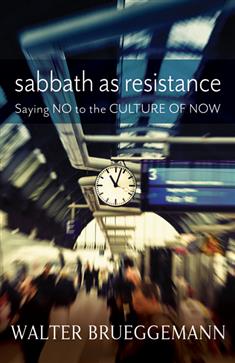
Sabbath as Resistance - A Review

We live in world that never stops moving. There are more options than ever for activities to spend our time. We have access to seemingly unlimited activities, many of which are harmless or even in some way good. Our jobs seem to claim more and more of our lives each week. The special effort for a big project begins to be the every week demand because we, and our employer, has realized if we can make the sacrifice sometimes we can make it all the time. The endless stream of entertainments and opportunities has led many cultural critics to describe Westerners as exhausted, bored, and overworked.

With that motif in the background, Walter Brueggemann’s recent book, Sabbath as Resistance: Saying No to the Culture of Now, has an interesting appeal. As an Old Testament scholar, an interpretation of the 4th Commandment would seem to be exactly in his realm of expertise. 

The book is a brief 90 pages or so, which makes reading it a sort of Sabbath in itself. This volume actually began its existence as a Bible study series that is available as a download from www.thoughtfulchristian.com for a higher price than this book. However, the original format of the volume explains the construction of the book and some of its characteristics.

Sabbath as Resistance has a brief preface followed by six studies on different aspects of the Sabbath. Brueggemann considers the Sabbath in relation to the first Commandment, and the Sabbath as resistance to a series of modern vices, namely anxiety, coercion, exclusivism, and multitasking. The book concludes with a discussion of Sabbath and the Tenth Commandment. Each of these topics is important and potentially helpful to Christians in a frantic world.

Brueggemann, interacting positively with Michael Fishbane’s work, argues the Sabbath “concerns the maintenance of a distinct faith identity in the midst of a culture that is inhospitable to all distinct identities in its impatient reduction of all human life to the requirements of the market.” He goes on to say that the celebration of Sabbath is “resistance because it is a visible insistence that our lives are not defined by the production and consumption of commodity goods.”

For Brueggemann, Sabbath is much less doxological and much more economic. He certainly has a point here. When the original practice of Sabbath is considered, it largely differentiated Israel from the surrounding nations on an economic basis. It is easy to find support in Scripture for the argument that resting from economic activity on the Sabbath reflects a trust in God which has a doxological element.

Unfortunately, this book never really makes such an argument. Sabbath as Resistance is much more a diatribe against market economics than it is a theological argument for worshipful rest. The rhetorical rejection of a market economy is an undercurrent that runs just beneath the surface of the entire volume, occasionally bubbling to the top. Through all this, Brueggemann does not appear to consider the possibility that consumerism is an abuse of market economics. 

I tend to agree with Brueggemann that Christians need to practice a form of Sabbath. The 10 Commandments are a part of the moral law, and as such, still in play since they reflect God’s very nature. The fact that God himself practiced Sabbath after creating the world demonstrates that resting and enjoying the fruit of one’s labor is a part of the proper cycle of the created order. The reality that a failure to constrain our desires often leads us to overwork and under-worship is another argument for restoring a healthy practice of the Sabbath that resonates with Brueggemann’s book.

However, Brueggemann’s simplistic view of a market economy––that it “mandates that one must sink or swim by one’s own effort, and it is never enough simply to tread water”––reflects a confusion of an unhealthy attitude that has cropped up in our current consumerist economy rather than a cry for a rejection of the system out of hand. The problem may not be the system as much as it is the sinful people living and working within the system. Therefore, I agree with much of Brueggeman’s application, but not with his motivation.

A weakness in this volume is that it never deals with some important questions: 1) How is Sabbath to be practiced? 2) How did the Sabbath transfer to the Lord’s Day in the NT fellowships? 3) What do we do with Jesus’ teaching on the Sabbath? Brueggemann appears to be so interested in presenting opposition to a free market economy that he misses obvious biblical data and practical questions that would make this a more helpful volume.

In the end, I appreciate some of what Brueggemann is doing here, but he has an axe to grind and does not support some of his conclusions well enough in this context. This is worth reading as one perspective on the contemporary practice of Sabbath in Christianity, but it has too many flaws to be helpful as a Bible study resource.

Note: A gratis copy of this book was provided by the publisher with no expectation of a positive review. The opinions above are entirely my own.

Prayer: Experiencing Awe and Intimacy with God

If you are Christian that struggles with prayer, then Tim Keller’s recent book, Prayer: Experiencing Awe and Intimacy with God, is for you. Of course, this means that I am recommending this book to every Christian on the planet because we all struggle with prayer at some point in our lives.

I like Keller’s stuff. I have read most of his books and have listened to many of his sermons. This is, perhaps, his best book so far. That is really saying something.

Despite my appreciation of Keller’s work, I wasn’t sure what I was going to get when I picked up this book. Most books with the word “prayer” in the title end up being glorified self-help books that present a moralistic vision that guilts the reader about not praying enough or not praying correctly. Other books provide simplistic formulas for prayer that may be helpful in the short term, but which fall short of helping the reader construct a theology of and methodology for personal prayer.

Prayer is a masterpiece on this very important spiritual discipline. In a world filled with a myriad of views on the nature of prayer, the methods of prayer, and the efficacy of prayer, Keller’s book stands above the rest.

This book critiques the most common popular errors about prayer. Keller disabuses his readers of the notion that an omnipotent, omniscient, sovereign God would not expect his people to pray. Keller writes:

“If we believed that God was in charge and our actions meant nothing, it would lead to discouraged passivity. If on the other hand we really believed that our actions changed God’s plan––it would lead to paralyzing fear. If both are true, however, we have the greatest incentive for diligent effort, and yet we can always sense God’s everlasting arms under us. In the end, we can’t frustrate God’s good plans for us (cf. Jer 29:11).”

With arguments like these, Keller eradicates the notion that theology–-understanding what God is like––is unimportant to prayer. This book convicts the reader of the importance of prayer, but reminds the reader of the reality and availability of grace.

Keller seeks to present a vision of prayer that is theological, experiential, and methodological in one book. He does this well.

The theological frame for this volume is built from Scripture. Keller emphasizes that the Psalms are largely a collection of prayers. They provide examples of how God’s people have prayed in the past, which can be appropriated by God’s people today. Keller also explores what great theologians of the past have written about Prayer. Augustine and Luther both wrote letters to parishioners on the topic of prayer. In The Institutes of the Christian Religion, Calvin has an excellent treatise on prayer. Keller summarizes and shares the pith of these pastor-theologians’ writing on prayer. The depth and breadth of the research are part of what makes this new volume a classic text.

The experiential aspect emphasizes the nature of prayer as a conversation with God. We speak to the God who hears and he communicates to us. Contrary to more theologically enigmatic perspectives on prayer, Keller rightly acknowledges that “if prayer is to be a true conversation with God, it must be regularly preceded by listening to God’s voice through meditation on the Scripture.” In other words, Keller’s vision of prayer is more holistic than others, because it includes substantial reflection on the Word of God as an essential part.

This book would be incomplete if it did not provide some helpful specifics that teach the reader to pray. He has chapters dedicated to theological and practical discussion on prayer as worship, as communion with God, and as a means of seeking help from God. Keller also provides some down to earth suggestions for making progress in this important spiritual discipline.

In a world where being Christian and popular at the same time often requires compromise, Tim Keller has managed to shatter the stereotype. Keller’s books sell well because they are well-written, thoughtful, and deal with culturally important topics. Keller’s books are worth owning because they winsomely communicate orthodox truths with depth and accuracy. This book is no exception on either count.

Note: A gratis copy of this book was provided to me by the publisher. There was, however, no expectation of a positive review. All opinions above are my own.

Some additional helpful links:

1. A 1990 sermon by Keller on Prayer from Redeemer Presbyterian.

2. A host of resources on prayer from Redeemer Presbyterian.

3. An index of Tim Keller resources from Steve McCoy's personal site. Multiple linked sermons, interviews, articles, etc.

A Christian Environmental Ethics - Part Four

This is Part Four of a series arguing toward a Christian environmental ethics. In the previous posts in this series we have examined the three aspects of the biblical narrative that point toward a comprehensive approach to human stewardship of creation. Those three aspects are Creation, Fall, and Redemption.


God created everything good, but it wasn’t in its final state. The vision of God was always to have humans populate the earth, develop technologies and build cities in the garden. However, Adam sinned, and God cursed the earth to remind humans that there is something wrong. Ever since then, humans have been pushing back against the disorder of the curse and struggling to overcome the wilderness.  When Christ came, he worked at alleviating the effects of the curse around him. Ultimately, his death on the cross made possible the final restoration of all things, which will come at some point in the future. In the meanwhile, since we are still on earth, we should be working to reverse the effects of the curse like Jesus did. We should be preaching the gospel verbally and demonstrating the implications of the gospel practically. We should be helping the weak, serving one another, and working as good stewards to use creation wisely. We do these things because we will be called to give an account of our work when Christ returns.

Some practical applications:

1.   Consume less – Americans are guilty of a lot of waste. We buy too much stuff we don’t need and throw it out. Excess consumption is bad stewardship of the environment and it is bad stewardship of financial resources that could be directed toward gospel activities.

2.   Simplify – One of the reasons why we consume so much is that we are trying to save time or do too much. Simplifying life can have benefits on a number of levels, including reducing the resources we use.

3.   Pick up trash – Simple activities that improve the aesthetics around us, like putting trash where it should be and keeping it from where it shouldn’t be, are good ways to be good stewards of the earth. When we work to directly improve the environment around us, we are showing some of the implications of the gospel, where the signs of the curse are wiped away.

Generally, we need to think close and move out. If we make small decisions about things we can directly control with the intent to be a good stewards of resources, we can do more than worrying about macro problems we can’t conquer. The larger problems will be reduced when the smaller problems are tackled.

To apply the three part paradigm to this: We should seek to conduct ourselves as good stewards, using the available resources wisely and cultivating the earth well. We should seek to do so in the character of Christ, which in this case means by pursuing actions that counteract the effects of the curse. We should have the goal of glorifying God by demonstrating the nature of the gospel through our actions.

Some things we don’t have to do:

1.   Stop having kids – God commanded us to be fruitful and multiply. It may be the only command that we’ve faithfully obeyed. Contrary to popular myth, the problem isn’t a lack of space or resources but the allocation and availability of them. People are producers, not just consumers. So we should be encouraged by having more of them.

2.   Stop all technological progress and development – Biodiversity is a good thing and we ought to take it into account when we are looking at developments and technology. However, we don’t need to stop all technological progress and development because we don’t know the answer to every question that could ever possibly be asked. We are called to be good stewards, not infallible prophets.

3.   Pretend everything is a disaster – There is certainly room for us to be better stewards of our resources, but that doesn’t require abandoning the things that have made the improvements in medicine, electronics, and education possible. Hopefulness is something that distinguishes non-Christian environmentalism from other forms. We should be hopeful that things can improve and live for God's glory instead of fear of an apocalyptic demise.

The bottom line is that an environmental ethic that loses sight of the whole picture of stewardship of creation and obedience to God is a bad ethic. As Christians, we ought to consider how our actions impact the environment, especially through our use of resources. However, we should not pursue the “ecological good” without considering the other goods that may be impacted.

Ordinary: How to Turn the World Upside Down

Don’t read this book unless you are prepared to have your practice of faith challenged. When he titled this book Ordinary, Merida wasn’t describing what your ordinary life is, he was describing what your ordinary life ought to be.

It turns out that the biblical definition of ordinary is a lot different than how most of us normally life. According to Merida,

Ordinary is not a call to be more radical. If anything, it is a call to the contrary. The kingdom of God isn’t coming with light shows, and shock and awe, but with lowly acts of service. I want to push back against sensationalism and ‘rock star Christianity,’ and help people understand that they can make a powerful impact by practicing ordinary Christianity.”

Read More

Fierce Convictions: The Extraordinary Life of Hannah More

Who is Hannah More?

Unless you have read Karen Swallow Prior’s recent book Fierce Convictions, or you are a careful student of late 18th century British history, you probably don’t know.

I have studied some history from that era. Until I picked up this book, I did not know who Hannah More is nor why I should care. I’ve been missing out.

William Wilberforce is the political figure that is recognized as the leader of the British abolitionist movement. He is the subject of multiple biographies, including the popular book by Eric Metaxas and the recent biographical film, Amazing Grace.

Like any significant political or social figure, Wilberforce did not act alone. Wilberforce was heavily influenced by John Newton’s personal accounts of slavery and his emotional and theological plea to end the barbarity. Wilberforce also relied on a circle known as the Clapham Sect for encouragement and support.

The list of individuals involved in the Clapham Sect includes authors, businessmen, and Members of Parliament. It also includes Hannah More.

Think about this: One of the most historically influential social reformers had a woman in his inner circle in the late 18th century in England. This is so socially abnormal that it speaks to the value More must have brought to the group, as a writer, thinker, organizer, and financial supporter.

Prior’s book fills in a gap in evangelical history by providing a well-written and well-researched biography of a significant player in the reformation of British society. More was instrumental in ending slavery, popularizing the Sunday School movement, legitimizing the role of women as writers, and ending popular support for a variety of social vices.

More wrote a novel, many poems, several plays, and hundreds of pamphlets–the blog posts of the late 18th century. Her literary product was well received and popular, which raises the question why Jane Austen’s moralistic volumes have superseded More’s in the canon of Western Literature. Although I took a course in British literature for my undergraduate degree that emphasized that period of literature (and had us read more than one of Austen’s books), More made nary an appearance.

In fact, it is More’s emphasis on manners and propriety that have largely led her to be marginalized and included only as a footnote to the lives of Wilberforce and Newton. Also, as Prior notes, More made the tragic mistake of rebuking the biographer of Samuel Johnson for drunkenly accosting her. Though she was a close and longtime friend of the popular and influential British author, Samuel Johnson, her rebuke led the offended James Boswell to largely write Hannah More out of Johnson’s biography. The small appearances More makes in that biography present her negatively, which has likely contributed to her disappearance from the pages of histories.

Prior portrays More sympathetically, though not without flaws. While More was adamant to teach the poor to read, she resisted teaching them to write since that was viewed as above their station. More was kind and considerate, but sometimes too subject to the opinions of others. Public criticism and theological debate would cause her to be physically ill.

In the balance, though, Prior’s depiction of More is overwhelmingly positive. Much like Dorothy Sayers, More points toward ontological egalitarianism while recognizing functional complementarianism between the genders. By her example, Hannah More helped to begin the movement evangelicalism from an unhealthy patriarchalism to a more appropriate view of gender. Through all this More clung to her distinct feminine identity and was most injured by accusations of theologically improper gender roles. This biography presents an intellectually brilliant woman who managed to be a major social influencer in a largely patriarchal society without devolving into the shrill protests common among feminists in our day. This facet of More’s life alone makes this biography a worthwhile read.

If you enjoy biographies, this book is a must read. Prior does an excellent job in presenting the facts of Hannah More’s life in engaging prose. The front of the biography may seem to drag a bit for some, as Prior carefully explains why the reader should be interested in More’s life, sets the social stage, and explains why More has been previously neglected. However, the information Prior provides in the first few chapters is essential to the narrative. Once the reader plows through of the details of the back story, which are extremely important to academics like me, into the action in More’s life story, the book is a page-turner.

By the end of the book I was encouraged as a believer living in a time of social turmoil that is similar to More’s epoch. I was instructed by the methods used by More and others to change society. I was delighted by an artful account of the life of a full life. I was blessed by the biography of a godly woman engaged in living her life according to her fierce convictions, which were shaped more by the content of Scripture than the cultural needs.

This is a book that belongs on your shelf. More importantly, it deserves to be read.

Note: A gratis copy of this book was provided by the publisher. There was no expectation of a positive review. All thoughts and ideas expressed above are my own.

A Christian Environmental Ethics - Part Three

This post is Part Three of a series on Christian environmental ethics. Part One emphasized the goodness of creation and the unique stewardship responsibility of humans within the created order. Part Two outlined the impact of sin on the world, particularly through the cursing of creation.

All of creation was good, as God described. However, because of Adam’s sin, God cursed creation to remind humans of the impact of their sin and point toward their need for a redeemer. Additionally, humans have, on many occasions, continued to sin by being poor stewards of creation, which can be seen in some of the pollution and many of the human-caused ecological disasters in the world.

In Scripture, Romans 8 points toward the final redemption of all things, when the curse will be lifted. This is both a present and future reality. In other words, redemption has a right-now aspect and a not-yet aspect. As Paul write in 1 Corinthians 13:12,

For now we see in a mirror dimly, but then face to face. Now I know in part; then I shall know fully, even as I have been fully known.”

Redemption is the work of Christ in the world. Even from the beginning, Christ has been deeply involved in every aspect of creation.

He [God the Father] has delivered us from the domain of darkness and transferred us to the kingdom of his beloved Son, in whom we have redemption, the forgiveness of sins.

He [Christ] is the image of the invisible God, the firstborn of all creation. For by him all things were created, in heaven and on earth, visible and invisible, whether thrones or dominions or rulers or authorities—all things were created through him and for him. And he is before all things, and in him all things hold together.  And he is the head of the body, the church. He is the beginning, the firstborn from the dead, that in everything he might be preeminent. For in him all the fullness of God was pleased to dwell, and through him to reconcile to himself all things, whether on earth or in heaven, making peace by the blood of his cross. (Col 1:13–20)

Christ created all things. He holds all things together. He will reconcile all things to himself, making peace by the blood of his cross.

We can see Christ’s work of redemption and reconciliation in his life. The vast majority of Christ’s miracles demonstrate a pushing back of the curse. The only two possible exceptions are the withering of the fig tree and the changing of water to wine at the wedding at Cana, but both of those can be explained as still demonstrating a positive influence over the created order.

The lesson we can pull from this is that we should be working right now to combat the effects of the curse. This includes such things as healing people, helping the poor, and minimizing pollution. Good stewardship includes working for a healthier ecosystem.

Revelation provides a picture of what the New Heavens and New Earth will look like:

“Then I saw a new heaven and a new earth, for the first heaven and the first earth had passed away, and the sea was no more. And I saw the holy city, new Jerusalem, coming down out of heaven from God, prepared as a bride adorned for her husband. And I heard a loud voice from the throne saying, “Behold, the dwelling place of God is with man. He will dwell with them, and they will be his people, and God himself will be with them as their God.  He will wipe away every tear from their eyes, and death shall be no more, neither shall there be mourning, nor crying, nor pain anymore, for the former things have passed away.” (Rev 21:1–4)

Here are two things to note from this text:

1.   History is moving from the garden to a city. This means that human development and population of the earth is expected. Untouched wilderness may be a good, and may be something we can enjoy, but it isn't the goal for all of creation.

2.   The final restoration of the created order––the removal of the curse––is the work of God and not the work of humans. It is something God has planned from the beginning.

Drawing these concepts together, we can see that the ultimate work of restoring the environment will be done supernaturally by God. However, just as Christ worked to reverse the effects of the curse on the earth, so should we. This will include finding ways to be environmentally friendly. Being environmentally friendly, in many cases, is a part of whole-life stewardship.

Eight Twenty Eight - A Love Story

I started following the story of Ian and Larissa Murphy a few years ago when John Piper's ministry, Desiring God, allowed them to guest blog and used their story to illustrate the concepts behind his helpful book, This Momentary Marriage.

If the Murphy's story isn't emotionally moving to you, then you have a heart of stone. It was amazing to see the story in brief several years ago, but their recent book Eight Twenty Eight: When Love Didn't Give Up retells the story in greater depth. This is a story of love that transcends romantic love, moving to the level of self sacrifice that is a testament to the power of God working in the hearts of believers.

Ian and Larissa went to college together. They fell in love. Soon they were going to get engaged. However, their pedestrian romance took a sudden and dramatic turn when Ian was in a horrific car accident. 

For weeks after the accident, no one was certain Ian would live. If he did survive, he would be left with severe brain damage and be physically handicapped for life.

Most normal women in their early twenties would have mourned the loss and eventually moved on. This story tells of Larissa not giving up, but clinging to her love of Ian and the hope of his recovery. It also talks about the work of an entire community in supporting Ian's family and Larissa and helping them cope and eventually overcome.

Ian will never make a full recovery in this life. Although there has been some recovery of physical and mental capacities, the trauma of that accident will forever impact how Ian lives. He will always require special care. By choosing to marry Ian, Larissa made a life-long commitment to serve someone in difficult and sometimes humiliating ways.

This makes the decision of a talented, educated young woman to stay and marry a man that will require significant, life-long care astounding.

Ian recovered significantly before they got married. Though he was not the same as he was before the accident, this books provides accounts that show he was really there, behind the handicap. Still, the self-sacrifice is amazing.

I am certain their marriage isn't perfect. None are. Larissa and Ian give some hints to places they have failed, though they don't talk about all the struggles in detail. This is fine, since knowing all of the dirt wouldn't make this story any more authentic. At its core, this is a story of an agape love imperfectly manifested, but about as well as can be done in this earth.

This book was an encouragement to read. God is working through and perhaps especially because of Ian's accident. God is also working through Larissa's response.

Take the time to read this book. It is worth the investment, but have a box of tissues nearby.

Note: I received a gratis copy of this book from the publisher, but there was no requirement of a positive review. The analysis above is entirely my own.