Reading the Syllabus

If you are a professor or a grader, you're probably reading this and saying, "Yes!!! I hope all my students read this."

If you are a student, you are probably thinking: (A) "this really doesn't matter," (B) "no one would ever do this," or (C) "is he talking about me?"

If you are in group A, you should be in group C. If you are in group B, you are totally wrong. If you are in group C, then you should rightly be embarrassed. Fortunately, there is hope for you if you recognize your faults and turn away from them.

Professors are required to create syllabi. (Or is it syllabuses?) They are designed to record what the class did so we can look back at it and also to tell the students what they should be doing over the semester.

The main content of a syllabus is the information students need to know to get through a class. It is the way higher education has developed to pierce the veil of mystery and provide help to the students who have elected to pursue further study.

Sort of like a Facebook post or a mass e-mail, a syllabus is a way to tell everyone the same thing at the same time in the same way.

To rehash that last point: syllabuses tell EVERYONE the information they need to get through the course AT THE SAME TIME. 

The whole point of a syllabus is to avoid answering everyone's questions individually, whether in person or via e-mail.

An Illustration of the Problem

Imagine carefully drafting an e-mail to invite 40 of your closest friends to a party. This is like a syllabus.

Now imagine 25 of those individuals calling to ask you questions that were clearly explained in the e-mail. "What time does it start?" "What should we wear?" "Can I get directions to your house?"

Assuming the necessary information was actually in the e-mail when it was sent, by about the fifth phone call you would be ready to spear someone through the heart.

Next imagine you held three parties every six month, and repeated this year in and year out for two decades. There is a level of quiet frustration that would builds over years of the repeated, minor aggravations.

To be fair, there is the possibility the professor something left something out. For instance, in your invitation writing, the first year you might not include your address. Woops! But every year after that you would include your address and maybe a link to the Google Map for it. Likely the error would not exist for long if you repeated the process several times.

And yet if your friends are anything like students as a whole, you would continue to have friends calling you for information that is clearly explained in the invitation.

You would stop holding parties after a few years. Or, you might stop answering e-mails requesting answers to the obvious.

For professors, they continually get new students who continue to not read the syllabus. They have to keep teaching so they can eat. Unfortunately, they are trapped in a cycle of ignorance not of their own choosing.

It's not just the Facts, Ma'am.

Sometimes student questions are not explicitly in the syllabus, but that's often because they don't belong there. Not because the information wouldn't be somehow useful, but because the information is (a) easily obtainable or (b) self-evident.

For example, on the first day of a graduate philosophy class, one of my fellow students raised his hand and asked, "Where do I get the Internet Encyclopedia of Philosophy?" (This was spoken in Hillbonics, but I have translated it here for you and taken out the intense bib overall accent.)

You see, the professor had referenced some peer reviewed articles in the syllabus that we would read in the Internet Encyclopedia of Philosophy. He did not give the website because, well, it seems self-evident that the Internet Encyclopedia of Philosophy is on the internet. Google is a free service, my friends. Foolishness like this has happened more than once.

Despite these warnings, some questions are good questions. For example: "Having consulted my syllabus, I would like to compliment you on your thoroughness." (For some discussion on student questions, see my earlier post here.)

In reality, there are some questions that need to be asked. If you need to ask, do so. But first have the common courtesy to check out the syllabus to save the professor some aggravation. Besides, it makes you look smarter.

Final Thoughts

I have rarely meet anyone who teaches in Higher Ed who did not get into the business because they enjoyed helping people learn. Even the nerdy, super-introverted Engineering professors I had honestly cared about students. (See what I did there?)

However, make it easy on your professors by being a good student. Good students read the syllabus, are considerate of others, and are diligent with their opportunities. This doesn't mean you will get an 'A', but may mean you are remembered positively. 

It also may make your professor's day.
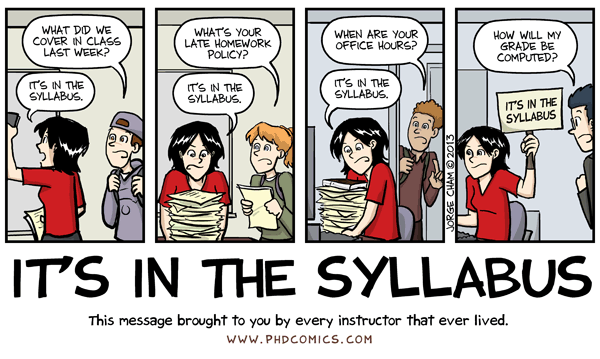
"Piled Higher and Deeper" by Jorge Chamwww.phdcomics.com

"Piled Higher and Deeper" by Jorge Cham
www.phdcomics.com

Is Charles Finney the Prototype for Evangelicalism?

With the recent publication of the second edition of a book from the 1970’s, Douglas M. Strong has repackaged Donald Dayton’s theory that evangelicalism is defined by faith experience and right living, rather than by doctrinal fidelity. 

 Dayton’s book uses Charles G. Finney and those closely tied to him as the exemplars of this trend. While it cannot be denied that Finney preached the gospel (or at least a form of it) widely and pointed many to Christ, there is significant doubt that Finney’s belief system is a viable foundation for a sustainable Christian faith, much less being at the heart of historic evangelicalism.

Charles G. Finney

Charles G. Finney

 Finney’s intellectual hubris was his theological undoing. As a trained lawyer, and by all accounts a very intelligent man, Finney assumed that he could, without cultural influence, rightly interpret Scripture. Based on a likely limited library at his teacher’s house, Finney rejected all historical Christian teachings because he did not like the way they were argued. Instead, he committed himself to a “no creed but the Bible” approach, without the aid of theological conversation with contemporary or historical peers. This unfortunate confidence was enabled by Finney’s quick wits and premature promotion to public ministry. In truth, Finney’s belief that he could rightly interpret Scripture without any external influence affecting the outcome rests very close to what is known as the “fundamentalist fallacy.”

Misunderstanding the Atonement

 In his autobiography, Finney records his opportunity to debate with a Universalist while he was still in his ministerial training. His teacher was ill and Finney stood in, ostensibly to defend orthodoxy. Finney writes,

I delivered two lectures upon the atonement. In these I think I fully succeeded in showing that the atonement did not consist in the literal payment of the debt of sinners, in the sense in which the Universalist maintained; that it simply rendered the salvation of all men possible, and did not of itself lay God under the obligation to save anybody; that it was not true that Christ suffered just what those for whom he died deserved to suffer; that no such thing as that was taught in the Bible, and no such thing was true; that, on the contrary, Christ died simply to remove an insurmountable obstacle out of the way of God’s forgiving sinners, so as to render it possible for him to proclaim a universal amnesty, inviting all men to repent, to believe in Christ, and to accept salvation that instead of having satisfied retributive justice, and borne just what sinners deserve, Christ had only satisfied public justice, by honoring the law, both in his obedience and death, thus rendering it safe for God to pardon sin, to pardon the sins of any man and of all men who would repent and believe in him. I maintained that Christ, in his atonement, merely did that which was necessary as a condition of the forgiveness of sin; and not that which cancelled sin, in the sense of literally paying for the indebtedness of sinners. (Charles G. Finney, Charles G. Finney: An Autobiography [Westwood, N. J.: Barbour Books], 38)

Finney rejected the notion of election, divine calling, and substitutionary atonement in Christ’s death on the cross.

In truth, Christ’s death on the cross as a human in human form was only necessary because it is substitutionary. If all Christ did was make possible salvation in a general way, it could have as simply been done by fiat as by self-sacrifice. Without extending this post with further discussion on the atonement, it is clear that Christ came as a redeemer not as an enabler. Even taking a thematic view of Scripture, rather than pursuing a verse by verse defense, it does not seem that Finney’s perspective on the atonement is helpful. In short, even without accepting a fully Calvinistic theological paradigm, Finney’s reasoning seems better suited to win an argument against Universalism than to be considered biblically faithful.

An Unsound Foundation for Evangelicalism

 In all this, I am not making the claim that Finney was not converted, nor that he did not have a profound impact on many people. Finney preached a form of the gospel that enabled many to come to faith in Christ through repentance of sin. He was also instrumental, as Dayton and Strong rightly argue, in ending the evils of American slavery.  All of these things could have been, and were otherwise, done while still maintaining doctrinal integrity.

 By basing their image of historic evangelicalism on individuals on the fringe of orthodoxy, more subject to their culture than to Scripture, Dayton and Strong have undermined their own case.

 In fact, most of the organizations and theological movements cited in this volume have tended to cut their mooring to Christian orthodoxy in the years since Finney’s influence. Wheaton University has maintained fidelity to its evangelical doctrine. On the other hand, the Salvation Army is no longer concerned with salvation in any meaningful sense. Oberlin College, where Finney was president, is no longer distinctly Christian.

The track record of Finney’s theology demonstrates a failure to thrive in the long term. In the first generation, the theological content is assumed, in the second it is unknown, and by the third it is rejected.

This should point present day evangelicals toward the need to be active in pursuing social justice while adamant about maintaining the doctrinal orthodoxy of our Christian heritage.

A New Help for Stylish Writing

Style manuals are both bane and blessing to writers of all types. I like Strunk and White’s classic volume, The Elements of Style. I’ve also benefited from Joseph Williams’ Style and A.P. Martinich’s Philosophical Writing. However, many times I wonder why some rules exist and whether they are always helpful. 

Sometimes the rules in style manuals seem to be more focused on obtaining polite compliance with convention rather than improving communication.

With that in mind, Steven Pinker sets out on a more helpful quest in his recent book, The Sense of Style: The Thinking Person’s Guide to Writing in the 21st Century! This book is neither reference manual nor remedial writing guide. Pinker states, “Like the classic guides, it is designed for people who know how to write and want to write better,” as well as “for readers who seek no help in writing by are interested in letters and literature and curious about the ways in which the sciences of mind can illuminate how language works at its best.”

Contrary to many of those who wring their hands over the prospects of style with each passing generation, Pinker paints a more positive outlook for the English language. He notes that much of the handwringing over grammar is generated when convention has shifted and the norms of an earlier style guide violated. This is much less significant than some grammarians would allow us to believe.

Pinker recognizes convention, but instead of placing grammatical rules as the primary objective for good writing, he offers style as the summum bonum of a solid sentence. 

There are three reasons style matters. (1) It gets the message across. (2) It earns trust by demonstrating the author’s concern for accuracy and clarity. (3) It adds beauty to the world. Thus the most important question is not whether a passive voice is used, but whether the intended meaning is conveyed in a comely and precise manner.

Summary

The book is divided into five chapters. In the first chapter, Pinker reverse engineers several passages of good writing. For each he shows why they convey their message and some critical aspects that readers can appropriate. This is certainly not exhaustive, but here Pinker is training his reader to be a better reader. Chapter two outlines the way classic style, with its conventions, is helpful to communicating meaning. Far from establishing a deconstructive attitude toward language with a cry to abolish syntax, Pinker calls for doing the basic things well. Those fundamentals of style, after all, are conventions that often point toward the way communication occurs.

Pinker’s third chapter treats “the curse of knowledge,” which is the real problem authors have when they know much more about their topic and its back story than the reader. Confusion is often sown instead of clarity because of technical terms and assumed knowledge. The point of this chapter is important, since specialization in disciplines often makes interdisciplinary communication and presentations to popular audiences difficult.

Each of the first three chapters are relatively short and simple. Chapters 4, 5, and 6, however, are much larger and more cumbersome. The fourth chapter moves beyond a basic discussion of style into linguistics. Following his own advice, Pinker does well in explaining terms as he goes along. He proposes an alternative way to diagram sentences than the horizontal arrangement with slanted lines branching off to show parts of speech. Instead, according to Pinker, language functions more like a tree, branching downward from initial concepts into new realms of meaning. He makes two significant points in this discussion. First, visually representing grammatical constructions can be helpful and sometimes improve understandings. Second, the “traditional” sentence diagram is somewhat limited because it misapplies categories at times. The neat rules set up for parts of speech and there function have messy exceptions. Understanding the way the human mind processes the web of meaning in texts can help writers to create more clear prose.

In Chapter 5, Pinker examines how to apply the concept of “arcs of coherence” to ensure writing conveys its meaning. Since these ideas are best represented in the negative, this chapter spends a great deal of time unpacking examples of bad writing, showing how a lack of clarity comes from placing the pieces of language in an irregular order. His discussion here is much like that in Williams’ Style, but he presents the concepts based on cognitive linguistics instead of preference, which give more weight and import to his recommendations.

In the final chapter Pinker goes after the sacred cows of many grammarians and presents some of his own norms. Here is uses historical research to show that many “rules” were merely preferences put into style manuals and grammar books to help establish some standards. In many cases, restrictions that are necessary to assist elementary writers learn the craft were transferred as inviolable truths necessary for communication. Pinker shows how some of these are unnecessary. At other times, language has changed and so the rules should be modified, requiring a redaction to the grammatical gospel according to Strunk and White. Still, in this behemoth chapter, there are a number of clear rules Pinker sets down that writers should follow to ensure clear communication, recognizing that some of the rules are provisional and linked to contemporary English usage. Pinker concludes the volume with an encouragement to lighten up on grammar and not nitpick, the fate of the world does not depend on the use of the Oxford comma. This, perhaps, is the most significant takeaway from the book.

The Sense of Style starts punchy and drags a bit toward the end. There are a dearth of section headings and breaking places in the many pages of careful linguistic explanation. This makes the book tough slogging after the first three chapters. 

Evaluation

Pinker makes significant contributions to the style discussion. First, he presents some of the cognitive linguistics data that help make sense of prose structure. This is done in a clear manner that communicates well and is helpful for contemporary writers. Second, he affirms beginning with basic style manuals, but shows how good writing may and should move beyond. This is helpful as an academic and popular writer. Third, Pinker demonstrates good writing throughout. The prose is punchy and alive. It is interesting, even when the content is heady and a bit dry. This is a demonstration of how to make bland content flavorful without being gimmicky.

I affirm this book and recommend it for good writers that want to get better. This will not be the first manual I pull off my shelf, but I hope I am a better writer for having read it and will likely read it again in the future.

Note: I received a gratis copy of this volume from the publisher with no expectation of a positive review.

A Defense of Nuclear Power

In the decade or so that I worked in nuclear power, I never found a comprehensive apologetic for nuclear power that was published in the marketplace. All of the arguments were available piecemeal or in a more unified manner from people inside the nuclear power guild, but none from someone who didn’t have a clearly vested interest in keeping nuclear plants running.

 Michael H. Fox is an emeritus professor in the Department of Environmental and Radiological and Health Sciences at Colorado State University. Here is an individual who is outside of the commercial and nuclear power world who has access to the best science about the most concerning aspects of the risk of nuclear––radiation and cancer.

 Fox’s conclusion is that compared to imminent risk of climate changes, the risks of nuclear power are worth it. He spends nearly three hundred pages making his case by considering the basic arguments for and against nuclear power, as well as the case for and against other forms of non-fossil energy.

 The beauty of this volume is that it is written at a level that can serve as an introduction, but it also ramps quickly into the explanations for the more technologically adept. With the clear structure of each chapter, I was able to skim past those explanations that I am familiar with based on my experience as an operator and instructor. By the end of each chapter, however, the progressive development of each explanation had me reading carefully to follow his explanations. Even regarding the topics that I am less familiar with––such as the mechanism of cancer development in cells––Fox’s explanations were sufficient for me to understand the more complex aspects based on his earlier explanations.

 This volume is, therefore, both a suitable introduction and a valuable reference on the topic of nuclear power.

Summary 

The book is divided into three nearly equal parts. The first part deals with Fox’s explanation of the global warming and the contribution of Carbon Dioxide from coal and natural gas. He also explains the limitations of solar power and wind power. Fox is positive toward the benefits of renewable sources of energy. However, unlike many of the rabid proponents, he is realistic about the limitations in terms of capacity and footprint required, and he recognizes the ongoing need for baseline energy generation that fossil or nuclear will provide. Thus the future is in nuclear power, if real changes are to be made to limit greenhouse gas emissions.

 The second part is a discussion of radiation and its biological effects. This is the section that plays to Fox’s strength, as he explains some basic physics, then digs quickly in to a realistic analysis of the dangers of radiation. He doesn’t hide the real risk, but he also doesn’t overplay it. The reality, as Fox explains, is that any radiation exposure increases the risk of cancer, but the amount of additional exposure due to nuclear power is negligible compared with naturally occurring background.

 This is the most significant argument against nuclear power and Fox handles it well. However, the scientifically ignorant will continue to persist in their argument that any risk is unacceptable. For some reason this argument is powerful against nuclear power when it isn’t for other concerns. The miniscule risk increase of cancer from living near a nuclear plant, even using the conservative (i.e., inflated) estimates required by law, pales in comparison to having a speed limit over 15 MPH.

 The third part focuses on the risks of nuclear power. Fox deals with concerns about nuclear waste, which have been overblown by opponents. He deals with the real and tragic history of the three significant accidents in the history of nuclear power. He is fair about the consequences, but also notes the real learning that has taken place and points toward the attempts by anti-nuclear groups to grossly misrepresent the consequences. Then he deals with the issue of Uranium mining, also dealing with the failings in early nuclear power to deal appropriately with the risks of pollution. That damage was avoidable and is being avoided in properly conducted mining enterprises now. Finally, Fox concludes with a chapter debunking in summary the five most significant myths used to argue against nuclear power. He does this by accepting the truth in the claims and then showing why the arguments aren’t realistic or persuasive.

Conclusion

 Fox writes well and he is honest in his assessment of risks. In other words, he presents the reality of risks on all sides, without overstating his case. I would have thoroughly enjoyed this book simply because of the robust integrity Fox demonstrates, without having to agree with him. As it turns out, I agreed with the substance of Fox’s arguments, as well. He is realistic and helpful in how he argues. He is looking for solutions to problems instead of trying to manipulate emotions and control people’s lives through excessive regulation. There are points that I disagree with Fox, typically on the political implications of his arguments, but overall the case is well made and reasonable.

 If the modus operandi of environmentalists is followed, where only people that have PhD’s in climatology have a right to speak about climate change, then Fox’s  book will have amazing convincing power. Notably, the majority of anti-nuclear advocates speak from outside of the pool of people that have expertise in the area.  Unfortunately, well-reasoned arguments like that of Fox are much less likely to gain headlines than “Fukushima is leaking, we’re all going to die and the government doesn’t care.” Indeed, that is largely the nature of a recent book which includes the Union of Concerned Scientists among its authors.

 If you have questions about nuclear power, buy this book and read it. If you are a proponent of nuclear power, buy this book and cite it in your arguments. This is, hands down, the best one stop reference on the subject I have encountered.

Note: A gratis copy of this book was provided by the publisher with no expectation of a positive review.

On Student Questions

Don’t be that student at seminary (or any other institution of higher learning).

Yes, I’m talking about that one.

Every class has that student who wants to teach the professor and the whole class something.

It goes like this: The student read this book. Or, maybe he’s read several books on a topic. Or, perhaps her pastor taught a series of sermons on a particular topic with a particular slant.

None of these qualifies this individual as an expert. Remember this, lest you become “that student.” The reason students are students is because they do not have the knowledge or expertise that the professor has.

This seems like a simple idea that would be clear to everyone, but educators themselves have allowed "that student" to continue to exist, in part, because they are too soft on ignorance.

Are there bad questions?

There is an adage among educators that “the only bad question is the question you don’t ask.”

This isn’t entirely true. First, there was the time when a student raised his hand to ask where we could get the Internet Encyclopedia of Philosophy. I realize this was the first day of class, but that was an insanely stupid question. The professor did a remarkable job in responding graciously. Nevertheless the question was both asked and bad.

The second kind of bad question is the non-interrogative question. This can take two different forms. Sometimes these “questions” can be phrased as comments that are long and rambling, after which the speaker adds, “What do you think?” That is, if they bother to make it a true question at all. These are usually designed more to demonstrate the questioners brilliance or to teach the audience something.

Another form often taken by the non-interrogative question is the “bear trap question.” These are used when a student has a nugget of information––usually trivia––that they want to surprise everyone (particularly the professor) with. These questions are usually tossed out in ways that, whether intended or not, break up the flow of the lecture or discussion. More often than not, they end up making “that student” look foolish to everyone else, though wise in her own eyes. Fortunately for “that student” Scripture is silent on this topic. Or not.

The reality that seems to escape the understanding of “that student” and his inbred cousins is that no one in the room is paying to hear him speak. 

No One Paid for Student Commentary

Everyone that has paid tuition to sit in a class is expecting to gain insight information from a highly qualified professional, usually a Doctor, who has invested countless hours reading, researching, discussing, teaching, are writing about the topic under consideration.

This means that the fact that “that student” has read a recent book is extremely unlikely to shatter the foundations of the professor’s worldview.

In reality, since I’ve been hanging around the academic community for a while, I’ve realized that most new books just rehash old books. Therefore, in the unlikely event that I’ve actually read some new book my professor has not read, he or she has likely encountered the thesis of that book in a dozen books previously.

The democratization of education has led to the feeling that everyone has an opinion that counts. Wikipedia, blogs (like this one!), and growing ease of self-publishing (particularly e-publishing) lend credibility to quackery and foolishness. They also increase the popular misconception that one can make a contribution to any field of interest nearly instantaneously merely once one has done a little research.

If you think this, you are wrong. Feel free to do your research, but please hold all comments and pseudo-questions until the end. This is part of stewardship of the education of you and those in the class with you.

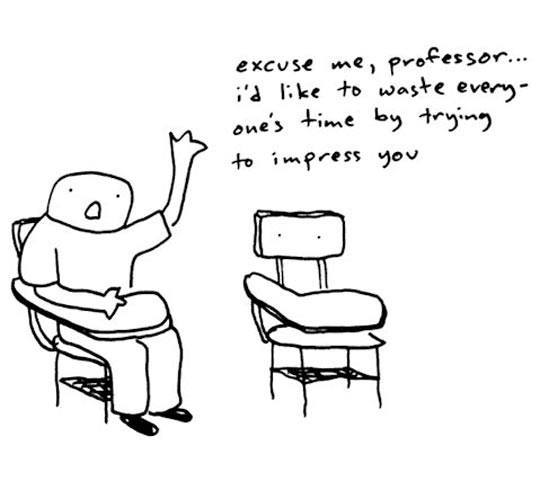
Far from being a mere rant by a student about his peers. I am actually hopeful that this discussion might change lives. Perhaps even yours, dear reader. With that in mind, I’ve included this helpful flowchart for when and how to ask questions. This did not originate with me, but it is so important that it bears sharing across the world and among all generations.

The moral of the story is not, “Don’t talk in class.” Instead, we should demonstrate neighbor love through our class participation. Only ask questions that will contribute to everyone’s understanding. And NEVER ask questions to show how smart you are. Most likely if you do, you’ll only end up looking dumber anyway.


Link photo courtesy of Sean Dreilinger. Used under a creative commons license in an unmodified state. The source of the photo is: http://ow.ly/HzUro 

Dress Colors, Social Media, and Questionable Research

Last week on Thursday, there were two hot topics on Social Media that kept many people amused (and somewhat less than maximally productive) for quite some time. The first was a debate on the color of a dress. 

Someone posted a picture on tumblr in mid-February and asked for help determining what color it is. (Here is the link, note there is some questionable language in the post.) 

Given a few weeks and a snow storm in the Southeast of the US, which gave a number of people downtime to try to discover the end of the internet, and presto!, we have a viral debate raging on social media about absolutely nothing. It's sort of like an episode of Seinfeld, only it lasted more than 22 minutes and really isn't nearly as funny.

For nerds (and I include myself in this descriptor), the science behind the confusion is pretty interesting. In fact, I found the post at Wired that explained the nature of the confusion to be enthralling. There is a scientific explanation for the perception of different colors depending on the setting.

The Social Phenomenon

More significant to my mind, though, is the way that such a benign and pointless social phenomenon has been reported in the media. Not only did it inspire Wired to write a post to cash in on the web traffic, but all of the major news network jumped on the story.

To put this in plain English, with everything going on in the world, a story about a social media debate got picked up by the news.

This reveals some of the significance of social media. It isn't just a fad that will be gone like slap-wrap bracelets (which are still around, just not as popular as when I was a kid). Social media is driving the way society thinks.

Is this the way it should be? I don't think so, but that's not the point. This particular cultural event reinforces the reality that we cannot simply ignore the phenomenon of social media or demonize it. We have to figure out how to meaningfully engage this tool without allowing it to cheapen our own way of thinking. To that end, Karen Swallow Prior has written a helpful blog at Christianity Today that details some of the potential lessons to be learned from #TheDress.

I have written previously on some of the dangers of social media, based on their potential to damage personal relationships. I have also written about reasons why Christians should (and should not) blog, which is pertinent because social media is the platform that conveys the bloggers message to a broad audience.

The answers are not immediately obvious, but a debate over dress colors and coverage of escaping llamas drew national attention and broad social media engagement. The church needs to figure out how to use this tool and how it fits into a Christian worldview.

The Research Phenomenon

A second significant issue is the way that informal reporting and researching techniques are being used to promulgate internet news. One example of this is, ironically, this post, which relies on internet searches and cultural artifacts to present a case. Recognizing this irony, and not claiming to be an actual news source, I press on with my opinion.

In a 1995 book, Telling the Truth, Lynne Cheney notes,

From 1968 to 1988, the average sound bite for a presidential candidate on the network evening news had plummeted from 42.3 seconds to 9.8 seconds. In the 1992 campaign the length of time would become shorter still: 8.4 seconds. Meanwhile, the portion of the news taken up by correspondents’ comments rose to 71 percent, with candidates sharing the remainder of the time with voters and political experts. A study of the New York Times showed a similar trend. From 1960 to 1992, the average continuous quote or phrase from a candidate in a front page story fell from fourteen lines to six lines. In both television and print, reporters increasingly had power to turn the candidates’ words and deeds into illustrative material for the stories they wanted to tell.

Twenty years after Cheney wrote this, the problem has not gone away. Indeed, if anything, social media platforms like Twitter have caused people, politicians included, to self-limit to 140 characters and thus strip their own comments of context. We have made it easier for someone to reframe our comments according to their own liking.

But a second significant theme is the prevalence of telling stories. In many cases the point is no longer to reveal truth, but to tell a compelling stories. This allows bloggers and media personnel to look for rapid sources of some credibility that will carry their message in a way that will get clicks and support their narrative.

Often this results in a tight circle self-reference with dubious credibility. This Tweet, captured on the day after the dress color debate went viral illustrates the research phenomenon:

Does this mean that the analysis is not correct? No. It may be correct. In fact, it may be so inconsequential that it doesn't matter if it is correct. After all, do we really care what color the dress is?

However, this is merely an illustration of what I believe to be a broader phenomenon that includes more significant topics. Experts are citing experts citing experts. Who knows that the chain of proof doesn't lead back to my blog, or another similar platform that also lacks credibility on a particular subject? 

We must seek truth. This means that we need to be skeptical of some of what gets conveyed as news. Just because we read it on the internet, even from a widely published source, does not mean it is credible or true. This also means we need to avoid crucifying people because of the way someone presents someone else's opinion on a blog or social media. Learning to do these things well is a critical task for Christians in the 21st century.

The Puritan Practice of Biblical Meditation

In his 2014 book An Infinite Journey, Andy Davis notes, 

Meditation on Scripture is essential to gaining a deep understanding of the truth of its words. Without meditation, the words of our daily reading can flow through our minds like water in a pipe and make no impact. But by means of meditation, we give the word a chance to settle in our minds and do its work.

Similarly in the recently published Prayer, Tim Keller writes, 

Many have written about the hyperactivity of today’s contemporary society and our cultural attention deficit disorder that makes slow reflection and meditation a lost art. Nonetheless, if prayer is to be a true conversation with God, it must be regularly preceded by listening to God’s voice through meditation on the Scripture.

Both of these men are pointing in the same direction, a return to a spiritual discipline that often eludes believers in an age of constant connectivity. Both Keller and Davis spend a few pages on the topic with some basic instructions, but there is a room for a great deal more practical instruction in the practice of Christian meditation. David Saxton provides such instruction in his recent book, God’s Battle Plan for the Mind: The Puritan Practice of Biblical Meditation.

It may be that the focus on the Puritans will turn some readers off from the beginning. However, that is a thoroughly unfair bias. As Leland Ryken shows in his book, Worldy Saints: The Puritans as They Really Were, there is a lot more to the Puritans than Max Weber and Nathaniel Hawthorne allow. In fact, while we cannot adopt everything the Puritans espoused wholesale, the contemporary Christian can benefit greatly by exploring the deeply scriptural worldview they developed.

As such, Saxton’s book really is helpful. Saxton is, in essence, bringing the Puritans forward to a contemporary audience and summarizing their perspective on a neglected spiritual discipline. While extremely beneficial to read, the Puritans are often quite prolix at times. This makes books like this a welcome addition to an arsenal of texts on Puritan theology.

God’s Battle Plan for the Mind is a short book at 138 pages of text. It is divided into twelve short chapters and a conclusion. In a very practical manner, Saxton presents an apology for biblical meditation, differentiates it from unbiblical forms, and demonstrates some of the times that biblical meditation is most helpful and necessary. Thankfully, the book does not leave the reader at the theoretical, but pushes into practical methods for meditation on the Word.

The last six chapters deal with the practical aspects of mediation. Saxton presents some specific instructions on how to choose subjects for meditation, how to be motivated to meditate, what benefits to look for in meditation, and ways to recognize enemies of meditation. The final chapter is an even more basic primer of how to get started developing the habit of meditation.

If you love Puritan theology, you will thoroughly enjoy this volume, which is well stocked with Puritan quotes. If you want to deepen your walk with Christ, you will find this book very beneficial, because it points readers toward practices which are important for becoming more Christlike. If you need encouragement in your walk with Christ, this short text will provide ample exhortation. It is worth your time to read it.

The most significant weakness of this volume, in my mind, is a bias toward Christian separatism. Saxton rightly notes the distraction which our entertainment saturated society can find, but he goes on to cite ungodly friends, by which he means unspiritual ones not merely ruffian acquaintances, and a “failure to decisively separate from the world” as major obstacles to meditation. While these latter factors may negatively impact spiritual disciplines if we never separate from worldly amusements and spend all our time among non-Christians, Saxton seems to be proposing an intentional withdrawal from culture. This may be helpful for maintaining a focus on Christ, but it also removes opportunities for evangelization and influencing a culture which is need of both salt and light. This is not a major emphasis in the book, however, so the value of the volume is not diminished.

Buy the book, apply the technique. There is little doubt that meditating on the Word of God is both biblical and necessary for growing in the knowledge of Christ.

Note: A gratis copy of this book was provided by the publisher with no expectation of a positive review.

I have previously reviewed Andy Davis' book, An Infinite Journey for Themelios, the academic journal of The Gospel Coalition. Click here to read the review.

A Poem by Theodore Geisel (Dr. Seuss)

"A Short Condensed Poem in Praise of Reader's Digest Condensed Books"

By Theodore Geisel (Dr. Seuss)

It has often been said
There's so much to be read,
you never can cram
all those words in your head.

So the writer who breeds
more words than he needs
is making a chore
for the reader who reads.

That's why my belief is
the briefer the brief is,
the greater the sigh
of the reader's relief is.

And that's why your books
have such power and strength.
You publish with shorth!
(Shorth is better than length.)

Today is the 111th anniversary of the birthday of Dr. Seuss. Across the US, many elementary schools will be celebrating the literary oeuvre of a man who wrote mainly nonsense. Though his storylines often lacked obvious purpose, he created characters that have engaged his readers for decades and led to a colorful silliness being passed on through several generations.

What American child has not read (or heard read) Green Eggs and Ham or would not recognize even the jaunty red and white striped hat of the cat in the hat? Or One Fish, Two Fish? A significant percentage of high school graduations, at least in the season when I went to a number of them, seemed to reference Oh, the Places You'll Go! Additionally, many of the scholarly tomes that I read, which otherwise lack any sort of a sense of humor, cite The Lorax as a viable inspiration for environmental ethics.

In any case, I offer this poem, which was printed on the dust jacket of Reader's Digest Condensed Books, for your entertainment in honor of Geisel's birthday.

Christian Bioethics

The recently release book by B&H Academic, Christian Bioethics, is a good introduction to a series of very important issues that face the people in the developed world today.

Medical technologies seem to press ahead without regard to ethics. The only question that seems palatable to most people in this day is, “Can we do it?” Very few are asking the important question, “Ought we do it?”

The moral vacuum of the culture compounds this problem, as subjective concerns of emotion and desire are promoted in favor of an ethical schema that anticipates objective answers founded on God’s structuring of reality. Fortunately Ben Mitchell and Joy Riley have a more biblical approach.

C. Ben Mitchell has a PhD in medical ethics and has taught moral philosophy for a number of years in a Christian context. D. Joy Riley is an M.D., with an MA in bioethics. With a strong background in the theory of ethics and the technical arguments related to bioethics, Mitchell and Riley can speak with authority and expertise where many others would need to be more tentative.

The book is written conversationally, which makes it suitable for non-academic audiences. Indeed, the subtitle of the volume is, A Guide for Pastors, Health Care Professionals, and Families. As an academic ethicist, this was one of the things I liked least about the book, but for the primary target audience, the approach is likely to be helpful.

The book consists of four parts. First, Riley and Mitchell begin by laying a foundation for Christian Bioethics. What forms of medicine are out there and how should we view them? How does Scripture speak to contemporary cases that are not clearly addressed? These are important questions that are well answered in the first two chapters.

Next, the authors discuss the sanctity of human life as it pertains to abortion and euthanasia. They explain these things in terms that are intelligible and helpful. In the third part, Mitchell and Riley discuss the ethics of infertility and assisted reproductive technologies. They also address the issues of organ donation, transplantation, and cloning. In the final section, the authors address the issues related to anti-aging technologies and the centrality of understanding and respecting our humanity in the contemporary age.

 The greatest strength of this volume is that it is written for a popular audience. It doesn’t use a lot of technical term, though it occurs in the context of a conversation between two experts. Based on my recent experience teaching ethics to laypeople, resources like this are necessary and helpful. Another strength is that each chapter has a series of references that can be used for further study and elaboration. This is again important as the overflow of information on the internet leaves us often wondering which expert we can trust and how someone got to their conclusions.

I am not a fan of written dialogue as an approach to moral reasoning. Thus, I find Augustine’s early philosophical works rather boring and less helpful than they might be. As such, I would have preferred it had this volume taken a more straightforward approach and presented the material in normal prose instead of relying on dialogue. However, this is a stylistic preference and not a rejection of the substance of the book.

 I commend this to readers who are looking for answers to some very important ethical questions. I plan on recommending it as a resource to people in my church who have questions about this topic. It is up to date and informative. It is written with a pastoral heart and academic acumen. It should be a trusted resource for the church for the near future.

Note: A gratis copy of this text was provided by the publisher with no expectation of a positive review.

A Brief History of Mercy Ministry in the Church - Part Three

This is part Three of Three posts in a series on the history of Mercy Ministry in the Christian Church. Part One is accessible here.  Part Two can be found here.
After introducing the topic and giving a brief overview of Mercy Ministry in the Early Church, Patristic Era, Medieval Era and Reformation Era, today's post emphasizes the Modern era, bringing the discussion up to the present time. 

Photo by Amir Farshad Ebrahimi. Used under creative commons license. http://ow.ly/IHxpd 

Photo by Amir Farshad Ebrahimi. Used under creative commons license. http://ow.ly/IHxpd 

As a reaction to the religious wars of the Reformation Era, Deism began to rise and people began to try to demonstrate that non-Christians could be ethical, too. Divisions began to form between Church and State, with none starker than the division in France due to the French Revolution. When the church and state split, the larger political organization rose as a more significant participant in what had previously been the church’s role in dealing with physical needs.

 The roots of modern evangelicalism are in British non-conformist religion. The four central aspects of early evangelicalism were conversionism, crucicentrism, biblicism and activism.[1] The key for today’s discussion is activism, which refers to the belief that the internal change brought about by gospel conversion would be worked out in external application of the gospel to life. It was this tendency toward activism that led William Carey to build businesses to improve the local economy in India, end injustices like the burning of widows, and start schools instead of only preaching the gospel. This also drove people like William Wilberforce and John Newton to fight for the abolition of slavery.

 It about the same time as the rise of evangelicalism that the higher critical approach to Scripture was developed. Faith became subjective, the integrity of the Bible was frequently questioned by Friedrich Schleiermacher, Julius Wellhausen, and others. Deism became increasingly accepted through the work of individuals like Thomas Paine. In summary, people began to doubt the central truths of Christianity, but retained their desire for the works of the Christian religion. As a result, mercy ministry began to take precedence over doctrine. Later, liberal theologians such as Walter Rauschenbusch began to promote the idea that the Kingdom of God was a condition of earthly justice that had no true doctrinal content.

 Unfortunately, the morals of the church cannot stand without a doctrinal foundation. Individuals like J. Gresham Machen, B. B. Warfield, and Charles Hodge resisted the discrediting of Scripture. Others reacted more strongly against the doctrinal decay of the theological liberals by rejecting the social aspect of ministry. This led to the rise of fundamentalism, particularly in the United States, which promoted doctrinal truth and evangelism without significant concerns for mercy ministry. This overreaction was a divergence from the central traditions of Christianity and the resurgence of an interest in mercy ministry among doctrinally conservative Christians should be seen as a course correction not an innovation.

Carl F. H. Henry

Carl F. H. Henry

 Carl F. H. Henry’s brief but significant book, The Uneasy Conscience of Modern Fundamentalism, speaks about the loss of social ministry among theologically fundamental Christians: “The social reform movements dedicated to the elimination of such evils do not have the active, let alone vigorous, cooperation of large segments of evangelical Christianity.”[2] That reality began to change in the mid Twentieth Century as some theologians began to shift the language from doing missions (which focus only or mainly on saving souls) to mission (which focuses on participating in God’s redemptive work in all creation).

Recently there has been an explosion in conferences, sermons, and books on the topic of Mercy Ministry. Evangelicalism has largely recovered its vision for working out the implications of the gospel in the world. Our task on our External Journey, with this cloud of witness in history behind us, is proclaim the gospel while we are serving them. Or, to enable them to hear our proclamation because we have met their physical needs.

[S]ome can’t hear our proclamation [of the Gospel] until they’ve been delivered physically from injustice and other forms of suffering. Until we pick them up from the road, they won’t hear of the good news. Today, millions are being drugged, sold, and raped multiple times a day in sex trafficking. Do you think they will hear your proclamation? I don’t.[3]

[1] David Bebbington, Evangelicalism in Modern Britain: A History from the 1730s to the 1980s (New York: Routledge, 1989), 5.

[2] Carl F. H. Henry, The Uneasy Conscience of Modern Fundamentalism (Grand Rapids, Mich.: Eerdmans, 1947), 3.

[3] Tony Merida, Ordinary: How to Turn the World Upside Down (Nashville, Tenn.: B & H, 2015), 29.