Worth Reading - 2/19

1. With the passing of Antonin Scalia last week there has been much discussion of the friendship of ideological opponents, Scalia and Ginsburg. There have been many retellings of the surprising friendship, but it is worth recounting again because it represents the sort of principled and humane opposition that we need to model as Christians. The link is to the NPR story on it, below is Ginsburg's statement that was released upon Scalia's death.

Toward the end of the opera Scalia/Ginsburg, tenor Scalia and soprano Ginsburg sing a duet: "We are different, we are one," different in our interpretation of written texts, one in our reverence for the Constitution and the institution we serve. From our years together at the D.C. Circuit, we were best buddies. We disagreed now and then, but when I wrote for the Court and received a Scalia dissent, the opinion ultimately released was notably better than my initial circulation. Justice Scalia nailed all the weak spots — the "applesauce" and "argle bargle" — and gave me just what I needed to strengthen the majority opinion. He was a jurist of captivating brilliance and wit, with a rare talent to make even the most sober judge laugh. The press referred to his "energetic fervor," "astringent intellect," "peppery prose," "acumen," and "affability," all apt descriptions. He was eminently quotable, his pungent opinions so clearly stated that his words never slipped from the reader's grasp.
Justice Scalia once described as the peak of his days on the bench an evening at the Opera Ball when he joined two Washington National Opera tenors at the piano for a medley of songs. He called it the famous Three Tenors performance. He was, indeed, a magnificent performer. It was my great good fortune to have known him as working colleague and treasured friend.

2. It is common in economic debates, especially those between Liberals and Conservatives, for Liberals to accuse anyone who advocates for small government and free-market principles a Libertarian. Here is a longish, but informative explanation and critique of Libertarianism from a Conservative perspective.

Modern liberals tend to call anyone who defends the free market and limited government a “libertarian,” but this is incorrect, and serves merely to protect them from seriously engaging the issues. Whereas modern liberals relegate economic liberty to a secondary status, libertarians root it in self-ownership and regard it as the most fundamental right, without which no other rights are meaningful. Libertarians therefore are “minarchists.” They believe that the only legitimate use of the state power is to prevent coercion.
At the same time, libertarians differ from classical liberals, who also hold economic liberty in high regard but place it within a social order that gives equal value to civil and political liberty. Classical liberals therefore recognize a wider range of public goods than security—such goods as roads, education, and assistance to the poor, all of which can justify state action. Libertarians also differ from anarchists (or “anarcho-capitalists”), who believe that the state is unnecessary and illegitimate and should be abolished altogether and replaced by private, voluntary associations.
Tellingly, just as modern liberals tend to regard anyone who defends the free market as a libertarian, so libertarians tend to regard anyone who defends anything other than minarchy as a “statist.” Libertarians and modern liberals are like two people gazing at one another through opposite ends of a telescope, which distorts the image of each side while obscuring from view any alternatives but the extremes.

3. This summer a new movie will be released about a rebellion in the South during the Civil War. The history is disputed, but this Smithsonian Magazine article about the so-called "Free State of Jones" is both interesting and says something about the need for racial reconciliation in the South today.

In October 1862, after the Confederate defeat at Corinth, Knight and many other Piney Woods men deserted from the Seventh Battalion of Mississippi Infantry. It wasn’t just the starvation rations, arrogant harebrained leadership and appalling carnage. They were disgusted and angry about the recently passed “Twenty Negro Law,” which exempted one white male for every 20 slaves owned on a plantation, from serving in the Confederate Army. Jasper Collins echoed many non-slaveholders across the South when he said, “This law...makes it a rich man’s war and a poor man’s fight.”
Returning home, they found their wives struggling to keep up the farms and feed the children. Even more aggravating, the Confederate authorities had imposed an abusive, corrupt “tax in kind” system, by which they took what they wanted for the war effort— horses, hogs, chickens, corn, meat from the smokehouses, homespun cloth. A Confederate colonel named William N. Brown reported that corrupt tax officials had “done more to demoralize Jones County than the whole Yankee Army.”
In early 1863, Knight was captured for desertion and possibly tortured. Some scholars think he was pressed back into service for the Siege of Vicksburg, but there’s no solid evidence that he was there. After Vicksburg fell, in July 1863, there was a mass exodus of deserters from the Confederate Army, including many from Jones and the surrounding counties. The following month, Confederate Maj. Amos McLemore arrived in Ellisville and began hunting them down with soldiers and hounds. By October, he had captured more than 100 deserters, and exchanged threatening messages with Newt Knight, who was back on his ruined farm on the Jasper County border.

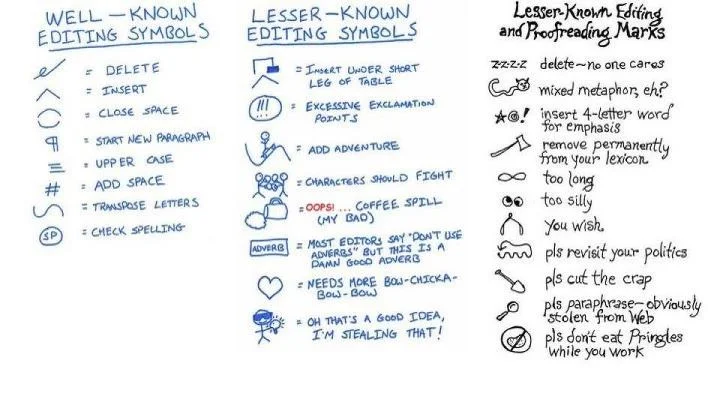
4. There are some newly developed copy editing symbols that are worth a look:
5. Bradley Green writes about Augustine, Modernity, and true education. This is a long read, but worth the time to contemplate the benefits of Liberal Arts for Christian scholarship, the long tradition of Christian Liberal Arts, and the importance of the resurrection in gaining knowledge.

And here is perhaps one of Augustine’s key contributions—often overlooked—to Christian discussions of the intellectual life. Augustine contends that one can only “get” to the knowledge of God via the cross. When this insight is taken, and extrapolation is made to apply it to every aspect of human knowledge, one has a powerful critique of autonomous human reasoning and intellectual inquiry—whether in its pre-modern or modern forms. That is, Augustine provides an example of, and a theology for, a gospel-centered understanding of the intellectual life. To know is to know with a mind transformed by the gospel. To truly acquire knowledge—whether knowledge of God or knowledge of the created order—is to know via mind that has been transformed by the cross. It is important to note that I am here “extending” Augustine in hopes of bringing an Augustinian insight to bear on our own contemporary setting. Augustine’s main concern was to wrestle with who the Trinitarian God is that he already believes in due to Scripture and tradition. He has argued that we will one day see God face to face, and that to actuallysee God requires that our minds be cleansed by the cross itself. In affirming the centrality of the cross in a construal of the face-to-face vision, Augustine is distancing himself from any position (neoplatonist or otherwise) which would affirm the possibility of seeing God apart from the cross. My suggestion is that we might take Augustine’s basic insight (that seeing and knowing God—in the fuller sense—requires minds transformed by the cross), and apply it to knowledge more generally. It then might be argued that to know God and His world—at least to “know” or “see” it in a more truer and fuller sense—is to “see” or “know” God via a mind that has been transformed by the gospel.

6. Matt Smethurst writes about how to criticize other Christians without being mean:

The power to love, then, flows only from him who bled for our sad ability to revile virtually anyone but ourselves. It flows from him who rose in the very resurrection power that’s still at work today—in every person bound to Jesus by faith. To the degree the Holy Spirit empowers us to see the horror of our pride and the beauty of his grace, we’ll find ourselves freed from the twin traps of “loveless truth” and “truthless love”—liberated instead to “speak the truth in love” (Eph. 4:15). We’ll be enabled to critique, correct, and confront without succumbing to slander, even in the silent confines of our own hearts.

Worth Reading - 2/12

1. Life is rarely what we think it ought to be. Sometimes that can lead us to hold on to bitterness, even bitterness against God. We can know that God is good and affirm that, but still hold onto a pocket of sinful rebellion in our hearts because we, in our sinfulness, believe we deserve better. Uncovering those pockets of rebellion is raw and difficult, and we can read about it on the blog of one adoptive mother.

When we brought our kids home five years ago, we were not expecting a fairy tale, but we were not expecting our lives to be shattered in a thousand different ways by the brokenness in ourselves and in our kids and in the foster system. And every single day as we've traveled through this mess, I've been terribly disappointed with the reality of our life.
And I have grown to believe that God has not been good to us.
Oh so mercifully, He showed me this weekend what wicked idol worship I have been participating in by nurturing disappointment and trusting in my paltry efforts to overcome what He has done, as if He has done wrong. He showed me that He is good. He taught me that if nothing else, our adoption is going to be used to wrench sin out of my heart and make me more like my King. He wants me to know that I am not to be defined by the circumstances of my home, however broken and ugly they may be. He is calling me to face what is ahead without acting like He messed up. Whatever the situation, He is there and He is good and to believe anything else is to believe a lie.

2. What is the difference between being known by our neighbors and being known by the government? This was a theme in Agatha Christie's novels with her famous detective, Miss Marple, and some of that history is explored in an intriguing article in The New Atlantis.

This is what happens when the social structures — family, community, church — that were once key to the establishment of identity fade into insignificance, supplanted by the power of the modern nation-state. Miss Marple may seem to speak on behalf of those older, humbler sources of meaning, but in fact she quite coldbloodedly acknowledges their disappearance. “But it’s not like that any more.... And people just come — and all you know about them is what they say of themselves.” The task of the amateur detective is to bring “what they say of themselves” into line with what the state says of them; that is all. Because there is no alternative.
Thus the significance of the setting of A Murder Is Announced: not in Miss Marple’s native village of St. Mary Mead, but in a place where she knows only one family, a family almost wholly disconnected from the mystery that must be solved. In her first appearance in the book, she comments to some policemen, “Really, I have no gifts — no gifts at all — except perhaps a certain knowledge of human nature.” Not local knowledge, not intimate acquaintance with a specific community in all its particularity, but knowledge of “human nature.” And human nature is a very abstract and generalized thing to know. I can’t help being reminded of the titular character of Auden’s short poem “Epitaph on a Tyrant”: “He knew human folly like the back of his hand, / And was greatly interested in armies and fleets.” Miss Marple in her own way sees exactly like a state — and for the state.

3. The Gaffigans put together a video of what real valentines from married couples would be like:

4. What is a University? If that question is posed, most will think of a brick and mortar location or an entity that markets degrees. That was not the original concept of a University, which fact is recalled and discussed at First Things. In reality, the question should be: "Who is a University?"

Unlike a factory, farm, or typical white-collar business, the work of a university is not in any kind of production—of discoveries, degrees, or books and articles. That a university typically does produce these things is incidental to its true work, which is the pursuit and attainment of truth, goodness, and beauty through intellectual exchange and the expressive power of art. It is in the life and labor of faculty and students that these things are pursued and attained. This life is a useless life: if adherence to it sometimes leads us to wealth or power, that is only because wealth and power sometimes come to those who are good and know the truth. But still this life is valuable not because of this eventuality, but because truth, beauty, and goodness themselves are valuable—we desire these things simply for what they are, not because of what they do for us, or we with them.
If this is what a university is, then it makes some sense to say that the faculty and students are it, are not just those who work at and attend it. Unlike a business in which employees exist to make profits for bosses and shareholders, and customers contribute money or goods in exchange for what they produce, in a university the administration is there to facilitate the communal activity of the faculty and students. Faculty and students can fail in their roles, but these failures and successes are determined in relation to the measures of beauty, goodness, and truth, not the profit motive or the duty of loyalty to any higher-ups. Thus donors and trustees do not “own” the university, nor do administrators “run” it, any more than the blessing of King, Pope, Prince, or Prelate was the measure of the communal activity of the scholastic guilds in medieval Paris or Bologna.

5. According to The Art of Manliness, one of the keys to building wealth is moving from a paycheck mentality to a net worth mentality. In this article, the author lays out the problems with confusing income and wealth and how to think more holistically about it. Worth a read.

Do you feel like you’re not getting ahead with your finances? That no matter how hard you work or how much extra money you earn, you’re still in the same place as you were a year or even five years ago? It may be that you have the wrong mindset about your finances.
The authors of The Bogleheads’ Guide to Investing (a book inspired by the sage investing principles of Jack Bogle) describe two mentalities when it comes to personal finance: the paycheck mentality and the net worth mentality. A person with a paycheck mentality just focuses on increasing their income in order to increase their wealth. A person with a net worth mentality also seeks to boost their income, but builds their wealth through saving and investing as well.

Pretty straightforward, right? The second path seems like the obvious tack to take. And yet many people are stuck in a paycheck mentality.

6. My latest post at the Institute for Faith, Work and Economics is a very brief synopsis of how Alexander Solzhenitsyn commended people in the U.S. to live  in light of the growing spiritual impoverishment. The answer was not to seek a naked public square.

We should also live faithfully and in a distinctly Christian manner because of the hope given to use through our Christian beliefs.
The Apostle Peter urges his readers to be zealous for what is good, to honor Christ in their hearts, and to be prepared to give a respectful defense of the hope drawn from knowing God through Christ. (1 Pt. 3:13-16)
In a world seeking to suppress the notion of a spiritual basis for morality, gospel-powered daily living has the potential to change society and also change the hearts of the people around us.

7. I love videos about how to make stuff. I also like spoofs that are well done. In this short video, the CBC (funded by the Canadian tax dollars!) puts their creativity to work to create this humorous video about artisanal firewood. Enjoy:

Worth Reading - 2/5

1. From the Washington Post, an article explaining why children should be taught philosophy.

The idea that schoolchildren should become philosophers will be scoffed at by school boards, teachers, parents, and philosophers alike. The latter will question whether kids can even do philosophy, while the former likely have only a passing familiarity with it, if any — possibly leading them to conclude that it’s beyond useless.
Yet nothing could be further from the truth. In fact, nothing could be more important to the future well-being of both our kids and society as a whole than that they learn how to be philosophers.

2. Conspicuous consumption hasn't gone away, it has merely changed form:

Simply put, the way you signal status in contemporary society is to spend a bunch of money to show off how much you reject consumerism, globalization, and “the corporations.” You show off how intellectual and worldly you are by devoting your disposable income to make a stand against what made much of that income possible.
Within the bohemian bourgeois elite, who has higher status, a banker making $500,000 per year or a social sciences professor making $120,000? An operations manager making $200,000 per year or an artist making $50,000? To ask these questions is to answer them.
Taking part in the perpetual wealth creation machine known as capitalism is considered to be a dirty, demeaning activity. You sold out. Not selling out, making a living still ensconced in a world in which you can still pretend that all those things your humanities professor taught you in college are true, that is true self-fulfillment (i.e., high status).

3. If you were awake in 2004 you probably remember the much lampooned "Dean scream." It was the moment when it seemed that Howard Dean's campaign to win the DNP's nomination for POTUS fell apart. However a recent 10 minute documentary tells a little different story. That scream is certainly a political meme that will be remembered in infamy. However, it's likely his campaign was faltering by that point. The scream simply gave an opportunity for a new narrative that hastened the end. Click this link to see the video on the native webpage.

4. In this era of skyrocketing self-esteem, it may just be that an individual's concept of their self-worth is the most significant barrier to the gospel.

When asked why he shared a table with tax collectors and prostitutes, Jesus said, “It is not the healthy who need a doctor, but the sick.” Awareness of their own depravity is what made sinners receptive to Jesus; they recognized their illness and need for healing. The Pharisees, on the other hand, rejected Jesus because they were convinced of their own righteousness; they were perfectly healthy (or so they thought). Today, we increasingly live in a culture of secular Pharisees—non-religious people convinced of their own righteousness who view Jesus as a morally inferior kook followed only by simpletons. Will we be more effective at reaching today’s Pharisees than Jesus was?

5. Our friend, Bekah Mason reviewed Jennifer's book of devotionals that focus on different names of Jesus. The review is gracious and kind, but in my opinion, it gets at the heart of what Jennifer is trying to do.

With all that has been written in recent years about the exodus of youth from the church and the biblical illiteracy of professing believers, devotional works like this one show us that learning about Jesus does not have to be either loud and flashy or dry and boring; learning about Jesus can be simple and satisfying. Learning can be fun, and it can be genuine, and it can be done alone or in groups. We can even learn as families. An ideal plan for families with kids spread across developmental stages is to simply start small (one verse and the concept) and then just allow the conversation to continue by using the additional passages and questions as your guide. You may be surprised just how long even the youngest in your family may stick around to talk and learn.

6. If you haven't noticed, the Superbowl is this weekend. It is likely to be Peyton Manning's last game. Even though he is playing in Denver, an Indianapolis sports reporter honors Manning's integrity and legacy. The writing alone is worth reading this article. As for me, I'm a fan. I appreciate Peyton's humility, consistent character, and pursuit of excellence.

He was different from the start, the privileged son of an NFL quarterback who scoffed at the idea of shortcuts. At times it felt like he was engineered in some sort of football laboratory, this 6-5, 230-pound quarterbacking machine with that laser, rocket right arm and the mind of an offensive coordinator to match, constructed to make all the right reads and all the right throws and when he was finished, say all the right things.
Hours after signing his first professional contract, the Indianapolis Colts’ rookie quarterback and newly minted $48 million man was asked what he planned on doing with all that money.
“Earn it,” he said.
How many 22-year-olds say that?
Peyton Manning did.

7. In the midst of political chatter and rancor, there is some meaningful meta analysis going on, including a recent article at Christianity Today on the importance of virtue in Christian engagement in the political conversation. It's worth a read, I think.

Followers of Christ are called to “hope all things.” According to Paul, this is one of the defining features of love. If this is true, then for Christians, there is no room for nihilist politics. We are obligated to treat our neighbors as people who deserve honest appeals. This does not mean that all political discourse must be highly rational. There is a place for appeals to emotion, as well as to beauty. Don’t think I am denouncing all political ads that appeal to our emotions. While I do think that our politics could do with a great deal more logic and reason, I reject the idea that only what is rational is relevant to political discourse.

No, my objection is to appeals that are dishonest, and dishonesty can be cloaked in “reason” or “emotion” or “patriotism.” The most common and insidious form that this takes is the example I began with: when we lie about particulars in order to justify a general truth. I call this insidious because it occurs so subtly and is so easy for us to personally justify.

Worth Reading - 1/29

1. One way that folks often try to stifle debate is by rejecting labels. Labels represent categories imperfectly, but without making some generalizations, it is nearly impossible to make a case that doesn't die a death of a thousand qualifications. While we'd all like to think we are one of a kind unique, the reality is that our thought processes generally fall into consistent patterns. Here is someone making the case for the usefulness of labels.

We seem to be living in times where wider culture finds it increasing difficult to handle difference. We are happy as long as everyone signs up to (some rather nebulous) British values, which of course includes the idea of being ‘tolerant’ and ‘inclusive’. But tolerance appears, all too often, to involve eliminating differences of view rather than recognizing that people have genuinely different views, often for very good reasons. It is only when we recognize these differences that we can offer genuine respect, genuine interest, and a genuine willingness to listen and learn from others.
This is why I find particularly odd the idea that I need to disown my label or my tradition in order to be ‘here for everyone’. Is it really not possible to respect, value, even encourage someone in their own tradition without leaving go of mine? Is it not possible to empathise and support someone else with whom I have genuine differences? It could be argued that I can only exercise empathy when I recognize how different the ‘other’ is from me. Empathy is about entering into the different and distinct world of the ‘other’, not imagining that we inhabit the same world as each other.

2. My wife wrote a Lenten devotional. I'm obviously partial, but I think it's pretty good. So did Katie King, who reviewed it and is giving away copies at her blog, Adopted by the King:

With the beginning of Lent fast approaching on February 10, you might be starting to think about how your family will progress through this season of preparation for Easter. Or you might not! Either way, I have a fantastic new resource to share with you.
My wonderful friend, Jennifer Spencer, has written a devotional for families entitled Forty Names of Jesus. I started using this with my kids back in November as part of Jennifer's test audience. Slowly but surely, we have worked our way through it. I can tell you that each day's reading encouraged me to know Jesus more deeply and to love Him more.

3. The debate between taking notes by hand and taking notes via computer will continue, but an article on Business Insider makes a solid case for why slowing down to take notes by hand is better for retention:

Earlier studies have argued that laptops make for poor note-taking because of the litany of distractions available on the internet, but their experiments yielded a counterintuitive conclusion: Handwriting is better because it slows the learner down. 
By slowing down the process of taking notes, you accelerate learning. 

4. I'm not a big fan of the Downton Abbey series, but here the Dowager Duchess makes a case that opposes big government.

5. Watch the story of the man who discovered a material that would encourage the regrowth of skin in burn victims and how a scientific failure led to a medical technology advance:

6. In case you didn't catch it in number 2 above, my wife has written a series of devotions for kids and families for the Lenten season. I am going to promote it on my blog, but I'll shamelessly plug it here, too. It's really good and it meets a market need.

Below the Fold

Some folks are tired of getting bombarded with political stuff, but I wanted to share a few posts that I found interesting without clogging everyone's feed. So, here you go:

1. Alan Noble wrote one of the thinkier think pieces on Trump and how we got to this stage of political machinations.

If we can’t understand this appeal then we cannot begin to offer an alternative; no matter how revolting we find Trump’s candidacy, many of his supporters are responding to deeply felt concerns, some of which are valid. The modern world is terrifying. We do feel impotent in the face of the global evil and suffering that modern media makes us hyperaware of. Maybe being helpless was okay for medieval serfs, but for individualist Americans living in a democracy where we define ourselves by our power to choose, powerlessness is terrifying. We need to know that we can do something.

And that’s what Trump promises to do: something. Specifically, something for white, middle and lower class Americans. He even recently went so far as to promise to give Christians “power” if he gets elected. In this way, his campaign is mirroring the identity politics of the left. People don’t support Trump because he would be good for the country; they support him because he’d be good for me and my people.

This kind of self-interested power shouldn’t be tempting to evangelicals. Our hope is in a sovereign God who overcomes the chaos and evil of our world, and our model is Christ, who denied Satan’s offer of power in exchange for submission. But just like the rest of society, we can get overwhelmed with fear, and the promise of secured power becomes more attractive when we are afraid.

2. Nikabrik's Candidate is an article on First Things that connects the Narnian character Nikabrik ("The dwarves are for the dwarves.") to Trump. It's an interesting connection.

Through the character of Nikabrik, Lewis explored the depths to which we can fall through fear. The first time Caspian meets Nikabrik, he is waking up after an accident and hears the dwarf’s voice near him, saying, “Kill it. . . . We can’t let it live. It would betray us.” There is absolutely no room in Nikabrik’s mind for the idea that a Telmarine could be good. And at first we can sympathize; his people have suffered greatly under the Telmarines, and he is fiercely loyal to his people—a good quality. But as Lewis frequently warned us, good qualities can be twisted and used for evil purposes.

3. A video that does a linguistic analysis of how Donald Trump answers a question. Even if you like the man, this is fascinating:

4. This is a satire, but it is really too close not to be funny. The Federalist published an imaginary conversation where Donald Trump talks about Smaug, the dragon from The Hobbit.

Let me tell you about Smaug. Now, I knew the guy a long time, a good friend, he worked with me on the Laketown deal and told me he learned a lot from watching me. You could say I invented him. By the way, people do tell me that all the time, that I am one of the great teachers. They tell me that on my hit show The Apprentice, they tell me that in life.
But Smaug, if he learned anything, he didn’t learn enough. He turned out to be a terrible investor, a real dummy, just sat on his gold. He literally sat on it! No deals, no moves. I said Smaug, you dummy, you gotta be out there making deals, negotiating, sitting down at the table, incinerating people with fire. You’re not going to make any money sitting there like a big lazy dumb rock! You’ll be small potatoes forever! But he didn’t listen and he stayed in that backwater and he got so lazy, he was such a slow moving target – I mean, come on, an illiterate redneck takes one shot at you and boom, done, gone, dead. At a Trump property, we are always on the move, we are cutting deals, the best deals, and we use gold the way it was meant to be used, on fountains, escalators, walls – all the best, and very classy, people say.

Worth Reading - 1/22

1. My friend Alan Noble wrote an article for Christianity Today talking about a sane approach to immigration:

This tension between the political left who support the refugees and the far right who see them as a threat is simply not conducive to accurate and unbiased reporting. On the contrary, both sides have reasons to silence parts of this event and broadcast others. Much to their shame, it appears that the local government in Cologne tried to ignore or downplay the sexual assaults. Meanwhile some American pundits have jumped on the event as evidence for why we can’t possibly allow more Muslims into the United States.
Take, for example, The National Review, which ran a story claiming that Muslims are “unassimilable” into western society and that the immigration is really just part of a larger plan of conquest with “rape jihad” as a major strategy to overtake the West. Countless other, smaller online publications have likewise promoted this angle, arguing that fundamentally, Muslims cannot coexist with civilized western culture. According to them, Muslims will outbreed us, use political correctness to silence critics, use terrorist attacks to kill infidels, institute Sharia law in our court system, rape our women until they submit to Sharia law, mooch off of our entitlement programs, lie about Islam or anything else in order to seduce us into accepting them, insist that they are entitled to special treatment because of their religion, infiltrate and undermine every level of our government and military, and in general cause the destruction of the western civilization as we know it.

2. Every new technology has an impact. Looking back in history, we can find evidence of apocalyptic predictions that didn't entirely come to pass. Smithsonian Magazine recently published an article talking about how the phonograph changes music and how it didn't.

It’s almost hard to reconstruct how different music was before the phonograph. Back in the mid-1800s, if you wanted to hear a song, you had only one option: live. You listened while someone played it, or else you played it yourself.
That changed in 1877 when Thomas Edison unveiled his phonograph. It wasn’t the first such device to record and play back audio, but it was the first generally reliable one: scratchy and nearly inaudible by modern standards, but it worked. Edison envisioned a welter of uses, including for business, “to make Dolls speak sing cry” or to record “the last words of dying persons.” But in 1878 he made a prediction: “The phonograph will undoubtedly be liberally devoted to music.”

3. Racism isn't gone in our society. A white mother with black children steps up to offer evidence of the racial bias of which many in the majority are likely unaware:

Never in my wildest dreams did I ever think that racism still existed. Some things you just can’t understand until you personally experience it – I would venture to say racism is one of those things. I would listen to my black friends and my friends who had black kids talk about their experiences. I listened and was aghast at some of the things they told me. But I never really understood until I experienced it myself. This is why we need to and we must listen to those who have lived this thing called racism, day in and day out. We need to take our cues from them, rather than from our own experiences and perceptions. Because as white men & women, our own experiences and perceptions are vastly different than our black friends and neighbors, I can assure you of this.

I learned just how real this difference is when I became the mom of black kids.

4. Have you ever thought about leaving a fake money tract as part of or instead of a tip at a restaurant? Here is a slightly whimsical explanation as to why that is a bad idea:

I ran into a post there the other day that caught my attention and promptly depressed me (but then, Happy Meals also depress me, so take that with a grain of salt). The post relayed a tweet from a server in Kansas named Garrett Wayman who thought a customer had left him a generous tip, only to find it was actually a Christian tract “cleverly” disguised as a $20 bill. I’m not sure how this got to be national news, since Christians do this all the time, because Christians are basically terrible (the Friendly Atheist and I agree on that point, I suppose)—but there you go.
Let’s take a second to be fair. There’s actually a good chance the people who left the tract wouldn’t even identify as Christians. While it’s possible they were misguided religious folks trying to save his soul, it seems at least as likely that they were just a couple of drunk jerks playing a “hilarious” practical joke. But—if you were the people who left the tract, and you’re reading this, and you’re Christians, let me be the umpteenth to tell you: you’re terrible.


Worth Reading - 1/15

Here are some articles that I found interesting this week.

1. The New York Times ran a post last week on why real books are better than e-books. It's part of an ongoing debate, but it's worth a read.

Perhaps the strongest case for a household full of print books came from a 2014 study published in the sociology journal Social Forces. Researchers measured the impact of the size of home libraries on the reading level of 15-year-old students across 42 nations, controlling for wealth, parents’ education and occupations, gender and the country’s gross national product.
After G.N.P., the quantity of books in one’s home was the most important predictor of reading performance. The greatest effect was seen in libraries of about 100 books, which resulted in approximately 1.5 extra years of grade-level reading performance. (Diminishing returns kick in at about 500 books, which is the equivalent of about 2.2 extra years of education.)
Libraries matter even more than money; in the United States, with the size of libraries being equal, students coming from the top 10 percent of wealthiest families performed at just one extra grade level over students from the poorest 10 percent.
The implications are clear: Owning books in the home is one of the best things you can do for your children academically. It helps, of course, if parents are reading to their children and reading themselves, not simply buying books by the yard as décor.

2. It's election season (it seems like it's always election season). So, much of divided America is spending time insulting the intelligence of people they disagree with. However, some of the impression given by social media that the other side is dumb is likely false.

In psychology, the idea that everyone is like us is called the “false-consensus bias.” This bias often manifests itself when we see TV ratings (“Who the hell are all these people that watch NCIS?”) or in politics (“Everyone I know is for stricter gun control! Who are these backwards rubes that disagree?!”) or polls (“Who are these people voting for Ben Carson?”).
Online it means we can be blindsided by the opinions of our friends or, more broadly, America. Over time, this morphs into a subconscious belief that we and our friends are the sane ones and that there’s a crazy “Other Side” that must be laughed at — an Other Side that just doesn’t “get it,” and is clearly not as intelligent as “us.” But this holier-than-thou social media behavior is counterproductive, it’s self-aggrandizement at the cost of actual nuanced discourse and if we want to consider online discourse productive, we need to move past this.

3. This is a post from Bruce Ashford on the trouble with political ideologies. It's a worthwhile read, even if it does increase political saturation.

Identifying political dysfunction is easy. Depending upon a person’s temperament, it may even be fun. But diagnosing the dysfunction beneath the dysfunction? That’s the rub. For those who care passionately about politics, the enemy generally resides over there, in some other political camp. Liberals blame conservatives; conservatives blame liberals. The reality, however, is more complex and, not surprisingly, much more interesting.
Underneath political dysfunction is a simple but powerful phenomenon—the sin of idolatry. The problem with politics runs deeper and spreads wider than the words or actions of any one politician, pundit, citizen, or party. Idolatry is located in the depths of the human heart and, for that reason, radiates outward into all a person says and does. It spreads like a plague. Sin is a progressively corrupting phenomenon, a serial intruder that crashes every party, including politics and public life. Its devastating impact is felt in structures, ideologies, and worldviews that can deform an entire society.
In politics and public life, sin does its worst party crashing via political ideologies. Ideologies arise from idolatry. In the Christian tradition, idols, or false gods, are created any time we take some aspect of God’s creation and elevate it to a position of primacy. A created thing is elevated to that status that only the Creator himself deserves. All sin is idolatry, and all idolatry is, at heart, a type of false worship. When we select an aspect of God’s creation—such as sex, money, power, liberty, or equality—and imbue that part of creation with all of our love, trust, and obedience…then we have become idolaters.

4. Aaron Earls at The Wardrobe Door takes a look at the way tone can hurt in a marriage as much or more than the words we say.

Married couples can find something to argue about. Two people constantly learning to live together as one results in unintentional, but completely expected clashes.
A good pre-marriage counselor will usually prepare couples for arguments over finances, household responsibilities and even parenting styles. Those topics often result in the most serious and fundamental disagreements between a husband and wife.
But a great pre-marriage counselor will go beyond those issues to an unspoken source of contention. It has nothing to do with the specific words you speak, but those words can carry this incendiary device into a seeming innocuous conversation and spark a roaring, raging fire between two people.
The not-so-silent marriage killer that never says a word is your tone. How you say things can make all the difference. We can see this in an unlikely place.
C.S. Lewis had an uncanny ability to diagnose the human condition and detail the hidden areas where sin and rebellion lurked unaware. And despite being his being married later in life, that often extended to his insight into marriage and married life.

5. Sometimes we think that just because we are doing kingdom work it's going to be easy. Here's a post by an adoptive mom struggling with the reality of life and finding hope in Christ.

For a brief moment as I sat on my bed, I wished I could go back to being that oblivious mom who didn’t know about the pain and suffering of the world. Who didn’t choose gratitude for her kids over success, who didn’t carry the burdens of so many, who cared what people thought of her. The one who filled her days with trips to Target, dreamed of having more, someone who put all her energy in creating happiness at home and didn’t give a hoot about others.
I got up to get a Kleenex and caught my reflection in the mirror. I stopped and stared at the tearstained tired woman looking back at me. I could only see brokenness.
But it’s funny how you can look like you have it all together on the outside and feel desperately empty inside or you can look like a broken, exhausted woman on the outside and have a deep peace and fullness within because you know what you do matters.

Below are links to my posts this week outside of Ethics and Culture.

1. At The Institute for Faith, Work and Economics I wrote about God's grace in providing works for us to do.

Our good works cannot save us (Ephesians 2:9) because God prepared them before we were born so we could do them (Ephesians 2:10).
As created beings, we can’t even do good things apart from the preparatory work of our Creator. Even our good works were created by God; they aren’t ours to offer him.
This frees us from thinking we can do something big enough to please God.
We may have opportunities to do big things for God, but they won’t be because we’ve imagined a perfect plan or invented a perfect process.
No, the same God that created us and calls us has also already planned out how we can best serve him. We are to diligently use our resources to walk in those good works.

2. At Intersect Project, which focuses on the integration of faith and culture, I wrote about finding support for a solid doctrine of work in Richard Baxter.

It’s easy to get trapped by the tyranny of the present, where contemporary problems seem to be unlike any others. With temporal blinders on, we assume that these new problems require new answers.
C. S. Lewis calls this attitude “chronological snobbery.” He recommends reading books from other centuries to break out of the trap of your own context.
Being concerned about the nature of work has recently come into vogue. There has been a relative explosion of books, conferences and blogs (like this one) about vocation and work. Is concern about work a new problem that requires new answers?
Not really. In fact, the nature, importance and reason for doing work have been discussed for centuries by pastors, theologians, and others — including Richard Baxter.

Worth Reading - 1/8

1. On this day in 1956, Jim Elliot, Nate Saint, Ed McCully, and Peter Flemming died in Ecuador. Their deaths helped inspire a generation or more of missionaries. 

On January 8, 1956 — sixty years ago today — Jim Elliot, Nate Saint, Ed McCully, Peter Flemming, and Roger Youderian were speared to death on a sandbar called “Palm Beach” in the Curaray River of Ecuador. They were trying to reach the Huaorani Indians for the first time in history with the gospel of Jesus Christ.

Elisabeth Elliot memorialized the story in her book Shadow of the Almighty. That title comes from Psalm 91:1: “He who dwells in the shelter of the Most High will abide in the shadow of the Almighty.”
When I was young, my friends and I would support our more improbable factual claims by following them with the words “ask anyone.” One of us would make a preposterous statement, another would say it wasn’t true, and the response would be something like: “Sure it is. Ask anyone.” In time, we would learn that the rules for corroborating assertions were more stringent and that disputable claims required either reasoned argument or reference to a reputable source.

Lately, though, I’ve wondered whether some journalists are relying too much on the “ask anyone” method of citation. Its more sophisticated form appears in a passive-voice clause that includes the word “widely”: “widely believed,” “widely suspected,” “widely thought,” “widely considered,” and so on.
When Harper Lee’s Go Set a Watchman was published earlier this year, readers learned that this much anticipated “second book” by Lee was actually a first draft of what would later become the beloved To Kill a Mockingbird. Lee radically revised this early version of the book on the advice of her editor, Tay Hohoff. That made us wonder: How much do editors shape the final book we read?

On hearing the news about the role Lee’s editor played in the creation of To Kill a Mockingbird, Pulitzer Prize-winning author A. Scott Berg was surprised at first. The story immediately made him think of legendary editor Max Perkins — who shepherded the works of such greats as F. Scott Fitzgerald, Thomas Wolfe and Ernest Hemingway. Berg, who wrote a biography of Perkins, says Perkins had a huge influence on the editors who came after him because of the way he worked with his authors.

4. Whether you favor Clemson or Alabama on Monday to win the game, this story of Dabo Sweeney keeping his life together despite difficulties is worth a read:

While it is undoubtedly the biggest game of Swinney’s coaching career, it is far from the biggest battle of his life. His difficult family life as a young man, as well as his unrelenting determination to forge a better life for not only himself but also his family, have transformed “That Boy” into the ultimate scrapper.

”He’s always been the underdog,” said former Alabama quarterback Jay Barker, one of Swinney’s teammates. “He has had to fight for everything and has never been given anything. That’s what has made him so successful. He loves being the underdog because he’s lived it his entire life.”

5. Pro athletes are often known for blowing their money young and living to regret it. However, there are a number of Redskin players who are thinking ahead and being thrifty, including the rising star Quarterback, Kirk Cousins.

Two-time pro bowl running back Alfred Morris, who makes a base salary of $1.5 million this year, has taken to riding a bike to work and leaving it in his reserved parking space. On days when it’s too cold or otherwise inconvenient to cycle to the facility, Morris switches to a splashier ride: a 1991 Mazda 626, which he drove up from Florida as a rookie in 2012. He calls it his Bentley.

Pass rusher Ryan Kerrigan signed a five-year, $57.5 million contract earlier this year. But he still shares his apartment in suburban Virginia with a roommate.

Worth Reading - 7/22

If we rely solely on government to maintain and upgrade America’s infrastructure, all of those problems will only grow worse.

For starters, look at Amtrak. Coastal elites in the Northeast Corridor and Southern California help its operations there turn a profit. But elsewhere, it hemorrhages red ink. The Amtrak inspector general reports that, even with $2.25 sodas and $6.75 cheeseburgers, its food and beverage service alone loses $87 million annually. Meanwhile, the average Amtrak employee makes upward of $100,000 a year in pay and benefits. The federal taxpayer winds up subsidizing this loss leader to the tune of about $1.4 billion annually.

Meanwhile, the U.S. freight-rail system — deregulated and modernized by private investment — is booming. Why can’t we do the same with Amtrak passenger service?

For numerous reasons, most Americans prefer driving to taking Amtrak. Highways account for about 87 percent of all passenger miles traveled, while Amtrak’s share is some 0.14 percent. Clearly, Washington’s infrastructure spending does not match taxpayers’ infrastructure preferences.

2. Thirty-eight ways many college campuses permit "Left-wing" bias:

One would likely be hard-pressed to find a more left-leaning group than college professors and admissions officers, who prioritize pulling marginalized groups out of their marginalization and adding people of diverse cultural and socioeconomic backgrounds to campus conversations.

Yet in their efforts to achieve a more egalitarian conversation, left-wing academics and their students completely ignore (at best) and marginalize (at worst) students and the rare colleague who disagree with them politically.

And therein lies the ultimate irony: The very voices that decry inequality in all its manifestations either accept or turn a blind eye to the stunning dearth of conservative academics and the de facto censorship of right-wing students on overwhelmingly left-wing campuses.

3. The beauty of sexual chastity between unmarried lovers. Scott Sauls deals with an important topic beautifully:

Martin Luther famously said that we’re all like drunk men on a horse, falling off to the left or to the right of the narrow path—the path of grace and truth—Jesus has paved for us. The fall to the right represents truth without grace, or religious moralism. The fall to the left represents grace without truth, or ethical license.

In the 1990s we might say that Western evangelicalism tended to fall to the right. For that decade and the few years that followed, the “Christian right” emphasized purifying society through strategic, largely law-based posturing in the culture wars. If enough Christians were in positions of power, the thinking went, society’s laws, norms, and values would eventually become more “Christian.”

The drift has reversed course ever since. If Christians could just forget the culture war mentality and focus on engaging culture, nurturing friendship, and being winsomely persuasive, the thinking goes, a better society would emerge.

Both approaches assume some risk. Falling to the right risks becoming alienated from culture due to a morality-based, us-against-them approach that emphasizes rules and rights over love. Falling to the left risks becoming so friendly with secular culture that we cease to be countercultural at all and instead become just like the culture.

4. The power of morning and evening routines. From The Art of Manliness:

Worth Reading - 7/21

1. Discernment bloggers or Watchblogs claim to be performing a service for Christ by revealing the bad theology in others, but sometimes their attitudes and methods make one wonder if they actually are Christian. Here is Tim Challies on the phenomenon of the discernment blogs:

Among the realities of this digital world is a whole class of web sites known as discernment blogs or watchblogs. These are sites ostensibly dedicated to keeping out a watchful eye for conflict and heresy. Some take a broad view, tracking a wide range of personalities and controversies; others take a much narrower view, tracking a single theological issue, ministry, or person. There have been times over the years that I have run afoul of discernment bloggers. On a few occasions I have said something, or neglected to say something, that has caused them to write an article about me. But then several weeks ago I wrote something that brought about an explosive reaction. Suddenly these bloggers were picking apart the meaning of my every word, taking stock of my deepest motives, and even writing with confidence about the state of my finances. Some of their commenters were crying out for people to hack my site and destroy it. A few were expressing themselves in profanity and threats of physical violence. It was intimidating, but also very clarifying.

I have sometimes warned about these discernment bloggers that are now all over the Internet, but somewhere in the back of my mind I’ve reserved a place for them. I’ve allowed myself to believe that they may serve a helpful purpose, that even while they go too far at times, a lot of their information is helpful. I’ve occasionally found myself visiting some of the sites, reading their articles, and justifying it all in my mind. After all, it is important that I know the truth about Christian leaders and their ministries, isn’t it?
If you want to disrupt a beautifully harmonious dinner party, all you have to do is bring up the radioactive issue of immigration. There might not be a more heated political topic in contemporary American life.

And yet pastors, by virtue of the changing diversity of their congregations and their role as community leaders, can’t afford to avoid the subject if we are to be faithful ministers of the gospel. Not only are we inundated with opinions from our parishioners, we’re forced to wrestle with real-world implications of immigration policy, whether our churches are located in Arizona or Alaska.

A sampling of political opinion, on all sides of the issue, reflects a failure on the part of many evangelicals to articulate a gospel-centered approach both to immigration policy and to immigrants themselves. A recent survey from the Pew Forum on Faith and Public Life suggests that just 12 percent of white evangelicals see this issue primarily through the lens of their faith. We think this presents a golden opportunity for pastors to reframe the debate from a missiological standpoint.

Pastors’ wariness to discuss the issue may stem from the politically charged nature of the national dialogue on immigration, or from the fear that by addressing the issue they will inevitably offend some in their congregation, putting attendance, tithes, and offerings at risk. We suspect that others avoid the issue, though, because—in a U.S. context where nearly a third of immigrants are present unlawfully—they see a paradox between the repeated biblical commands to welcome and love immigrants and the equally biblical commands to be subject to the governing authorities. Unsure of how to reconcile these seemingly conflicting commands, some pastors just avoid the issue altogether.

3. Five tips for spotting and debunking fake internet news. Please think before you share:

This week, the stock market was hoodwinked by a story, posted at Bloomberg.market, that Twitter was about to be sold. The story looked like every other story posted by Bloomberg News, and Twitter’s price began to soar.

But the story was fake, filled with misspellings and other errors, and before long Twitter’s price began to settle down.

Among other recent fake stories was this shocker, allegedly from NBC News: “Christian Pastor in Vermont Sentenced to One Year in Prison After Refusing to Marry Gay Couple.”

Only the story wasn’t from NBC. It was from NBC.com.co—a fake website, filled with ads, and hosted on an overseas website.

“We are all too gullible,” warned my friend, Ed Stetzer, this week.

Hoax stories like these are likely to become more common as hoaxers become more sophisticated, warned Dan Gillmor, a journalism professor at Arizona State who specializes in digital media.

4. Bias is a powerful thing. Those that have watch cultural conversations about divisive topics like abortion note that typically those opposed to abortion are asked "hard questions" about their positions, but most abortion supporters get a free pass. The reality is that both sides have important questions to answer. Here is Aaron Earl's list of 11 questions he thinks abortion supporters should have to answer:

Every time one pro-life politician has made a controversial statement, all others are asked by the media to respond. Now that Planned Parenthood is under fire for the undercover video discussing the selling of fetal organs, should the tables not be turned?

Yet, even with the 2016 presidential campaign already in full swing, I’ve yet to see pro-choice politicians be regularly hounded by reporters with questions related to their stance on abortion.

Why has Hillary Clinton not faced a barrage of questions about her stance on Planned Parenthood? It’s almost as if these reporters only consider one side of the debate controversial.

Worth Reading - 7/17

1. The New York City taxi industry is under pressure because of the rise of Uber, an online app that enables ridesharing at a lower cost than taxis. This article analyzes some of the ways the disruption is impacting the taxi medallion owners and their creditors:

Cabbies aren’t the only ones feeling the heat from Uber Technologies Inc.’s incursion into New York City. Their lenders are, too.

Taxi companies typically borrow against the value of medallions — licenses to carry passengers — and then refinance the loans before they come due. Citigroup Inc. is trying to foreclose on 89 medallions, New York Community Bancorp Inc. put its taxi-loan portfolio up for sale, and credit unions with a combined $2.5 billion in medallion loans are suing the city for failing to stop Uber from stealing customers. Amid the turmoil, the value of a medallion has sunk to $770,000 from $1.1 million in 2013, according to data from the New York City Taxi & Limousine Commission.

“It’s very hard to find new financing for the medallions,” said Alexander Twerdahl, an analyst with Sandler O’Neill & Partners LP in New York. “As the banks are pulling back from the industry, I think they’re only hurting themselves. And they’re hurting the industry more.”

Competition from New York’s 26,000 Uber drivers has driven down meter revenue for the city’s 13,600 medallion holders and their 50,000 operators. The breakdown of the $15 billion New York City taxi industry that began with Uber’s arrival four years ago continues with lenders pulling their support.

“This is not hyperbole,” said Todd Higgins, a co-founder of Crosby & Higgins LLP who’s representing the credit unions. “The numbers very clearly show that the medallion market has seized and that the industry is already collapsing.”

2. Bethany Jenkins from TGC is beginning a four part series on Esther and its application to Christians living as sojourners in a strange culture:

The Esther story is one of the most realistic biblical accounts of God’s providence precisely because God seems absent. It shows us how the unseen God often works through human history—“not by his miraculous intervention,” Karen Jobes observes, “but through completely ordinary events.”

In Esther, a string of “coincidences” occur in order for the Jews to be saved—a drunken and boastful king, a self-respecting queen, a beauty pageant, a sensuous girl, an overheard plot, and a timely insomnia. God even uses morally questionable decisions to work all things together for the good of his people.

And through these inscrutable and seemingly insignificant means, he advances his purposes. In the Esther story, God cares less about appearances and more about his sovereignty.
The rifle shots rang out across Arlington National Cemetery, but is wasn’t until the bugle sounded the twenty-four notes of taps that I felt a strange combination of joy and sadness flood over me.

Joy came in the knowledge that my father, who we were honoring, was now one of the great cloud of witnesses (Hebrews 12:1) waiting for me to faithfully finish the race.

Sorrow came in the knowledge that I will not be able to see my father again until Jesus returns or takes me home, whichever comes first.

These mixed emotions surrounding death aren’t abnormal. Many people have felt this way when a loved one passes.

The main thing we all feel is a deep conviction that this is not the way things are supposed to be.
It was the first of March, 1985. I remember where I was sitting when it happened.

I was pastor of a church in the western suburbs of Chicago. A guest preacher was speaking at a series of meetings at our church. He was teaching on the prayers of the apostle Paul found in his New Testament letters, and encouraging us to pray these inspired prayers as our own.

Then, at one point he held up his Bible said, “Folks, when you pray, use the prayer book.”

In that moment I suddenly realized, “The entire Bible is a prayer book. We can pray not only the prayers of Paul in Ephesians, we can pray everything in the Book of Ephesians.”

So I started praying each day through one of the passages in my daily Bible reading. Soon I was reading in the Psalms and found it easy to make the words of the psalmist my own prayers.

Worth Reading - 7/6

1. A recent study indicates that overly protective parents of college students contribute to depression:

Academically overbearing parents are doing great harm. So says Bill Deresiewicz in his groundbreaking 2014 manifesto Excellent Sheep: The Miseducation of the American Elite and the Way to a Meaningful Life. “[For students] haunted their whole lives by a fear of failure—often, in the first instance, by their parents’ fear of failure,” writes Deresiewicz, “the cost of falling short, even temporarily, becomes not merely practical, but existential.”

Those whom Deresiewicz calls “excellent sheep” I call the “existentially impotent.” From 2006 to 2008, I served on Stanford University’s mental health task force, which examined the problem of student depression and proposed ways to teach faculty, staff, and students to better understand, notice, and respond to mental health issues. As dean, I saw a lack of intellectual and emotional freedom—this existential impotence—behind closed doors. The “excellent sheep” were in my office. Often brilliant, always accomplished, these students would sit on my couch holding their fragile, brittle parts together, resigned to the fact that these outwardly successful situations were their miserable lives.

2. The role of books in the Harry Potter series. This is whimsical, but fascinating:

The Harry Potter novels take place in a fully developed book culture – that is, they take place in a world where people (some people) use and interact with books. There are many more books used in the Harry Potter novels than there are other series with which they are sometimes compared. When I present this topic as a talk, I begin by asking the audience for the names of books that are mentioned in the HP novels. After getting about a dozen titles mentioned (usually very quickly) I then ask the audience for the names of books that are mentioned in The Chronicles of Narnia. The silence is stunning. How about The Lord of the Rings Trilogy? Usually someone will remember There and Back Again (which is part of Red Book of Westmarch) but that’s it. Any books in The Hunger Games? We haven’t been able to remember any.

The prominence of books in the Harry Potter novels is only partially explained by the fact that the Harry Potter novels are set in a school. Several of the most important books in these novels are not school books or textbooks. Consider The Life and Lies of Albus Dumbledore, Tom Riddle’s diary and The Tales of Beedle the Bard. None of these are textbooks, and yet these are so important that they could almost be said to function as characters in the novels. Notice also that the Twilight series is at least partially set in a school – in a high school – and there are not nearly as many books mentioned. Certainly there’s nothing like The Monster Book of Monsters.

It is clear that Rowling understands books. They are an ocean in which she knows how to swim (as does her sometimes spokesperson Hermione.) In her interview with Charlie Rose Rowling talked about growing up in a house full of books and thanked her mother for that.

3. From Smithsonian Magazine on why Milo's sunrises in The Phantom Tollbooth are symphonies of color:

Tollbooth, Juster’s first book, was published in 1961 and came about accidentally, through procrastination and boredom. He had been awarded a Ford Foundation grant to write a textbook on urban planning for school kids, but instead found himself scribbling notes and doodles about his childhood. He started creating a fantastical world based on wordplay and puns and his friend, cartoonist Jules Feiffer, agreed to illustrate it.

“Between the two of us, we just blundered through absolutely everything, and it somehow managed to work,” he says in a faint Brooklyn accent.

The book tells the story of Milo, a disengaged 10-year-old who doesn’t understand school or grownups. A phantom tollbooth appears in his room and transports him to the Lands Beyond, where he encounters strange places and people, fights demons and rescues the princess sisters of Rhyme and Reason.
Working at a Bible college for three years and spending seven years (so far) as a student in biblical and theological training, it’s always said (but not repeated enough) that doing theology is a humble person’s task. Pride puffs up, leaving the theologian with nothing but Spirit-less fodder for intramural debates. Humility, on the other hand, allows for God-exaltation to happen in the life and work of the theologian.

Theology literally means words about God. God-talk. That’s no small thing! We’re attempting to describe the character, acts, and will of an infinite, perfect being with finite, imperfect language. In order to even attempt at doing theology humbly, let me encourage you to consider three things (that I constantly need to remind myself).

Worth Reading - 7/1

1. What makes a writer? This is a thoughtful discussion on the task of writing and its difficulties even for those who do it a lot.

Anthony T. Grafton, a professor of history at Princeton University and past president of the American Historical Association, has a list of books he’s written longer than your arm. He’s a meticulous archival scholar and broad thinker, director of centers, recipient of awards, a man whose prose, gentle and gracious, appears with frequency in the rarefied periodicals that still publish for a general, educated readership.

Yet he insists that he is not a writer: “I’ve never felt I could claim to be a writer in that full sense. It just seems arrogant.”
As a journalism student, I was told repeatedly that there is no such thing as objective reporting—an accurate assessment. Every person approaches events from a perspective, an existing worldview or set of assumptions that shape how they perceive and share those events. A reporter’s approach is no different.

Because this is true, Christians must practice discernment when filtering through news updates. Am I reading that something happened (an event) or what someone thinks about something that happened (a commentary)? Most of the news we receive today is a mixture of both, if not heavier on the commentary side. This kind of reporting often buries whatever truth it contains in conjecture and opinion.

Just as very human reporters craft news stories, very human editors make value judgments about which stories to feature. The decision of what goes on the front page and what leads the evening newscast is a worldview decision.
Years ago, a colleague mentioned what he had learned from Job. I was surprised to hear that his study had yielded a markedly different conclusion than mine. In his words, “Job got everything back and more for his suffering. He was blessed with more children and more money than he ever had before. That’s what the story shows us — doing the right thing always brings blessing and prosperity.”

While the first part was true, I disagreed with his conclusion. He subtly was echoing the message of the so-called “health, wealth, and prosperity gospel” — that God’s goal for us in this life is perfect health, total happiness, and financial gain. In this life. “We simply need to name what we want,” it says, “live the right way, and then claim our victory. That is what living for God looks like.”

I contend that this approach is not living for God. Such thinking is idolatry. It is elevating God’s gifts above him, the giver. And that is a great assault on God’s value.
A good way to measure a country’s debt is to compare it to its GDP. The United States deficit averaged -3.03 percent of GDP from 1948 until 2014, reaching an all time high of 4.60 percent of GDP in 1948 and a record low of -12.10 percent in 2009 (low is bad). Greece averaged -7.19 percent of GDP from 1995 until 2014, reaching an all time high of -3.20 percent of GDP in 1999 and a record low of -15.70 percent of GDP in 2009. In other words, Greece spends about twice as much (as a percentage of it’s GDP) as does the U.S.

Let’s imagine two countries—Greece and the U.S.—as if they were persons: GDP would be the person’s “income”; the deficit would be “additional credit card debt”; and interest on the deficit would be like “interest on a credit card.”

The U.S. has a high income (16.7 trillion a year) and every year adds about 3 percent to the total it owes the credit card companies (the national debt). No one is too worried that the U.S. will default on its loans so the credit card companies give them a low interest rate (2.43 percent).

Greece, on the other hand, has a relatively modest income (242 billion, or 1/70 the size of U.S GDP) and adds a lot more to its debt every year (7 percent). Greece has a low credit score (i.e., the credit card companies aren’t sure Greece will pay off it’s debt) and so is charged a high interest rate (about 15 percent).

Worth Reading - 6/29

1. This post from the Reformed African-American Network outlines both the promise and peril of taking down the Confederate Flag in South Carolina. Just to be clear, I am in favor of removing the display of that flag from the government facilities, but opposed to the cultural cleansing of all things Confederate from society. This RAAN post is particularly helpful, I think, because it outlines both the positive and the negative implications and calls for a reasoned approach to the issue.

News feeds are filled with people going to battle over the Confederate flag. After the tragic slaying of nine African American men and women at the historic Emanuel A.M.E. Church in Charleston, SC, pictures emerged showing the killer proudly displaying the Confederate flag. The flag flies on the grounds of the South Carolina state capitol building and calls to take it down surfaced soon after the incident. The campaign went viral and now the state legislature plans to take up the issue.

The fervor to take down the Confederate flag has spread beyond South Carolina. Southern Baptist leaders like Al Mohler and Russell Moore have made strong statements in support of removing the flag. Political leaders, both Republican and Democrat, have also advocated for its removal. The outcome seems pre-determined in South Carolina. The results in Mississippi, the only state that still has the Confederate flag emblem as part of its state flag, is less certain.

While there are definite benefits to taking down the Confederate flag, might we be missing some unintended consequences?
Over the course of the last seven days, the power of social media has been on full display. Between the open letter of Taylor Swift to Apple and the mass eradication of the Confederate flag, social media has flexed its muscles and the world is taking notice.

I’ve written a number of times on the social media hivemind and the effects of “Trial by Hashtag.” The way in which humans interact on social media is a sight to behold.

Is social media inherently productive or destructive? On the surface, it’s productive, right? You take pictures and share them on Instagram; you think witty things and share them on Twitter; you record videos and share them on Facebook.

You’re producing content, not destroying it.

But if you’ve been watching social media trends for any amount of time, like I have, you’ll notice how quickly a social media mob armed with keyboards and mice, can take down CEOs, politicians, and, most recently, flags.

Social media is a neutral tool; it’s a hammer. Hammers are used to build houses and to tear them apart.

3. Just like any big project, the Post-Dissertation slump is a real thing. Some might even argue that the Post-Comprehensive Exam slump is a real thing, too:

“Post-dissertation stress disorder” and “post-dissertation depression” are real things. A friend introduced those terms to me when I was trying to find an explanation for my lack of productivity after finishing my Ph.D. Turns out, I wasn’t alone in experiencing a slump. As one blogger wrote of post-dissertation life: “If you are work- and project-driven, the adjustment takes time.”

People who successfully complete dissertations are a disciplined cross section of the population. We are capable of working independently, sticking to self-imposed deadlines, and focusing on the big picture. We may have thrown ourselves into the study of best writing practices, kept a strict schedule, formed writing accountability groups, and workshopped parts of our dissertation during the process. We are not people who have trouble staying on task and self-motivating.

So when the blues hit – when well-meaning refrains of “Congratulations, Doctor!” result in a cringe rather than a smile – what is going on?

4. There has been a rash of fires at African American churches this past week. Several of them were likely arson. This should concern us greatly:

“What’s the church doing on fire?”

Jeanette Dudley, the associate pastor of God’s Power Church of Christ in Macon, Georgia, got a call a little after 5 a.m. on Wednesday, she told a local TV news station. Her tiny church of about a dozen members had been burned, probably beyond repair. The Bureau of Alcohol, Firearms, and Tobacco got called in, which has been the standard procedure for church fires since the late 1960s. Investigators say they’ve ruled out possible causes like an electrical malfunction; most likely, this was arson.

The very same night, many miles away in North Carolina, another church burned: Briar Creek Road Baptist Church, which was set on fire some time around 1 a.m. Investigators have ruled it an act of arson, the AP reports; according to The Charlotte Observer, they haven’t yet determined whether it might be a hate crime.

Worth Reading - 6/26

I’ve grown up my whole life hearing that racism was wrong, that “prejudice, discrimination, or antagonism directed against someone of a different race based on the belief that one’s own race is superior” (to use one of the first definitions that popped up on my phone) is sinful. I’ve heard it from my parents, from my public school, from my church, from my college, and from my seminary. The vast majority of Americans know that racism is wrong. It’s one of the few things almost everyone agrees on. And yet, I wonder if we (I?) have spent much time considering why it’s wrong. We can easily make our “I hate racism” opinions known (and loudly), but perhaps we are just looking for moral high ground, or for pats on the back, or to win friends and influence people, or to prove we’re not like those people, or maybe we are just saying what we’ve always heard everyone say. As Christians we must think and feel deeply not just the what of the Bible but the why. If racism is so bad, why is it so bad?

Here are ten biblical reasons why racism is a sin and offensive to God.
For decades, Catholic colleges and universities have debated required classes in theology and philosophy. Some argue for a more “open” system that does not presume a primarily Catholic student body. This usually means fewer required classes in theology and philosophy. Others argue that a commitment to social justice marks a properly Vatican II university. This need not mean fewer required classes in theology, but as a practical matter space must be made for new priorities, and so often requirements are diluted. University education has lately gone in a pre-professional direction, and university leaders committed to Catholic identity now feel a great deal of market pressure to reduce core requirements so that students can quickly advance to the specializations that will get them jobs. But through all of this the consensus has held. Most have agreed that the disciplines of theology and philosophy are the foundations of Catholic education.

It’s striking, then, that the curriculum review at Notre Dame is questioning this consensus. The review goes deeper than how many courses in theology and philosophy should be required. In a shift that reflects trends in higher education more broadly, the review questions the very idea of discipline-oriented requirements that specify courses taught by particular departments. Are disciplines the building blocks of university education and thus the proper focus for a core curriculum? Or should we recognize that academic disciplines are “artificial” and reorient our thinking around curricular “goals” such as “critical thinking skills,” “effective communication,” “ethical decision-making skills”? Or the capacity to “comprehend the variations of people’s relationship with God and develop respect for the religious beliefs of others,” as one Catholic university defines a distinctively religious goal? Some leaders in the current Notre Dame administration seem to favor this reorientation. As Notre Dame German professor Mark Roche put it, the university’s leadership want faculty to get out of their disciplinary bunkers and think about “how the Catholic mission” of Notre Dame “can be enhanced not by thinking about departments alone but by focusing instead on ­overarching learning goals.”

3. A lot of what Peter Enns writes these days is pretty annoying as he has shifted from denying inerrancy to actively trying to undermine the authority of Scripture. However, this humorous post on blog comments is funny and worth a few minutes to read:

Behold, I am he who speaks, the one who will open his mouth and sound speech will come forth, concerning this blog and those who comment on it.

I have read this blog, and although sometimes the Author seems a little full of himself and a little too cute for my tastes now and then, nevertheless the Author has shown wisdom and great insight by allowing almost anyone to comment almost anything, and by exercising light maintenance of comments by utilizing the “moderate comments” function provided by WordPress (may its name be blessed).

I have also read the comments to this blog. Listen, commenters. Hear my words and meditate upon them.

I know your works, your enthusiasm, and your persistence. I know some of you simply can’t wait to post your next comment, and I have seen how you endure patiently as you wait for the Author to remember he has “moderate comments” turned on so he can let your comment pass. Your reward will be great.

4. Economic systems can have victims. While it is popular to demonize the free market, it is worthwhile to remember that the totalitarian nature of the communist system and the expressions it restricted cost many people a great deal. Watch this seven minute video from a victim of the rise of communism:

Worth Reading - 6/24

New York Times writer Tim Kreider coined the term, “Outrage Porn,” to describe what he sees as our insatiable search for things to be offended by. Based on hundreds of comments and letters to the editor, Kreider says that many contemporary people feed off of feeling 1) right and 2) wronged. Outrage Porn resembles actual pornography. It aims for a cheap thrill at the expense of another human being, but without any personal accountability or commitment to that human being.

Outrage Porn often escalates into the public shaming of groups and persons. Labeling, caricature and exclusion occur as offended parties rally together against a common enemy.

There are many forms of online shaming. There is passive-aggressive shaming via the non-responsive ignoring of personal emails, comments and tweets. A person gets singled out via an unflattering photo shared without permission and intended to mock. Another is left out of a group selfie that says, “You are not one of us.”

Active-aggressive shaming is more direct. The angry blog, the critical tweet, the vicious comment on Facebook, or whatever the method – people try to hurt people. Sometimes the shaming escalates into a mob, a faux-community that latches on to the negative verdict and piles on. Under the pretense of righteous indignation, the mob licks its chops as it goes about demonizing, diminishing and destroying its target.
The apostle Paul starts all of his letters with the prayer that “grace and peace” will come to the reader. But he never uses a verb. He never says, “Grace and peace be to you,” or, “Grace and peace come to you.” He assumes the verb.

Peter makes it explicit. He begins both his letters, “May grace and peace be multiplied to you.” Paul would be very happy with this verb. It’s what he means when he says thirteen times, “Grace to you and peace.” The verb behind “be multiplied” is used twelve times in the New Testament and always means “increase” — move from lesser to greater.

There are at least seven important implications in these words for our lives.

3. Ever wonder how the history of words is researched and proved for the Oxford English Dictionary? Here is a podcast on tracing to origins of the word "mullet":

4. Bethany Jenkins discusses the reality for many, when career plans don't pan out:

Almost 10 years ago, Johnathan Agrelius felt clearly that God was calling him to become a real estate developer and transform underutilized or abandoned buildings in the downtown area of his hometown. “I had a lot to learn,” he recalls, “but other people in my community—architects, city planners, historic preservationists, bankers, and investors—all got on board with my vision, and we started to work toward it together. I thought I had found my career, and I was excited.”

For the past 10 years, though, Agrelius has faced setbacks and frustrations. His career path has been anything but simple and straight. In fact, he still isn’t a real estate developer.

How do we live in the tension of having a sense of God’s calling and not seeing it come to fruition? What happens when our career plans aren’t panning out?

Worth Reading - 6/23

It is here, in the preaching of the Word, that we show what we really believe. It is here that we show our theology in action. We open the Bible, say what it says, believe what it proclaims, and do what it commands. We open it up, allow God to speak, and then live out what he has spoken. There is nothing fancy about it. But there is something extraordinary and downright supernatural.

As people sit under this kind of preaching week after week, year after year, and book after book, they see inerrancy, they experience inerrancy, they believe inerrancy, and they consider anything less unthinkable. The most important lessons on inerrancy are not the ones in the systematic theology text but in the pulpit.
This past year I have attempted to become more intentional with my reading. In previous years I have read a lot but I would not say that I read well. My reading lacked a detailed attack plan. As a result, sometimes reading happened and other times it did not. What’s more, I felt as though my reading was more chosen for me rather than me choosing it. I read what I thought I needed to read for my job. Over the last few years I have been slowly making adjustments and feel like I am in the best place that I’ve been since I first became a Christian. I am reading more and enjoying it much more. With summer here, and summer reading listing abounding, here are some personal discoveries that were helpful to me.
‘There is not a more important and fundamental principle in legislation than that the ways and means ought always to face the public engagements; that our appropriations should ever go hand in hand with our promises.’ Current Congressman and future President of the United States James Madison spoke these words in a 1790 speech to Congress during contentious debates about whether the US government should assume the states’ considerable debts.

Madison was seeking to remind Americans that balanced budgets are a basic element of sound public finance. Sadly, this is advice that most contemporary Western governments appear unable to embrace, judging from their public debt levels. There are perfectly legitimate debates about the economic benefits and perils associated with different public debt levels. Nonetheless, the very high public debt carried by many developed nations today and their apparent inability to stabilize—let alone reduce—such debts also reflect particular political challenges that contemporary Western democracies are failing to master.

4. The Smithsonian Magazine created an informative video about the origins of the Rollercoaster. Unfortunately, this platform will not allow me to embed the video here, but click on the link and you can watch.

Worth Reading - 6/18

Today is the day the Vatican is supposed to release the newest encyclical from Pope Francis. In honor of that, and because Environmental Ethics is a major interest of mine, I have compiled some helpful links to help frame the issue.

First, here is a link to the encyclical itselfLaudito Si

1. Here is a post I wrote for the ERLC proposing a staid and patient response to the forthcoming encyclical:

Initial reports about the encyclical are likely to report affirmation of specific policies promoted by some environmentalists. For example, if the Pope affirms popular climate models, some media outlets may spin that as support for a tax on carbon emissions or population control measures. However, affirmation of a certain climate model does not present a blank check to activists to enlist every Roman Catholic for every policy proposed in the name of the environment.

The content of this forthcoming encyclical will probably not be earth-shatteringly new. The Pope is likely to call members of the Roman Catholic Church to be better stewards of the created order. He is also likely to affirm that abuse of God’s creation is a sin. He will probably remind his Church that many times the poor have the least ability to survive and recover from natural disasters, and thus mitigating natural disasters is a part of caring for the poor. These are basic, biblical ideas that the Catholic Church has previously affirmed and should resonate with both Protestants and Catholics.

2. Yesterday, the Institute for Faith, Work and Economics posted a blog I wrote about developing a whole-life stewardship, including the encyclical:

There is value in the created order. Humans are part of that created order, but a special part. God gave a special responsibility to humans to be fruitful and to have dominion over the earth as his image bearers (Genesis 1:26-28).

The nature of this dominion is more clearly revealed in Genesis 2:15, where God puts Adam into the Garden of Eden with instructions to cultivate and keep the garden.

Through all of this, humanity remains both connected to the entire web of creation and distinct from it. Only humans have both the ability and the responsibility to influence the created order in a way that changes it. This is part of dominion.

We see in Genesis an unpopulated garden. But in Revelation, which is the final destination God intends for the world, we see a garden city (Revelation 21:9–22:4). God’s plan from the beginning was for there to be development, growth, and change.

The environment, therefore, was not intended to remain an unpopulated wilderness.

Human existence on earth is not an accident.

We are not an alien species.

We actually have a God-given place in the created order to steward it, tend it, and bring it to its full potential. This is the cultural mandate.

3. Acton Institute has put together a large set of resources anticipating and framing the backdrop to the encyclical. There are a whole lot of good resources on this page.

4. Here are resources from Ethics and Culture on the environment and my attempt to build a Christian perspective on the environment.

Worth Reading - 6/16

1. The reality is that we don't read our Bibles because we don't want to enough:

If we were to survey Christians at evangelical churches in America most people would agree that they need to read their Bibles. They understand that it is both required and good for them. But the sad truth is, many do not. This lands us in that strange place of knowing, but yet still avoiding, what is good and beneficial for us.

Why do we do it?

Most people when asked about their Bible reading say: I have been really busy. This may be the truth; people are very busy. However, it is not the reason. I think we can distinguish between realities and reasons. Those same people who are really busy do have the time to eat food and sleep. I know people who have their entire day (and evening) mapped out for them. They are extremely busy; yet they still read their Bibles. There is time for even the busiest of us. However, others who claim busyness also are up to date on the news, watch movies, use social media, exercise, and a host of other things. In pursuit of a true diagnosis here, let’s be honest: none of us are truly too busy to read the Bible. We may be busy but we choose to put the Bible aside for one reason or another.

Let me give you a few reasons why many Christians do not regularly read their Bibles.
Elisabeth Elliot, who has been described as one of the most influential Christian women of the 20th century, died yesterday at the age of 88. Here are nine things you should know about this important missionary, author, and speaker:

1. Elisabeth Elliot (née Howard) was born in Belgium, where her parents served as missionaries. She moved to the U.S. as an infant and would go on to attend Wheaton College. At Wheaton she studied classical Greek to enable her to work in the area of unwritten languages during her future missionary work.

2. While at Wheaton, Elliot met her future first husband, Jim Elliot. After graduation, and for five years before their engagement, Jim and Elisabeth served in different parts of Ecuador. Elisabeth eventually accepted Jim’s marriage proposal and the condition attached to it: to learn the Ecuadorian Quichua language before they got married.

3. When work and wonder meet. Dory rowing in the canyon:

One day, while riding down the Colorado River, Amber Shannon suddenly realized her vocation. “I really wanted to row little wooden boats down big rapids with big canyon walls,” she says. “That was the life dream.”

Although it may sound impractical to some, tour guide John Shocklee calls being a boatman in the Grand Canyon “the most coveted job in the world.” “It’s definitely easier to get a PhD than it is to get a dory here in the Grand Canyon,” he says.

Worth Reading - 6/15

1. An Interview with the Gaffigans. Jim Gaffigan and his wife, Jeannie, are both talented comedians. Jim's new show is entertaining and clean, which reflects the general tenor of his commedy:

As the conference call with Jim, Jeannie, and other religious news outlets went on, what came through very strongly was the everyday importance of the Gaffigans’ faith. As an example, after working with some major networks, they grew tired of dealing with the suffocating bureaucracy. The networks asked whether they could make the priest a non-denominational minister who could date, or whether they could reduce the number of Gaffigan kids from five to two. So the Gaffigans took their show to TV Land, on cable, where they can maintain creative control and keep their experience of Catholicism in the show.

The strong portrayal of the Gaffigans’ Catholicism extends to the priesthood. Jim and Jeannie talked about the fact that growing up there was no stigma attached to the priesthood. But after the public nature of the sex abuse scandal, Jim said, “There’s no other occupation other than maybe a McDonald’s employee where if you walk around in your uniform people know exactly what you do. Now the priesthood has become such a lightning rod. But the priests we know are eccentric, intelligent, generous people.” Jeannie added, “The priests that have been influential in our lives and have become our friends are brilliant and generous people, and that’s our experience of priests. We don’t have any other experience of priests. . . . We are tired of the priest jokes.” Jim added that they didn’t want the priest to be “comedy fodder” but a priest who could be “a teacher to Jim . . . .and the opposite of American consumerism and superficiality.”

2. An essay on manhood, written from a non-Christian perspective, but with some very illuminating take-aways:

Tallulah, in the Mississippi Delta, is picturesque but not prosperous. Many of the jobs it used to have are gone. Two prisons and a county jail provide work for a few guards but the men behind bars, obviously, do not have jobs. Nor do many of the young men who hang around on street corners, shooting dice and shooting the breeze. In Madison Parish, the local county, only 47% of men of prime working age (25-54) are working.

The men in Tallulah are typically not well educated: the local high school’s results are poor even by Louisiana’s standards. That would have mattered less, in the old days. A man without much book-learning could find steady work at the mill or in the fields. But the lumber mill has closed, and on nearby farms “jobs that used to take 100 men now take ten,” observes Jason McGuffie, a pastor. A strong pair of hands is no longer enough.
There are nearly 73 STEM workers for every public school in America. Imagine the impact if every student could say they personally knew at least one scientist by the time he or she graduates from high school. If you are one of these professionals—whether you’re a computer scientist, a mechanical engineer, or a conservation biologist—seize the opportunity to help students in your community dream bigger. They need specific examples of real people working at real jobs, solving real problems, and having fun.

One high school student told us recently that her internship with us was the first time she had met an adult who loved their work. That’s a transformative realization—the idea that a job, a science one at that, could be a vocation. Smithsonian researchers are not alone. A 2014 survey conducted by the journal Nature found that 65 percent of American researchers were “very satisfied” with their jobs. It’s one thing to tell kids they should pursue science, it’s another to show them that it’s rewarding.
Limitless finances and force can build an impressive kingdom, but they cannot make the people happy, not for long. The highest praise for a king is the happiness of his subjects.

We know it’s true from everyday life. The happiness of a wife is the glory of her husband. The flourishing of a child is an honor to his parents. The collective joy of a local church is a tribute to her elders (Hebrews 13:17).

The height of a leader’s glory is the happiness of those in his care.

Worth Reading - 6/12

1. The move to silence unpopular political opinions has gone so far that a techie recently got disinvited to speak about a platform he created at a tech conference because he blogs politically unacceptable ideas under a pseudonym. While the conference has every right to choose whomever they wish to speak, the petulant desire for ideological homogeneity in culture is getting out of control when an expert on a subject is declared to be an unacceptable speaker on that topic because some people don't like political views unassociated with the  topic of his presentation:

The decision to toss Yarvin is foolish but not because it’s censorship. By making the issue about Yarvin being a “distraction,” Miller has created a perverse incentive. By that logic, anyone could get tossed from the conference if enough people object for any reason at all. Miller admits as much when he says he hasn’t even read Yarvin’s political writing. (I can’t blame him.) Ergo, make enough noise, and you can get your target kicked out of Strange Loop. This is the mentality of “no platforming,” as it’s known in the U.K., a tactic that was once used to exclude (sensibly, in my opinion) National Front members from public life but has now become so widespread that even the hard-left New Statesman is objecting to the practice. If the problem is, as Miller wrote to Yarvin, that people’s “reactions are overshadowing the talk and acting as a distraction,” then all objectors need to do is create a distraction to get a presenter thrown out.

2. A letter to young essayists. A plea for thoughtful, creative engagement with the world:

I have often wondered why people who give you so sprightly a conversational account of their thinking balk at putting prose on paper. It seems to be that there is a kind of reverse gatekeeper, a St. Peter of the Writing Threshold, who makes sure that nothing gets out that isn’t righteously stiff and properly dead. The best advice is to write it as you think it and postpone the censorship until the first revision. It is easier said than done because it requires self-confidence, the confidence that your uncurried and uncombed inward speech is interesting. Believe it: Since you trust your internal interlocutor more than anyone else, what you say to yourself is going to be interesting—as interesting as human beings and the human condition always will be. But it also means starting way before the deadline, very rightly so called. Last-minute writing is forced, false and lifeless. To be sure, due dates should loom, but as a gentle remote pressure. Senior essays, as you know, are due on a midnight of late winter. The dean has the Joshua-power to make the moon stand still in the valley of Ajalon, and so some seniors “get their essay in” (funny locution) two hours late and yet on time, but that’s not the way.

But I want to say more about this so frequent disconnect between internally spoken and externally written speech. Conversation has to paper-speech a little bit the relation of noise to music. The former is usually diffuse and jagged, now potential infinite, now abruptly ended, now a sound continuum, now a discrete ejaculation, while the latter is supposed to be controlled, composed, articulated, completable as well as deliberately finished. Above all, speech is blessedly evanescent (“Forget I ever said it” is sometimes efficacious), whereas something down in writing and out in public is pretty undeletable. But then writing can be censored before it is released, while the moment for biting back the spoken word, the moment, in that wonderful Homeric phrase, before it has “escaped the barrier of your teeth,” is easily missed, and then it’s too late.

3. From the New Yorker, "All Humanities Dissertations Considered as a Single Tweet":

What looked like a moment of failure, confusion, or ugliness in this well-known work is better seen as directions for reading the whole.

A problem you thought you could solve defines your field; you can’t imagine the field without the problem.

The only people able to understand this work properly cannot communicate that understanding to you.

Those two apparently incompatible versions of a thing are better regarded as parts of the same, larger thing.

4. David Bebbington on the task of being a historian: