Worth Reading - 7/1

Here are some links worth reading today:

1. Brent Aucoin, a historian at Southeastern Baptist Theological Seminary, explains why the SBC's resolution distancing itself from the Confederate battle flag. Not only is its origin found in racism, but since the middle of the last century, it has come to be the symbolism for white supremacists. This is a well-written explanation from a well-informed individual, as Brent has spent his academic career exploring civil rights and racist influences in America.

Whether one likes it or not, symbols get loaded with meaning, and it is folly to ignore the reality of such a situation.  For instance, it would be folly on my part to proudly display a rainbow flag because I contend that the rainbow is a symbol of one of God’s promises.  The vast majority of the people who saw my rainbow flag would immediately conclude that I am showing support for the LGBT movement, not reminding people of a promise of God.  In the same way, it is folly to deny the historically-based fact that the Confederate Battle Flag shows support for the white supremacy movement – a movement that Christians have no business being associated with.
If you wish to show your Southern pride, or honor your Confederate ancestors, or demonstrate your support for states’ rights, then there are other flags for you to fly.  But if you insist on continuing to fly the Confederate Battle Flag then no matter what message you think you are communicating you are actually expressing your allegiance to the failed movement to deny blacks basic civil rights.

2. A recent, disturbing trend in religious restrictions is flowering in Russia. A new law drastically restricts speech by outlawing evangelism and invitations to church outside the walls of the church.

Christians in Russia won’t be allowed to email their friends an invitation to church or to evangelize in their own homes if Russia’s newest set of surveillance and anti-terrorism laws are enacted.
The proposed laws, considered the country’s most restrictive measures in post-Soviet history, place broad limitations on missionary work, including preaching, teaching, and engaging in any activity designed to recruit people into a religious group.
To share their faith, citizens must secure a government permit through a registered religious organization, and they cannot evangelize anywhere besides churches and other religious sites. The restrictions even apply to activity in private residences and online.

3. This opinion article from the New York Times explores the influence the real-life experience of J.R.R. Tolkien during World War I influenced his mythological depiction of Mordor. It's an entertaining and informative read:

When the Somme offensive was finally called off in November 1916, a total of about 1.5 million soldiers were dead or wounded. Winston Churchill, who served on the front lines as a lieutenant colonel, criticized the campaign as “a welter of slaughter.” Two of Tolkien’s closest friends, Robert Gilson and Ralph Payton, perished in the battle, and another, Geoffrey Smith, was killed shortly afterward.
Beside the courage of ordinary men, the carnage of war seems also to have opened Tolkien’s eyes to a primal fact about the human condition: the will to power. This is the force animating Sauron, the sorcerer-warlord and great enemy of Middle-earth. “But the only measure that he knows is desire,” explains the wizard Gandalf, “desire for power.” Not even Frodo, the Ring-bearer and chief protagonist, escapes the temptation.
When Tolkien’s trilogy was published, shortly after World War II, many readers assumed that the story of the Ring was a warning about the nuclear age. Tolkien set them straight: “Of course my story is not an allegory of atomic power, but of power (exerted for domination).”
Even this was not the whole story. For Tolkien, there was a spiritual dimension: In the human soul’s struggle against evil, there was a force of grace and goodness stronger than the will to power. Even in a forsaken land, at the threshold of Mordor, Samwise Gamgee apprehends this: “For like a shaft, clear and cold, the thought pierced him that in the end the Shadow was only a small and passing thing: There was light and high beauty forever beyond its reach.”

4. Anyone who rejects the reality of systematic racism might think again. A bank in the American South has recently been accused of "red-lining," which is practice of denying or marking up loans to certain (typically minority) communities. The bank settled without acknowledging fault, but the allegations point to a larger, ongoing trend.

Federal regulators filed a complaint Wednesday against a Mississippi bank, accusing it of “numerous” discriminatory mortgage lending practices that harmed African-Americans and other minority borrowers.
The action by the Consumer Financial Protection Bureau and the Justice Department against BancorpSouth Bank alleges the bank, based in Tupelo, Miss., engaged in “redlining” by placing its branches in the Memphis area outside of minority neighborhoods and directing nearly all its marketing away from such neighborhoods.

5. Trevin Wax considers whether American Christians have become too focused on religious liberty. As a non-alarmist, Wax raises significant concerns about the ability for Christians to occupy cultural space in the future.

Religious liberty is not just a Christian way of saying “Live and let live.” It is itself an integral part of a flourishing society and a fundamental right for all people.
For this reason, leaders who support religious liberty for Christians also support conscience rights for other faiths.
  • It’s why Christians celebrated the court ruling that recognized the right of a Muslim prisoner to grow a beard.
  • It’s why evangelicals who do not object to birth control defend the right of a Catholic charity to choose not to cover the pill through its insurance plan.
  • It’s why Southern Baptists pass resolutions that defend religious liberty for all Americans, including Muslims, to build houses of worship.
Religious freedom advocates are not inward-focused. The fact that Levin describes their struggle this way gives ammunition to those who would put scare quotes around “religious liberty” – as if it is merely a mask for self-interest or bigotry.
No, religious liberty is more than just a way of making space for our moral vision to flourish; religious liberty is itself part of that moral vision to be shared with the world.

Worth Reading - 6/24

1. Social media allows instant communication and self-expression. There is a growing trend of individuals and groups being castigated for not publicly expressing the right sentiments at the right times in the right words on social media. According to Samuel James, this is part of defining decency down, where real expressions of grief, sorrow, and sympathy are much less important the projection into cyberspace.

If a horrific act of murder happens somewhere in the world, but you don’t blog within minutes about it, or Tweet about What It All Means…do you still care?
In the week and a half since a young man (I won’t name him. It’s a scandal that we make celebrities out of terrorists and psychopaths) brutally murdered nearly 50 people in an Orlando nightclub, I and many of those close to me have had much to think about. The nightclub was a gay nightclub. The killer obviously targeted a specific community of human beings that particularly offended him, one that he wanted to terrorize. In the era of our media-soaked, clicks-oriented identity politics, the weight of that thought can be hard to feel. Not hard to understand, mind you; hard to feel, to truly have the horror and hatred and vulnerability of such an act reverberate in the soul.

2. An interesting post at Public Discourse on a woman's interaction with a muslim man who wouldn't shake her hand for religious reasons. Her point is that we should be careful not to jump to conclusions and label things as hate, simply because we do not understand the basis.

I was impressed by Muhammad’s resume, which included a rigorous education at an excellent college that left him just as prepared to attend graduate school in Islamic studies or medical school (he has since done both). We had never met in person, as the internship had been arranged via e-mail. But on paper he sure seemed like a rising star.
The first thing that happened when he arrived in Princeton to start his internship was that he refused to shake my hand. Shock. Shock was my initial response. I tried to hide how stunned I was, but it was difficult. He was absolutely gracious in declining. I felt angry when he refused to shake my hand just because I am female, but it was hard to be angry at someone who was so kind. It wasn’t even clear to me what or who the object of my confused anger was. He explained that it was due to his religious beliefs that he does not shake women’s hands. Was I, who had hired this intern to help with religious freedom work, going to reject his freedom to follow his religious beliefs?
I suppressed how baffled and worried I felt. I moved right along as if nothing had happened. I welcomed him to the Witherspoon Institute and began introducing him to the work we would be doing that summer. But inside, my head and heart were spinning.

3. Not a new post, but a good one on civility and online engagement from Mere Orthodoxy.

A friend of mine recently addressed this question well when he was asked about how to respond to someone asking questions about the traditional Christian understanding of sexuality. He said it’s important to distinguish between the different sorts who might ask this question: On the one hand, you may be talking to someone like a younger version of Wes Hill or Eve Tushnett, in which case you very much need to discern the sincerity of the question and respond with all appropriate compassion, gentleness, and pastoral sensitivity to the difficulty of their situation. On the other, you may be getting the question from a person not at all interested in conversation who is only interested in getting you to say something dumb or to somehow out yourself as some kind of bigot. It’s the same question, but with two radically different rhetorical intents.
Thus it is vitally important that evangelicals not only know how to make arguments, but how to read situations rhetorically and to make sound judgments on how to respond given their read on the situation. We have to be shrewd in how we handle these kind of situations.

4. How many times have you heard someone argue that a certain doctrine was biblical or another one unbiblical? What does that even mean? My friend, Matt Emerson picks up that topic in a helpful post from his website.

The basic question at stake is, “What makes a doctrine biblical?” That question is of course important to Catholics, Orthodox, and Protestants alike, but it is particularly important for us Protestants, affirming as we do sola scriptura. What I would like to do here is articulate an appropriate theological method that is faithful to sola scriptura in a robustly theological and historical manner (which, by the way, is how the Reformers originally articulated the idea). In contrast to a stark biblicism that sees theology as essentially an individual project whereby the reader exegetes a handful of passages and then makes theological conclusions, this method is, I think, more careful to understand that theology is not autonomous, it is not presupposition-less, it is not a-historical, it is not merely a matter of proof-texting or collecting a handful of texts, and it is not unmoored from other Christians’ reflection throughout space and time. With that said, then, what does an evangelical theological method look like?

5. Don't sleep on the report that China continues the practice of harvesting organs from prisoners.

A new report claims that China is still engaged in the widespread and systematic harvesting of organs from prisoners, and says that people whose views conflict with the ruling Chinese Communist Party are being murdered for their organs.
The report -- by former Canadian lawmaker David Kilgour, human rights lawyer David Matas, and journalist Ethan Gutmann -- collates publicly reported figures from hospitals across China to show what they claim is a massive discrepancy between official figures for the number of transplants carried out throughout the country.

They blame the Chinese government, the Communist Party, the health system, doctors and hospitals for being complicit.
"The (Communist Party) says the total number of legal transplants is about 10,000 per year. But we can easily surpass the official Chinese figure just by looking at the two or three biggest hospitals," Matas said in a statement.
The report estimates that 60,000 to 100,000 organs are transplanted each year in Chinese hospitals.

6. This testimony of the problem of being an overweight, single, Christian woman is important.

I once had a close friend confide in me that a boy I liked told her he could never date me, despite being “attracted to my personality,” because of my weight, because he was embarrassed by me. It was my worst nightmare come true — that my personality does not offer enough redemption for my looks. That my body is a great concession that my future husband would have to make. That everything that makes me lovable cannot outweigh my weight.
I wish I could say this guy was in the minority, but we have to face facts: for men in the church, it’s a buyer’s market. With the surplus of godly, talented, accomplished Christian women, men can afford to be pickier, holding tightly to standards of physical attraction, sense of humor, similar interest, or taste in coffee. Women, on the other hand, have narrowed down their lists primarily to non-negotiables: growing in the Lord, bathing regularly. That’s it.

Worth Reading - 6/17

1. Every so often, a new text pops up on the world's radar that claims to undermine the authority of the Bible. Some scholars and many pundits jump on these "new" texts to claim that Christianity is just a farce, where a bunch of nasty, power-hungry men picked the books of the Bible and kicked everyone else out. That happened a few years go with the dramatic announcement of the "discovery" of a papyrus that was supposed to demonstrate at a very early date that Jesus had a wife. Through some amazing investigative journey, Ariel Sabar was able to cast significant doubt on the origins of that document. The story is shady, almost so preposterous that it is unbelievable, and super long. However, it's worth your time to read it.

On a humid afternoon this past November, I pulled off Interstate 75 into a stretch of Florida pine forest tangled with runaway vines. My GPS was homing in on the house of a man I thought might hold the master key to one of the strangest scholarly mysteries in recent decades: a 1,300-year-old scrap of papyrus that bore the phrase “Jesus said to them, My wife.” The fragment, written in the ancient language of Coptic, had set off shock waves when an eminent Harvard historian of early Christianity, Karen L. King, presented it in September 2012 at a conference in Rome.
Never before had an ancient manuscript alluded to Jesus’s being married. The papyrus’s lines were incomplete, but they seemed to describe a dialogue between Jesus and the apostles over whether his “wife”—possibly Mary Magdalene—was “worthy” of discipleship. Its main point, King argued, was that “women who are wives and mothers can be Jesus’s disciples.” She thought the passage likely figured into ancient debates over whether “marriage or celibacy [was] the ideal mode of Christian life” and, ultimately, whether a person could be both sexual and holy.
King called the business-card-size papyrus “The Gospel of Jesus’s Wife.” But even without that provocative title, it would have shaken the world of biblical scholarship. Centuries of Christian tradition are bound up in whether the scrap is authentic or, as a growing group of scholars contends, an outrageous modern fake: Jesus’s bachelorhood helps form the basis for priestly celibacy, and his all-male cast of apostles has long been cited to justify limits on women’s religious leadership. In the Roman Catholic Church in particular, the New Testament is seen as divine revelation handed down through a long line of men—Jesus, the 12 apostles, the Church fathers, the popes, and finally the priests who bring God’s word to the parish pews today.
King showed the papyrus to a small group of media outlets in the weeks before her announcement—The Boston Globe, The New York Times, and both Smithsonian magazine and the Smithsonian Channel—on the condition that no stories run before her presentation in Rome. Smithsonian assigned me a long feature, sending me to see King at Harvard and then to follow her to Rome. I was the only reporter in the room when she revealed her find to colleagues, who reacted with equal parts fascination and disbelief.

2. This week was the annual meeting of the Southern Baptist Convention. Usually the resolutions portion of the meeting is either particularly dull or an exercise in making public pronouncements about things that should be pretty obvious already. This year, however, in addition to an extremely exciting presidential race (where there were two high quality candidates, unlike in the good ol' US of A.), an important resolution was passed. Below is the video of former SBC president, James Merritt, making a speech in support of a resolution encouraging Christians not to fly the Confederate flag.

3. I've enjoyed the Babylon Bee's style of humor, though there have been some instances where authors seemed to have written too harshly or the timing of articles was poor. There is promise, however, in a theologically informed satire that points out the errors in Christianity in ways that straight commentary will not. Recently, Christ and Pop Culture published an essay that offers a friendly critique of the Babylon Bee in light of the longevity and humor of Weird Al Yankovic.

I know that there are those who are still squeamish at the thought of a Christian flat-out mocking something, and I understand their concerns. Let’s face it, though: there are things in our Christian culture worthy of mockery. But we don’t have to be so harsh when we do it. That’s the danger of parody. Anyone can do it, but few do it well.
When we have an artiste par excellence in our midst, we’d be remiss to ignore his talent and impact. We have a man in Weird Al who can show us all how poking fun doesn’t have to be so harmful, and not every joke about another human being creates an enemy.  Parody with kindness doesn’t happen often, but when it does, we tend to live in a better place.

4. Another important moment at the SBC was this call for religious liberty by Russell Moore, president of the Ethics and Religious Liberty Commission. It's worth watching.

5. Ideas matter. That is nowhere more important than in the contemporary movement to ignore arguments based on the common good in light of arguments for personal rights. In many cases these rights are not drawn merely from a desire for self-fulfillment and the mythical notion of absolute equality.

With this notion of the “self,” arguments about “the good,” especially those concerning the “common good of the society,” become meaningless. The more citizens become aware that they are lacking any independently convincing rational justification for their own judgments about what is for the good of the nation, the more they will come to doubt the rationality of their opponents. The suspicion that all such arguments are merely “masks” for a person’s will to power causes each side to suspect the hidden motives of its opponents.
When it comes to many of the fiercest political battles of our day, both sides have been intractable precisely because this notion of the unencumbered self is at stake. Challenging the Rawlsian resolution of abortion, euthanasia, gay marriage, and transgenderism is taken to be a challenge to the very conception of the unencumbered self that undergirds the entire Rawlsian and modernist project. It is a challenge to the self as autonomous and totally self-defining. What is at stake is precisely any notion of the human person that might regard us as obligated to fulfill ends we have not chosen—ends given by nature or God, for example, or by our identities as members of families, peoples, cultures, or traditions. Encumbered identities such as these are at odds with the liberal conception of the person as free and independent selves, and thus must be treated, for political purposes, as impermissible attacks on the very foundation of the system.

Worth Reading - 6/3

1. An article in Scientific American calls for the need for increased skepticism of science. Why? Because it's what keeps junk science away and helps real progress be made in scientific exploration.

I’m a science journalist. I don’t celebrate science, I criticize it, because science needs critics more than cheerleaders. I point out gaps between scientific hype and reality. That keeps me busy, because, as you know, most peer-reviewed scientific claims are wrong.
So I’m a skeptic, but with a small S, not capital S. I don’t belong to skeptical societies. I don’t hang out with people who self-identify as capital-S Skeptics. Or Atheists. Or Rationalists.
When people like this get together, they become tribal. They pat each other on the back and tell each other how smart they are compared to those outside the tribe. But belonging to a tribe often makes you dumber.

2. Last week, I posted an article from Smithsonian Magazine about the potential for so-called "superbugs" to become prevalent and antibiotics to stop working. Here is a TED talk that explains why that is such a big deal.

3. From the print edition of First Things, an argument that the progressive movement has been punching down. In other words, the white collar liberals are going after blue collar citizens. We shouldn't have to agree with everything that the victims stand for to recognize the class difference and the regular abuse being heaped from above.

There has been a distinct theme of class warfare in a significant number of the lawsuits that have been brought seeking to compel operators of small businesses peripheral to the wedding industry—florists, bakers, photographers, and proprietors of picturesque wedding venues—to offer their services in same-sex ceremonies that their sincerely held Christian beliefs deem invalid. The same-sex couples who pursue the litigation are often highly educated professionals, the ACLU is ubiquitously at hand to offer them free legal representation, and the relief sought in court is typically far broader than simply making plaintiffs claiming injury whole by providing them a one-off service. It typically involves a blanket court order requiring the Christian florist or baker or photographer or innkeeper to ­provide those services in perpetuity to every same-sex couple that darkens his doors or face financially ruinous consequences. In a few cases, such as Stutzman’s, the defendant faces a court order plus financial ruin, because many progressive judges lend sympathetic ears to same-sex plaintiffs’ claims of humiliation and severe emotional harm. Typically as well, militant gay-rights sympathizers—and there are apparently plenty of them—flood social media and review sites such as Yelp with one-star comments about wilted flowers and cupcakes that gave them food poisoning, all in obvious efforts to put those holdout Christians out of business.

4. This article ran over a month ago, but it is a worthwhile read from Bruce Ashford at SEBTS about the intellectual who predicted the factors what would lead to the present cultural disaster in the US.

The great American sociologist Philip Rieff (1922–2006) stands as one of the 20th century’s keenest intellectuals and cultural commentators. His work was stunning in its intellectual breadth and depth. Rieff did sociology on a grand scale—sociology as prophecy—diagnosing the ills of Western society and offering a prognosis and prescription for the future. Although he wasn’t a Christian, his work remains one of the greatest gifts—even if a complicated and challenging one—to Christians living today. (Tim Keller often lists Rieff’s The Triumph of the Therapeutic as one of his essential “big books” on culture.)

Rieff began his academic career in the 1950s and 60s by focusing on the work of Sigmund Freud. According to Rieff, Freud’s exploration of neurosis was really an exploration of authority, as Western man was realizing the idea of divine authority is an illusion. God doesn’t exist; therefore, he isn’t a legitimate authority. Freud recognized that as belief in God faded, psychological neuroses multiplied. Instead of correcting this by pointing persons back to God, however, Freud sought to heal by teaching his patients to accept this loss of authority as a positive development.

Thus the therapeutic culture was born. In place of theology, Freud and his progeny left us with sociology. Rieff warned that the tradeoff would not be a fruitful one.

Worth Reading - 5/27

1. The "superbug apocalypse" may be upon us. The number of antibiotic resistant bacteria is increasing. This article at Smithsonian argues there are things we can do about it.

Historically, antibiotics combated infections like strep throat and STDs. But since the end of World War II, when the use of these drugs began, the bugs have fought back, developing resistance to many antimicrobial medicines and new antibiotics as they arrive on the market.

Now, that antimicrobial resistance (AMR) is reaching a crisis point. The World Health Organization reports that multi-drug resistant tuberculosis is on the rise and in some parts of the world malaria has developed drug resistance. Multi-drug-resistant staph infections (MRSA), pneumonia, and gonorrhea, among other diseases, are also becoming worldwide problems.

To combat these rising infections, in 2014 the U.K. prime minister, David Cameron, commissioned a series of studies on drug resistance led by economist Jim O’Neill. Since then, The Review on Antimicrobial Resistance has issued eight papers, including their final report published earlier this week.

Overall, the news is not great.

2. Gas prices are low, so some folks are spending the extra dime on premium gas because they think it is good for their car. However, that might not be true as this article from National Geographic argues.

“Some people mistakenly believe they're ‘treating’ their car by buying premium gasoline,” says Michael Green, spokesperson for the motorist group AAA. Premium gas only makes sense for engines designed to use it, but for drivers who don’t realize this, he says, “It's like taking their car to the day spa.”
The luxe association makes sense. Premium gas is pricey, and getting pricier: The U.S. national average per gallon is currently $2.69, a full 47 cents above regular. That’s a shift from previous years, when the gap between fuels was lower.
“There was a time when premium was only 15 to 20 cents per gallon more than regular,” says Green, “but those days have long passed us by." The gap persists because premium gas buyers aren’t as price-sensitive as those for regular, Green says, adding that domestic oil supplies are better suited to refining into regular fuel.

3. A video that explains what makes Pixar videos so relatable.

4. Thomas Kidd argues that we need to remember the horrible events of our past, like the lynching of Jesse Washington in Baylor. It's part of working toward racial reconciliation.

As Christians, what should we learn from the “Waco horror” of 1916? As Jemar Tisby wrote recently for the Reformed African American Network, “awareness” is an essential component of racial reconciliation. He pointed to the need for more attention to the “racial history of the United States.”

Tisby is right. To be sure, I can understand why some may balk at dredging up the past. Some may fear such painful memories will sow more bitterness and violate gospel unity between Christians of different ethnicities. Pastors, in particular, have to decide for themselves and their churches how best to handle historical and contemporary issues of racial strife.

But at some basic level, we need to acknowledge and lament episodes such as Jesse Washington’s lynching. If we do, they may help us take a sober, nuanced look at current concerns related to racial tension, such as the regular shooting deaths of black youths in America’s cities. These cases are made more complex when the African American victim, as with Washington, may have been guilty of a crime.

Incidents like Jesse Washington’s lynching make it clearer why many Americans today are so indignant about cases like the 2014 shooting of Michael Brown in Ferguson, Missouri. Context matters. Whatever one thinks about Ferguson, it was not a one-off situation to those who know the deeper past of our racial history.

A public spectacle like Jesse Washington’s dismemberment and burning leaves social, psychological, and spiritual scars that last for generations. Jesse Washington’s body took the brunt of a kind of venomous hatred you can’t easily put into words. What the mob did to him said something profound about the status of whites, and the status of African Americans, in our country’s history.

Worth Reading - 5/20

Here are some links worth following today.

1. This week, a memorial service was held for the British version of Oscar Schindler. He died last year. In his life, he saved hundreds of children from the Nazis in World War II. This link goes to the NPR story. Below I've included the audio and a video from BBC from the 1980s.

2. A family has been on a road trip for seven years and over 100,000 miles. This BBC story is quite interesting.

“We’re at our best when we’re travelling,” says Graeme who describes his family as “longtime nomads” who prefer the backroad journey to the actual destination. The Bells hail from Cape Town, South Africa, and first tested the life as short-term nomads in their beloved Defender, “Landy”. Long-haul road-tripping — or “overlanding”, as it is known to those who do it — involved plenty of vehicle research. After considering Toyota Land Cruisers, Nissan Patrols and even the odd Unimog, the Bells settled on Land Rover’s venerable Defender 130 Double Cab Pickup. In the family’s back garden, Graeme installed a stout aluminium canopy before embarking on their first big overland jaunt — to Tanzania’s Mount Kilimanjaro and back, a distance of close to 7,500 miles. Overland bug bitten, the Bells have since shipped Landy across the Atlantic and explored South America and Central America and into the US and Canada. Most recently, they drove from Argentina to Alaska.

3. A recent Barna poll shows that much of the population sees race as an ongoing present issue. Except that Evangelicals (they don't define the term, unfortunately) and conservatives don't seem to believe it. There are some important numbers and some food for thought here.

When it comes to the lived experience of people of color in this country, seven in 10 Americans agree they “are often put at a social disadvantage because of their race” (67%). However, once again evangelicals and Republicans are less likely than the general population to believe this is true. For example, evangelicals are 11 percentage points less likely than the adult average to believe people of color are at a social disadvantage (56% compared to 67%), and this gap widens even further when you look at the figures from another angle.

Evangelicals are more than twice as likely as the general population to “strongly disagree” that people of color are socially disadvantaged because of race (28% compared to 12%). This is also the case for Republicans who are 10 percentage points less likely than the adult average (57% compared to 67%), and 21 percentage points less likely than democrats (57% compared to 78%), to believe people of color are at a social disadvantage (57%), and more than twice as likely as democrats to “strongly disagree” that people of color are socially disadvantaged because of race (17% compared to 8%).

There are also deep divides between black Americans and white Americans. 84 percent of black Americans agree that people of color are often put at a social disadvantage because of their race, while only 62 percent of white Americans agree—lower than the national average, though still higher than either evangelicals or Republicans.

4. Ed Stetzer took to the pages of the Washington Post to call Christians to talk more in public. . . about Jesus Christ. In this opinion article, he calls out Christians who talk more about being Christian than about the Christ they claim to serve.

Even in our multi-faith environment, this calling should not be offensive to those of other faiths or no faith at all. Evangelism does not mean coercion. We can and should respect each other and strive for tolerance across varying beliefs, but that does not require pretending those differences do not exist. One of the core beliefs of Christianity is that Christianity should be propagated.

It isn’t necessary for every Christian to rent a stadium to proclaim the gospel to thousands. Most Christians can gain a hearing for the gospel while exchanging life stories at the coffee shop, taking a meal to a hurting family or standing for justice in an unjust world.

What evangelism requires is that when we care for a friend or speak out for a cause, we tell others that our faith is the reason. We tell them the good news that was told to us.

5. The Babylon Bee is on it again. This time mocking the out-of-context Scripture tattoo.

Samuel Levenson’s life verse—and only tattoo—is Jeremiah 29:11, and with good reason. Levenson first encountered the biblical promise when his spiritual life was in a lull, his career was in a slump, and he was enduring a harsh and brutal exile in the pagan kingdom of Babylon. His only sustenance during this time of doubt, depression, and being a captive of King Nebuchadnezzar, was the clear promise in Jeremiah Chapter 29 that God had plans laid out for him—plans for a future and hope—despite his people’s obstinate rebelliousness.

6. There is a lack of trust between many students and educational institutions. Mark Bauerlein discusses some of the possible root causes of this growing distrust at First Things.

This relentless emphasis on costs and risks is a sign of the times. When parties don’t trust one another, they need a concrete yardstick to ensure that the contract holds. A moral sense, skill in inquiry and logic, humanitas . . . they won’t do. Money, not knowledge or character, happiness or piety, is the trustworthy measure in any marketplace, which is what college admissions has become.

Young people live in a society of guardedness. It casts life as potentially rewarding but ever perilous. My generation assumed that going to a respected university would set us on a path toward maturity and prosperity. The system would take care of us.

My son’s generation doesn’t have that trust. They’re never certain of where they stand in any institution’s eyes. In the last year, college students invaded the offices of the president, hounded deans out of office, and denounced their professors. Their demands for “safe space” have been roundly mocked in the national press. Beneath their overdone indignation, however, the mistrust of institutions simmers. And if administrators and professors have responded with cowering conciliation, it may be because they know that, on this matter, the students are right. After all, the gauntlet students run just to get in tells them that the institution doesn’t trust them, either.

Worth Reading - 5/13

1. Aaron Earls is one of my favorite "small name" bloggers. He consistently produces good, thoughtful content off of the main aggregate channels of the blogosphere. This piece he wrote yesterday is a gem, where he discusses the options that the culture gives to Christians and how the growing anti-Christian consensus is a return to historical norms.

I cannot decide which of those beliefs I will embrace based on the popular opinion of the day. For me and many others, they are intertwined and inseparable. To do otherwise would make me a hypocrite. I would be acting in a way contrary to my beliefs.
And that is the lose-lose situation for the Christian. We can become a hypocrite, albeit one praised by culture instead of criticized, or we will be deemed a bigot and/or a weirdo.

2. Basic economics are under attack. The foundational principles of economics, which have been observed by economists for years, are now being discredited by other economists not simply because they need to be adjusted, but because they believe they are outright wrong.

The attacks on 101 seem to be motivated in large part by public debate over whether demand curves slope down — e.g., by whether increasing the minimum wage will reduce employment, or whether increasing the supply of immigrant workers will reduce wages for native-born workers. The standard 101 supply-and-demand models of the labor market predict that both will occur.

Critics suggest that introductory textbooks should emphasize empirical studies over these models. There are many problems with this suggestion, not the least of which that economists’ empirical studies don’t agree on many important policy issues. For example, it is ridiculous to suggest that economists have reached consensus that raising the minimum wage won’t reduce employment. Some studies find non-trivial employment losses; others don’t. The debates often hinge on one’s preferred statistical methods. And deciding which methods you prefer is way beyond the scope of an introductory course.

3. Lecrae is a Christian rapper who is being recognized as one of the best hip hop artists. He has taken criticism for not being explicitly Christian enough in his lyrics and for sharing the stage with artists who are distinctly unChristian. In this post at Facts and Trends, Lecrae reflects on what he wishes Christians would have told him before he converted.

When I decided to follow Jesus one night at a Christian conference in Atlanta, I assumed becoming a Christian would make life easier. I thought the rest of my life would be smiling and smooth sailing.

I assumed I wouldn’t be tempted by women and partying and acceptance and all the things that I’d been a slave to for so many years. I thought I would walk around with a continual inner peace and serenity like Gandhi or something.

This turns out to be a lie that too many people believe. You’ll actually experience more temptation, not less, after you become a Christian. Following Jesus doesn’t mean you’ll start living perfectly overnight. It certainly doesn’t mean your problems will disappear.

Rather than ridding you of problems or temptations, following Jesus means you have a place—no, a person—to run to when they come. And the power to overcome them.

4. Bob Smietana interviews a sociologist from Johns Hopkins on the problem of living on less than two dollars a day. This awful level of poverty exists even in the US, and the problem (and solutions) are not as clear cut as it might seem.

I wrote my first book on how single mothers make ends meet. I toured the country for six years, interviewing hundreds of single mothers about their budgets. This was right before the Clinton-era welfare reform, and people on welfare generally had about 500 bucks a month.

That wasn’t enough to survive, of course. So you basically had to work under the table to make up the difference. But the importance of that story is in spending so many years asking poor people about their budgets, you get this mental calculator going in the back of your head.

I came to Baltimore in 2010 to lead a research team working with young people who had been born in high-rise public housing, but had moved on to better neighborhoods through a variety of interventions—demolition, voucher programs, and so on. That summer, I came into contact with a lot of really disadvantaged people, more disadvantaged even than the working poor I had been hanging out with.

5. An argument in the Washington Post that many of Bernie Sanders' proposals would not significantly benefit the most impoverished, despite the crippling costs and good intentions.

Sanders’s overall philosophy is to tax the rich more heavily to provide more benefits for all. The costliest benefits would come from establishing a government-run universal health-insurance program and eliminating tuition at public colleges and universities.

Yet these initiatives would not radically change the lives of the country’s poorest people. Many poor Americans already qualify for Medicaid. Higher education is a distant dream for many of them. Likewise, doubling the minimum wage would only help those who already have a job.

Economists who support Sanders’s proposals generally argue that a major increase in federal borrowing would stimulate an economy that seems persistently weak, putting more people to work and increasing national income.

Worth Reading - 5/11

1. At The Gospel Coalition, Bethany Jenkins writes about what to do when you don't like your job.

Right now, I’m mainly focusing on my heart, remembering that there was a time when I loved my work and knowing that, if I delight myself in the Lord and seek first his kingdom and righteousness, then I’ll find all things—including vocational clarity (Matt. 6:33Ps. 37:4).
Whether we’re in mid-life, like me, and wondering why we’re suddenly questioning our vocation, or young and asking if this is all there is to life, or retired and feeling disengaged and aimless, we can’t afford merely to blame our circumstances. We need to invite God to examine our hearts and search out any waywardness in us (Ps. 139:23–24).
Such a doctrine of vocation and spiritual maturity applies to all of us, not because our work is equally fulfilling and meaningful, but because the same God is Lord over all. One way we can work with distinctiveness in this world is by not jumping from job to job in search of the perfect mix of fulfilling circumstances. Instead, we can open our hands and inquire of the One who loves us and intends to sanctify us wherever we may be.

2. Some pundits, particularly from those on the left, are concerned about tyranny from the right after this election. Many, however, are observing the present and promised tyranny of the left, as Trevin Wax points out.

Andrew Sullivan may be right that our democracy has never been so ripe for tyranny. But evangelicals worry that tyrannical dangers lurk in the corners of both the right and the left.
Choosing a candidate is like picking the kind of poison you want your democracy to die from. And that’s why this November, before spending a few moments in the voting booth, evangelicals may be spending a lot of time in prayer.

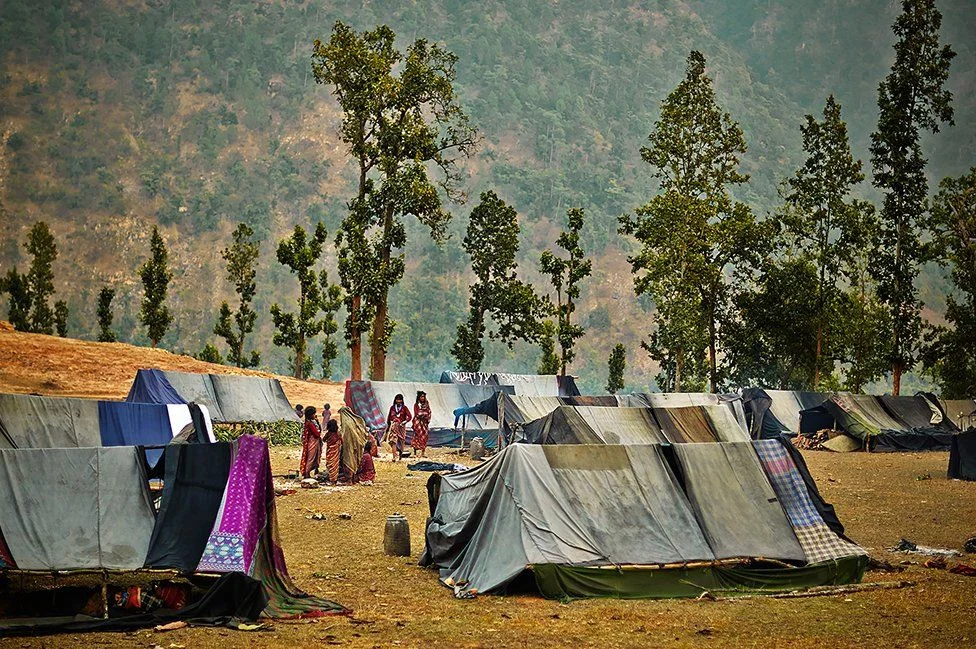
3. From the BBC, photos of the Raute people, some of the last remaining nomads in Nepal.

4.  David Brooks at The New York Times argues that we need ways to reward something more than just GPA.

Success is about being passionately good at one or two things, but students who want to get close to that 4.0 have to be prudentially balanced about every subject. In life we want independent thinking and risk-taking, but the G.P.A. system encourages students to be deferential and risk averse, giving their teachers what they want.

Creative people are good at asking new questions, but the G.P.A. rewards those who can answer other people’s questions. The modern economy rewards those who can think in ways computers can’t, but the G.P.A. rewards people who can grind away at mental tasks they find boring. People are happiest when motivated intrinsically, but the G.P.A. is the mother of all extrinsic motivations.

5. A video that explains how the soundtrack of the Lord of the Rings movies elevates the story. (At least there is something decent about those desecrations of Tolkien's creation.) The point is less about LOTR and how good soundtracks can aid in communicating the content of the movie.

Get 10% any purchase here: http://squarespace.com/nerdwriter HELP ME MAKE MORE VIDEOS: http://www.patreon.com/nerdwriter ASK ME QUESTIONS HERE: http://thenerdwriter.tumblr.com TWITTER: https://twitter.com/TheeNerdwriter Email me here: thenerdwriter@gmail.com SOURCES: Judith Bernanke, "Howard Shore's Ring Cycle: The Film Score and Its Operatic Strategy" (From: Studying the Event Film: The Lord of the Rings) New York: Manchester University Press, 2008.

Worth Reading - 5/6

1. Russell Moore argues that the evangelical church cannot fail to speak against racism in its virulent forms and maintain a gospel witness. This is, perhaps, the most significant issue that many evangelical churches are failing to grapple with.

Years ago, members of a Southern Baptist church in suburban Birmingham, Ala., who couldn’t figure out why their church was in decline asked a friend of mine for advice. The area had been majority white during the violent years of Jim Crow. While civil rights protesters were beaten and children were blown apart by bombs, church members had said nothing. That would be “political,” church members said, and they wanted to stick to “simple gospel preaching.”
As the years marched on, the area became majority black. The congregation dwindled to a small band of elderly whites who now lived elsewhere. They tried, they said, to “reach out” to the church’s African-American neighbors, but couldn’t get them to join.
A canvass of the area would have told them that the church had already sent a message to those neighbors when it had stood silent in the face of atrocity. Those neighbors now had no interest in bailing out a congregation with a ministry too cowardly to speak up for righteousness when it had seemed too costly to do so.

2. The political vitriol of the present age is related somehow to the rise to prevalence of the alt-right. There are mobs of individuals, most of them hiding behind anonymous avatars and pseudonyms, who are preaching identity politics for Europeans, advocating blatant racism, and generally assaulting (online so far) who opposes Trump. It's real folks and it needs resisting.

One way to understand the alt-right is not as a movement but as a collective experiment in identity, in the same way that many people use anonymity on the Internet to test more extreme versions of themselves. Moldbug, when he stepped out from behind his pseudonym, turned out to be a Silicon Valley computer programmer who had started as a commenter in the factional circles of libertarian message boards. CisWhiteMaelstrom, who convened the pro-Trump hordes that swallowed the politics sections of Reddit, turned out to be a law student in his early twenties who was looking forward to a job in which he could make the most money possible. These are familiar conservative types, in the same way that the alt-right pioneers John Derbyshire and Taki Theodoracopulos are familiar conservative intellectuals, who first came to prominence at National Review. And as pointed as Zero Hedge’s Russophilia is, it was the Virginia co-chair of the Ted Cruz campaign who flew to Syria last week to assure Bashar al-Assad that President Cruz would be on his side. The tone of Trumpism and of the alt-right conceals a more familiar politics. Partisans of the alt-right are often described as “shock troops” of the Trump phenomenon, in the same way that Trump voters are understood to be outsiders invading the Republican Party. But my suspicion is that these descriptions get them wrong, by imagining that they are a new group of people rather than the same old group during their off hours, trying out a different form of play.

3. If you've paid much attention on social media, you've probably heard about a nincompoop suggesting she deserves "me-ternity" leave to find herself, since maternity leave sounds like such a vacation. This post in response is appropriately pointed and delightfully humorous in a snarky sort of way.

It’s a silly little article posted for the purpose of marketing her novel “Meternity… about a woman who fakes a pregnancy and discovers some hard truths about what it’s really like to ‘have it all.'” And it’s done a fairly good job of that, I assume, since there’s a slew of discussion on the subject flaring all over the internet.
My favourite parts are where she argues that this is about women “putting themselves first” and that she should get both “Meternity” leave and maternity leave if she decides to have kids later. Why not just take the rest of your life?
Really though, the article isn’t actually as stupid or as the headline makes it seem – she’s basically arguing for paid time off to find yourself – which you either support or you don’t. And for all I know the book is awesome and insightful.
But her piece did get me thinking about what a “maternity leave without kids” would look like. So, I drew up a list of suggested rules guidelines, and now I think that this is a great idea.

4. A small sized study (and thus not fit for drawing firm conclusions) of participants in the reality TV show, The Biggest Loser, reveals that the bodies of obese individuals may be working against them to keep them fat. It's a long read, but it details the reality that most of the folks that worked so hard to lose weight on the show can't keep it off and this is in large part because their metabolisms slow to lower than normal and their body produces hormones to make them crave food. 

Researchers knew that just about anyone who deliberately loses weight — even if they start at a normal weight or even underweight — will have a slower metabolism when the diet ends. So they were not surprised to see that “The Biggest Loser” contestants had slow metabolisms when the show ended.
What shocked the researchers was what happened next: As the years went by and the numbers on the scale climbed, the contestants’ metabolisms did not recover. They became even slower, and the pounds kept piling on. It was as if their bodies were intensifying their effort to pull the contestants back to their original weight.
Mr. Cahill was one of the worst off. As he regained more than 100 pounds, his metabolism slowed so much that, just to maintain his current weight of 295 pounds, he now has to eat 800 calories a day less than a typical man his size. Anything more turns to fat.

5. Everyone loves a myth buster right? It's good to validate information and not simply accept what has been accepted as ultimate fact, but who fact checks the fact checkers? Who keeps the debunkers from slipping into a wormhole of doubt and doom? This is an interesting read, a bit long, but worth some thought as we live in an information saturated world.

It seems plausible to me, at least, that the tellers of these tales are getting blinkered by their own feelings of superiority — that the mere act of busting myths makes them more susceptible to spreading them. It lowers their defenses, in the same way that the act of remembering sometimes seems to make us more likely to forget. Could it be that the more credulous we become, the more convinced we are of our own debunker bona fides? Does skepticism self-destruct?
Sutton told me over email that he, too, worries that contrarianism can run amok, citing conspiracy theorists and anti-vaxxers as examples of those who “refuse to accept the weight of argument” and suffer the result. He also noted the “paradox” by which a skeptic’s obsessive devotion to his research — and to proving others wrong — can “take a great personal toll.” A person can get lost, he suggested, in the subterranean “Wonderland of myths and fallacies.”

Worth Reading - 5/4

1. Individuals who favor socialism tend to whitewash the negative impact it has in many cases. One strong example of this is the current regime in Venezuela, which has significantly undermined economic freedom and created an economy so poor it cannot print more money

From motorcycle parts, to flour, to fuel, to aspirin, we’ve been documenting the turmoil as Venezuela rapidly runs out of just about everything and spirals into economic collapse. But this week’s story of shortages surpasses them all.

Now Venezuela is running out of money. Actual money. As in banknotes. The country can no longer afford the pieces of paper which represent the money it doesn’t have.

2. It's not just advocates of small government who think that business regulations are excessively complex, it's also small business owners. These are regular people trying to make a living. Unfortunately, in an ever changing regulatory environment, the jungle of rules, guidelines, and compliance requirements often consume an incredible amount of their time.

“In one year,” wrote Warren Meyer in 2015, “I literally spent more personal time on compliance with a single regulatory issue -- implementing increasingly detailed and draconian procedures so I could prove to the State of California that my employees were not working over their 30-minute lunch breaks -- than I did thinking about expanding the business or getting new contracts.”
Meyer is the owner of a company that runs campgrounds and other recreational facilities on public lands under contract from the government. It doesn’t seem like regulatory compliance should be eating up so much of his time; he is not producing toxic chemicals, operating a nuclear facility, or engaged in risky financial transactions that might have the side effect of sending our economy into a tailspin. He’s just renting people places to pitch a tent or park an RV, or selling them sundries. Nonetheless, the government keeps piling on the micromanagement lest some employee, somewhere, miss a lunch break.
I know what you’re going to say: Employees should have lunch breaks! My answer is “Yes, but.…” Yes, but putting the government in charge of ensuring that they get them, and forcing companies to document their compliance, has real costs. They add up.

3. Anti-Semitism is a thing of the past, right? Everyone is very tolerant and inclusive. Except when they aren't. There is a rising tide of anti-semitism that is coming from the political left in Europe and to some degree in America, too. It often takes the form of anti-Zionism, and includes calls to divest from Israel in order to punish them for their human rights abuses. While we certainly don't need to agree with everything that Israel does, there seems to be an unhealthy bias against Israel. Here's an article from the UK that talks about that bias.

But on another, more visceral level, it chills me to the bone. And it’s not the terrorists. They threaten me, of course, as they threaten us all. Yet to me, the real chill comes from their fellow travelers – the useful idiots of the terrorists and Jew-murderers who say they do not have a racist bone in their body, but when it comes to Jews, a blind spot emerges. The likes, to be blunt, of the now suspended Ken Livingstone, who claims never to have come across a single example of Anti-semitism in the Labour Party. He clearly has never looked in the mirror. Much has been written – especially by the brilliant Nick Cohen – on the "Red/Green Alliance"; the phenomenon by which a swathe of the Left has linked up with radical Islam, leading to the bizarre spectacle of Leftist feminists supporting Islamists who would cut off the hands of women who read books.
With "anti-Western-imperialism" as part of the glue binding the alliance, everything else falls into place. So Hamas and Hezbollah might have as their defining goal the elimination of an entire people from the face of the earth, but that unfortunate consequence for Jews is by the by, because Hamas and Hezbollah are freedom fighters.

4. Sometimes life isn't fair. And because of that, sometimes we need to make adjustments and use common sense to be safe. David Mills discusses recent furor over a candidate for the GOP presidential nomination urging young ladies to stay away from parties with a lot of alcohol. He argues this isn't a case of blaming the victim, but urging potential victims to avoid risky situations. 

Recently, the governor of Ohio, John Kasich, responded to a young woman’s worries about being sexually assaulted on campus by saying all the right things and adding that having two 16-year-old daughters, he didn’t even like to think about it. Every father will know what he meant. (I am not, I should make clear, a Kasich supporter.)
She responded, “It’s sad, but it’s something that I have to worry about.” Kasich answered: “Well, I would give you, I’d also give you one bit of advice, don’t go to parties where there’s a lot of alcohol. OK? Don’t do that.”
The political and ideological opportunists leapt in, reading from the standard liberal script that men blame women for being raped, from which some moved to the necessity for unrestricted abortion and funding Planned Parenthood. Their button had been pushed.

5. Even before autonomous cars are approved for the road, there are ways to dissipate traffic jams and prevent them from happening. Read this article to see what you can do to make the world a better place by improving the flow of traffic.

Adding extra space between cars would cause jams to dissipate, and allowing people to merge early would ease bottlenecks. In general, driving more slowly will get drivers to their destinations faster. At its essence, the execution of his theory just encouraged drivers to keep a steady average speed, rather than racing ahead only to brake to a stop.

Worth Reading - 4/29

1. The number of minors requesting genital cosmetic surgery has risen to the degree that it warranted a NY Times opinion article. They went far out of their way, however, to avoid discussing the root cause of the issue, which is pornography. The trend and their discussion is worth reading in light of the interaction linked in the second post below.

So many teenagers are seeking cosmetic surgery to trim or shape the external genitalia that the American College of Obstetricians and Gynecologists issued guidance from its Committee on Adolescent Health Care to doctors last week, urging them to teach and to reassure patients, suggest alternatives to surgery that may alleviate discomfort, and screen them for a psychiatric disorder that causes obsession about perceived physical defects.
As for why there has been an increase in demand for the surgery among teenagers, physicians are “sort of baffled,” said Dr. Julie Strickland, the chairwoman of A.C.O.G.’s committee on adolescent health care

2. Samuel James interacts with the above NY Times article in a post at First Things. He digs into some of the damage that pornography, which is a part of the sexual revolution that has dealt its rotten goods the fastest and in the most empirically demonstrable fashion.

Of all the Sexual Revolution’s fruits, porn is arguably the one that has rotted fastest. It has defied the categorical wisdom of libertines by growing in users and extremeness, even as cultural mores against casual, commitment-free sex have eroded. Contrary to the predictions of many, porn has proven to be addictive and isolating. What was once promised as an end to slavish prudishness has instead ensnared millions in powerful neurological patterns, patterns that, if unabated, are conducive to the worst kinds of abusive and sadomasochistic behavior.
Despite much emerging data, including research on the psychological costs of addiction, it seems that the American left rarely talks about porn and culture. A celebrity iCloud hack or the firing of a schoolteacher tend to inspire a round of takes on body-shaming and feminism, of course. And occasionally a Game of Thrones episode will trigger a backlash against simulated rape. Otherwise, it seems that pornography is the pink elephant in the room for most mainstream liberals.

3. Conservatives are stupid. Or that's what many on the left seem to argue. The smugness of the left is being called out on Vox of all places. (Not that we don't all get smug sometimes.) It's a lengthy read, but it may be a sign that the Left is beginning to recognize that they contribute to the problem of an inability to communicate.

Knowing is the shibboleth into the smug style's culture, a cultural that celebrates hip commitments and valorizes hip taste, that loves nothing more than hate-reading anyone who doesn't get them. A culture that has come to replace politics itself.
The knowing know that police reform, that abortion rights, that labor unions are important, but go no further: What is important, after all, is to signal that you know these things. What is important is to launch links and mockery at those who don't. The Good Facts are enough: Anybody who fails to capitulate to them is part of the Problem, is terminally uncool. No persuasion, only retweets. Eye roll, crying emoji, forward to John Oliver for sick burns.
The smug style has always existed in American liberalism, but it wasn't always so totalizing. Lionel Trilling claimed, as far back as 1950, that liberalism "is not only the dominant, but even the sole intellectual tradition," that "the conservative impulse and the reactionary impulse ... do not express themselves in ideas, but only in action or in irritable mental gestures which seek to resemble ideas."

4. Trillia Newbell discusses complementarianism in her experience as an African-American.

If complementarianism is defined solely by outward behavior and by certain societal standards for “a godly family model,” then many of us would be disqualified—including my mother. I grew up in a two-parent home and, though I wouldn’t say it was a Christian home, it was filled with love and laughter. My father owned a shoe-shine stand and took his role as husband, father, and leader seriously. My mother worked full-time and eventually, as an adult, finished college. We were a typical lower-to-middle class family. But to provide, my father needed the assistance of his wife. So she worked. This is the case for many families of all nationalities and ethnicities.
But some evaluating the African-American community might draw the conclusion that our sub-culture trends toward matriarchy. I’ve heard this stereotype many times in the past. The stereotype comes mainly from the large number of single mothers. In 2011, the Census Bureau’s American Community Survey reported a staggering 68 percent of black women who gave birth at the time of the survey reported as single parents. This is alarming. To put those numbers in perspective, ACS calculated 595,983 total births and 403,820 of them were from single mothers.

5. From Compassion, a slideshow of 30 kids bedrooms from around the world. This may be a good teaching tool for some American kiddos.

6. A recent post at Facts and Trends highlights the reality of human trafficking and what some Christians are doing to combat it.

Human trafficking occurs when those most vulnerable are exploited for financial gain, whether it be the young boy in Pakistan forced to work in brick kilns or the teenage girl in California being trafficked for sex by her boyfriend.
Forced labor and human trafficking make up one of the largest criminal enterprises in the world, generating $150 billion a year, according to the International Labour Organization. Roughly two-thirds appears to come from the commercial sexual exploitation of women, children, and men.
Although human trafficking is found in many trades, the risk is more pronounced in industries that rely on low-skilled or unskilled labor. In America, the high demand for cheap labor creates trafficking opportunities in such diverse places as restaurants, nail salons, oil rigs, agricultural fields, and garment factories.
If you think this can’t be happening in your town, think again. Trafficking occurs in all 50 states and in most zip codes, according to Polaris, an anti-trafficking organization.

Worth Reading - 4/22

1. When a man walks away from $13m, it brings many to question his motives. This ESPN article about the recent retirement of Adam Laroche talks about his decision, but it also provides the portrait of a man who was not dominated by love of his image or of money. Would we have done the same? Who knows. This article is worth reading either way.

So here's the deal: You need to forget everything you think you know about professional athletes. Adam LaRoche is different. He walked into the clubhouse for the first time every spring and greeted new teammates by saying, "Oh, hey, I didn't know we signed you." During spring training in 2010, with the Diamondbacks, he and his family pulled a trailer to Tucson, and he rode a bicycle from the campground to the ballpark every day. He's one of the stars of the reality TV show Buck Commander, in which he bow-hunts with a couple of ex-ballplayers, two country music singers and one member of the unapologetically redneck Robertson family, they of the Duck Dynasty dynasty. He also owns E3 Meat Co., which is run out of the Kansas ranch that's been in his wife's family for six generations.

2. An evangelical couple illustrates beautifully the extent of their pro-life belief. They adopted two embryos, one of which split into identical twins, and gave birth to them. Embryo adoption is an issue that the culture will have to deal with in the near future. An interesting read.

We see protection of children not as charity, nor as part of a political agenda, but as something near to the heart of God. Because every human life bears his image, all life –no matter how young or old, no matter the stages of development — has inherent dignity and value. The Scriptures testify that God has always pleaded for the protection of his most helpless and needy image-bearers. Another prevalent theme of the Bible is that God adopts believers into his own family. When we adopt, we are echoing his own compassionate work, giving the world a glimpse of the truth and beauty of the gospel.

3. Many middle class families lack the financial resources to cover moderate, unexpected expenses. An author discusses the shame he has felt in being financially needy while making a solid income.

You wouldn’t know any of that to look at me. I like to think I appear reasonably prosperous. Nor would you know it to look at my résumé. I have had a passably good career as a writer—five books, hundreds of articles published, a number of awards and fellowships, and a small (very small) but respectable reputation. You wouldn’t even know it to look at my tax return. I am nowhere near rich, but I have typically made a solid middle- or even, at times, upper-middle-class income, which is about all a writer can expect, even a writer who also teaches and lectures and writes television scripts, as I do. And you certainly wouldn’t know it to talk to me, because the last thing I would ever do—until now—is admit to financial insecurity or, as I think of it, “financial impotence,” because it has many of the characteristics of sexual impotence, not least of which is the desperate need to mask it and pretend everything is going swimmingly. In truth, it may be more embarrassing than sexual impotence. “You are more likely to hear from your buddy that he is on Viagra than that he has credit-card problems,” says Brad Klontz, a financial psychologist who teaches at Creighton University in Omaha, Nebraska, and ministers to individuals with financial issues. “Much more likely.” America is a country, as Donald Trump has reminded us, of winners and losers, alphas and weaklings. To struggle financially is a source of shame, a daily humiliation—even a form of social suicide. Silence is the only protection.

4. Although many narrow-minded people in contemporary culture would like to deny the basic human right of freedom of conscience, which is more narrowly referred to as religious freedom, there is a case to be made for the benefits of the freedom of religion. Right now the true bigots are winning. Those of us who value a classically liberal pluralism must continue to push back against the totalitarian demands of the radical left.

It’s remarkable, really. At the same time religious freedom appears both at a height of controversy in America and utterly collapsing in the Middle East, the world has at its fingertips volumes of research that affirm how good religious freedom is for every human on earth.

Most of us typically approach religious freedom through theology, philosophy, or history. Christians provide biblically informed arguments and learn from the history of our own tradition, both as martyrs and as oppressors. Similarly Judaism, Islam, and other religions provide their own rationale for religious freedom from within their traditions. And non-theists recognize their own self-interest in religious freedom when they are victims of theocratic oppression. We continue to need to cultivate and promote those reasons from within each religion and other worldviews.

But you may not have heard about the data-driven research that provide new tools with which to promote religious freedom. Sociologists and other scholars continue to find that religious freedom is a key ingredient to human flourishing around the globe.

5. A call for increased civility in political campaigns. Also, the realization that Trump has been so identified with incivility that his supporters are attacking calls for civility as being anti-Trump.

A story in The Oklahoman this week about Edmond fifth-graders urging presidential candidates to raise their level of discourse prompted a letter to the editor (unsigned) accusing the reporter of “stooping so low as to recruit kids to take down Donald Trump.”

Yet Trump, the Republican front-runner, wasn’t mentioned in the article, even one time. Sadly, the candidate has indeed become that synonymous with the boorish behavior among grown-ups that these young people are trying to temper.

Trump is known for following his own counsel most of the time (and, it should be noted, this has served him well, in business and now in politics), so he wouldn’t be likely to pay much heed to what a group of grade-schoolers has to say about comportment. Yet he and the other remaining candidates for president could stand to lend their ear.

Reporter Darla Slipke wrote Monday about a project in Linda Skinner’s enrichment classes at Heritage Elementary School, in which fifth-graders first discussed some of their concerns regarding the election, then wrote letters to the editor and letters to candidates.

Worth Reading - 4/15

1. Everything you know about Ty Cobb may be wrong. The transcript of a lecture given by Charles Leerhsen at Hillsdale College is a longish read, but worthwhile. He outlines his belief that the popular story of Cobb as a dirty player, racist, and overall nasty man is, in part, a myth created by a biographer. His description of his research process has explanatory power, and helps to remind us that much of what we are presented as historical fact may have been well-shaped by the mill of selective reporting.

As I proceeded I found many more stories contradicting the myth. Was he widely hated? An old newspaper clipping reported that the Chicago White Sox gave Cobb an award—remarkably, a set of books; Cobb was known as a voracious reader of history—for being Chicago’s most popular visiting player. And it turns out that when the Detroit Tigers were in town, Ring Lardner, Chicago’s smartest and best sportswriter, bought cheap seats in the outfield so he could spend the game bantering with Cobb.

Did he steal stamps from children? Letters in museums and private collections make abundantly clear that Cobb responded to his young fans, sometimes with handwritten letters that ran to five pages. And he always told them he was honored by their autograph requests.

2. What do we do when science is biased? That appears to be a growing trend. When modern trust in science becomes scientism, the falsification of contemporary scientific data can be problematic.

Many defenders of the scientific establishment will admit to this problem, then offer hymns to the self-correcting nature of the scientific method. Yes, the path is rocky, they say, but peer review, competition between researchers, and the comforting fact that there is an objective reality out there whose test every theory must withstand or fail, all conspire to mean that sloppiness, bad luck, and even fraud are exposed and swept away by the advances of the field.

So the dogma goes. But these claims are rarely treated like hypotheses to be tested. Partisans of the new scientism are fond of recounting the “Sokal hoax”—physicist Alan Sokal submitted a paper heavy on jargon but full of false and meaningless statements to the postmodern cultural studies journal Social Text, which accepted and published it without quibble—but are unlikely to mention a similar experiment conducted on reviewers of the prestigious British Medical Journal. The experimenters deliberately modified a paper to include eight different major errors in study design, methodology, data analysis, and interpretation of results, and not a single one of the 221 reviewers who participated caught all of the errors. On average, they caught fewer than two—and, unbelievably, these results held up even in the subset of reviewers who had been specifically warned that they were participating in a study and that there might be something a little odd in the paper that they were reviewing. In all, only 30 percent of reviewers recommended that the intentionally flawed paper be rejected.

If peer review is good at anything, it appears to be keeping unpopular ideas from being published. Consider the finding of another (yes, another) of these replicability studies, this time from a group of cancer researchers. In addition to reaching the now unsurprising conclusion that only a dismal 11 percent of the preclinical cancer research they examined could be validated after the fact, the authors identified another horrifying pattern: The “bad” papers that failed to replicate were, on average, cited far more often than the papers that did! As the authors put it, “some non-reproducible preclinical papers had spawned an entire field, with hundreds of secondary publications that expanded on elements of the original observation, but did not actually seek to confirm or falsify its fundamental basis.”

3. A somewhat edgy post on some of the difficulties of pornography, particular that it tends to objectify women and turn sex into a performance. Though this is not written from a Christian worldview, it illustrates that the real damage of the sexual revolution is not a figment of the Christian imagination. It is a reflection of the disorder of the world.

In the survey report, entitled Don’t send me that pic, participants reported that online sexual abuse and harassment were becoming a normal part of their everyday interactions. And while the behavior seemed so common, more than 80% said it was unacceptable for boyfriends to request naked images.
Sexual bullying and harassment are part of daily life for many girls growing up as a part of this digital generation. Young girls are speaking out more and more about how these practices have links with pornography—because it’s directly affecting them.
Pornography is molding and conditioning the sexual behaviors and attitudes of boys, and girls are being left without the resources to deal with these porn-saturated boys.

4. The social media echo-chamber is a real phenomenon. It is common on both the right and the left, but seems to be more prevalent on the left. This cuts off people from understanding that there are any people, much less a large number, who see the world differently. It may explain why blatant misrepresentations of laws are allowed to propagate unchecked.

My former classmate's enthusiastic endorsement of the gun video I posted made me consider how my circle of virtual and real-life friends has expanded over the years. The people who have entered it tend to all fall on one side of the political spectrum, and my most intimate interactions are with people who share a majority of my worldview and beliefs.
This is quite common. According to Mitchell, "Nearly half (47 percent) of those with consistently conservative political views and about a third (32 percent) of consistent liberals say that the posts they see are nearly always or mostly in line with their own views." This phenomenon is commonly referred to as the "echo chamber effect."

5. As bad as the latest Superman movie appears to have been (I have not seen it), there seems to be a lesson in it about moral relativity, which gets unpacked in this Canon and Culture article.

Western society has long been the subject of a power struggle. Since the dawn of the Enlightenment, there has been a steady tide attempting to erode belief in the supernatural. More recently, the philosophical assumptions that issue from broad acceptance of an ultimate reality have come into the crosshairs, and nowhere is this more clearly on display than in terms of morality. But substituting faith in a divine or ultimate authority, in favor of naturalism and rationality is not without its consequences. Indeed, while our culture is in fact becoming more secular, such an experiment—at least in America—necessarily severs our ties to the philosophical and ethical moorings that undergird not only our laws, but our national identity. I am confident we have underestimated the cost.

6. Alan Noble offers some humorous small group icebreakers in a column at Christianity Today.

A well-designed icebreaker does just that: it disperses the smokescreen of societal politeness by tricking people into Doing Life Together. Here are just some examples of the kinds of questions you can ask to help your small group feel comfortable sharing deeply personal issues with people they have just met because they attend the other service:
  1. If you could change one thing you dislike about yourself, why haven't you done it already?
  2. If you hadn't married your spouse, who would you have married? Is their life better than yours?
  3. What hidden sin would you not like to confess tonight?

Worth Reading - 4/8

1. Eugenics is back. Now it's designer babies. While we certainly have the ability to modify the human gene or simply select the "best" human genes, this does not imply that we should do so. However, there appears to be a movement in the UK to do just that:

A hundred years ago the eugenic mission involved a handful of crude tools: bribing the ‘right’ people to have larger families, sterilising the weakest. Now stunning advances in science are creating options early eugenicists could only dream about. Today’s IVF technology already allows us to screen embryos for inherited diseases such as cystic fibrosis. But soon parents will be able to check for all manner of traits, from hair colour to character, and choose their ‘perfect’ child.

The era of designer babies, long portrayed by dystopian novelists and screenwriters, is fast arriving. According to Hank Greely, a Stanford professor in law and biosciences, the next couple of generations may be the last to accept pot luck with procreation. Doing so, he adds, may soon be seen as downright irresponsible. In his forthcoming book The End of Sex, he explains a brave new world in which mothers will be given a menu with various biological options. But even he shies away from the word that sums all this up. For Professor Greely, and almost all of those in the new bioscience, eugenics is never mentioned, as if to avoid admitting that history has swung full circle.

The first 10 minutes of this podcast are worthwhile, too:

2. Does the government have a right to know what you support? A recent question of privacy rights in California is raising that question. Government efficiency is good, but it may not trump all individual freedoms.

The state of California argued that its interest in rooting out fraud and abuse is important enough to require charitable organizations to provide the state with big donors’ names, saying that review of donor information helps investigators detect misuse of charities. The foundation — Americans for Prosperity (AFP), a conservative political advocacy group that supports limited government, lower taxation, and free market principles — argued that such disclosures would discourage would-be donors from giving money, out of fear of reprisals. The foundation had ample examples at its disposal of what gives rise to such fears, including witness testimony from several donors who have been harassed and threatened for supporting conservative movements. One witness described being spat on at a right-to-work event. Another testified that he received death threats.
This is how we do things on the Internet, though. We come up with terrible ideas and then immediately push them out into the world where they ruin people’s lives. We do it with tweets, and we do it with new technologies, even when they’re loaded with obvious problems. The main problem, of course, with the “Mic Drop” feature was that it was too easy to use by mistake, but there were other problems as well. There was the fact that they didn’t do enough to educate people about what it would do. And then, there was…well, there was the “mic drop” image itself.

Whatever else you may say about the act of “dropping the mic,” it’s hard to deny that it’s an inherently aggressive act. Owing to rap battles as it does, there’s an implied message to it: “I’ve just said the last word, and I’ve shut you down so effectively that I know I can both surrender my platform and damage some expensive electronics that I don’t own with impunity.”

4. Again with the humor thing. The Babylon Bee struck a chord with a number of folks this week with a piece on quarterly church attendance and a faithless kid. There were some folks riled about it because it hit too near to home. However, it raises a question about absenteeism from church and the message that sends to kids.

Local father Trevor Michelson, 48, and his wife Kerri, 45, are reeling after discovering that after 12 years of steadily taking their daughter Janie to church every Sunday they didn’t have a more pressing sporting commitment—which was at least once every three months—she no longer demonstrates the strong quarterly commitment to the faith they raised her with, now that she is college-aged.

5. This video is of Slavoj Zizek relating political correctness to modern totalitarianism. The point is well taken and worth thinking about. I think that his example of using racial epithets is a poor example. (He uses several, which I do not condone. If that will offend you, then don't click this link.) However, the general chain of logic and the difference in the sort of coercion being used in postmodern argumentation is worth noting.

Worth Reading - 4/1

Here are some links worth reading this weekend.

1. A big case in Malaysia in which someone was allowed to convert from Islam to Christianity. This is a reminder to appreciate our present religious liberty in the US and continue to pray for those who are oppressed elsewhere.

In a landmark ruling last week, a Malaysian court upheld the rights of a Christian to convert from Islam.
The judgment establishes a precedent in a country where religious conversions, particularly from Islam to Christianity, have been steeped in controversy. The verdict reaffirms the right of freedom of religion, guaranteed under Article 11 of Malaysia’s constitution.
Rooney Rebit, the plaintiff, argued that his belief in Jesus was a fundamental human right, and the High Court in Kuching, Sarawak state, agreed. The judge, Yew Ken Jie, said, “He is free to exercise his right of freedom to religion, and he chose Christianity.”

2. On the other hand, in the US, one writer makes a strong connection between religious liberty and Apple's fight over encryption. Why should Apple have a right to avoid governmental intrusion in its product, market, and practices when they lobby for other entities to lose similar rights? The two things need not be exactly the same to find important similarities between the issues.

Responding to consumer demand for privacy, Apple’s iPhones possess seemingly unbreakable encryption. According to the company’s motion to vacate, the government asked the company to write unlocking software that will work only on this particular iPhone, belonging to Syed Rizwan Farook. Apple argues that since the law treats computer code as speech, the government is attempting to violate First Amendment rights by compelling its speech. The government must show that getting Apple to create this code is “narrowly tailored to maintain a compelling state interest.” Apple claims the FBI has not submitted any evidence that the iPhone holds relevant information that the government needs.
In the Hobby Lobby case, the government faced similar burdens under the Religious Freedom Restoration Act. It had to demonstrate that the contraceptive mandate was the “least restrictive means” to achieve its compelling interest. Ultimately, the court ruled that in asking Hobby Lobby to violate its sincerely held religious beliefs, the government had not chosen the least burdensome approach.

3. One of the best things that Christians can do when communicating with non-Christians is to admit when skeptics have a valid point. It's not that there are no difficulties in Christianity, it's that Christianity provides the best overall answers to the most difficult questions. Simply dismissing someone's concerns is unlikely to lead to a meaningful dialog.

Years ago, when I began earnestly addressing my questions about the plausibility of Christianity, I often found myself disappointed when I found answers. In fact, I sometimes felt that it would have been better to not have voiced my doubts at all. “If this is the best we can do,” I thought, “then I guess my concerns were well-founded.”
Of course, there’s a legitimate reason for finding an answer unsatisfactory: perhaps there isn’t a good answer. But this usually wasn’t the case, and it certainly wasn’t the most troubling kind of case. Rather, the responses that bothered me most were those that didn’t seem to see the real weight of my question. When people underestimated the difficulty of my objection they usually gave distressingly facile answers, which, to my mind, immediately discredited their competence (even if not their sincerity). And along with that credibility went a little bit of Christianity’s believability.
But whenever I found an author who unblinkingly acknowledged the difficulties—who admitted that the opposition had a point worth addressing—I found immediate relief. In fact, even if the response to the objection wasn’t enough to fully alleviate my doubt, merely knowing that someone else understood the issues gave me solace and breathing room. I then had time and space to work through my questions slowly and carefully.

4. If you haven't linked with the Babylon Bee, you're missing out. It's a satire site based on a Christian worldview that shares traits with the Onion. They are a month or so in and still producing great content. Today's gem mocks the first-year seminary student who, for some reason, thinks he's got it all covered.

First-year seminarian, George Turner, 23, confirmed Friday that—if necessary—he could easily step in to take over Rev. Gary Price as Senior Pastor at Covenant Presbyterian.
Turner realized it probably wouldn’t be that hard as he sat through Rev. Price’s Easter sermon over break during his first semester at his divinity school.
“Well, it’s not that he’s a bad preacher”, Turner hedged, “but I don’t know how well he’d do in my preaching class nowadays”, noting that since he had been in ministry for more than 20 years, it had been a while since Price had received his Master of Divinity.
“We’re just not as propositional in postmodernity. The Bible is a story, you know?”

5. Justin Taylor shares some insights on writing curated from the writing of C.S. Lewis. They are worth a few minutes and a bookmark.

Work hard at being clear.
“Take great pains to be clear. Remember that though you start by knowing what you mean, the reader doesn’t, and a single ill-chosen word may lead him to a total misunderstanding. In a story it is terribly easy just to forget that you have not told the reader something that he needs to know—the whole picture is so clear in your own mind that you forget that it isn’t the same in his.”
Don’t throw away writings projects that you put aside.
“When you give up a bit of work don’t (unless it is hopelessly bad) throw it away. Put it in a drawer. It may come in useful later. Much of my best work, or what I think my best, is the re-writing of things begun and abandoned years earlier.”

6. Chris Krycho and Stephen Carradini discuss art and politics in their latest podcast:

Worth Reading - 3/25

1. A few weeks ago, Aaron Earls wrote about the courage it will take to stand as a faithful Christian in the coming days. This is a message we need to understand now because it will only become more important in the future.

The bride of Christ has confronted and thrived in the midst of cultural embrace of triumphalist leaders parading as political messiahs, sub-biblical sexuality offering empty promises, the devaluing of human life from the unborn to the elderly, and rejection of our shared humanity over issues of race and class.
That the Church will come through victoriously on the other side yet again is not in doubt—not because our strength or accomplishments, but because of Christ’s strength in our weakness and His finished work on our behalf.
The only real question is about you and I. Will we make it through unscathed? Will individual Christians maintain their faithful witness in the midst of trying times? That all depends on how we choose to respond.
We will be told that there are only three options—capitulation, cowardice or cynicism. Each have their own temptations and allures, but each is faulty and unbiblical.

2. Derek Rishmawy tangles with the notion that people always live consistently with their doctrine. Sometimes they do, but sometimes they don't.

See, while I still believe that doctrine and life go together, I think there’s a bit of confusion more broadly about the connection between believing and living. People seem to have bought into a popular version of what economists call “rational actor theory”, where (on my dummy definition) people make their decisions in a goal-oriented, reflective, and maximizing way. In other words, there’s something of a clean link up between beliefs and behaviors. If you know one, you should be able to draw a straight line to the other.
This is the kind of folk theory you see at work in a lot of our conversations around politics, or in theology, and so forth. Joe believes in penal substitution, and he just punched Lou in the face, so clearly it’s his violent ideology at work. Jenny struggles with anxiety, so that must be her Arminian theology of providence crushing her with stress. Jake has been flirting with progressive theology lately, so we can expect him to acquire a harem soon. And so forth. Or, we’re shocked when someone who believes as we do acts in a manner we never would.

3. Over at RAAN (Reformed African American Network) they spent some time talking about a recent kerfuffle on social media. More significantly, the podcast talks about what can be learned from a mistake made in public about race relations.

4. Over at BBC an article considers why people are so gullible. I don't agree with everything the author argues, but it worth a read an some thought.

If you ever need proof of human gullibility, cast your mind back to the attack of the flesh-eating bananas. In January 2000, a series of chain emails began reporting that imported bananas were infecting people with “necrotizing fasciitis” – a rare disease in which the skin erupts into livid purple boils before disintegrating and peeling away from muscle and bone.
According to the email chain, the FDA was trying to cover up the epidemic to avoid panic. Faced with the threat, readers were encouraged to spread the word to their friends and family.
The threat was pure nonsense, of course. But by 28 January, the concern was great enough for the US Centers for Disease Control and Prevention to issue a statement decrying the rumour.
Did it help? Did it heck. Rather than quelling the rumour, they had only poured fuel on its flames. Within weeks, the CDC was hearing from so many distressed callers it had to set up abanana hotline. The facts became so distorted that people eventually started to quote the CDC as the source of the rumour. Even today, new variants of the myth have occasionally reignited those old fears.

5. Social media gives us the ability to speak too quickly (see number 3 above). Richard Clark argues that the tendency to be a hashtag activist leads us to respond too quickly to perceived injustices.

If only every online controversy or burst of outrage were as valuable or effective. Perhaps because we’ve seen some Twitter-storms work effectively, they have become a go-to for airing grievances and frustrations even when it would be better to workshop them with friends and experts. We sometimes confuse a call for something to be done with the act of actually doing something—instead of giving strategic thought to the best course of action, much less working to become a part of the solution. Often the wise course is instead to wait, listen, and think for a while.
To wait and listen is not inaction. Few of us are crime-fighting superheroes. We are rarely directly affected by, or experts in, the issue at hand. For many issues, it might be better to not immediately enter the fray—especially if we suspect we may be justifying ourselves by showing that we’re on the right side of the latest cause. In most cases, the charitable and wise step is to listen to those who have “a dog in the fight” or more expertise about the issue. As Proverbs puts it, “Do you see a man who is hasty in his words? There is more hope for a fool than for him” (29:20, ESV).

6. Why would a church support abortion? Russell Moore unpacks one explanation. The answer is pretty awful.

In 2006, Schaper wrote an article about the abortion she had. She wrote that her abortion was the right choice since she and her husband had young twins at the time. “Because women are mature sexual beings who make choices, birth control and abortion are positive moral forces in history,” she wrote. “They allow sex to be both procreational and recreational, for both men and women.”
What was striking to me at the time was that Schaper did not rely on the standard abortion advocacy arguments of the unborn child as a “clump of tissue” or a “mass of cells.” Instead, she called her abortion murder, and spoke of her unborn child as a child. She even named her “Alma,” which means “soul.”
“I happen to agree that abortion is a form of murder,” she wrote. “I think the quarrel about when life begins is disrespectful to the fetus. I know I murdered the life within me.”
“I could have loved that life but I chose not to,” she continued. “I did what men do all the time when they take us to war: they choose violence because, while they believe it is bad, it is still better than the alternatives.”

Worth Reading - 3/18

1. A long form essay by Karen Swallow Prior on developing moral imagination. Particularly a moral imagination that envisions a future without abortion.

It is not enough to expose the horror of the abortion trade for what it is, as the Planned Parenthood videos have done. We need to imagine ways to make abortion obsolete by filling the needs it meets with something better.
We must challenge the assumptions that portray abortion as a “necessary evil” with research, stories, art and real lives that offer countering visions. In doing so, we can refashion the image held within the cultural imagination of pregnancies as problems to be solved into one that envisions all children as blessings to society and all mothers as worthy of honor and support. We can replace the narrative that says women need abortion in order to flourish, that the economy needs abortion in order to reduce crime, and that children who fit into our lives according to plan are better off than those who don’t with a life-affirming narrative.
How do we cast such an image? By embodying it in our own lives, churches and communities.

2. David Brooks explains why many conservatives will never vote for Trump:

[T]here are certain standards more important than one year’s election. There are certain codes that if you betray them, you suffer something much worse than a political defeat.
Donald Trump is an affront to basic standards of honesty, virtue and citizenship. He pollutes the atmosphere in which our children are raised. He has already shredded the unspoken rules of political civility that make conversation possible. In his savage regime, public life is just a dog-eat-dog war of all against all.
As the founders would have understood, he is a threat to the long and glorious experiment of American self-government. He is precisely the kind of scapegoating, promise-making, fear-driving and deceiving demagogue they feared.

3. From BBC, 10 of the worlds most beautiful ceilings:

4. The Winning Slowly podcast, featuring my friend Chris Krycho, gives a thoughtful, creative perspective on immigration, the refugee crisis, and how we should or should not respond.

5. Trevin Wax writes about the importance of holding ourselves separate from strong political affiliations. As Christians, we belong to a supreme King, and not the culture whose time and space we occupy.

Past leaders of conservative Christianity warned against excessive attachments to political parties. Chuck Colson warned against the Left’s growing intolerance for religious liberty and the rights of conscience. But he also drew fire from the Right when he advocated prison reform. He was willing to buck the party line and be labeled “soft” on crime because he knew what needed to be done and he was willing to take a stand, no matter where the political winds were blowing.
“When the church aligns itself politically,” Colson wrote, “it gives priority to the compromises and temporal successes of the political world rather than the its rightful Christian confession of eternal truth. And when the church gives up its rightful place as the conscience of the culture, the consequences for society can be horrific.”

Worth Reading - 3/11

1. Trevin Wax notes that the Trolls are winning. They are stifling discussion and debate online. While Christians cannot prevent others from trolling, they can certainly refrain from it themselves.

Whenever you feel the need to relentlessly attack the candidates you disagree with, you should see that tendency as fleshly, not godly. Do not spread slander. Fact check. Make your disagreements substantive and your commentary winsome.
The Apostles Peter and Paul were clear: Christians are to show honor to everyone, including (in their time) Nero, a bloodthirsty, sexual deviant on Caesar’s throne. We should be known for honor in a world of insults.
Alongside programs that filter internet content coming into our phones or computers, we ought to consider an “honor filter” that would help us control what goes out.
The world needs the aroma of heaven, not the toxic fumes of our online battles. If it’s true the trolls are winning the web, let’s make sure they are as few Christians as possible among them.

2. Why are place names in Britain so strange? A recent BBC article gives a linguistic response. This is a real treat for a language nerd.

The drive from the town of Much Wenlock to Ashby-de-la-Zouch is 60 miles east across the English Midlands. Once you have crossed the River Severn and passed the Wrekin rising to the left – the last of the Shropshire Hills – you join the M54 at the Wrekin Retail Park. At Featherstone, you have a choice: north and then east past Lichfield and Tamworth, or southeast past Walsall, Wednesbury and Birmingham, south of Sutton Coldfield, and northeast to cross the River Tame. Either way, once you’re past Appleby Magna and crossing the River Mease, you’re almost there. Be sure not to make a wrong turn and end up in Donisthorpe, Newton Burgoland or Snarestone.
And just like that, in an hour and a quarter, you will have covered the great sweep of British history: from the Celts through the Romans, Anglo-Saxons, Scandinavians, and Normans to modern times – all as displayed in Britain’s place names.

3. The so-called "Same God" controversy at Wheaton has wound down. The professor has gotten another job at UVA and the media furor has died down somewhat. The media has shifted to focus on other more interesting occurrences, but the wounds are still open at Wheaton. Daniel Treier, who is on faculty at Wheaton, has offered some lessons learned from the events with well-meant criticisms of all sides. This is a must-read for those involved in or thinking about being involved in higher education at a faith-based institution.

Will this Wheaton tragedy foster any newfound wisdom? I have tried to indicate how the actions of all parties could involve good faith and fragmentary wisdom despite the tragic outcome. If so, then our primary focus should not be fighting over the assignment of blame but seeking mutual growth in wisdom. All the same, we must be sober about two final aspects of our challenging circumstances.
First, “Christian liberal arts” education may be more effective at conveying intellectual skills and professional success than fostering wisdom. Extreme right-wing and left-wing rhetoric is not isolated among alumni. It is hard to quantify how many people quietly engaged thoughtful perspectives rather than jumping to conclusions, but a distressing proportion of the visible responses from all Wheaton stakeholders violated James 1:19-21. Four years of education can only do so much, but unfortunately the alumni reaction matches the mixed character of the response from me and my colleagues.

4. Ross Douthat from the New York times examines the connection between Prosperity Gospel believers and support for the potential presidency of he-who-must-not-be-named. It seems that the name it and claim it heresy is wound up in political aspirations.

And the lure of the strongman is particularly powerful for those believers whose theology was somewhat Trumpian already — nationalistic, prosperity-worshiping, by turns apocalyptic and success-obsessed.
With the steady post-1960s weakening of traditional Christian confessions, the preachers of this kind of gospel — this distinctively American heresy, really — have assumed a new prominence in the religious landscape. Trump, with his canny instinct for where to drive the wedge, has courted exactly these figures. While more orthodox Christians have kept him at arm’s length or condemned him, he’s wooed televangelistsand prosperity preachers, and pitched himself to believers already primed to believe that a meretricious huckster with unusual hair might be a vessel of the divine will.
Which he is not, save perhaps in this sense: In the light of Trumpism, many hard truths about American Christianity — its divisions, its failures, its follies, its heresies — stand ruthlessly exposed.
And the truth, we’re told, will set you free.

5. King's College professor, Anthony Bradley, writes about the intersection of Race, Mass Incarceration, and Drug Policy. While the disproportionate rates of incarceration indicate a problem, he argues that the usual scapegoat--the war on drugs--is not necessarily the culprit.

With the 2010 publication of The New Jim Crow: Mass Incarceration in the Age of Colorblindness by Ohio State University law professor Michelle Alexander, the conversation about America’s exploding prison population singularly became focused on the intersection of race, poverty, and the War on Drugs. According to the narrative, the drug war disproportionately targets blacks in lower income communities as a means of social control via the criminal justice system similarly to the way Jim Crow controlled blacks in the early 20th-century.
The one problem with mass incarceration-as-Jim-Crow thesis is that it does not fit the empirical data. The drug war is not the reason that today we have nearly 2.5 million people incarcerated in this country. In the mid-1970s the U.S. prison population grew from about 300,000 to 1.6 million inmates, and the incarceration rate from 100 per 100,000 to over 500 per 100,000 largely due to violent crime, property crime, and rogue prosecutors. Drug policy changes would, therefore, have little effect on prison population rolls.

6. A NY Times interview with Wendell Berry where he answer some questions and gives amazing non-answers to others. Still worth a read.

From my earliest life, my mother and other grown-ups in my family read to me and encouraged me to love books. After I learned to read, I read intensely but intermittently. Often I would be too much outdoors, playing or working, to read. As a reader, I was inclined to find a book I liked and read it over and over again. When I was about 12, I could fairly recite “The Yearling.” “The Swiss Family Robinson” I read many times, also the novels of Mary O’Hara: “My Friend Flicka” and “Thunderhead.” I read, and believed, “Tarzan of the Apes,” other books by Edgar Rice Burroughs and several novels by Zane Grey. I read also (illegally) many comic books.

7. In an Op-Ed at the New York Times, Roger Cohen argues there is a rising anti-Semitism in the world. 

The zeitgeist on campuses these days, on both sides of the Atlantic, is one of identity and liberation politics. Jews, of course, are a minority, but through a fashionable cultural prism they are seen as the minority that isn’t — that is to say white, privileged and identified with an “imperialist-colonialist” state, Israel. They are the anti-victims in a prevalent culture of victimhood; Jews, it seems, are the sole historical victim whose claim is dubious.
A recent Oberlin alumna, Isabel Storch Sherrell, wrote in a Facebook post of the students she’d heard dismissing the Holocaust as mere “white on white crime.” As reported by David Bernstein in The Washington Post, she wrote of Jewish students, “Our struggle does not intersect with other forms of racism.”

8. Do we have the freedom to dissent? Conscience protections seem to be embedded in our Constitution's First Amendment, however the conflict between the sexual revolution and the conscience of some citizens seems to be prioritizing the will of some over the integrity of others. Andrew Walker from the ERLC picks up the topic in context of a conscience protection bill being considered in Georgia.

Much misinformation and mischaracterization surrounds the proposed religious-liberty legislation in Georgia. The legislation at hand, HB 757, incorporates what’s known as a pastor-protection act and language similar to the federal First Amendment Defense Act, a proposed piece of legislation that prevents government from taking any adverse action against individuals or organizations because of a belief about marriage.

Worth Reading - 3/4

Here are some links worth reading this weekend:

1. The President of the SBC's ERLC explains why he's stopped using the term 'Evangelical.' This is largely because it is being misused to indicate a political stance instead of faithfulness to gospel doctrine and praxis. His explanation is helpful as we seek to understand how self-proclaimed evangelicals can lobby for morally corrupt policies:

The word “evangelical” has become almost meaningless this year, and in many ways the word itself is at the moment subverting the gospel of Jesus Christ.
Part of the problem is that more secular people have for a long time misunderstood the meaning of “evangelical,” seeing us almost exclusively in terms of election-year voting blocs or our most buffoonish television personalities. That’s especially true when media don’t distinguish in election exit polls between churchgoers and those who merely self-identify as “born again” or “evangelical.”
Many of those who tell pollsters they are “evangelical” may well be drunk right now, and haven’t been into a church since someone invited them to Vacation Bible School sometime back when Seinfeld was in first-run episodes.

2. My friend, Amy Whitfield, writes about how politics has changed in the last two decades. As an avid follower of American and World politics, Amy is faced with a different tone and rhetoric than has been used in her experience. This impacts how she parents and the questions that she has to answer for her children as she seeks to educate them on politics. Note that this was written before one candidate made crude reference to his genitalia at the RNC debate.

I'm learning that every teachable moment is a gift, if we can just open our eyes to see the light. As much as I want to shield them from the very worst, I have decided to tell the truth. We talk about the good things and the bad things. We talk about what we can learn. We talk about being good citizens no matter what the context, and no matter what rights we may have to lay down. And we talk about a perfect city that I assure them is completely real.
In a different time, when every day felt like “morning in America,” it could be difficult to long for something else. And when it all seemed fixable, it was easy to think that we didn't need rescuing.
But today I am pointing my children to something better, because it has become appallingly clear how much we need it. I take them with me to the polls to show them that part of participating in this world means using my voice. But I want them to know that when I cast my vote in that booth, I’m casting my cares somewhere else.

3. An article in the Atlantic that talks about the merits of going to a Free Market approach to water rights in the American West. Is this what we must do to cope with the drought?

Farmers might prefer to sell their extra water rather than letting it soak into the ground, but there, too, the laws get in the way. Not only is it difficult to prove that water sales satisfy standards for beneficial use, but they are generally forbidden across state lines. Where intrastate trades are allowed, they are conditioned on not causing harm to other rights holders in the surrounding area. That’s a laudable intention, but it forces farmers who want to sell their water to spend thousands of dollars on engineers and lawyers.
The West’s cities, meanwhile, are forecast to add at least another 10 million residents over the next three decades. Where the water to serve those people will come from is anyone’s guess. City and state leaders have seriously discussed building a pipeline from the Missouri River, seeding clouds with silver iodide to create rain, and towing icebergs from the Arctic. Their most pragmatic hopes lie in desalinating ocean water, an expensive and energy-intensive process.
Something has got to give.

4. Bible scholar, Patrick Schreiner, discusses the moral significance of our jokes and what we laugh at.

The biggest questions in the world matter for our everyday lives more than we often realize. For instance, how you understand time, space, and God will affect what makes you laugh.
On a casual reading of Paul’s letters, some might assume that Paul ignores philosophical questions. Yet Paul did not shy away from the deepest, most complicated questions at all. In fact, he tackled them with the strength and confidence of a bull in a rodeo. But unlike many philosophers, Paul’s philosophy was wrapped in pastoral garments. He thought that our understanding of time and space should determine the types of jokes we tell and what sort of husbands and wives we should be.

5. An article at the Institute for Faith, Work and Economics on the need to create opportunities for economic inclusion of the poor, not just create a system of handouts. This is a basic lesson, but one that bears repeating.

The underlying causes of poverty reveal that economic freedom matters greatly.
Creating lasting change in the realm of foreign aid and international development requires a strong understanding of the nature of poverty.
The poor lack access to the market, they have no property rights, and they have little to no justice in the courts.
By understanding the components of economic freedom, we can change the direction of our efforts to aid the poor and start to place a greater emphasis on creating more free economically free societies that protect the poor and seek their flourishing.

6. A Podcast by Russell Moore on how his family does family devotions.

7. While the capitalism is not a perfect economic system, looking at some of the improvements in the quality of life in the U.S. in the last 100 years gives us reasons to celebrate the benefits of the system. Some of the reasons include:

  • Life expectancy at birth for people born in 1915 was 54, versus 79 today.

  • Over half of the 100 million in the US was under 25, versus only a third of our 321 million.

  • 87% of births were outside hospitals, versus 1% today.

  • The population was 90% white, versus 63% today.

  • 13% of the population was foreign-born… which is equal to what it is today! (N.B. it dropped below 5% by 1970.)

  • 50% of the population was rural, versus 20% today, and 78% lived in their state of birth, versus 59% today.

  • 85% of men over 14 and 23% of women over 14 were employed full-time, versus today’s over 16 full-time stats of 69% for men and 57% for women.

  • 14 % of people ages 14–17 were in high school; 18% of the population ages 25 and older had completed high school, compared to 85% in 2014. (You could leave school at 14, instead of 16-18.)

  • Only federal employees had 40-hour weeks; the typical was 55 to 65 hours for the lower and middle classes.

8. A new Christian satire site has launched. The Babylon Bee appears to be on track to be a legit, humorous way for us to poke fun at ourselves. In any case, a recent post by Karen Swallow Prior is very funny. 

In an effort toward uniformity and correctness, the Counsel on Biblical Gender Roles is updating all its official materials with the correct spelling of “complementarian,” according to Executive Director Pat Doyle. “Biblical roles and spelling rules go hand-in-hand,” Doyle added. “It’s hard for a doctrine to be taken seriously when those who advocate for our view don’t even know how to spell it.” The organization will undertake updating all of its existing publications to replace the frequent misspelling, “complimentarian,” with the correct spelling, which, grammar experts say, has an entirely different meaning.
“‘Compliment’ means to say something nice to someone,” Trisha McAuliffe, an adjunct English instructor at Rochester Community College explained. “‘Complement’ means a fitting counterpart.” She had, however, never heard of complementarianism.


Worth Reading - 2/26

1. Don Whitney shares an immensely encouraging account of his daughter's thankfulness for leading family worship faithfully for years, even when there wasn't an immediate impact evident.

Many times after family worship, I wondered if anything good had been accomplished. Almost nightly I had to remind myself to trust in the Lord to do his work through his Word, and not in my perceptions or feelings about what had or had not occurred.
Often came the nights when I perceived no enthusiasm to gather for family worship, and frankly, many times I had very little myself. In many such cases I knew we needed to proceed with at least a brief time of family worship out of sheer discipline and a resolve that refused to cave in to plausible excuses of everyone’s fatigue or busyness. Sometimes I sensed that to mandate family worship on that occasion would be received as harsh and legalistic, so we settled for simply singing the Doxology or offering a brief prayer. And I second-guessed myself just about every time I had to make such a call.

2. Alistair Begg on the difference between knowing and feeling in worship:

3. Sometimes the things that critics of Christianity say about the Bible are just silly. Here is a post from a few weeks ago where Greg Gilbert debunks many of the claims that are most often repeated.

One American tabloid recently said this about the Bible:
No television preacher has ever read the Bible. Neither has any evangelical politician. Neither has the pope. Neither have I. And neither have you. At best, we’ve all read a bad translation—a translation of translations of translations of hand-copied copies of copies of copies of copies, and on and on, hundreds of times.
First, it’s not true we’re dealing with “a translation of translations of translations,” as if the original Greek first went into Chinese, which went into German, which went into Polish, and finally we got around to putting it into English. No, we’re able to translate directly from the original Greek and Hebrew, so at worst we’re dealing with a translation, full stop. But what should we say about that that idea, the charge that all we have available to us are “hand-copied copies of copies of copies of copies”?
Copypock. Er, I mean, poppycock. That’s what we should say.

4. The ignorance is apparently catchy. A professor at Notre Dame notes that even his excellent student are simply unaware of much of Western history and thought. They are heirs without an inheritance:

My students are know-nothings.  They are exceedingly nice, pleasant, trustworthy, mostly honest, well-intentioned, and utterly decent.  But their minds are largely empty, devoid of any substantial knowledge that might be the fruits of an education in an inheritance and a gift of a previous generation.  They are the culmination of western civilization, a civilization that has forgotten it origins and aims, and as a result, has achieved near-perfect indifference about itself.
It’s difficult to gain admissions to the schools where I’ve taught – Princeton, Georgetown, and now Notre Dame.  Students at these institutions have done what has been demanded of them:  they are superb test-takers, they know exactly what is needed to get an A in every class (meaning that they rarely allow themselves to become passionate and invested in any one subject), they build superb resumes.   They are respectful and cordial to their elders, though with their peers (as snatches of passing conversation reveal), easygoing if crude.  They respect diversity (without having the slightest clue what diversity is) and they are experts in the arts of non-judgmentalism (at least publically).  They are the cream of their generation, the masters of the universe, a generation-in-waiting who will run America and the world.

5. John Piper celebrates the ability to be productive at 70. Don't waste your life.

Join the happy psalmist: “My mouth is filled with your praise, and with your glory all the day. Do not cast me off in the time of old age; forsake me not when my strength is spent” (Psalm 71:8–9). We have good reason to believe God will answer that prayer for Christ’s sake.
Break free from the spirit of this age. See the world — see your life — the way God sees it. In his reckoning, sweet soul-rest begins when you are born again (Hebrews 4:310), and rest from our labor — true retirement — begins when you die.
Make no mistake. The Bible believes in retirement. It’s called heaven. Then the new earth. It lasts forever. Compared to it, this life is a vapor’s breath. All our trials here are “a light and momentary affliction” that are preparing for us an “eternal weight of glory beyond all comparison” (2 Corinthians 4:17). Keep your eyes on this prize. Such a rest the world has never dreamed of.
“Blessed are the dead who die in the Lord . . . that they may rest from their labors, for their deeds follow them!” (Revelation 14:13). Be up and doing. Joyfully. For Christ. Full of hope.