The Choir Member's Lexicon

As you probably know already there is nothing that a church choir is typically more in need of than tenors.  Second only to that is some knowledge of music.  We see the little booklet of black dots and lines in front of us every Sunday morning and Sunday afternoon, but all those symbols do is make neat boundaries around where the words are; that’s all we really use it for.

The previous paragraph isn't entirely true: some of the choir doesn't make it to both morning and afternoon sessions on Sunday.  For those that do, and those that are reading this who have some knowledge of music theory, you will forgive any typographical errors which may cause definitions of certain words to be expressed in ways that you are not familiar with, or cause definitions to appear to be factually incorrect.  Also, for the more rigid lexicographical purists, you will note that I have disposed with the usual alphabetical organization of things because I felt like it.  

As to my choice of words, I have chosen only the words most important for a Biblical understanding of church music: I have trimmed out all the fluff and developed what is a basic guide to choir membership.  Anyway, let’s begin...

A Flat n. The reason that half the choir was late to the Easter cantata.

Crescendov. To increase the volume of one’s voice, e.g. What happens in the Soprano section when the choir director is working with the Baritones.

Bassn. One of the group of men who couldn't be a Tenor. Synonym: general population. 

Soprano – 1.  n. Women who sing the top set of notes in choir music.  2. n. Choir members who can comfortably sing the Tenor line in a David Clydesdale piece.

“Okay, let’s try it again” – 1. Uh, Oh. 2. We’re singing this Sunday? 3. What else do we know that we could sing Sunday?

“This may not be your best gift” -  1. What the choir director tells you at auditions to encourage you in your children’s ministries. 2. A sign that a recording contract isn't in your future. 3. Even Carol Cymbala might not want you.

Alton. A popular brand of mints.

Fermatta n. A soft Greek cheese usually associated with pitas.

A Naturaln. The note that is a step above the range of some Sopranos.

B Flat -   Colloquialism referring to the nature of the Tenors, i.e. “You B Flat.”

Solon. A section of music in which only one person miscounts the number of measures rest.

Decrescendov. What happens abruptly after a solo.

Duetn. A solo for two people. See also: Solo.

Ad Lib v. What the praise team does when the words get messed up on the projection screen.

Mass Confusionn. Congregational Ad Lib.

Forte – 1. Adj. The median age of the altos. 2. Adj. Ten greater than the admitted median age of the altos.

Tenors – 1. n. The blessed ones. The elect. 2. Adj. The first half of the phrase indicating a value slightly greater than nine, i.e. What time did you go to bed?  I don’t know, tenor ‘leven.

Pianissimo -  n. The Italian word for Big Piano.

Mezzo ForteAdj. The admitted age of the gray haired altos.  See Also: Forte.

Quarter Noten. One of those little black dots we don’t look at anyway.

Baritonesn. Fence sitters. 
Mock Draft 1.0 for the Upcoming Pastor's Draft

The coverage of the 2015 NFL draft has taken over sports media. Who is the best player? Who will be drafted first? Which team will blow their future for a marginally better player in this year's draft? These are the pressing questions of the day.

However, a more significant question is out there. That is, who are the top prospects available for the 2015 Pastor's draft? In this post I'll take a modified "Big Board" approach to list my top prospects for this year, with commentary. I'll also stop at five, because that's about how long anyone might care.

1.    David Blakely is the top prospect on my Big Board this year. He’s an all-star student that can really bring the house down when he preaches. The best things about him are that he plays the guitar AND the organ, and he’s got experience as a church janitor because that's how he paid his way through seminary. He comes as a twofer, because his wife will get her MA in Biblical Counselling this Spring, and has spent the last six years working in early child education. She can bring home the bacon and run VBS, which makes this couple the top pick in this year’s pastoral draft. Blakely has no leadership experience, but that makes him ready to be controlled by a solid deacon board. He’s likely to go to Crick River Baptist, who finished at the bottom of their association last year after the volunteer Youth Leader and Pastor ran off together.

2. I think the next prospect off the board will be Eli Felluten, though it's not because of quality. Eli declared for the pastoral draft early by taking an MA instead of the MDiv. He says it’s so he can “get on mission” sooner, but sources say that it was the D- in Hebrew that scared him off biblical languages. At any rate, he’s likely to be off the board early because his name is Felluten and Felluten Baptist Church of Felluten, Alabama, which is in Felluten County, wants an Associate Pastor to serve under Reverend Elvis Felluten, who happens to be Eli’s Grand-daddy.

3. Philbert Dolittle is the near the top of the talent pool in this year's draft. He was a top student in each one of seminary classes and always produced when it came to paper time. Everyone remembers the Hermeneutics paper where he delivered the blow-out 35 page paper on the 15 page assignment. This guy has staying power. The downside is that he comes from a Calvinist system, so there are questions about what kind of scheme he will fit into and whether he can adjust to associational politics in Georgia or Louisiana. I think he's a solid first round pick, but his stock is likely to dip a little come draft day because of the "TULIP" tattoo on his right forearm and his mismatched socks. Though he's got the chops to be an every Sunday starter from day one, his stock may fall until he gets selected as a Youth Pastor at a large church, where his X-Box skills will serve him well, even if his overall talent is underutilized.

4. The next guy on my Big Board is Thaddeus Pig. Pig brings in the bacon at a meaty 302 pounds, 5 feet 7 inches. He has the physical characteristics of the average mid-career pastor, so he's way ahead of the game. Pig is also known to be a top performer at church potlucks. In fact, his numbers were off the charts in calorie consumption at the Combine.  This guy excels at the apt art of alliteration and avoids conflict like a treadmill, so he's a good fit for a number of small churches. His lack of theological awareness was a liability in seminary, but it will stand him in good stead when he gets into their pulpits. Look for this guy to go early and then disappear into the rural church system.

5. Julian Barnsworth is really the best prospect in this year's draft, but I've got him pegged at number five on my Big Board just because he's not likely to get much attention. When you watch the tape on Julian, he's got good delivery. This guy stands in the pulpit and reads the congregation well. He needs a little polish on his sermons, but the intangibles are there and I think he's the most pastor-ready of all the candidates. His theological accuracy is way beyond the rest of the field. However, since all the tape on this guy is in the practice setting and scrimmages--you know, class assignments--it's unlikely he gets picked in the first three rounds. You just can't get a job without experience, which makes it tough for guys like Julian who have families and can't take youth pastor positions. Julian is a second career pastoral candidate who spent ten years as an Electrical Engineer and Supervisor for a major corporation, which should be credited to him as experience, but it's likely churches will be concerned with how well his people skills will translate to the local church. This guy is a late round gem if he doesn't decide to pull out of the draft and get a PhD.

Editor's Note: For those that aren't aware, this is satire. Which, of course, means that it is probably more true to life than I choose to admit. Any likeness of names, descriptions, and personalities in this to anyone you know or have heard of is incidental, because when I wrote it I was going off of stereotypes and not individuals. Really.

How Then Should We Give?

Photo courtesy:  Edd Sowden - Day Eighteen - Change - Used by Creative Commons License.

Photo courtesy:  Edd Sowden - Day Eighteen - Change - Used by Creative Commons License.

Given how often social media posts, hear radio ads, or television commercials ask me to donate money electronically, I would have assumed a generation of digital natives would be among the most generous around. There are always opportunities being presented for needs around the globe.

Additionally, the popularity of the story about the guy who raise tens of thousands of dollars for a Potato Salad on Kickstarter, gives the impression that floods of money are being sent by digitally connected people to many causes, worthy and otherwise.

The February 2015 report from the Bureau of Labor and Statistics on the results of the 2013 Consumer Expenditure Survey shows this isn’t the case. On average, people in the United States give about 2.9% of their income to charity. People under 25 give only 1.7%, while those in the 25-34 age bracket give about 1.6%. All of the media awareness has not raised the rate of giving at any age, even among digital natives.

Despite millennials being engaged in many social causes, and the increasing use of digital media to raise awareness, the result has not been a world-changing generosity toward charitable causes.

This is statistical reality, but it leads us to an important question as we experience the relative wealth of living in a developed nation: How much should we give?

Should We Tithe?

Some figures in church history would have us believe that giving 10% of our income is taught in Scripture. However, the case for carrying over the duty to tithe from the Old Testament to the New Testament is much more complicated than some allow.

For example, there seems to be more than one tithe in Scripture (E.g., Num. 18:21, 24; Deut. 14:22-27; Deut. 14:28-29). Additionally, the tithe(s) were not the extent of required giving. There are other offerings and sacrifices prescribed in Old Testament law. Since there is no clear command to give a particular percentage in the New Testament, and the tithe and offering system seems to be more clearly a part of the old covenant system of worship, it is questionable whether 10% is the amount Christians need to give.

As a matter of fact, as with most of the ethical mandates of the Old Testament, the New Testament seems to call for a higher degree of generosity. Just as Christ explained that lust is a sin like adultery (Matt 5:27-28), so he provided an example of heroic generosity instead of a duty based giving of a particular percentage (Mark 12:41–44).

Paul’s teaching in 2 Corinthians 8 is one of the key passages for determining how contemporary Christians should give.  In Paul’s letter to the Corinthians, he describes Macedonia giving generously from their poverty as an encouragement to give.

This exhortation to be generous comes after Paul’s earlier instructions in 1 Corinthians 16:1-4 to regularly set aside money in preparation for a large gift being sent to alleviate the financial difficulties of the church in Jerusalem.

In neither of these places does Paul cite a specific amount, but urges generosity according to means. The Corinthians were to do more than calculate a percentage when writing their check to the church.

Practical Lesson from Paul

There are at least three things we can learn and apply from Paul’s teaching to the Corinthians:

1.      Giving should be planned. Paul’s encouragement to the Corinthians to “put something aside” on “the first day of the week” (1 Cor 16:2) is significant as it required discipline and planning. Giving is not a reactionary donation of whatever is left after the remainder of our paycheck is spent, it is intended to be a planned economic activity.

2.      Giving should be according to our means. We mathematical modern Christians like to think this signifies a certain percentage; that way the amount goes up with our income. In reality, however, there is a minimum amount we need to survive. We should consider giving an ever increasing portion of our excess as we have the opportunity (2 Cor 8:14).

3.      Giving should be with a genuine generosity. Paul calls giving an act of grace (2 Cor 8:7). He also issues a plea not a command to the Corinthians to be generous (2 Cor 8:8). In other words, giving is to be out of an overflow of love for Christ, in view of his sacrifice for us (2 Cor 8:9), not out of a sense of duty or guilt. We should want to give.

As with any spiritual discipline, giving has the potential for legalism. Our goal should be to put resources entrusted us to work in the best way possible, which should include generous giving as well as wise investment of resources. After all, the earth is the Lord’s and everything in it (Ps 24:1). We are merely stewards of the resources God provides us.

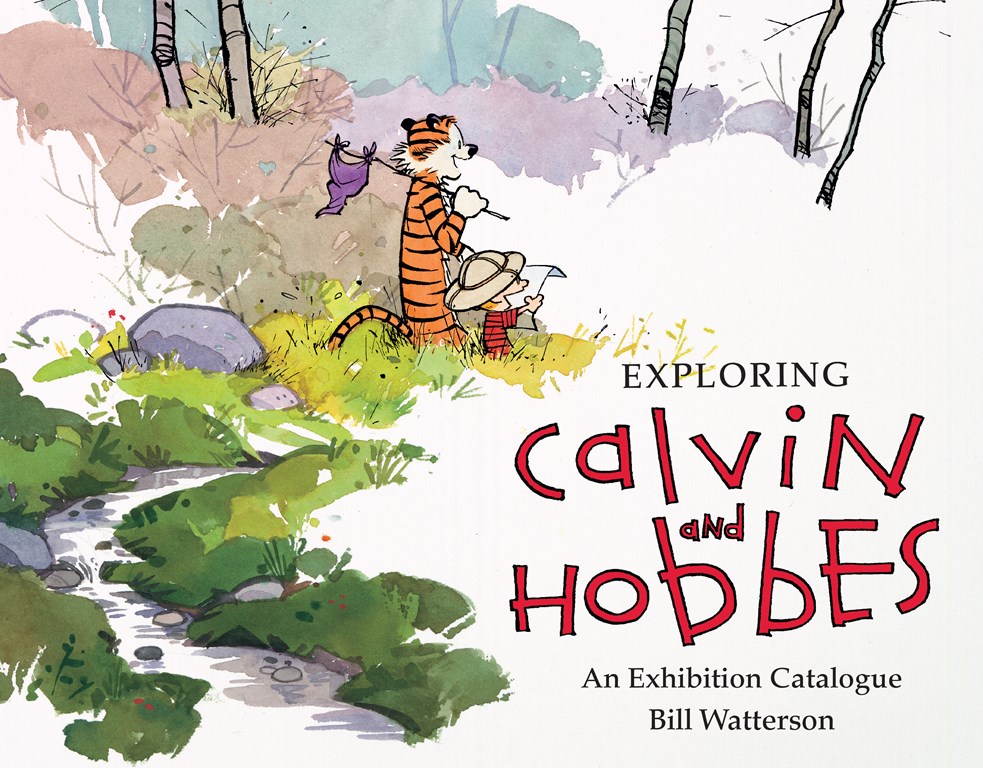
Exploring Calvin and Hobbes

When the latest Calvin and Hobbes book appeared on my front porch, there is little chance the postman recognized he was delivering a piece of my childhood in a hand addressed manila envelope. That is, however, exactly what happened.

For those of you who don’t know, Calvin and Hobbes, is an American cultural landmark. It is a comic strip that ran from 1985 until 1995 in papers across the country and around the world. Unlike many current comics, Calvin and Hobbes was always humorous and often side-splittingly hilarious.

Some comics currently in print have continued for decades, often recycling jokes, offering overly complicated plots with a multitude of extraneous characters, and losing the crispness and energy that once made them great. Thankfully Bill Watterson, the man behind Calvin and Hobbes, knew when to walk away and stopped drawing the strip after a decade.

Bill Watterson is a somewhat enigmatic artist. He did very few extended interviews while the strip was in print. Since he retired from drawing Calvin and Hobbes he has largely been out of public view. Many creative people are ready to write an autobiography to cash in on their celebrity as soon as they’ve had success, often providing tedious details of their creative processes. Watterson, on the other hand, has left his many fans largely in the dark.

Exploring Calvin and Hobbes

This new book from Andrews McMeel Publishing is a breakthrough for the hungry Calvin and Hobbes fan. Exploring Calvin and Hobbes: An Exhibition Catalogue begins with an extended interview with the man who curated a recent exhibit of Calvin and Hobbes strips at the Billy Ireland Cartoon Library & Museum. In this interview, Watterson discusses his childhood, how he became interested in cartooning, his various attempts to break into the industry, and how the production of Calvin and Hobbes took place for its decade-long run.

The second section contains ink on paper samples of some of the cartoonists and illustrators that influenced Watterson. These samples were chosen and annotated by Watterson himself. Next, there are samples of Watterson’s early efforts at editorial cartooning and submissions to syndicates that never made it to press. Finally, the collection includes many pages of samples of published cartoons from the strip’s epic run. These are original, ink on paper drawings that sometimes have whiteout, pencil marks, and even scotch tape visible. The final portion of the collections was selected by Jenny Robb, who is an associate professor at Ohio State University and a curator of the Billy Ireland Cartoon Library and Museum. They reflect her choice of some of the best and most representative strips that Watterson created.

Conclusion

To say that this book is a delight is an understatement. The pages are visually appealing, the layout creative, and the arrangement of the material tells the story well. The interview is engaging and highlights some of the information any true fan of Calvin and Hobbes should want to know. This is a pearl of great price.

Exploring Calvin and Hobbes is not the best entry point for people new to the strip. Starting here would be like trying to read the appendices to The Lord of the Rings before reading the book itself. Every true fan will read the appendices, but only after they have carefully digested the main body of work. The same applies for Watterson’s oeuvre.

However, for those that have read most or all of the Calvin and Hobbes cartoons, especially those who remember poring over the graphic delights offered by the strip during its newspaper run, this is a true gift. It is worth the time and well worth the money if you have the good fortune to be able to buy this volume.

You can see the daily strips and subscribe to have them in your social media account through the GoComics web distributor: Click Here.

Note: A gratis copy of this volume was received from the publisher with no expectation of a positive review.

Communicating Truth in a Digital Age

Used by CC license. Original: https://www.flickr.com/photos/seanbonner/2086934736

Used by CC license. Original: https://www.flickr.com/photos/seanbonner/2086934736

The greatest thing about the internet is that democratizes the exchange of information. We are no longer dependent on curators choosing which parts of the story we get to hear.

The worst thing about the internet is that it democratizes the exchange of information. We no longer have people filtering the stories we hear to help us get an accurate understanding of issues.

Carl Trueman wrote a critique of the problem the democratization of the internet a few years ago:

Then there was the case of a young guy who wanted to engage in email banter about something I’d written. What fascinated me was the way this person referred to himself at one point in our exchange as a scholar. Yet he had no higher degree, no track record of publications which had passed muster with peers in the field. Indeed, he’s still a student, not yet even beginning a doctoral program. Indeed, he’s a long way from possessing that most basic of academic union cards: a PhD. Now, I guess I’m old fashioned but the category of scholar is one which should be reserved for those who have established themselves in their chosen field by actual scholarly achievement, not by simply talking a good game. This credibility is achieved by consistent, careful and scholarly contributions to a field in terms of refereed publications which then enjoy currency among qualified peers outside the person’s immediate circle of epigonous friends.

Trueman may be a bit stodgy when it comes to academic qualifications. Sometimes people without the guild card of a terminal degree can make outstanding contributions to fields of study. However, those people are usually put forward by an expert who knows the field and recognizes the contribution made by an individual. Rarely do they self-identify as an expert. And rarely do they rise to the top of the field by merely reading and writing blogs.

Additionally, sometimes people that have academic qualifications are not as well informed as they believe themselves to be. This is particularly true when people are qualified in one area and speak out in another.

Overreaching by assuming authority in another discipline is a common trap for smart people to fall into. They assume that because they are highly qualified in one field, that ability bleeds over to other fields. Thus, an excellent civil engineer may feel herself to be an expert in evolutionary theory, too. The potential for that expertise may exist, but, as we all know, potential and actuality are two vastly different things.

The Value of Experts

Trueman’s criticism is generally valid because the process of earning a PhD in any subject trains an individual to recognize their own ignorance. The practice of careful scholarship and the fear of academic hubris that is generated during higher academics should improve a person’s ability to reason and explain a position.

There is an old aphorism, “The more you know, the more you realize you don’t know.” I heard professors spout that over the years, but it never really sunk home until I started working toward a PhD.

When I was reading introductory books and sitting in classes as an MDiv student, I was able to gain much of the information rapidly. Sometimes I felt like I knew it all. Then I started doing independent, academic research and realized how little I knew. I also realized how many of the opinions that I held so strongly had more potential criticisms that I had imagined.

This doesn't mean that my positions were not correct. I held to and still hold to a robust orthodoxy. However, sometimes I’ve had to rephrase my understanding of my positions. At other times, I’ve maintained my position and recognized that I’ve held it for the wrong reasons. And, still other times, I’ve come to the recognition there are a broader range of valid options than I had initially allowed.

Used by CC license. See Original: https://www.flickr.com/photos/tedxcalgary/15917692961

Used by CC license. See Original: https://www.flickr.com/photos/tedxcalgary/15917692961

None of this means there isn’t an absolute truth, which can be objectively known. Neither does it mean that all ideas are fair game and we can’t know anything. However, it does mean that a bit more humility is in order than I originally allowed, particularly when I am dealing with differing ideas within the bounded set of orthodoxy.

This is where the democratization of expertise comes back into this discussion. The internet is the Wild West of information and opinions. Anyone with a little time can start up a blog and make it look official.

As a result, the internet gets flooded with content that is ill-reasoned, ill-informed, and often caustic toward people that hold different opinions. You won’t go far on the internet before you run into someone being denounced because he holds a different position than another person.

Debate is a good thing, but in the wilderness of the internet there is a great deal more bloviating than debate. This is true on the left and the right. Part of this is that things look black and white when considered at an elementary level. This means that the subtleties of positions are generally not understood. It makes debate difficult, but being an insulting troll very easy.

So what’s the point?

The point is that we all need to engage in online conversations with grace and humility. We need to appreciate our own limitations. The handful of blogs and few books we’ve read don’t necessarily qualify us to comment on every social or theological debate.

We need to be clear, but gracious, where Scripture speaks clearly. In places Scripture doesn't specifically speak we need to be especially gracious and humble in how we approach the issue. We also need to recognize the complexity of our views and the opposing views.

No one believes they are a bad guy. Everyone thinks they are doing good, except for a few psychotically selfish people. Most of the time the place the discussion needs to begin is much deeper than the actual issue in question. The problem is not in the particular position, but at a deeper theological level.

For instance, the debate about abortion is more about an appropriate understanding of the value of human life than it is about individual rights. When we hold the debate in rights language instead of dealing with the deeper theological issue, we will make little progress. Unfortunately, the popular debate is nearly always couched in rights language.

Worse still, when we insult and impute motives to the people that disagree with us we merely galvanize their position. As William Blake wrote in the Proverbs of Hell, “Damn braces. Bless relaxes.” It’s hard to convince someone of your position when you’ve insulted them. More significantly, it’s hard to show the light of the gospel to someone you’ve verbally assaulted.

Christians, as people who claim to have access to objective truth through God’s special revelation, need to be especially careful about engaging in conversations well. We need to be purveyors of truth who seek to make our case well, but never compromising on both the meaning and the tone of our message.

Should Christians Pay Taxes?

As the ominous tax day approaches, the ethics of paying taxes seems like a timely topic. What should Christians think about paying taxes? Should we pay taxes if our government is doing things with the money we find morally objectionable? These are questions of growing significance.

Fortunately Scripture is not silent on this matter, and it provides us clear answers to the ethical questions about paying taxes.  Most helpful is the account of Jesus paying taxes, which is recorded in all three of the synoptic gospels (Matt 22:15–22; Mark 12:13–17; Luke 20:19–26), but there are other portions of Scripture in play, as well.

In the account of Mark 12:13–17, the Pharisees are attempting to trip Jesus up by questioning him about paying taxes to their religiously and socially hostile government. According to New Testament scholar Robert Stein, by asking this question, the Pharisees are putting Jesus in a dilemma. “If he answers yes, he will lose favor with the people, for they despise the Roman taxation. If he answers no, he will be advocating rebellion against Rome and force the Roman authorities to take immediate action against him.”[1] Jesus evades the religious leaders’ trap by demonstrating that their acceptance of the good provided by the Roman government, as evidenced by their possession of the coin which Jesus uses as an illustration, obliges them to pay taxes when they are required.[2]

The Romans had a history of oppression, including the violent suppression of a revolt in A.D. 6, which was started in reaction by the same tax in question in this passage.[3] Paying the tax was offensive to the people of Israel because the Roman tribute was used to fund their oppressor; the occupying nation who had committed the social and religious atrocity of killing worshippers in the process of performing their sacrifices (Luke 13:1) was being supported by this taxation. A radical faction of the people of Israel, the Zealots, would not pay the tax because it represented Caesar’s unjust rule over the nation.[4] Even among those who paid the tax, there was likely a deep seated resentment at the obligation to support their oppressors.

Jesus’ response to the question was, “Render to Caesar the things that are Caesar’s, and to God the things that are God’s.” (Mark 12:17, ESV) In other words, he was telling them to pay the tax in recognition of their obligation as subjects (not even citizens) of the Roman Empire. This message is consistent with Paul’s admonition to Romans to “Pay to all what is owed them,” including “taxes to whom taxes are owed.”  (Rom 13:7) It is also in line with Peter’s instructions to submit to authorities, including governments. (1 Pet 2:13)

We should keep in mind as we read these instructions in Scripture that the government that Jesus, Paul and Peter were subjected to was not friendly to godliness. These admonitions were written more than two centuries before the Roman government became friendly to Christianity, through Emperor Constantine’s public conversion. In contrast, all three men who commanded submission to the government died at the hands of the government.

So, the answer to the original questions about paying taxes when the government is misusing the money to support evil, even our own persecution, is that even then the payment is required. This is not, however, the end of the question.

In the United States in particular, but really in any democratically organized nation, citizens have a function in determining the use and appropriation of government funds. At the national level in our form of democracy, the input of the citizens in taxation consists of election of representatives and advocacy for just policies. At lower levels of government, particularly the local level, citizens have the right to directly vote on tax levies and municipal budgets. Submission to government by paying taxes does not rule out responsible advocacy to see tax policies changed.

Our submission to government is limited by our submission to God. In our obedience to the government, Calvin writes, we “must be particularly careful that it is not incompatible with obedience to him to whose will the wishes of all kings should be subject.”[5] However, based on the examples provided by Peter, Paul, and Jesus, paying taxes to an unpopular, pagan, and violent government does not result in sin.

Here are three conclusions we can draw from this discussion as tax season approaches and as political debates over the rate of taxation and use of appropriated funds continues:

1.      Everyone should pay their taxes in accordance with the laws of the land. Objecting to policies established by the government or the use of the government funds does not, according to Scripture, relieve the Christian of the duty to pay taxes. However, this does not mean that paying as much as possible in taxes is ethically required; using exemptions, deductions and credits in the tax code to reduce your tax bill is consistent with good stewardship.

2.      Participate in the political processes of the land to promote just uses of taxes.  Since we live in a context in which active engagement in the political processes is permitted under the law, we should be engaged in advocacy for uses of tax monies consistent with the Moral Law. In other words, we should politically resist attempts to use government funds to promote vices or punish virtues. This is inconsistent with the biblically recognized role of government, which is to “punish those who do evil and to praise those who do good.” (1 Pet 2:14, ESV).

3.      Be active in advocating for just forms of taxation. Again, our privilege in living in a democratically organized context gives us the ability to engage in open discussion and political activism regarding the tax code itself. We have to pay our taxes, but if we can change the tax code to make it more just, then that reflects submission to the government, as well. Reasonable, legal means of advocacy for changes to the law in order to promote the common good are well within the ethical bounds for Christians. We should work for laws that are just toward rich and poor alike, and that allow the government to punish evil and praise the good.

[1] Robert Stein, Mark, (Grand Rapids, Mich: Baker Academic, 2008), 542.

[2] Stein, Mark, 545–46.

[3] R. T. France, The Gospel of Mark, (Grand Rapids, Mich.: Eerdmans, 2002), 465

[4] William L. Lane, Mark, (Grand Rapids, Mich: Eerdmans, 1974), 423.

[5] John Calvin, Institutes of the Christian Religion, IV.20.32.

Thoughts on the Day after a plane Crash

We still don’t know all the details and we probably never will understand everything. However, if you are like me, you’re probably a bit shocked by the news of the recent plane crash, which appears to be the result of the co-pilot intentionally flying the plane into a mountain.

This is tragic. The loss of life is awful. The heartache the accident has caused so many people is saddening even from afar.

As I was reading the news stories and watching the press conferences, a few thoughts came into my mind. These are just things that struck me as I worked to understand this new tragic news through my worldview. They aren’t intended to make grand pronouncements or pointed apologetic points. This is one theologian's reflections on some terrible news.

1.       The effects of sin are more significant than we often recognize.

It doesn’t matter whether there was a grand plot to inspire fear, a twisted mind that wanted to make people suffer, or a person suffering from depression that chose to end his life in an awful way. This crash is a symptom of sin in the world.

Things aren’t supposed to be this way, but sin causes all humans to be turned in on themselves and away from God. Sometimes it causes bodies not to work right so synapses fire wrong and people make bad choices. No matter whether it was evil intent or bad brain chemistry, the world was not meant to be this way. This is a sign of sin in the world.

Evil is all around us, both natural evils and those brought on through ill will. We need to recognize this, grieve over it, fight sin in our own hearts, and yearn for the coming renewal of all things.

2.       We are far more dependent on mutual goodwill than we acknowledge.

One person was able to kill hundreds of others due to an awful choice. Every time we get on a plane we trust in the good will of the mechanics, the flight crew, and the tower controllers to do their jobs as well as they can and get us to our destination safely.

Every day we trust that most people are generally honest or afraid enough of the consequences not to steal from us. Generally we can trust that someone won’t break into our car or kill us when we walk down the street.

We are all capable of horrible evil and yet generally we don’t do the worst things we are able to. However, one bad choice can hurt a lot of people. One dishonest business person can bankrupt dozens of others. One unfaithful spouse can disrupt the lives of an entire family and leave stains of sin on generations to come. There is a fine line between justified trust and abuse of trust.

Neighbor love is important because it makes life bearable.

3.       We are far more dependent on God’s common grace than we can see.

Part of what keeps us from being as bad as we could be is God’s common grace. If it weren’t for God’s kindness that restrains us by implanting some sense of goodness in all humans, things would be much worse.

And things could be much, much worse. While we mourn for the sorrow of this event, we can thank God for restraining so much evil that we never even recognize.

Thank God for his common grace on all creation that keeps it from being entirely distorted.

4.       Christians can have hope in the coming renewal of all things.

Even as we mourn with those who mourn, we do not mourn as those who have no hope. Instead, like Paul, we can consider these present sufferings unworthy to be compared with the glory that is to be revealed in us as well as all creation. (cf. Romans 8:18ff)

This isn’t the way it’s supposed to be. Thank God that he has set in motion his plan to make it all better someday. There will be a day when every tear is gone and all things are made new. (cf. Revelation 21)

That doesn’t dull the pain and shock of the tragedy today, but it does provide a way to keep from despair. If it weren’t for the hope of all things being set to rights, the weight of sin might well overcome us and lead us to despair.

Thank God for his mercy on all of us. Thank God for his grace that leads to repentance and renewal. Thank God and pray for those suffering from this tragedy.

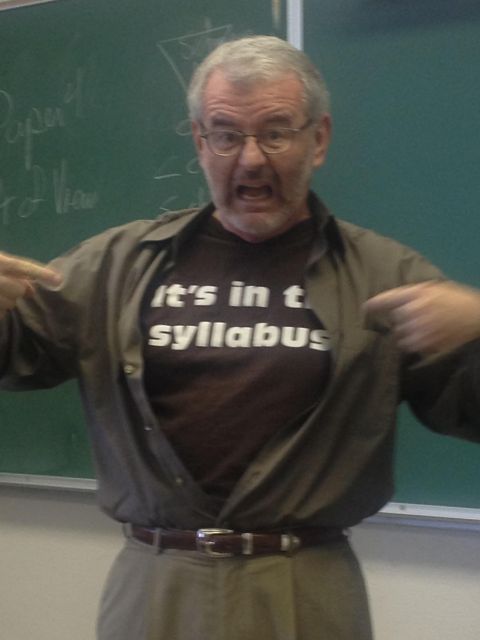
Reading the Syllabus

If you are a professor or a grader, you're probably reading this and saying, "Yes!!! I hope all my students read this."

If you are a student, you are probably thinking: (A) "this really doesn't matter," (B) "no one would ever do this," or (C) "is he talking about me?"

If you are in group A, you should be in group C. If you are in group B, you are totally wrong. If you are in group C, then you should rightly be embarrassed. Fortunately, there is hope for you if you recognize your faults and turn away from them.

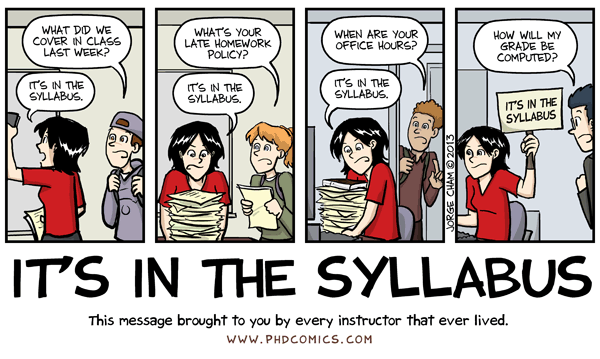
Professors are required to create syllabi. (Or is it syllabuses?) They are designed to record what the class did so we can look back at it and also to tell the students what they should be doing over the semester.

The main content of a syllabus is the information students need to know to get through a class. It is the way higher education has developed to pierce the veil of mystery and provide help to the students who have elected to pursue further study.

Sort of like a Facebook post or a mass e-mail, a syllabus is a way to tell everyone the same thing at the same time in the same way.

To rehash that last point: syllabuses tell EVERYONE the information they need to get through the course AT THE SAME TIME. 

The whole point of a syllabus is to avoid answering everyone's questions individually, whether in person or via e-mail.

An Illustration of the Problem

Imagine carefully drafting an e-mail to invite 40 of your closest friends to a party. This is like a syllabus.

Now imagine 25 of those individuals calling to ask you questions that were clearly explained in the e-mail. "What time does it start?" "What should we wear?" "Can I get directions to your house?"

Assuming the necessary information was actually in the e-mail when it was sent, by about the fifth phone call you would be ready to spear someone through the heart.

Next imagine you held three parties every six month, and repeated this year in and year out for two decades. There is a level of quiet frustration that would builds over years of the repeated, minor aggravations.

To be fair, there is the possibility the professor something left something out. For instance, in your invitation writing, the first year you might not include your address. Woops! But every year after that you would include your address and maybe a link to the Google Map for it. Likely the error would not exist for long if you repeated the process several times.

And yet if your friends are anything like students as a whole, you would continue to have friends calling you for information that is clearly explained in the invitation.

You would stop holding parties after a few years. Or, you might stop answering e-mails requesting answers to the obvious.

For professors, they continually get new students who continue to not read the syllabus. They have to keep teaching so they can eat. Unfortunately, they are trapped in a cycle of ignorance not of their own choosing.

It's not just the Facts, Ma'am.

Sometimes student questions are not explicitly in the syllabus, but that's often because they don't belong there. Not because the information wouldn't be somehow useful, but because the information is (a) easily obtainable or (b) self-evident.

For example, on the first day of a graduate philosophy class, one of my fellow students raised his hand and asked, "Where do I get the Internet Encyclopedia of Philosophy?" (This was spoken in Hillbonics, but I have translated it here for you and taken out the intense bib overall accent.)

You see, the professor had referenced some peer reviewed articles in the syllabus that we would read in the Internet Encyclopedia of Philosophy. He did not give the website because, well, it seems self-evident that the Internet Encyclopedia of Philosophy is on the internet. Google is a free service, my friends. Foolishness like this has happened more than once.

Despite these warnings, some questions are good questions. For example: "Having consulted my syllabus, I would like to compliment you on your thoroughness." (For some discussion on student questions, see my earlier post here.)

In reality, there are some questions that need to be asked. If you need to ask, do so. But first have the common courtesy to check out the syllabus to save the professor some aggravation. Besides, it makes you look smarter.

Final Thoughts

I have rarely meet anyone who teaches in Higher Ed who did not get into the business because they enjoyed helping people learn. Even the nerdy, super-introverted Engineering professors I had honestly cared about students. (See what I did there?)

However, make it easy on your professors by being a good student. Good students read the syllabus, are considerate of others, and are diligent with their opportunities. This doesn't mean you will get an 'A', but may mean you are remembered positively. 

It also may make your professor's day.

"Piled Higher and Deeper" by Jorge Chamwww.phdcomics.com

"Piled Higher and Deeper" by Jorge Cham
www.phdcomics.com