How Then Should We Give?

Photo courtesy:  Edd Sowden - Day Eighteen - Change - Used by Creative Commons License.

Photo courtesy:  Edd Sowden - Day Eighteen - Change - Used by Creative Commons License.

Given how often social media posts, hear radio ads, or television commercials ask me to donate money electronically, I would have assumed a generation of digital natives would be among the most generous around. There are always opportunities being presented for needs around the globe.

Additionally, the popularity of the story about the guy who raise tens of thousands of dollars for a Potato Salad on Kickstarter, gives the impression that floods of money are being sent by digitally connected people to many causes, worthy and otherwise.

The February 2015 report from the Bureau of Labor and Statistics on the results of the 2013 Consumer Expenditure Survey shows this isn’t the case. On average, people in the United States give about 2.9% of their income to charity. People under 25 give only 1.7%, while those in the 25-34 age bracket give about 1.6%. All of the media awareness has not raised the rate of giving at any age, even among digital natives.

Despite millennials being engaged in many social causes, and the increasing use of digital media to raise awareness, the result has not been a world-changing generosity toward charitable causes.

This is statistical reality, but it leads us to an important question as we experience the relative wealth of living in a developed nation: How much should we give?

Should We Tithe?

Some figures in church history would have us believe that giving 10% of our income is taught in Scripture. However, the case for carrying over the duty to tithe from the Old Testament to the New Testament is much more complicated than some allow.

For example, there seems to be more than one tithe in Scripture (E.g., Num. 18:21, 24; Deut. 14:22-27; Deut. 14:28-29). Additionally, the tithe(s) were not the extent of required giving. There are other offerings and sacrifices prescribed in Old Testament law. Since there is no clear command to give a particular percentage in the New Testament, and the tithe and offering system seems to be more clearly a part of the old covenant system of worship, it is questionable whether 10% is the amount Christians need to give.

As a matter of fact, as with most of the ethical mandates of the Old Testament, the New Testament seems to call for a higher degree of generosity. Just as Christ explained that lust is a sin like adultery (Matt 5:27-28), so he provided an example of heroic generosity instead of a duty based giving of a particular percentage (Mark 12:41–44).

Paul’s teaching in 2 Corinthians 8 is one of the key passages for determining how contemporary Christians should give.  In Paul’s letter to the Corinthians, he describes Macedonia giving generously from their poverty as an encouragement to give.

This exhortation to be generous comes after Paul’s earlier instructions in 1 Corinthians 16:1-4 to regularly set aside money in preparation for a large gift being sent to alleviate the financial difficulties of the church in Jerusalem.

In neither of these places does Paul cite a specific amount, but urges generosity according to means. The Corinthians were to do more than calculate a percentage when writing their check to the church.

Practical Lesson from Paul

There are at least three things we can learn and apply from Paul’s teaching to the Corinthians:

1.      Giving should be planned. Paul’s encouragement to the Corinthians to “put something aside” on “the first day of the week” (1 Cor 16:2) is significant as it required discipline and planning. Giving is not a reactionary donation of whatever is left after the remainder of our paycheck is spent, it is intended to be a planned economic activity.

2.      Giving should be according to our means. We mathematical modern Christians like to think this signifies a certain percentage; that way the amount goes up with our income. In reality, however, there is a minimum amount we need to survive. We should consider giving an ever increasing portion of our excess as we have the opportunity (2 Cor 8:14).

3.      Giving should be with a genuine generosity. Paul calls giving an act of grace (2 Cor 8:7). He also issues a plea not a command to the Corinthians to be generous (2 Cor 8:8). In other words, giving is to be out of an overflow of love for Christ, in view of his sacrifice for us (2 Cor 8:9), not out of a sense of duty or guilt. We should want to give.

As with any spiritual discipline, giving has the potential for legalism. Our goal should be to put resources entrusted us to work in the best way possible, which should include generous giving as well as wise investment of resources. After all, the earth is the Lord’s and everything in it (Ps 24:1). We are merely stewards of the resources God provides us.

Exploring Calvin and Hobbes

When the latest Calvin and Hobbes book appeared on my front porch, there is little chance the postman recognized he was delivering a piece of my childhood in a hand addressed manila envelope. That is, however, exactly what happened.

For those of you who don’t know, Calvin and Hobbes, is an American cultural landmark. It is a comic strip that ran from 1985 until 1995 in papers across the country and around the world. Unlike many current comics, Calvin and Hobbes was always humorous and often side-splittingly hilarious.

Some comics currently in print have continued for decades, often recycling jokes, offering overly complicated plots with a multitude of extraneous characters, and losing the crispness and energy that once made them great. Thankfully Bill Watterson, the man behind Calvin and Hobbes, knew when to walk away and stopped drawing the strip after a decade.

Bill Watterson is a somewhat enigmatic artist. He did very few extended interviews while the strip was in print. Since he retired from drawing Calvin and Hobbes he has largely been out of public view. Many creative people are ready to write an autobiography to cash in on their celebrity as soon as they’ve had success, often providing tedious details of their creative processes. Watterson, on the other hand, has left his many fans largely in the dark.

Exploring Calvin and Hobbes

This new book from Andrews McMeel Publishing is a breakthrough for the hungry Calvin and Hobbes fan. Exploring Calvin and Hobbes: An Exhibition Catalogue begins with an extended interview with the man who curated a recent exhibit of Calvin and Hobbes strips at the Billy Ireland Cartoon Library & Museum. In this interview, Watterson discusses his childhood, how he became interested in cartooning, his various attempts to break into the industry, and how the production of Calvin and Hobbes took place for its decade-long run.

The second section contains ink on paper samples of some of the cartoonists and illustrators that influenced Watterson. These samples were chosen and annotated by Watterson himself. Next, there are samples of Watterson’s early efforts at editorial cartooning and submissions to syndicates that never made it to press. Finally, the collection includes many pages of samples of published cartoons from the strip’s epic run. These are original, ink on paper drawings that sometimes have whiteout, pencil marks, and even scotch tape visible. The final portion of the collections was selected by Jenny Robb, who is an associate professor at Ohio State University and a curator of the Billy Ireland Cartoon Library and Museum. They reflect her choice of some of the best and most representative strips that Watterson created.

Conclusion

To say that this book is a delight is an understatement. The pages are visually appealing, the layout creative, and the arrangement of the material tells the story well. The interview is engaging and highlights some of the information any true fan of Calvin and Hobbes should want to know. This is a pearl of great price.

Exploring Calvin and Hobbes is not the best entry point for people new to the strip. Starting here would be like trying to read the appendices to The Lord of the Rings before reading the book itself. Every true fan will read the appendices, but only after they have carefully digested the main body of work. The same applies for Watterson’s oeuvre.

However, for those that have read most or all of the Calvin and Hobbes cartoons, especially those who remember poring over the graphic delights offered by the strip during its newspaper run, this is a true gift. It is worth the time and well worth the money if you have the good fortune to be able to buy this volume.

You can see the daily strips and subscribe to have them in your social media account through the GoComics web distributor: Click Here.

Note: A gratis copy of this volume was received from the publisher with no expectation of a positive review.

Communicating Truth in a Digital Age

Used by CC license. Original: https://www.flickr.com/photos/seanbonner/2086934736

Used by CC license. Original: https://www.flickr.com/photos/seanbonner/2086934736

The greatest thing about the internet is that democratizes the exchange of information. We are no longer dependent on curators choosing which parts of the story we get to hear.

The worst thing about the internet is that it democratizes the exchange of information. We no longer have people filtering the stories we hear to help us get an accurate understanding of issues.

Carl Trueman wrote a critique of the problem the democratization of the internet a few years ago:

Then there was the case of a young guy who wanted to engage in email banter about something I’d written. What fascinated me was the way this person referred to himself at one point in our exchange as a scholar. Yet he had no higher degree, no track record of publications which had passed muster with peers in the field. Indeed, he’s still a student, not yet even beginning a doctoral program. Indeed, he’s a long way from possessing that most basic of academic union cards: a PhD. Now, I guess I’m old fashioned but the category of scholar is one which should be reserved for those who have established themselves in their chosen field by actual scholarly achievement, not by simply talking a good game. This credibility is achieved by consistent, careful and scholarly contributions to a field in terms of refereed publications which then enjoy currency among qualified peers outside the person’s immediate circle of epigonous friends.

Trueman may be a bit stodgy when it comes to academic qualifications. Sometimes people without the guild card of a terminal degree can make outstanding contributions to fields of study. However, those people are usually put forward by an expert who knows the field and recognizes the contribution made by an individual. Rarely do they self-identify as an expert. And rarely do they rise to the top of the field by merely reading and writing blogs.

Additionally, sometimes people that have academic qualifications are not as well informed as they believe themselves to be. This is particularly true when people are qualified in one area and speak out in another.

Overreaching by assuming authority in another discipline is a common trap for smart people to fall into. They assume that because they are highly qualified in one field, that ability bleeds over to other fields. Thus, an excellent civil engineer may feel herself to be an expert in evolutionary theory, too. The potential for that expertise may exist, but, as we all know, potential and actuality are two vastly different things.

The Value of Experts

Trueman’s criticism is generally valid because the process of earning a PhD in any subject trains an individual to recognize their own ignorance. The practice of careful scholarship and the fear of academic hubris that is generated during higher academics should improve a person’s ability to reason and explain a position.

There is an old aphorism, “The more you know, the more you realize you don’t know.” I heard professors spout that over the years, but it never really sunk home until I started working toward a PhD.

When I was reading introductory books and sitting in classes as an MDiv student, I was able to gain much of the information rapidly. Sometimes I felt like I knew it all. Then I started doing independent, academic research and realized how little I knew. I also realized how many of the opinions that I held so strongly had more potential criticisms that I had imagined.

This doesn't mean that my positions were not correct. I held to and still hold to a robust orthodoxy. However, sometimes I’ve had to rephrase my understanding of my positions. At other times, I’ve maintained my position and recognized that I’ve held it for the wrong reasons. And, still other times, I’ve come to the recognition there are a broader range of valid options than I had initially allowed.

Used by CC license. See Original: https://www.flickr.com/photos/tedxcalgary/15917692961

Used by CC license. See Original: https://www.flickr.com/photos/tedxcalgary/15917692961

None of this means there isn’t an absolute truth, which can be objectively known. Neither does it mean that all ideas are fair game and we can’t know anything. However, it does mean that a bit more humility is in order than I originally allowed, particularly when I am dealing with differing ideas within the bounded set of orthodoxy.

This is where the democratization of expertise comes back into this discussion. The internet is the Wild West of information and opinions. Anyone with a little time can start up a blog and make it look official.

As a result, the internet gets flooded with content that is ill-reasoned, ill-informed, and often caustic toward people that hold different opinions. You won’t go far on the internet before you run into someone being denounced because he holds a different position than another person.

Debate is a good thing, but in the wilderness of the internet there is a great deal more bloviating than debate. This is true on the left and the right. Part of this is that things look black and white when considered at an elementary level. This means that the subtleties of positions are generally not understood. It makes debate difficult, but being an insulting troll very easy.

So what’s the point?

The point is that we all need to engage in online conversations with grace and humility. We need to appreciate our own limitations. The handful of blogs and few books we’ve read don’t necessarily qualify us to comment on every social or theological debate.

We need to be clear, but gracious, where Scripture speaks clearly. In places Scripture doesn't specifically speak we need to be especially gracious and humble in how we approach the issue. We also need to recognize the complexity of our views and the opposing views.

No one believes they are a bad guy. Everyone thinks they are doing good, except for a few psychotically selfish people. Most of the time the place the discussion needs to begin is much deeper than the actual issue in question. The problem is not in the particular position, but at a deeper theological level.

For instance, the debate about abortion is more about an appropriate understanding of the value of human life than it is about individual rights. When we hold the debate in rights language instead of dealing with the deeper theological issue, we will make little progress. Unfortunately, the popular debate is nearly always couched in rights language.

Worse still, when we insult and impute motives to the people that disagree with us we merely galvanize their position. As William Blake wrote in the Proverbs of Hell, “Damn braces. Bless relaxes.” It’s hard to convince someone of your position when you’ve insulted them. More significantly, it’s hard to show the light of the gospel to someone you’ve verbally assaulted.

Christians, as people who claim to have access to objective truth through God’s special revelation, need to be especially careful about engaging in conversations well. We need to be purveyors of truth who seek to make our case well, but never compromising on both the meaning and the tone of our message.

Nonviolent Action - A Review

There are, generally speaking, three distinct understandings of war. The first is pacifism, which holds that war is never right and a nation is never right to go to war, even in self-defense. The second is just war, which argues war is a last resort, but that there are conditions under which war is justified. The third is crusade, which finds war is acceptable for ideological reasons regardless of other considerations.

Ronald Sider is a pacifist. Unlike earlier voices in his tradition, however, Sider has gone from proclaiming pacifism as normative for Christians alone (as earlier anabaptistic pacifists did) to claiming pacifism in a universal norm. While this book is about more than rationale for war, it is still no surprise that Sider ends up claiming nonviolent action is the expected response of all Christians in all situations. I disagree with the breadth of Sider’s conclusion, but there is much to learn from Sider’s perspective nonetheless.

Summary

The book is divided into four parts. In the first part, Sider recounts some of the instances in history of nonviolence apparently achieving its tactical goals. He includes Gandhi’s resistance to the British Empire, Martin Luther King, Jr., resistance to guerrillas in Nicaragua, and the overthrow of Marco is the Philippines. Each of these highlights a place where non-violence was the primary form of action used against a political threat, with a positive result.

Part II recounts the use of nonviolence on a grander political scale with the overthrow of the Soviet Empire in both Poland and East Germany. The third part covers more recent resistance movements, including the impact some Liberian women had through prayer and protest, the nonviolent tactics used in some portions of the Arab Spring, and the recent growth of peacemaker teams, which are equipped and trained for nonviolent interference in political situations.

Part IV moves from description to prescription as Sider calls for a renewed dedication and investment in nonviolent action, including training volunteers who are willing to die to nonviolently resist in conflict areas.

Analysis

Nonviolent Action will convince only those who are already inclined to believe that Christian Ethics really demands such methods which have never really been tried. First, the bulk of the book is designed to show places that nonviolent action has been tried in response to oppression and aggression. Second, Sider makes no defense for his premise that nonviolence is the only course of action for Christian ethics. Instead he argues that nonviolence is better than violence, so we need to be nonviolent. Even sympathetic readers that dislike violence should demand more careful support for a position.

Beyond the flaws in the argument, there is an unacknowledged limit of the scope considered in the context surrounding the nonviolent movements. In other words, Sider describes situations in which nonviolent action was taken and positive results achieved, then he asserts nonviolence was the ultimate cause of success. This may be the case, but Sider’s analysis is not sufficient to justify his conclusions. The fall of the communist regimes in East Germany and Poland may have been expedited by nonviolent resistance, but the communist capitulation may have had nearly as much to do with the underlying economic weakness of socialism causing a collapse.  Similarly, Sider does not consider that the nonviolent resistances of Gandhi and King may have been made possible because a world with a conscience and a will to fight stood by to watch the proceedings. In other words, nonviolence may have worked in some cases because there was an external threat of violence if things got out of hand.

Ronald Sider

Ronald Sider

Those criticisms are significant, but they do not undermine the overall value of the volume. Sider’s larger point is that nonviolent action should be the first effort and be more robustly invested in. Seeing the long term impact on combat veterans makes looking for alternative solutions when possible a more appealing alternative. Additionally, the recent events in Ferguson might have been more helpful and less polarizing had the protestors taken a stronger stance toward nonviolence. Sider’s expectation that nonviolence will really work in all situations is unrealistic, but his description of the success in some circumstances warrants further, more detailed evaluation.

A second strength is that Sider is advocating for action. The flaw in some pacifistic argument is the ostrich-like hope that if violence is ignored it will eventually go away. In some descriptions of the position, the pacifist approach boils down to a non-interventionist strategy, which has had significantly negative results historically. Instead, Sider recognizes the evil in the world and calls for action to end conflict through nonviolent resistance, even to the point of losing life. There is something worth consideration in Sider’s case.

Conclusion

This is basically a popular level book with some sociological research to support it. The conclusion outpaces the argumentation at several points, but this is still a thought provoking text. It has some significant weaknesses, but the strengths are sufficient to make it worth reading. Nonviolent Action is unlikely to become a classic text on the subject, but it makes a contribution to an important conversation in turbulent times.

Note: A gratis copy of this volume was provided by the publisher with no expectation of a positive review.

Should Christians Pay Taxes?

As the ominous tax day approaches, the ethics of paying taxes seems like a timely topic. What should Christians think about paying taxes? Should we pay taxes if our government is doing things with the money we find morally objectionable? These are questions of growing significance.

Fortunately Scripture is not silent on this matter, and it provides us clear answers to the ethical questions about paying taxes.  Most helpful is the account of Jesus paying taxes, which is recorded in all three of the synoptic gospels (Matt 22:15–22; Mark 12:13–17; Luke 20:19–26), but there are other portions of Scripture in play, as well.

In the account of Mark 12:13–17, the Pharisees are attempting to trip Jesus up by questioning him about paying taxes to their religiously and socially hostile government. According to New Testament scholar Robert Stein, by asking this question, the Pharisees are putting Jesus in a dilemma. “If he answers yes, he will lose favor with the people, for they despise the Roman taxation. If he answers no, he will be advocating rebellion against Rome and force the Roman authorities to take immediate action against him.”[1] Jesus evades the religious leaders’ trap by demonstrating that their acceptance of the good provided by the Roman government, as evidenced by their possession of the coin which Jesus uses as an illustration, obliges them to pay taxes when they are required.[2]

The Romans had a history of oppression, including the violent suppression of a revolt in A.D. 6, which was started in reaction by the same tax in question in this passage.[3] Paying the tax was offensive to the people of Israel because the Roman tribute was used to fund their oppressor; the occupying nation who had committed the social and religious atrocity of killing worshippers in the process of performing their sacrifices (Luke 13:1) was being supported by this taxation. A radical faction of the people of Israel, the Zealots, would not pay the tax because it represented Caesar’s unjust rule over the nation.[4] Even among those who paid the tax, there was likely a deep seated resentment at the obligation to support their oppressors.

Jesus’ response to the question was, “Render to Caesar the things that are Caesar’s, and to God the things that are God’s.” (Mark 12:17, ESV) In other words, he was telling them to pay the tax in recognition of their obligation as subjects (not even citizens) of the Roman Empire. This message is consistent with Paul’s admonition to Romans to “Pay to all what is owed them,” including “taxes to whom taxes are owed.”  (Rom 13:7) It is also in line with Peter’s instructions to submit to authorities, including governments. (1 Pet 2:13)

We should keep in mind as we read these instructions in Scripture that the government that Jesus, Paul and Peter were subjected to was not friendly to godliness. These admonitions were written more than two centuries before the Roman government became friendly to Christianity, through Emperor Constantine’s public conversion. In contrast, all three men who commanded submission to the government died at the hands of the government.

So, the answer to the original questions about paying taxes when the government is misusing the money to support evil, even our own persecution, is that even then the payment is required. This is not, however, the end of the question.

In the United States in particular, but really in any democratically organized nation, citizens have a function in determining the use and appropriation of government funds. At the national level in our form of democracy, the input of the citizens in taxation consists of election of representatives and advocacy for just policies. At lower levels of government, particularly the local level, citizens have the right to directly vote on tax levies and municipal budgets. Submission to government by paying taxes does not rule out responsible advocacy to see tax policies changed.

Our submission to government is limited by our submission to God. In our obedience to the government, Calvin writes, we “must be particularly careful that it is not incompatible with obedience to him to whose will the wishes of all kings should be subject.”[5] However, based on the examples provided by Peter, Paul, and Jesus, paying taxes to an unpopular, pagan, and violent government does not result in sin.

Here are three conclusions we can draw from this discussion as tax season approaches and as political debates over the rate of taxation and use of appropriated funds continues:

1.      Everyone should pay their taxes in accordance with the laws of the land. Objecting to policies established by the government or the use of the government funds does not, according to Scripture, relieve the Christian of the duty to pay taxes. However, this does not mean that paying as much as possible in taxes is ethically required; using exemptions, deductions and credits in the tax code to reduce your tax bill is consistent with good stewardship.

2.      Participate in the political processes of the land to promote just uses of taxes.  Since we live in a context in which active engagement in the political processes is permitted under the law, we should be engaged in advocacy for uses of tax monies consistent with the Moral Law. In other words, we should politically resist attempts to use government funds to promote vices or punish virtues. This is inconsistent with the biblically recognized role of government, which is to “punish those who do evil and to praise those who do good.” (1 Pet 2:14, ESV).

3.      Be active in advocating for just forms of taxation. Again, our privilege in living in a democratically organized context gives us the ability to engage in open discussion and political activism regarding the tax code itself. We have to pay our taxes, but if we can change the tax code to make it more just, then that reflects submission to the government, as well. Reasonable, legal means of advocacy for changes to the law in order to promote the common good are well within the ethical bounds for Christians. We should work for laws that are just toward rich and poor alike, and that allow the government to punish evil and praise the good.

[1] Robert Stein, Mark, (Grand Rapids, Mich: Baker Academic, 2008), 542.

[2] Stein, Mark, 545–46.

[3] R. T. France, The Gospel of Mark, (Grand Rapids, Mich.: Eerdmans, 2002), 465

[4] William L. Lane, Mark, (Grand Rapids, Mich: Eerdmans, 1974), 423.

[5] John Calvin, Institutes of the Christian Religion, IV.20.32.

Engaging the Doctrine of Revelation - A Review

One of the biggest divides between Roman Catholics and Protestants has been the understanding of the relative weight of authority of the Church and Scripture. Roman Catholics have tended to have a very high view of both sources of authority with equal or nearly equal weight given to both when making doctrinal determinations. Protestants, with their famous motto sola scriptura have tended to minimize the importance of church tradition in understanding doctrine.

Many of the radical reformers (i.e., Anabaptists) and contemporary fundamentalists have clung to Scripture alone, when the reality is that suprema scriptura is probably more consistent with the intent and practice of the reformation. Scripture alone is the supreme authority in making doctrinal determinations. However, if Church tradition is entirely neglected and a foundation for doctrine is laid only on one’s own interpretation of Scripture, then Mormonism, the Campbellite doctrine of baptismal regeneration, and Charles Finney’s (near) Pelagianism is a likely result. “No creed but the Bible” is a warning sign that heresy is soon to come. This is a pattern that has been reinforced by Church History.

On the other hand, the approach Matthew Levering takes in Engaging the Doctrine of Revelation: The Mediation of the Gospel through Church and Scripture, is not correct. Levering is Roman Catholic. Therefore, when he finds a dual source for revelation in both the Church and Scripture, it is not surprising. His conclusions, like my own, were likely to go no farther than his presuppositions. However, Levering makes the case so clearly that, were I to be converted to a Roman Catholic understanding of revelation, this would be the sort of argument that I would find most convincing.

Summary

After the introduction, which surveys some of the previous academic volumes on this topic, the book is divided into eight chapters. In each of the chapters Levering explains how divine revelation is mediated by the Church through various means. Chapter One begins with revelation mediated through the outward motion of the Church as she fulfills her mission. As the Church participates in the self-denying missio Dei, she demonstrates the very nature of God to herself and the world. The second chapter focuses on revelation experienced through the Church’s liturgy, which is considered a demonstration of God’s character on public display.

Levering then shifts to treating revelation and the hierarchical priesthood, arguing that the accepted hierarchy of the Roman Catholic (and some “high church” Protestant denominations) affirms Jesus’ design for the Church, and represents divine revelation. This is, I think, the weakest of the chapters because there is no clear logical basis for this assertion. Chapter Four relates the relationship between the gospel and revelation. While Chapter One focused mostly on the Church’s collective demonstration of revelation through action, this section zooms in on the life of the individual as impacted by the gospel.

Chapter Five explains the necessity of Tradition and Levering’s belief that Church Tradition has been faithfully transmitted in much the same way Scripture has been transmitted. Levering seems to beg the question in this chapter, as can be seen in his introductory comments that “divine revelation has a specific cognitive content that must be transmitted. Tradition cannot be less than this.” This is valid in the way that Levering intends it only if you assume the premise he is trying to prove. The sixth chapter moves into the relationship between revelation and the development of doctrine, arguing that the Roman Catholic Church has, necessarily, been faithful in transmitting doctrine in the same manner that Scripture has been faithfully transmitted.

The next chapter deals with revelation and biblical inspiration. This is a more helpful chapter, though Levering’s conclusions concede too much ground. He points out the difference between modern expectations for historical and scientific accuracy, arguing for more latitude in interpreting Scripture so that contemporary hermeneutic constraints are not applied to an ancient document. At the same time, Levering’s approach allows the denial of the historicity of significant events without clear guidance as to how one would have faith in certain facts over others. Therefore, he affirms the historicity of the resurrection, which is of first importance, but the same arguments he uses to allow for denial of other historical events could be used to undermine that one. This is problematic.

Chapter Eight closes the volume exploring some of the relationship between Hellenistic philosophy and Scripture, particularly places where Levering believes such philosophical elements were imported (not merely referenced) in Scripture. His conclusion in this chapter is that “we should view Hellenistic philosophical culture as providentially providing the scriptural communication of divine revelation with some important and true insights about God.” It would be easy to overreact to this statement, because it seems to imply too strong a link between pagan philosophy and Scripture. It would be better had Levering nuanced his position to argue Hellenistic provided a helpful framework for expressing truths about God, which is more likely the case. In that sense, such philosophies shaped Scripture, but it does not seem they were a source for divine revelation, as it were.

Analysis

While I appreciate what Levering has done here I am unconvinced. His scholarship is of high quality and his summaries of many different thinkers are fair and accurate, however his case is built upon presuppositions he never adequately supports. His purpose is “to explore the missional, liturgical, and doctrinal forms of the Church’s mediation of divine revelation and to appreciate Scripture’s inspiration and truth in this context.” This is admirable, except that it assumes that the Church and the Church alone can mediate divine revelation. It also seems to imply that the Church has faithfully done so through its history. Levering provides no reason to suppose this is so and history, at least as seen from this Protestant’s perspective, seems to argue otherwise.

Additionally, in trying to argue for the consistent mediation of divine revelation through the Church as a close analogy to that mediation through Scripture, Levering does more to denigrate Scripture than to elevate the Church. He writes,

I agree with Gunton’s view that Scripture’s truthfulness does not depend on an absolute lack of any kind of error, just as I agree with his insistence that there has been no rupture in the mediation of ‘certain beliefs about God, Christ, salvation, the church and the work of the Spirit.’ (26)

 He goes on,

In my view, we need not claim for the later Church the same ‘relation to revelation’ as the apostles, but we can still argue that the Church, like the prophets and apostles, mediates divine revelation in the process of appropriating it under the guidance of the Holy Spirit. Without placing the Church over revelation, the Spirit can guarantee the Church’s preservation from error in its definitive interpretations of revelation––which differs from guaranteeing the truthfulness of everything the Church says and does. This perspective enables us to give due weight to ‘the church of the living God, the pillar and bulwark of the truth’ (1 Tim. 3:15). IN short, we can accept the existence of errors within the Church’s works and teachings over the centuries, so long as we do not suppose that these (reformable) errors produced a rupture, that is to say a false definitive doctrine about faith or morals in the heart of the transmission of revelation. (27)

I quote this section at length because it is assumed and not supported throughout the remainder of the argument. To my mind, Levering needed to show how this could be so. Instead, he assumes this and shows how he thinks it comes to pass. Hence the book has a great deal of explanatory power, but little chance of convincing those skeptical of this position. This, I think, is the critical weakness of the volume.

Overall, though, this volume is well written and may replace Avery Dulles’ book, Models of Revelation. Having done a fair amount of reading on this topic, it is the best explanation of a Roman Catholic understanding of the doctrine of Revelation I have encountered. I would recommend it to those seeking to meaningfully engage in inter-denominational dialogue on this topic. Levering is an excellent scholar, whose work on Augustine I have benefited from in the past. This book is a helpful addition to the discussion, but it is far from the final word.

Note: A gratis copy of this book was provided by the publisher with no expectation of a positive review.

Thoughts on the Day after a plane Crash

We still don’t know all the details and we probably never will understand everything. However, if you are like me, you’re probably a bit shocked by the news of the recent plane crash, which appears to be the result of the co-pilot intentionally flying the plane into a mountain.

This is tragic. The loss of life is awful. The heartache the accident has caused so many people is saddening even from afar.

As I was reading the news stories and watching the press conferences, a few thoughts came into my mind. These are just things that struck me as I worked to understand this new tragic news through my worldview. They aren’t intended to make grand pronouncements or pointed apologetic points. This is one theologian's reflections on some terrible news.

1.       The effects of sin are more significant than we often recognize.

It doesn’t matter whether there was a grand plot to inspire fear, a twisted mind that wanted to make people suffer, or a person suffering from depression that chose to end his life in an awful way. This crash is a symptom of sin in the world.

Things aren’t supposed to be this way, but sin causes all humans to be turned in on themselves and away from God. Sometimes it causes bodies not to work right so synapses fire wrong and people make bad choices. No matter whether it was evil intent or bad brain chemistry, the world was not meant to be this way. This is a sign of sin in the world.

Evil is all around us, both natural evils and those brought on through ill will. We need to recognize this, grieve over it, fight sin in our own hearts, and yearn for the coming renewal of all things.

2.       We are far more dependent on mutual goodwill than we acknowledge.

One person was able to kill hundreds of others due to an awful choice. Every time we get on a plane we trust in the good will of the mechanics, the flight crew, and the tower controllers to do their jobs as well as they can and get us to our destination safely.

Every day we trust that most people are generally honest or afraid enough of the consequences not to steal from us. Generally we can trust that someone won’t break into our car or kill us when we walk down the street.

We are all capable of horrible evil and yet generally we don’t do the worst things we are able to. However, one bad choice can hurt a lot of people. One dishonest business person can bankrupt dozens of others. One unfaithful spouse can disrupt the lives of an entire family and leave stains of sin on generations to come. There is a fine line between justified trust and abuse of trust.

Neighbor love is important because it makes life bearable.

3.       We are far more dependent on God’s common grace than we can see.

Part of what keeps us from being as bad as we could be is God’s common grace. If it weren’t for God’s kindness that restrains us by implanting some sense of goodness in all humans, things would be much worse.

And things could be much, much worse. While we mourn for the sorrow of this event, we can thank God for restraining so much evil that we never even recognize.

Thank God for his common grace on all creation that keeps it from being entirely distorted.

4.       Christians can have hope in the coming renewal of all things.

Even as we mourn with those who mourn, we do not mourn as those who have no hope. Instead, like Paul, we can consider these present sufferings unworthy to be compared with the glory that is to be revealed in us as well as all creation. (cf. Romans 8:18ff)

This isn’t the way it’s supposed to be. Thank God that he has set in motion his plan to make it all better someday. There will be a day when every tear is gone and all things are made new. (cf. Revelation 21)

That doesn’t dull the pain and shock of the tragedy today, but it does provide a way to keep from despair. If it weren’t for the hope of all things being set to rights, the weight of sin might well overcome us and lead us to despair.

Thank God for his mercy on all of us. Thank God for his grace that leads to repentance and renewal. Thank God and pray for those suffering from this tragedy.

Every Square Inch Belongs to God

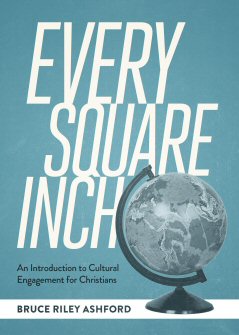
How much of creation is under Christ’s lordship? Bruce Ashford answers that question in Kuyperian fashion in Every Square Inch: An Introduction to Cultural Engagement for Christians.

This small book packs a punch as Ashford translates his understanding of the Church-culture relationship into terms laypeople can understand and appreciate. Having spent several years living outside of the culture of the United States, Ashford gained insight into ways his understanding of Christianity was inappropriately tied up in his perception of American life.

 Ashford sums up his biggest point as he wraps up his discussion of culture,

Absolutely everything in life matters to God. He cared not only about the goings-on within the four walls of a congregational gathering, but also about the goings-on in other corners of society and culture. We must live Christianly not only as the Church gathered on Sunday morning for worship, but also as the Church scattered into the world in our work, leisure, and community life. We must take seriously our interactions in the arts, the sciences, the public square, and the academy.

 Every Square Inch seeks to show what the interface between Christianity and culture should look like.

 Summary

 After a brief introduction, Ashford demonstrates how views on culture vary. Just as a fish can’t describe water, so do we have difficulty understanding our own view on culture until someone points out distinctions between positions. In Chapter Two, Ashford explains his vision for a theology of culture, following the pattern of the biblical narrative through three movements: Creation, Fall, and Redemption/New Creation. These categories provide the rubric for much of Ashford’s academic work.

Dorothy L. Sayers

Dorothy L. Sayers

 In the third chapter, the topic is vocation as it relates to culture. For many, vocation means the work one does to earn wages. However, Ashford’s vision is richer and fuller, encompassing various aspects of life like family, career/work, church, etc. We are called to more than just a career, we are called to honor God in every aspect of our lives. Chapter Four outlines six case studies on engagement with culture, which helps prove Ashford’s position is valid. He uses Augustine of Hippo, Balthasar Hubmaier, Abraham Kuyper, C.S. Lewis, Dorothy L. Sayers, and Francis Schaeffer as examples. Although none of these examples are expounded thoroughly, Ashford gives sufficient information to portray them accurately and to point the readers on to do further investigation for themselves.

Chapters Five through Nine all deal with particular spheres that Christians should seek to influence for Christ. In these five chapters, Ashford discusses engagement with the Arts, Sciences, Politics and the Public Square, Economics and Wealth, and Scholarship and Education. None of these chapters is a final analysis, but they do provide a helpful introduction and a place to begin the process of discovery.

Ashford concludes the book discussion the Christian Mission, which entails living all of life under Christ’s lordship and seeking to help demonstrate his Lordship in all creation. This a grand theme that permeates Scripture and pushes the Church outside her walls and into her communities for the glory of the Lord.

Analysis

In about 130 pages of content, Ashford manages to provide a solid overview of a broad sweep of Christian thought. Besides the question of the relationship between the Law and the Gospel, there are few questions more significant to Christian theology than how Christians should relate to cultures which are, most often throughout history, not distinctly Christian. Ashford’s book is a beginner’s field guide on the topic.

 This is the sort of book I would recommend as a gift as a High School or College graduation gift. It’s the sort of thing I wish I had read earlier in life. It would also be a useful tool for pastors seeking to help expose an inquiring parishioner to meaningful cultural engagement or to help someone break out of a pattern of cultural isolationism.

 As Western culture becomes increasingly post-Christian, learning to be a Christian minority will become more and more significant. Ashford’s book will help someone make a beginning step in that direction.